What Are Dividends? A Beginner's Guide to Dividend Investing
1. What Are Dividends?
A dividend is a payment a company makes to its shareholders. In simple words, when a company earns money and decides it does not need all of that cash for running or growing the business, it may share part of the profit with the people who own its stock.
Imagine you and your friends own a small bakery. At the end of the year, the bakery has money left after paying rent, salaries, ingredients, taxes, and repairs. The owners can keep all the money inside the business, use it to open another branch, pay down debt, or distribute some of it to the owners. That owner payment is similar to a dividend.
Public companies work in a similar way. If you own shares of a company, you own a tiny piece of that business. When the company pays a dividend, you receive your share based on how many shares you own.
A quick example
Suppose a company announces a dividend of $1 per share. If you own 100 shares, you receive $100 before any applicable taxes. If you own 10 shares, you receive $10. The company is not paying you because you worked for it. It is paying you because you are an owner of its shares.
| Item | Example |
|---|---|
| Dividend per share | $1.00 |
| Shares owned | 100 |
| Cash dividend before tax | $100 |
| What happens next | Cash is deposited into the brokerage account or automatically reinvested if DRIP is enabled |
2. How Dividend Investing Works
Dividend investing is the practice of buying stocks, ETFs, mutual funds, or other income-producing investments that pay regular distributions. The goal is usually one or more of the following: to earn cash flow, reinvest that cash for long-term compounding, reduce dependence on selling shares, or create a future income stream for retirement.
The basic cycle is simple:
- You buy shares of a dividend-paying company or fund.
- The company earns cash from its business.
- The board of directors decides whether to declare a dividend.
- If you own the shares before the ex-dividend date, you qualify for the next payment.
- On the payment date, cash appears in your brokerage account or is reinvested into more shares.
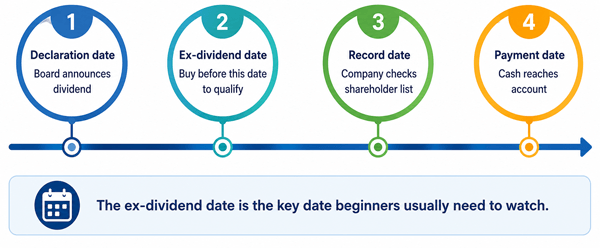
Figure 1. A simple dividend payment timeline. The ex-dividend date is usually the date beginners must understand first.
2.1 The four dividend dates beginners should know
| Date | Meaning | Beginner takeaway |
|---|---|---|
| Declaration date | The company announces the dividend amount and key dates. | Useful, but not the date that determines eligibility. |
| Ex-dividend date | The first day the stock trades without the right to the next dividend. | This is the key date. Buying on or after this date generally means you do not receive the upcoming dividend. |
| Record date | The date the company checks its shareholder records. | Mostly handled behind the scenes by the broker and settlement process. |
| Payment date | The date the dividend is paid. | Cash arrives in the account or buys more shares if reinvestment is turned on. |
3. Types of Dividends
Most beginners hear the word dividend and think only of cash, but dividends can appear in several forms.
| Type | What it means | What beginners should know |
|---|---|---|
| Cash dividend | A cash payment per share. | Most common and easiest to understand. |
| Stock dividend | Additional shares instead of cash. | You receive more shares, but your ownership percentage may not meaningfully change. |
| Special dividend | A one-time payment, often after an asset sale or unusually strong cash position. | Do not assume it will repeat. |
| Preferred dividend | Payment to preferred shareholders, often fixed. | Preferred shares behave differently from common stocks and can be sensitive to interest rates. |
| Fund distribution | ETF or mutual fund passes through dividends, interest, or capital gains. | The fund structure matters for taxes and yield quality. |
4. Dividend Yield Explained
Dividend yield tells you how much annual dividend income you receive compared with the current share price. It is usually shown as a percentage.
Formula: Dividend Yield = Annual Dividend per Share / Current Share Price
Example: If a stock pays $2 per year in dividends and trades at $50, the dividend yield is 4%.
| Input | Value |
|---|---|
| Annual dividend per share | $2.00 |
| Current share price | $50.00 |
| Dividend yield | $2 / $50 = 4% |
4.1 Why a high dividend yield can be a warning sign
A high dividend yield looks attractive, especially when someone is searching for passive income, monthly income, or retirement income. But yield alone can mislead beginners. A yield can become high because the dividend is generous, or because the share price has fallen sharply due to business trouble.
| Situation | What is happening | Investor response |
|---|---|---|
| Healthy high yield | The business has stable cash flow, manageable debt, and a sustainable payout. | Worth researching further. |
| Dangerous high yield | The stock price fell because profits, cash flow, or balance sheet quality are weakening. | Possible dividend cut risk. |
| Temporary high yield | A special dividend or cyclical profit spike makes the yield look unusually high. | Do not treat it as normal income. |
5. Dividend Payout Ratio: The Sustainability Check
The dividend payout ratio compares dividends paid to company earnings. It helps answer a practical question: is the company paying a reasonable portion of profits, or is it stretching too far?
Formula: Payout Ratio = Dividends per Share / Earnings per Share
If a company earns $5 per share and pays $2 per share in dividends, the payout ratio is 40%. That may be manageable for many mature companies. If a company earns $1 per share and pays $2 per share in dividends, the payout ratio is 200%, which is usually a serious warning sign unless there are special circumstances.
| Payout ratio | General meaning | Beginner action |
|---|---|---|
| Below 40% | Often conservative, but depends on industry. | Could allow room for dividend growth. |
| 40% to 70% | Common range for many mature dividend companies. | Look at cash flow, debt, and business stability. |
| 70% to 90% | Less flexible. | A downturn could pressure the dividend. |
| Above 100% | Company is paying more than it earns. | Investigate carefully; dividend may be at risk. |
6. Dividend Growth: Why the Raise Matters
Dividend growth means a company increases its dividend over time. For long-term investors, dividend growth can matter more than the starting yield. A 2.5% yield that grows every year may eventually produce more income than a 6% yield that never grows or gets cut.
People with experience in dividend investing often learn this lesson the hard way: the biggest yield is not always the best income investment. A growing dividend supported by growing profits is usually healthier than a very high dividend funded by debt, asset sales, or accounting adjustments.
| Example | Profile | Lesson |
|---|---|---|
| Stock A: high starting yield | 6% yield, no growth | Higher income today but may lose purchasing power if inflation rises. |
| Stock B: lower yield, steady growth | 3% yield, dividend grows 7% per year | Lower income today but may become stronger over time. |
| Stock C: very high yield, weak business | 10% yield, profits falling | High risk of dividend cut and capital loss. |
7. Dividend Reinvestment: The Quiet Power of Compounding
Dividend reinvestment means using dividends to buy more shares instead of taking the cash. Many brokers allow investors to turn on a dividend reinvestment plan, often called a DRIP. This can be powerful because each new share may generate its own future dividends.
Reinvestment is not magic and does not remove market risk. The stock can still fall, the dividend can be cut, and taxes may still apply in a taxable account. But for investors with long time horizons, reinvesting dividends can help build wealth because returns start earning returns.
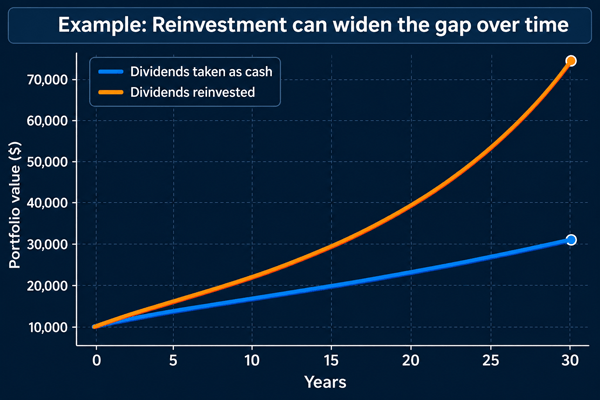
Figure 2. Illustration only: reinvesting dividends can create a compounding effect over decades. This example assumes steady returns, which real markets do not provide.
7.1 Cash dividends vs reinvested dividends
| Approach | Benefit | Best suited for |
|---|---|---|
| Taking dividends as cash | Provides spending money or retirement income. | Retirees, income-focused investors, people needing cash flow. |
| Reinvesting dividends | Buys more shares and may compound over time. | Long-term investors who do not need current income. |
| Partial approach | Spend some, reinvest some. | Investors transitioning from accumulation to income. |
8. Dividend Stocks vs Dividend ETFs
Beginners often ask whether they should buy individual dividend stocks or dividend ETFs. The honest answer is that ETFs are usually simpler for beginners because they spread money across many companies. Individual stocks can work, but they require more research, patience, and ongoing monitoring.
| Factor | Individual dividend stocks | Dividend ETFs |
|---|---|---|
| Diversification | One company; concentrated risk. | Many companies in one fund. |
| Research required | High. You must analyze business quality, debt, cash flow, payout ratio, and valuation. | Lower, but you still need to understand the fund strategy, fees, holdings, and tax treatment. |
| Income control | More control over each holding. | Less control; fund decides holdings and rebalancing. |
| Risk of dividend cut | A single cut can hurt income. | One company cut may matter less if diversified. |
| Fees | No fund fee, but trading and tax issues may apply. | Expense ratio reduces returns. |
| Best for | Investors willing to study companies. | Beginners wanting broad exposure and simpler management. |
9. What Beginners Should Look for Before Buying a Dividend Investment
A beginner should not start by asking, “Which stock has the highest dividend yield?” A better question is: “Is this dividend supported by a strong, understandable business that can keep paying through normal economic ups and downs?”
9.1 The beginner checklist
- Business quality: Does the company sell products or services people continue to need?
- Dividend history: Has the company paid and raised dividends consistently, or is the payment unstable?
- Payout ratio: Is the dividend reasonable compared with earnings and cash flow?
- Free cash flow: Does the company generate real cash after operating and capital spending needs?
- Debt level: Could interest payments or refinancing pressure the dividend?
- Industry risk: Is the company in a cyclical, declining, or highly regulated industry?
- Valuation: Are you overpaying because the stock is popular among income investors?
- Tax impact: Will the dividend be qualified, ordinary, or subject to special rules?
- Portfolio fit: Does it improve diversification, or are you adding more of the same risk?
10. Common Dividend Investing Mistakes
| Mistake | What it looks like | Better habit |
|---|---|---|
| Chasing yield | Buying the highest yield without checking sustainability. | Start with business quality and payout safety, not yield. |
| Ignoring total return | Focusing only on income while the stock price keeps falling. | Track income plus price change. |
| Assuming dividends are guaranteed | Thinking a long history means the dividend cannot be cut. | Review earnings, cash flow, debt, and industry changes. |
| Buying just before ex-dividend date | Trying to capture the dividend as “free money.” | Understand that stock prices often adjust and taxes/trading costs can reduce benefit. |
| Lack of diversification | Owning only banks, utilities, REITs, or energy because they yield more. | Spread across sectors and consider broad funds. |
| Forgetting taxes | Reinvesting dividends but not planning for tax bills. | Know taxable vs tax-advantaged account treatment. |
| Confusing dividend with interest | Treating stock dividends like guaranteed bank interest. | Remember stocks carry business and market risk. |
11. Are Dividends Passive Income?
Dividends are often described as passive income because the investor does not have to work each month to receive the payment. But “passive” does not mean risk-free or effort-free. Someone still needs to choose the investment, monitor it, understand taxes, and avoid emotional decisions when the market falls.
A realistic beginner view is this: dividends can become semi-passive income after the portfolio is built responsibly. In the early stage, dividend investing requires learning, discipline, and patience.
12. Dividend Taxes: Simple Beginner Explanation
In many tax systems, dividends are taxable. In the United States, the IRS generally classifies dividends as ordinary or qualified. Ordinary dividends are included in ordinary income, while qualified dividends may be taxed at lower long-term capital-gain rates if specific requirements are met. Tax rates and rules can change, and readers should confirm current rules or consult a qualified tax professional.
| Dividend type | Basic tax idea | Beginner note |
|---|---|---|
| Ordinary dividends | Taxed as ordinary income. | Often applies to many non-qualified payouts and some fund distributions. |
| Qualified dividends | May receive lower capital-gain tax rates if rules are met. | Often applies to many U.S. corporation dividends when holding-period rules are satisfied. |
| REIT dividends | Often not qualified; may have special tax treatment. | Popular for income, but tax treatment can be less simple. |
| Dividend reinvestment | Reinvested dividends may still be taxable in a taxable account. | You can owe tax even when you did not take cash out. |
13. Dividend Investing for Different Goals
| Goal | Possible approach | Warning |
|---|---|---|
| Young beginner building wealth | Dividend reinvestment, diversified ETFs, learning valuation and risk. | Do not sacrifice growth and diversification just to get yield. |
| Middle-career investor | Blend dividend growth with broad market exposure. | Use dividends as part of total return, not the whole plan. |
| Retirement income investor | Quality income, cash-flow planning, lower volatility, tax awareness. | Avoid relying on one stock or one high-yield sector. |
| Conservative investor | Dividend ETFs, blue-chip dividend growers, balanced allocation. | Stocks can still fall; consider cash and bonds for near-term needs. |
| Income-focused investor | Sustainable yield, payout safety, diversified income sources. | A high yield that gets cut is not safe income. |
14. How to Start Dividend Investing Step by Step
- Define your goal. Are you investing for long-term growth, future retirement income, current cash flow, or a mix?
- Build an emergency fund first. Dividend stocks are not a replacement for cash needed for rent, bills, or short-term emergencies.
- Choose an account. Compare taxable brokerage accounts, retirement accounts, and other tax-advantaged options available in your country.
- Start broad. Many beginners are better served by diversified ETFs before buying many individual dividend stocks.
- Learn the numbers. Understand dividend yield, payout ratio, earnings, free cash flow, debt, valuation, and total return.
- Create simple rules. For example: no single stock above 5% of the portfolio, no purchase based only on yield, and review holdings quarterly.
- Reinvest while you are building. If you do not need income today, reinvestment can help compounding.
- Keep records. Track dividends received, taxes, cost basis, and portfolio allocation.
- Review without overreacting. A falling price may create opportunity or signal danger; use evidence, not emotion.
- Keep learning. Read company annual reports, fund prospectuses, and educational material from trusted sources.
15. Practical Portfolio Example for a Beginner
The following example shows how a beginner might think about portfolio structure rather than specific securities.
| Portfolio sleeve | Example allocation | Purpose |
|---|---|---|
| Core broad market fund | 50% | Provides broad diversification and growth exposure. |
| Dividend growth ETF | 25% | Adds dividend-focused exposure without relying on a few stocks. |
| High-quality individual dividend stocks | 15% | Allows learning and customization, kept small to manage risk. |
| Bonds or cash equivalents | 10% | Helps reduce volatility and covers near-term needs. |
A retiree might use a higher income allocation, while a younger investor might use more broad-market growth exposure. The point is not to copy the example. The point is to avoid building a portfolio only from the highest-yielding stocks you can find.
16. How Much Money Do You Need to Earn Dividends?
You do not need a huge amount to start learning. Many brokers allow fractional shares, which means a beginner can buy part of a share. But meaningful dividend income takes time and capital.
| Portfolio size and yield | Approx. annual income | Approx. monthly average |
|---|---|---|
| $1,000 portfolio at 3% yield | $30 per year | $2.50 per month |
| $10,000 portfolio at 3% yield | $300 per year | $25 per month |
| $100,000 portfolio at 3% yield | $3,000 per year | $250 per month |
| $500,000 portfolio at 3% yield | $15,000 per year | $1,250 per month |
This table helps set honest expectations. Dividend investing is not a quick-income shortcut. It is usually a long-term wealth and cash-flow strategy.
17. Dividend Investing vs Growth Investing
| Factor | Dividend investing | Growth investing |
|---|---|---|
| Main focus | Income and steady cash return to shareholders. | Companies reinvest profits to grow faster. |
| Typical companies | Mature, profitable businesses. | Younger or faster-growing businesses. |
| Cash flow to investor | Often regular dividends. | Usually little or no dividend. |
| Risk | Dividend cuts, slow growth, valuation risk. | High valuation, volatility, uncertain future profits. |
| Best use | Income needs, defensive allocation, compounding through reinvestment. | Long-term capital growth and innovation exposure. |
| Balanced view | Many investors combine both instead of choosing only one. | A portfolio can hold dividend stocks and growth stocks. |
18. What Experienced Dividend Investors Often Learn
- A safe 3% yield can be better than a risky 9% yield.
- The dividend cut usually hurts twice: income falls and the share price may fall too.
- Dividend growth matters because inflation slowly reduces the buying power of fixed income.
- Buying great dividend companies at unreasonable prices can still lead to poor returns.
- Sector concentration creeps in quietly because many high-yield stocks cluster in utilities, banks, telecom, energy, and real estate.
- Reinvesting dividends works best when paired with patience and diversification.
- Total return matters: a dividend is only one part of what you earn.
19. Red Flags Before Buying a Dividend Stock
| Red flag | Why it matters | What to check |
|---|---|---|
| Dividend yield far above peers | Market may expect a cut. | Compare payout ratio, cash flow, debt, and recent earnings. |
| Payout ratio above 100% | Dividend may exceed profits. | Check whether this is temporary or structural. |
| Falling revenue and earnings | Business may be weakening. | Avoid relying only on past dividend history. |
| Heavy debt and rising rates | Interest costs can pressure cash flow. | Review debt maturity and interest coverage. |
| Management talks more about dividend than business quality | The dividend may be used as a marketing signal. | Focus on business fundamentals. |
| Frequent special dividends marketed as regular income | Income may not be repeatable. | Separate recurring income from one-time payments. |
| Complex structure you do not understand | Tax and risk can be different. | Read the prospectus or avoid until you understand it. |
20. Frequently Asked Questions
20.1 Are dividends free money?
No. Dividends are paid from company resources, and the stock price often adjusts around the ex-dividend date. Dividends can be valuable, but they are not free cash appearing without trade-offs.
20.2 Can I live off dividends?
Some investors eventually live partly or mostly off dividends, but it usually requires a large portfolio, diversification, tax planning, and realistic spending. For most beginners, dividends are better seen as a long-term building block rather than instant income.
20.3 Do all stocks pay dividends?
No. Many companies do not pay dividends because they prefer to reinvest cash into growth, research, acquisitions, debt reduction, or share repurchases.
20.4 Are monthly dividend stocks better?
Monthly payments can feel convenient, but payment frequency is less important than business quality, sustainability, valuation, diversification, and taxes. A risky monthly dividend is not better than a safer quarterly dividend.
20.5 What is a good dividend yield?
There is no universal number. A “good” yield is sustainable, supported by cash flow, reasonable for the industry, and appropriate for the investor’s goals. For many beginners, extremely high yields deserve extra caution.
20.6 What happens if a company cuts its dividend?
Your income falls. The stock price may also drop because income-focused investors often sell after a cut. A cut is not always fatal, but it means the original income thesis should be reviewed.
20.7 Should beginners buy dividend stocks or dividend ETFs?
Many beginners may find dividend ETFs easier because they provide diversification and reduce single-company risk. Individual stocks can be useful for investors willing to research and monitor businesses.
20.8 Do reinvested dividends still count as income?
In many taxable accounts, yes. Reinvesting dividends does not necessarily avoid tax. The tax treatment depends on account type, dividend type, and local rules.
21. Conclusion
Dividends are payments companies make to shareholders, usually from profits. Dividend investing can help investors build income, reinvest for compounding, and create long-term cash flow. Beginners should understand dividend yield, payout ratio, ex-dividend dates, dividend reinvestment, taxes, and the risk of dividend cuts before investing. The safest approach is not to chase the highest yield, but to focus on quality, sustainability, diversification, valuation, and total return.
Sources Consulted and Checked
The following authoritative sources were consulted and checked while preparing this article and reviewing its accuracy.
- SEC Investor.gov - Ex-Dividend Dates: https://www.investor.gov/introduction-investing/investing-basics/glossary/ex-dividend-dates-when-are-you-entitled-stock-and
- SEC Investor.gov - Compound Interest Calculator: https://www.investor.gov/financial-tools-calculators/calculators/compound-interest-calculator
- IRS Topic No. 404 - Dividends and Other Corporate Distributions: https://www.irs.gov/taxtopics/tc404
- IRS Topic No. 409 - Capital Gains and Losses: https://www.irs.gov/taxtopics/tc409
- S&P Dow Jones Indices - Dividend Aristocrats methodology and index materials: https://www.spglobal.com/spdji/
- NYSE - Ex-Date Dividends and T+1 settlement context: https://www.nyse.com/ex-date-dividends
Reader Advice
This article is provided solely for educational and informational purposes and does not constitute personal financial, investment, tax, legal, or accounting advice. It does not recommend buying, selling, or holding any particular stock, fund, or other investment. Dividends are not guaranteed, investment values can rise or fall, and past performance does not assure future results.
Rules, tax treatment, market practices, product features, figures, and eligibility requirements may change over time and can differ by country, account type, security, and individual circumstances. Before making any financial decision, readers should independently verify current information through relevant official sources and consider consulting appropriately qualified financial, tax, legal, or accounting professionals. Readers should also assess their objectives, time horizon, risk tolerance, liquidity needs, diversification, and ability to bear loss.