10 Best High-Yield Dividend Stocks for Income Investors
Quick Answer: What Are the Best High-Yield Dividend Stocks Right Now?
For income investors, the best high-yield dividend stocks are not simply the stocks with the biggest quoted yields. The better approach is to look for a mix of above-average yield, durable business cash flow, reasonable payout coverage, manageable debt, and a history of treating dividends seriously.
Based on recent 2026 dividend-yield screens and analyst commentary, a practical watchlist for U.S.-focused income investors includes Verizon, Pfizer, Realty Income, UPS, Amcor, T. Rowe Price, Kimberly-Clark, VICI Properties, Regions Financial, and DTE Energy. Some offer higher current income; others offer better dividend quality or diversification. The right choice depends on whether the reader wants monthly income, defensive cash flow, dividend growth, or a more balanced retirement income portfolio.
| Rank | Stock | Approx. yield | Best for | Main appeal | Beginner caution |
|---|---|---|---|---|---|
| 1 | Amcor (AMCR) | 6.87% | Packaging | High yield | coverage risk |
| 2 | Pfizer (PFE) | 6.71% | Healthcare | Big pharma cash flow | pipeline risk |
| 3 | VICI Properties (VICI) | 6.57% | REIT | Long leases | REIT/tenant risk |
| 4 | Verizon (VZ) | 6.23% | Telecom | Defensive services | debt/capex |
| 5 | United Parcel Service (UPS) | 6.09% | Logistics | Global network | cyclical costs |
| 6 | T. Rowe Price (TROW) | 5.68% | Asset management | Aristocrat | market-fee risk |
| 7 | Realty Income (O) | 5.41% | REIT | Monthly payout | rate risk |
| 8 | Kimberly-Clark (KMB) | 5.26% | Consumer staples | Essential brands | payout risk |
| 9 | Regions Financial (RF) | 3.80% | Regional bank | Payout discipline | credit risk |
| 10 | DTE Energy (DTE) | 3.01% | Utility | Regulated earnings | rate risk |
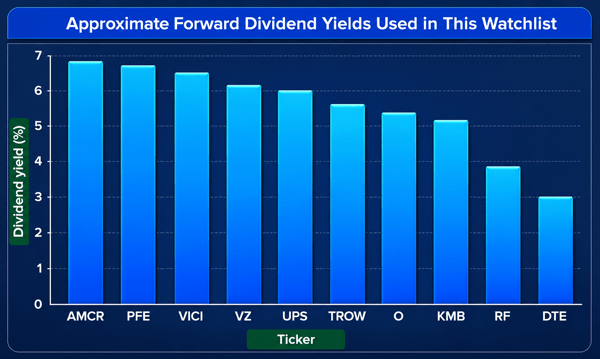
Figure 1. Approximate forward dividend yields used in this watchlist (July 2026 source data).
1. What Is a High-Yield Dividend Stock?
A dividend stock is a company stock that pays shareholders part of its profits or cash flow, usually every quarter. A high-yield dividend stock is one where the annual dividend is large compared with the stock price. For example, if a company pays $4 per share per year and the stock trades at $80, the dividend yield is 5%.
That sounds simple, but beginners often miss one important point: dividend yield rises when the stock price falls. A 7% yield can mean the company is generous, but it can also mean investors are worried and have pushed the share price down. That is why experienced income investors ask, “Can the company keep paying this dividend?” before they ask, “How high is the yield?”
2. How Dividend Income Works in Real Life
Dividend income is not magic income. It is a cash distribution from a business you own a small piece of. If you own 100 shares of a company that pays $1 per share each quarter, you receive $100 each quarter before taxes. If the stock pays four times per year, that is $400 per year.
Some investors spend dividends as income. Others reinvest dividends to buy more shares. Reinvestment can be powerful over long periods because new shares may produce their own dividends in future years. Retirees often prefer cash payments, while younger investors often prefer dividend reinvestment.
| Example | Shares owned | Annual dividend/share | Estimated annual income |
|---|---|---|---|
| Verizon example | 100 | $2.83 | $283 |
| Realty Income example | 100 | $3.15 | $315 |
| UPS example | 100 | $6.56 | $656 |
2.1 The Beginner’s Dividend Formula
Dividend yield = annual dividend per share / current share price.
Example: A stock pays $1 every quarter. That is $4 per year. If the stock price is $100, the yield is 4%. If the stock price falls to $80 and the dividend stays $4, the yield becomes 5%. The income looks better, but the investor also has a lower stock price. That is why total return matters.
3. What Beginners Should Know Before Buying High-Yield Dividend Stocks
- High yield can be a warning sign: A high yield is sometimes caused by a falling stock price, not by a stronger business. This is called a yield trap when the dividend later gets cut and the investor also loses capital.
- Dividend safety matters more than headline yield: Look at payout ratio, free cash flow, debt, earnings trend, and whether management has a realistic capital allocation plan.
- Sectors behave differently: Telecom, utilities, REITs, banks, consumer staples, healthcare, and logistics all have different risks. A 6% telecom yield does not mean the same thing as a 6% REIT yield.
- Taxes can reduce income: Qualified dividends, ordinary dividends, REIT distributions, and retirement-account income can be taxed differently. Readers should consult a tax professional for their own situation.
- Diversification is not optional: Owning one or two high-yield stocks is not a plan. A beginner should think in baskets: sectors, payout schedules, dividend growth, and risk levels.
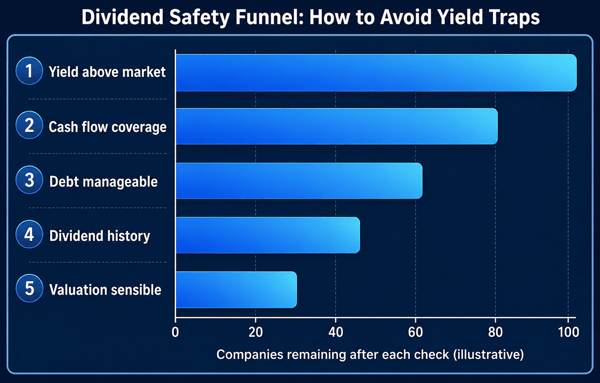
Figure 2. Dividend safety funnel illustrating a quality-first process for filtering potential yield traps.
4. How We Selected These 10 Dividend Stocks
This article uses a quality-first income screen rather than a pure highest-yield screen. The list favors companies that appear repeatedly in 2026 dividend research, have recognizable businesses, and give beginners useful lessons about dividend investing. It intentionally includes different sectors so readers can compare income stocks instead of treating all yields as equal.
The screen considered: current or forward dividend yield, business durability, payout ratio or cash-flow coverage where available, dividend history, sector diversification, analyst caution, and whether the stock can be explained clearly to a beginner.
5. 10 Best High-Yield Dividend Stocks for Income Investors
5.1 Amcor (AMCR)
Investor type: Packaging dividend stock
Approximate yield (June 2026 source data): 6.87%
Why income investors look at it: Amcor makes packaging used across consumer, healthcare, food, beverage, and industrial markets. Packaging demand can be more stable than discretionary spending because people still buy everyday goods.
What can go wrong: The risk is payout coverage and margins. Packaging companies face raw material costs, customer pricing pressure, and integration costs from deals.
How a beginner can use it: A beginner might consider Amcor for high current yield and defensive demand, but should verify whether free cash flow comfortably covers the dividend.
One practical question before buying: Is dividend coverage based on cash flow improving, not just earnings optics?
5.2 Pfizer (PFE)
Investor type: Healthcare turnaround income stock
Approximate yield (June 2026 source data): 6.71%
Why income investors look at it: Pfizer is a major pharmaceutical company. The stock has offered a high yield because investor expectations reset after the COVID-era revenue boom faded. For income investors, the opportunity is that large pharmaceutical companies can generate substantial cash flow from drug portfolios.
What can go wrong: The risk is pipeline execution. Patent cliffs, drug approvals, acquisition integration, and research spending all matter. A high yield is not enough if earnings keep falling.
How a beginner can use it: A beginner might view Pfizer as a high-income healthcare position, but should follow management’s earnings guidance, debt from acquisitions, and whether newer drugs can replace lost revenue.
One practical question before buying: Is the drug pipeline replacing lost revenue fast enough?
5.3 VICI Properties (VICI)
Investor type: Experiential real estate REIT
Approximate yield (June 2026 source data): 6.57%
Why income investors look at it: VICI owns gaming and experiential real estate, often under long-term leases. Its attraction is a high REIT yield supported by contracted rent streams.
What can go wrong: The risk is tenant concentration and real-estate financing. Casino and entertainment properties are specialized assets, and refinancing costs matter.
How a beginner can use it: A beginner might use VICI as a higher-yield REIT diversifier, but should watch lease coverage, tenant health, debt maturity schedule, and acquisitions.
One practical question before buying: Are tenants healthy enough to keep rent coverage strong?
5.4 Verizon (VZ)
Investor type: Telecom income stock
Approximate yield (June 2026 source data): 6.23%
Why income investors look at it: Verizon sells wireless and broadband services that many households and businesses treat as essential. That makes revenue more recurring than many cyclical businesses. The appeal for income investors is a high yield backed by a large subscriber base.
What can go wrong: The risk is that telecom companies carry heavy debt and must keep spending on networks. If interest costs rise or competition forces pricing pressure, dividend growth can be slow.
How a beginner can use it: A beginner might use Verizon as a defensive income holding, but not as an all-in bet. Watch free cash flow after capital spending, debt reduction, subscriber growth, and whether dividend increases remain small but consistent.
One practical question before buying: Is free cash flow after network spending comfortably covering the dividend?
5.5 United Parcel Service (UPS)
Investor type: Logistics and economic-cycle income stock
Approximate yield (June 2026 source data): 6.09%
Why income investors look at it: UPS is a global package delivery and logistics company. Its dividend looks attractive because the stock has been under pressure from volume changes, labor costs, and a weaker freight environment.
What can go wrong: The risk is cyclicality. Package volumes and margins can weaken when businesses and consumers ship less. A high yield can be safe for a while but still produce poor total returns if earnings stay weak.
How a beginner can use it: A beginner might use UPS as a cyclical income recovery idea, not a bond substitute. Watch operating margin, free cash flow, labor costs, and management’s dividend coverage commentary.
One practical question before buying: Can earnings recover enough to make the dividend coverage comfortable?
5.6 T. Rowe Price (TROW)
Investor type: Dividend aristocrat asset manager
Approximate yield (June 2026 source data): 5.68%
Why income investors look at it: T. Rowe Price is an asset manager with a long dividend record and a debt-light financial profile. Its revenue depends on assets under management, so bull markets generally help and bear markets hurt.
What can go wrong: The risk is industry pressure. Passive investing and fee compression challenge active managers, and market declines reduce fee revenue.
How a beginner can use it: A beginner might use T. Rowe Price as a dividend-growth income stock, but should track net client flows, operating margin, cash balance, and dividend payout discipline.
One practical question before buying: Are assets under management and client flows stabilizing?
5.7 Realty Income (O)
Investor type: Monthly dividend REIT
Approximate yield (June 2026 source data): 5.41%
Why income investors look at it: Realty Income is popular because it pays monthly dividends and owns a diversified portfolio of net-lease properties. Tenants usually pay many property expenses, which can make cash flows more predictable than ordinary rental models.
What can go wrong: The risk is interest rates. REITs often borrow money and issue shares to grow. If capital costs rise or property values fall, growth slows.
How a beginner can use it: A beginner who wants monthly dividend income may like Realty Income, but should study funds from operations, occupancy, tenant quality, and payout ratio based on REIT cash flow rather than normal earnings.
One practical question before buying: Is adjusted funds from operations growing faster than the dividend?
5.8 Kimberly-Clark (KMB)
Investor type: Consumer staples income stock
Approximate yield (June 2026 source data): 5.26%
Why income investors look at it: Kimberly-Clark owns everyday brands such as tissues, diapers, and personal-care products. Demand is relatively defensive because people keep buying essentials in weak economies.
What can go wrong: The risk is valuation and payout strain. Consumer staples can become expensive when investors seek safety, and high payout ratios reduce flexibility.
How a beginner can use it: A beginner might like Kimberly-Clark for defensive income, but should not ignore slow growth, input-cost pressure, and whether dividend increases outpace inflation.
One practical question before buying: Can pricing and productivity offset input costs while funding the dividend?
5.9 Regions Financial (RF)
Investor type: Regional bank dividend stock
Approximate yield (June 2026 source data): 3.80%
Why income investors look at it: Regions Financial is a regional bank with a moderate-to-high yield and a stated payout target that is lower than many distressed income stocks. Banks can pay attractive dividends when credit quality is healthy and capital ratios are strong.
What can go wrong: The risk is credit. Loan losses, deposit costs, commercial real estate exposure, and regulation can quickly change the income story.
How a beginner can use it: A beginner might use Regions as a financial-sector income position, but should monitor loan-loss provisions, capital ratios, net interest margin, and deposit stability.
One practical question before buying: Are credit losses controlled and capital ratios strong?
5.10 DTE Energy (DTE)
Investor type: Utility dividend-growth stock
Approximate yield (June 2026 source data): 3.01%
Why income investors look at it: DTE Energy is a regulated utility. Utilities usually offer lower yields than distressed high-yield names, but regulated earnings can support steadier dividend growth.
What can go wrong: The risk is regulation and capital spending. Utilities need large investments, and customer rates require regulatory approval.
How a beginner can use it: A beginner might use DTE for stability rather than maximum yield. Watch allowed returns, debt, capital plan, earnings growth, and whether dividend growth stays aligned with earnings.
One practical question before buying: Are regulators allowing returns that support dividend growth?
6. Best Use Case Comparison
| Goal | Stocks to study first | Why | What to avoid | Beginner takeaway |
|---|---|---|---|---|
| Highest current income | AMCR, PFE, VICI, VZ, UPS | Higher current yields around 6%+ | Putting all money into one distressed sector | Use a basket, not a single yield bet |
| Monthly income | O | Monthly payout schedule | Confusing monthly payments with guaranteed safety | Check REIT cash-flow payout ratio |
| Defensive income | VZ, KMB, DTE | Essential services or products | Overpaying for safety | Stable businesses can still be bad buys at wrong prices |
| Dividend growth potential | TROW, DTE, KMB | History or earnings-linked dividend growth | Ignoring business slowdown | Growth and safety matter more than starting yield |
| Diversification | O, VICI, RF, UPS | Different economic drivers | Owning 10 stocks from one sector | Sector mix lowers single-risk exposure |
7. How to Build a Beginner Dividend Income Portfolio
A beginner should not start by asking, “Which stock pays the most?” A better question is, “How much income do I need, how much risk can I accept, and how diversified should the income sources be?”
A practical starter framework is to divide dividend stocks into three buckets: core defensive income, higher-yield satellite income, and dividend-growth income. Core holdings are the companies you would be comfortable holding through a recession. Satellite holdings may pay more but need closer monitoring. Dividend-growth holdings may start with a lower yield but can raise income over time.
| Bucket | Possible allocation | Example stocks | Purpose |
|---|---|---|---|
| Core defensive income | 40%-50% | VZ, KMB, DTE | Stability and recession resistance |
| REIT and real-asset income | 20%-30% | O, VICI | Income and inflation-sensitive real assets |
| Cyclical or turnaround income | 10%-20% | PFE, UPS, AMCR | Higher yield with closer monitoring |
| Financial/dividend growth | 10%-20% | TROW, RF | Diversification and long-term compounding |
8. A Simple Dividend Safety Checklist
- Dividend yield: Is it high because the dividend rose, or because the stock price fell?
- Payout ratio: Is the company paying out a reasonable portion of earnings or cash flow?
- Free cash flow: Is there enough cash after capital spending?
- Debt: Can the company refinance or repay debt without squeezing the dividend?
- Business trend: Are revenue, earnings, and margins stable or improving?
- Dividend history: Has management protected the dividend through hard periods?
- Valuation: Is the investor paying too much for the income stream?
- Sector risk: Is the portfolio too concentrated in REITs, telecom, banks, or staples?
9. Common Mistakes People Make With High-Yield Dividend Stocks
- Chasing the biggest yield: Many investors buy a 10% or 15% yield without asking whether the payout is sustainable. The market often prices a stock that way because it expects trouble.
- Ignoring total return: A 6% yield is not attractive if the stock falls 25% and never recovers. Income and capital preservation must be considered together.
- Believing dividends are guaranteed: A board can cut, suspend, or freeze a dividend. Dividend history is useful, but it is not a legal promise.
- Overconcentrating in one sector: Many high-yield stocks cluster in REITs, telecom, banks, energy, and consumer staples. One sector shock can hit income and capital at the same time.
- Not reading earnings calls or filings: Dividend investors do not need to become accountants, but they should read management commentary about cash flow, debt, payout ratio, and capital spending.
10. Dividend Stocks vs Dividend ETFs
Individual dividend stocks offer control and the possibility of higher yield, but they also require research. Dividend ETFs provide instant diversification, but the yield may be lower and investors pay an expense ratio. Beginners who do not want to monitor earnings, dividend declarations, payout ratios, and sector exposure may prefer starting with a dividend ETF and adding individual stocks slowly.
| Choice | Pros | Cons |
|---|---|---|
| Individual stocks | More control, potential for higher income, targeted sector choices | Requires research; single-company risk |
| Dividend ETFs | Diversification, easier maintenance, lower single-stock risk | Expense ratio, less control, yield may be lower |
| Mixed approach | Balance of control and diversification | Still requires monitoring and rebalancing |
11. Practical Example: Turning a $50,000 Portfolio Into Dividend Income
Assume a beginner has $50,000 and wants income, but does not want to gamble on one high-yield name. They might divide the money across 10 stocks at $5,000 each. If the average yield were around 5.6%, the portfolio would generate about $2,800 per year before taxes. That is about $233 per month on average, although most companies pay quarterly and payment dates will not be perfectly even.
This example is not a recommendation. It simply shows how yield translates into cash flow. In real life, the investor would also consider emergency savings, debt, age, tax bracket, retirement accounts, risk tolerance, and whether a broad index fund should remain the core portfolio holding.
12. FAQs About High-Yield Dividend Stocks
12.1 Are high-yield dividend stocks safe?
Not automatically. Some are stable income stocks, while others are yield traps. Safety depends on cash flow, balance sheet strength, payout ratio, and business durability.
12.2 What is a good dividend yield?
A good yield is one the company can sustain. For many large U.S. stocks, 3% to 6% can be attractive if coverage is strong. Yields far above that require extra caution.
12.3 Can I live off dividend income?
Some investors do, but it usually requires a large portfolio, diversification, tax planning, and realistic spending. Beginners should not assume a small portfolio can safely produce high income without risk.
12.4 Are monthly dividend stocks better?
Monthly dividends are convenient for budgeting, but payment frequency does not make a dividend safer. Realty Income is popular for monthly income, but it still has REIT and interest-rate risk.
12.5 Should I reinvest dividends?
Investors who do not need the cash often reinvest to compound. Retirees may take cash. The best choice depends on goals and tax situation.
12.6 How often should I review dividend stocks?
At least after quarterly earnings, annual reports, dividend announcements, and major debt or acquisition news. High-yield holdings deserve closer monitoring than broad index funds.
13. Final Takeaway
The best high-yield dividend stocks for income investors are not always the highest-yielding stocks in the market. A smart income investor looks for dependable cash flow, sustainable payout ratios, manageable debt, and a valuation that leaves room for error. Verizon, Pfizer, Realty Income, UPS, Amcor, T. Rowe Price, Kimberly-Clark, VICI Properties, Regions Financial, and DTE Energy each teach a different income-investing lesson. Some are higher-yield opportunities; others are steadier dividend-quality names.
For beginners, the honest rule is simple: never buy a dividend stock just because the yield looks high. Understand the business, check whether the dividend is covered, diversify across sectors, and remember that dividend income is only one part of total return.
Sources Consulted and Checked
The following sources were consulted and checked while preparing this article and reviewing its accuracy. Readers should also consult current company filings, dividend declarations, and other official sources before making decisions.
- Kiplinger, “Highest-Yielding Dividend Stocks in the S&P 500,” updated June 9, 2026. Used for S&P 500 high-yield screen and yield data for AMCR, PFE, VICI, VZ, UPS, O and related risk caveats. https://www.kiplinger.com/investing/stocks-with-the-highest-dividend-yields-in-the-sandp-500
- Morningstar, “The 10 Best Dividend Stocks for 2026,” April 30, 2026. Used for quality dividend stock commentary and yield data for KMB, TROW, DTE and RF. https://www.morningstar.com/stocks/10-best-dividend-stocks
- Fidelity Viewpoints, “Which stocks might pay the highest dividends in 2026?” June 9, 2026. Used for beginner explanation of dividend yield and risks of chasing high yields. https://www.fidelity.com/learning-center/trading-investing/high-dividend-stocks
- S&P Dow Jones Indices, S&P 500 High Dividend Index description. Used to explain high-dividend benchmarking and the concept of broad high-yield screening. https://www.spglobal.com/spdji/en/indices/dividends-factors/sp-500-high-dividend-index/
- Verizon investor dividend history and June 2026 dividend declaration. Used to verify recent declared dividend amount and payment schedule. https://www.verizon.com/about/investors/dividend-history
- UPS investor dividend page and May 2026 dividend announcement. Used to verify recent declared dividend amount. https://investors.ups.com/quarterly-earnings-and-financials/dividends
- Kimberly-Clark January 2026 dividend increase announcement. Used to verify recent dividend increase. https://www.investor.kimberly-clark.com/news-releases/news-release-details/kimberly-clark-declares-dividend-increase-1
Reader Advice
This article is provided solely for educational and informational purposes and does not constitute financial, investment, tax, legal, or other professional advice. It is not a recommendation to buy, sell, or hold any security. The term “best” reflects the selection criteria and information considered for this article and should not be interpreted as a guarantee of suitability, performance, or future returns. High dividend yields may involve additional risks and can change or be reduced or discontinued, so readers should carefully evaluate each investment rather than relying on yield alone.
Dividend payments, yields, share prices, company fundamentals, tax treatment, market conditions, and applicable rules may change at any time, and past performance or dividend growth does not guarantee future results. Before making any decision, readers should conduct independent research, verify all facts and figures through current official sources and company filings, consider their objectives, risk tolerance, time horizon, diversification, and personal circumstances, and seek advice from an appropriately qualified and regulated professional where necessary. Investing involves risk, including the possible loss of principal.