10 Highest Dividend-Paying Stocks to Buy in 2026
1. Quick Answer: The 10 Highest Dividend-Paying Stocks to Research in 2026
Based on market prices available on July 15, 2026, and the declared or annualized dividends used in this article, the highest-yielding names in this guide are listed below. The key word is research: a high yield is not automatically a good investment. Sometimes it is a warning that the market expects trouble.
| Rank | Stock | Sector | Approx. price | Annual dividend | Approx. yield | Beginner view |
|---|---|---|---|---|---|---|
| 1 | Conagra Brands (CAG) | Packaged food | $14.15 | $1.4 | 9.89% | High yield, high turnaround risk |
| 2 | Pfizer (PFE) | Healthcare/pharma | $24.25 | $1.72 | 7.09% | Patent-cliff and pipeline-execution risk |
| 3 | The Campbell's Company (CPB) | Packaged food | $22.10 | $1.56 | 7.06% | High yield, demand and brand-turnaround risk |
| 4 | General Mills (GIS) | Packaged food | $36.46 | $2.44 | 6.69% | Mature staples business; slow-growth risk |
| 5 | Verizon Communications (VZ) | Telecom | $42.47 | $2.83 | 6.66% | Debt and competitive telecom market |
| 6 | Kraft Heinz (KHC) | Packaged food | $25.08 | $1.6 | 6.38% | Brand turnaround and margin risk |
| 7 | Altria Group (MO) | Tobacco | $70.16 | $4.24 | 6.04% | Regulatory, litigation, and declining cigarette volumes |
| 8 | United Parcel Service (UPS) | Logistics | $113.67 | $6.56 | 5.77% | Cyclical shipping volumes and restructuring risk |
| 9 | AT&T (T) | Telecom | $21.28 | $1.11 | 5.22% | Debt, competition, and limited dividend growth |
| 10 | Realty Income (O) | REIT/real estate | $63.77 | $3.252 | 5.10% | Interest-rate and tenant-concentration risk |
Data note: Prices are market quotes available on July 15, 2026, and yields are approximate forward yields calculated as annualized dividend per share divided by the quoted stock price. Dividend amounts are based primarily on company investor-relations pages and dividend announcements. Prices and yields change continuously, so readers should verify current figures before making any decision.
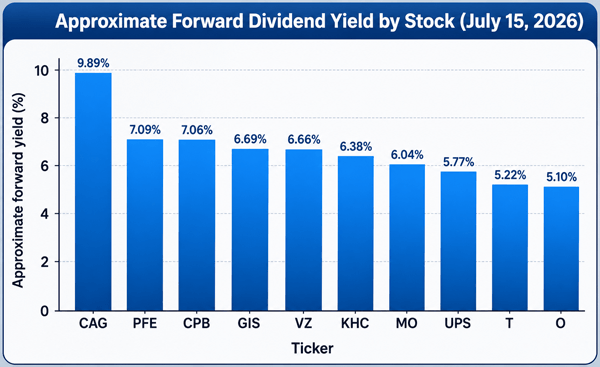
Chart: Approximate forward dividend yields for the 10 stocks covered in this article, based on market prices available July 15, 2026. A higher yield can mean greater income potential, but it also increases the need for careful risk checks.
2. What Is a Dividend Stock?
A dividend stock is a share of a company that regularly sends part of its profits or cash flow back to shareholders. Think of it like owning a small piece of a business that pays you cash for holding the stock. The payment is called a dividend.
For beginners, the attraction is simple: instead of relying only on the stock price going up, dividend investors aim to collect cash along the way. That cash can be used for spending, saved as income, or reinvested to buy more shares.
2.1 How Dividend Yield Works - Simple Example
Dividend yield shows how much income a stock pays compared with its share price. The formula is:
Dividend yield = Annual dividend per share / Current stock price x 100
Example: If a stock trades at $50 and pays $2.50 per share each year, its dividend yield is 5%. If you invest $1,000, you might expect about $50 per year before taxes, assuming the dividend is not cut and the price does not change.
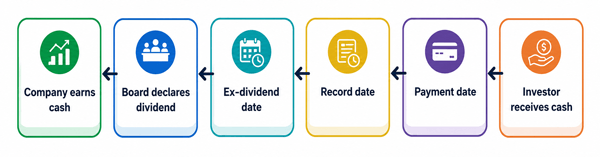
Figure. How a dividend usually reaches investors: declaration, ex-dividend date, record date, and payment date.
3. Beginner Checklist Before Buying Any High-Dividend Stock
- Check the payout ratio: A payout ratio that is too high may mean the company is paying more than it can comfortably afford. REITs are different because they use funds from operations, not simple earnings, to judge coverage.
- Look at free cash flow: Dividends are paid with cash, not headlines. A company with weak cash flow may keep paying for a while, but the risk of a cut rises.
- Avoid buying only because the yield is high: A falling stock price can push the yield up. That can make a weak company look attractive just before a dividend cut.
- Understand the business: A telecom, a REIT, a tobacco company, and a packaged-food company have very different risks. Do not treat all high-yield stocks as the same.
- Diversify income sources: A beginner should avoid putting most of the portfolio into one stock or one sector. Dividend income feels stable until one company cuts its payout.
- Think after tax: Qualified dividends, ordinary dividends, REIT dividends, and foreign dividends can be taxed differently depending on the account and investor situation.
4. The 10 Highest Dividend-Paying Stocks to Buy or Research in 2026
The following stock profiles are written for a beginner. Each includes what the company does, why the dividend is high, what to check before buying, and the type of investor it may fit. These are not guarantees or personalized recommendations.
4.1 Conagra Brands (CAG) - Approx. Yield: 9.89%
Business in plain English: Conagra Brands operates in packaged food. Investors are mainly looking at it for income, not fast growth.
Why the dividend is high: The yield is high because packaged-food stocks have been under pressure from slower volume growth, changing consumer habits, pricing fatigue, and margin concerns. These companies sell familiar products, but familiar brands do not automatically mean safe dividends.
Who it may fit: This may fit investors who want consumer-staples exposure and are comfortable with turnaround risk. It may not fit someone who needs maximum dividend safety.
What to check before buying: Check sales volume trends, debt, gross margin, brand investment, and whether management keeps funding the dividend without weakening the balance sheet.
Dividend data used: Conagra Board approved $0.35 quarterly dividend payable June 3, 2026. Approximate forward yield is annual dividend of $1.4 divided by a share price of $14.15, or about 9.89%.
4.2 Pfizer (PFE) - Approx. Yield: 7.09%
Business in plain English: Pfizer operates in healthcare/pharma. Investors are mainly looking at it for income, not fast growth.
Why the dividend is high: Pfizer offers a high yield because the market is worried about post-pandemic revenue normalization, patent expirations, and whether the drug pipeline can replace older cash flows.
Who it may fit: This may fit investors who want healthcare income and can tolerate uncertainty around clinical results, acquisitions, and patent cycles.
What to check before buying: Watch free cash flow, debt after acquisitions, pipeline approvals, and management commentary about dividend coverage.
Dividend data used: Pfizer dividend history shows $0.43 quarterly dividend in 2026. Approximate forward yield is annual dividend of $1.72 divided by a share price of $24.25, or about 7.09%.
4.3 The Campbell's Company (CPB) - Approx. Yield: 7.06%
Business in plain English: The Campbell's Company operates in packaged food. Investors are mainly looking at it for income, not fast growth.
Why the dividend is high: The yield is high because packaged-food stocks have been under pressure from slower volume growth, changing consumer habits, pricing fatigue, and margin concerns. These companies sell familiar products, but familiar brands do not automatically mean safe dividends.
Who it may fit: This may fit investors who want consumer-staples exposure and are comfortable with turnaround risk. It may not fit someone who needs maximum dividend safety.
What to check before buying: Check sales volume trends, debt, gross margin, brand investment, and whether management keeps funding the dividend without weakening the balance sheet.
Dividend data used: Campbell's declared $0.39 quarterly dividend payable Aug. 3, 2026. Approximate forward yield is annual dividend of $1.56 divided by a share price of $22.10, or about 7.06%.
4.4 General Mills (GIS) - Approx. Yield: 6.69%
Business in plain English: General Mills operates in packaged food. Investors are mainly looking at it for income, not fast growth.
Why the dividend is high: The yield is high because packaged-food stocks have been under pressure from slower volume growth, changing consumer habits, pricing fatigue, and margin concerns. These companies sell familiar products, but familiar brands do not automatically mean safe dividends.
Who it may fit: This may fit investors who want consumer-staples exposure and are comfortable with turnaround risk. It may not fit someone who needs maximum dividend safety.
What to check before buying: Check sales volume trends, debt, gross margin, brand investment, and whether management keeps funding the dividend without weakening the balance sheet.
Dividend data used: General Mills 2026 dividend table shows $0.61 quarterly payments. Approximate forward yield is annual dividend of $2.44 divided by a share price of $36.46, or about 6.69%.
4.5 Verizon Communications (VZ) - Approx. Yield: 6.66%
Business in plain English: Verizon Communications operates in telecom. Investors are mainly looking at it for income, not fast growth.
Why the dividend is high: Telecom companies often pay large dividends because they generate recurring monthly customer revenue. The trade-off is heavy capital spending, debt, and intense competition.
Who it may fit: This may fit income investors who prefer mature, subscription-like businesses, but dividend growth may be modest.
What to check before buying: Review free cash flow after capital spending, wireless subscriber growth, debt reduction, and whether dividend growth is realistic.
Dividend data used: Verizon dividend history shows $0.7075 quarterly dividend in June 2026. Approximate forward yield is annual dividend of $2.83 divided by a share price of $42.47, or about 6.66%.
4.6 Kraft Heinz (KHC) - Approx. Yield: 6.38%
Business in plain English: Kraft Heinz operates in packaged food. Investors are mainly looking at it for income, not fast growth.
Why the dividend is high: The yield is high because packaged-food stocks have been under pressure from slower volume growth, changing consumer habits, pricing fatigue, and margin concerns. These companies sell familiar products, but familiar brands do not automatically mean safe dividends.
Who it may fit: This may fit investors who want consumer-staples exposure and are comfortable with turnaround risk. It may not fit someone who needs maximum dividend safety.
What to check before buying: Check sales volume trends, debt, gross margin, brand investment, and whether management keeps funding the dividend without weakening the balance sheet.
Dividend data used: Kraft Heinz declared $0.40 quarterly dividend payable June 26, 2026. Approximate forward yield is annual dividend of $1.6 divided by a share price of $25.08, or about 6.38%.
4.7 Altria Group (MO) - Approx. Yield: 6.04%
Business in plain English: Altria Group operates in tobacco. Investors are mainly looking at it for income, not fast growth.
Why the dividend is high: Altria pays a high dividend because tobacco is a mature, regulated industry with declining cigarette volumes. The cash flow can be strong, but the business carries major regulatory, legal, and ESG risks.
Who it may fit: This may fit investors who prioritize cash income and accept tobacco-specific risks. Some readers may avoid it for ethical reasons.
What to check before buying: Check smoke-free product progress, cigarette volume declines, payout ratio, litigation, and regulatory developments.
Dividend data used: Altria declared $1.06 quarterly dividend in February 2026. Approximate forward yield is annual dividend of $4.24 divided by a share price of $70.16, or about 6.04%.
4.8 United Parcel Service (UPS) - Approx. Yield: 5.77%
Business in plain English: United Parcel Service operates in logistics. Investors are mainly looking at it for income, not fast growth.
Why the dividend is high: UPS has a high yield because investors are worried about package volumes, labor costs, Amazon-related volume shifts, and restructuring. The dividend is attractive, but it depends on shipping demand and cash generation.
Who it may fit: This may fit investors who want income from a global logistics leader and can handle economic-cycle risk.
What to check before buying: Watch operating margin, free cash flow, capital spending, volume trends, and management comments about dividend commitment.
Dividend data used: UPS declared $1.64 quarterly dividend in May 2026. Approximate forward yield is annual dividend of $6.56 divided by a share price of $113.67, or about 5.77%.
4.9 AT&T (T) - Approx. Yield: 5.22%
Business in plain English: AT&T operates in telecom. Investors are mainly looking at it for income, not fast growth.
Why the dividend is high: Telecom companies often pay large dividends because they generate recurring monthly customer revenue. The trade-off is heavy capital spending, debt, and intense competition.
Who it may fit: This may fit income investors who prefer mature, subscription-like businesses, but dividend growth may be modest.
What to check before buying: Review free cash flow after capital spending, wireless subscriber growth, debt reduction, and whether dividend growth is realistic.
Dividend data used: AT&T historical dividend data shows $0.2775 quarterly payments in 2026. Approximate forward yield is annual dividend of $1.11 divided by a share price of $21.28, or about 5.22%.
4.10 Realty Income (O) - Approx. Yield: 5.10%
Business in plain English: Realty Income operates in reit/real estate. Investors are mainly looking at it for income, not fast growth.
Why the dividend is high: Realty Income is a REIT, so it is built to distribute a large share of cash flow to shareholders. It is known for monthly dividends, but REITs are sensitive to interest rates and property-market conditions.
Who it may fit: This may fit investors who want monthly dividend income and real-estate exposure without directly owning property.
What to check before buying: Focus on adjusted funds from operations, occupancy, tenant quality, debt maturity schedule, and interest-rate sensitivity.
Dividend data used: Realty Income increased monthly dividend to $0.2710, or $3.252 annualized, in June 2026. Approximate forward yield is annual dividend of $3.252 divided by a share price of $63.77, or about 5.10%.
5. Best Uses: Which Dividend Stock Fits Which Goal?
| Investor goal | Stocks to research first | Why | Main warning |
|---|---|---|---|
| Highest raw income | CAG, CPB, GIS, KHC | Yields are among the highest in the group. | High yield can signal weak growth or possible dividend stress. |
| More defensive income | VZ, T, PFE, O | Large businesses with recurring revenue or essential services. | Debt, rates, and industry disruption still matter. |
| Monthly cash flow | O | Realty Income pays monthly. | REIT dividends can be tax-inefficient in taxable accounts. |
| Turnaround income | UPS, PFE, packaged-food stocks | Income plus possible upside if operations improve. | Turnarounds can take years and may fail. |
| Ethics-sensitive investors | Avoid or limit MO | Tobacco income may conflict with personal values. | High cash flow does not remove regulatory and ethical concerns. |
6. How Beginners Can Use Dividend Stocks in a Portfolio
A practical beginner approach is to decide the role of dividend stocks before choosing names. Are you trying to create current income, reinvest dividends for compounding, reduce volatility, or diversify away from growth stocks? Your answer changes what you should buy.
| Strategy | How it works | Beginner caution |
|---|---|---|
| Dividend reinvestment (DRIP) | Use dividends to automatically buy more shares. This can compound over time if the business remains healthy. | You still pay taxes in a taxable account even if dividends are reinvested. |
| Income bucket | Hold dividend stocks to help fund expenses. | Do not rely on one company; a dividend cut can hurt cash flow. |
| Core-satellite | Use diversified ETFs as the core, then add individual dividend stocks as satellites. | This lowers single-stock risk but does not eliminate market risk. |
| Watchlist buying | Build a list and buy only when valuation and fundamentals look reasonable. | Waiting can be emotionally hard, but it avoids buying only because a headline says “highest yield.” |
7. Practical Example: Building a $10,000 Dividend Watchlist
Suppose a beginner has $10,000 and wants dividend income, but not reckless risk. Instead of putting all $10,000 into the highest-yielding stock, a more balanced test portfolio might look like this:
| Bucket | Example allocation | Example stocks | Purpose | Estimated yield range |
|---|---|---|---|---|
| Core income | 40% | VZ, T, O | Recurring revenue and monthly/quarterly income | 5%-6% |
| Healthcare income | 20% | PFE, BMY alternative if added later | Diversify away from telecom and food | 4%-7% |
| Turnaround income | 25% | UPS, GIS, KHC | Potential recovery plus income | 6%-7% |
| Speculative high yield | 15% | CAG, CPB | Higher income, higher risk | 7%-11% |
This is only an educational example, not a model portfolio. A conservative investor may prefer dividend ETFs, Treasury bills, CDs, or high-quality bonds instead of individual high-yield stocks.
8. Biggest Mistakes Beginners Make With High-Dividend Stocks
- Mistake 1: Chasing yield without asking why it is high: A 10% yield can be attractive, but it can also mean the stock price has collapsed because investors expect weaker earnings or a dividend cut.
- Mistake 2: Ignoring total return: A stock paying 7% can still lose money if the share price falls 20%.
- Mistake 3: Treating all dividends as safe: Dividends are not bond payments. A board can reduce or suspend them.
- Mistake 4: Forgetting taxes: REIT dividends, foreign dividends, and qualified dividends may be taxed differently. Account placement matters.
- Mistake 5: Overconcentration: Many high-yield lists cluster in telecom, tobacco, REITs, energy, and struggling consumer staples. Diversification matters.
9. A Simple 5-Step Research Process Before You Buy
- 1. Start with the dividend yield: Compare the current yield with the company’s own history and peers.
- 2. Check dividend coverage: Look at payout ratio, free cash flow, and management guidance.
- 3. Read the last earnings release: Find out whether revenue, margins, debt, and cash flow are improving or getting worse.
- 4. Look for a clear reason to own it: Do not buy only because it appears on a high-yield list. Know the business thesis.
- 5. Decide your sell rules in advance: Examples: dividend cut, debt gets worse, earnings thesis breaks, or a better opportunity appears.
10. FAQs About High Dividend-Paying Stocks in 2026
10.1 Are high-dividend stocks safe?
Not automatically. Some are mature cash-generating companies, while others have high yields because investors expect problems.
10.2 What is a good dividend yield in 2026?
There is no perfect number. A 3%-5% yield may be attractive if it is sustainable. A 7%-10% yield requires deeper research because it can signal risk.
10.3 Do dividend stocks pay monthly?
Most U.S. companies pay quarterly. Some REITs, including Realty Income, pay monthly.
10.4 Can I live off dividend income?
Possibly, but it usually requires a large, diversified portfolio and careful tax planning. Beginners should not assume dividends are guaranteed income.
10.5 Should I buy before the ex-dividend date?
Buying only to capture a dividend rarely works as a simple trick because stock prices often adjust around the ex-dividend date and taxes may apply.
10.6 Are dividend stocks better than growth stocks?
Neither is always better. Dividend stocks can provide income, while growth stocks may provide higher capital appreciation. Many investors use both.
11. Final Takeaway
The best high-dividend stock is not always the one with the highest yield. In 2026, some of the highest yields are coming from packaged-food companies under pressure, mature telecom companies, healthcare names facing patent-cycle concerns, logistics companies managing restructuring, tobacco stocks with regulatory risk, and REITs exposed to interest rates. That does not make them bad investments, but it does mean beginners should slow down and ask better questions.
A smart dividend strategy focuses on reliable cash flow, reasonable payout ratios, balance-sheet strength, sector diversification, tax awareness, and patience. Use the list above as a starting point for research, not a command to buy.
Sources Consulted and Checked
The following sources were consulted and checked while preparing this article and reviewing its accuracy. Company investor-relations pages and official dividend announcements were treated as primary sources for dividend amounts, while investor-education and tax sources were used for general guidance. Readers should consult the latest official information because market prices, dividends, tax rules, and company circumstances can change.
- Verizon dividend history
- AT&T historical common dividends
- Altria dividend information and 2026 dividend announcement
- Realty Income June 2026 monthly dividend increase
- Pfizer dividend and split history
- UPS May 2026 quarterly dividend announcement
- Bristol Myers Squibb dividend announcement
- Conagra Brands quarterly dividend announcement
- General Mills dividends and stock splits
- Campbell’s quarterly dividend announcement
- Kraft Heinz dividend history and 2026 declaration
- FINRA stocks investor education
- IRS Topic 404: Dividends and other corporate distributions
- Fidelity high-dividend stocks guide
- Schwab dividend investing guidance
- Kiplinger highest-yielding S&P 500 dividend stocks, June 2026
Reader Advice
This article is provided solely for educational and informational purposes and does not constitute financial, investment, tax, legal, or other professional advice. It is not a recommendation to buy, sell, or hold any security. The inclusion of any company or stock in this “10 Highest Dividend-Paying Stocks to Buy in 2026” list is based on the author’s research and editorial assessment for informational purposes only and should not be interpreted as an endorsement, guarantee, or prediction of future performance or dividend income. The terms “highest” and “to buy” should be understood in the context of the criteria and information considered for this article; high dividend yields may change and can sometimes reflect increased investment risk, while dividends may be reduced, suspended, or discontinued at any time.
Dividend payments, yields, share prices, company fundamentals, tax treatment, market conditions, and applicable rules may change at any time, and past performance or dividend growth does not guarantee future results. Before making any decision, readers should conduct independent research, verify all facts and figures through current official sources and company filings, consider their objectives, risk tolerance, time horizon, diversification, and personal circumstances, and seek advice from an appropriately qualified and regulated professional where necessary. Investing involves risk, including the possible loss of principal.