10 Best Monthly Dividend Stocks for Passive Income in 2026
1. What Are Monthly Dividend Stocks?
Monthly dividend stocks are shares of companies that send cash to investors every month instead of every quarter. For a beginner, the attraction is simple: the income arrives on a schedule that feels closer to rent, salary, or a monthly bill cycle. That makes budgeting easier and gives investors a clear way to see passive income grow over time.
But monthly income is not the same as safe income. A stock can pay every month and still be risky. The dividend can be cut. The share price can fall. A very high yield can sometimes be a warning sign, not a bargain. The goal of this guide is to help readers understand how monthly dividend stocks work, which names are worth researching in 2026, and how to build a more sensible monthly dividend portfolio without chasing yield blindly.
This article focuses on U.S.-listed monthly dividend stocks that are widely followed by income investors. The list favors businesses with understandable models, visible cash flow, and a clear reason for paying monthly. It also includes a few higher-yield choices, but labels them honestly so beginners can see the trade-off.
2. How Monthly Dividends Work in Plain English
A dividend is a cash payment a company chooses to send to shareholders. If you own 100 shares and the company declares a $0.10 monthly dividend, you would usually receive $10 for that month before taxes. The amount is normally deposited into your brokerage account as cash unless you have dividend reinvestment turned on.
The key dates are the declaration date, ex-dividend date, record date, and payment date. The ex-dividend date matters most for buyers. If you buy on or after the ex-dividend date, you normally do not receive that specific upcoming payment. Beginners should not buy a stock only to capture one dividend; the share price often adjusts around the ex-dividend date.
Most monthly dividend stocks come from real estate investment trusts (REITs), business development companies (BDCs), mortgage REITs, and closed-end fund-like income vehicles. That is because these structures often distribute a large part of their cash flow. This can create attractive income, but it also means investors must check coverage, debt, leverage, and business quality.
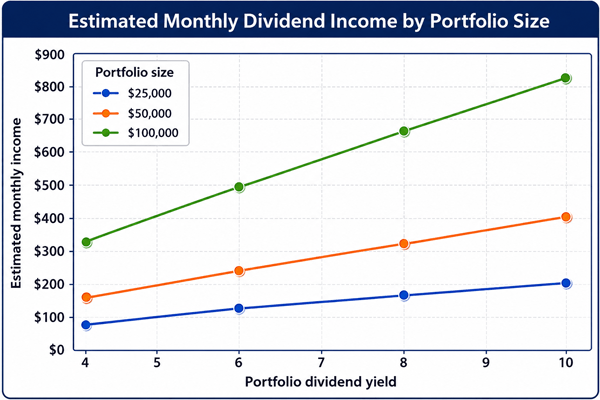
Figure 1: A simple income example. A $100,000 portfolio yielding 6% would produce about $500 per month before taxes. This is an estimate, not a promise.
3. Best Monthly Dividend Stocks for 2026: Quick Comparison
Data check: Market prices were reviewed on July 15, 2026. Dividend amounts were checked against company investor-relations information available at the time of review.
The table below uses recent market prices checked on July 15, 2026 and the latest stated or annualized regular dividends available from company investor-relations pages. Prices and yields change continuously, so readers should verify current figures before acting.
| Rank | Stock | Ticker | Type | Recent price | Regular annual dividend | Approx. yield | Best fit |
|---|---|---|---|---|---|---|---|
| 1 | Realty Income | O | Net-lease REIT | $63.77 | $3.252 | 5.1% | Core income |
| 2 | Agree Realty | ADC | Net-lease REIT | $77.99 | $3.204 | 4.1% | Core quality |
| 3 | Main Street Capital | MAIN | BDC | $53.09 | $3.18 | 6.0% | Balanced income |
| 4 | EPR Properties | EPR | Experiential REIT | $59.54 | $3.72 | 6.2% | Higher yield |
| 5 | LTC Properties | LTC | Health-care REIT | $40.03 | $2.28 | 5.7% | Defensive income |
| 6 | Apple Hospitality REIT | APLE | Hotel REIT | $16.68 | $0.96 | 5.8% | Cyclical income |
| 7 | Gladstone Commercial | GOOD | Office/industrial REIT | $12.57 | $1.2 | 9.5% | High yield |
| 8 | Gladstone Capital | GLAD | BDC | $19.80 | $1.8 | 9.1% | High yield BDC |
| 9 | Gladstone Investment | GAIN | BDC | $16.52 | $0.96 | 5.8% | BDC income + specials |
| 10 | PennantPark Floating Rate Capital | PFLT | BDC | $7.18 | $0.96 | 13.4% | Speculative high yield |
3.1 How This List Was Chosen
- Monthly payment schedule confirmed from company dividend history pages or reputable dividend data sources.
- Business model is understandable enough for a beginner to research further.
- Dividend yield is considered together with risk, not in isolation.
- The list avoids pretending any stock is risk-free. High-yield names are clearly marked as higher risk.
- STAG Industrial is not included because it announced a shift from monthly to quarterly dividends in January 2026, which makes it less suitable for a 2026 monthly-dividend list.
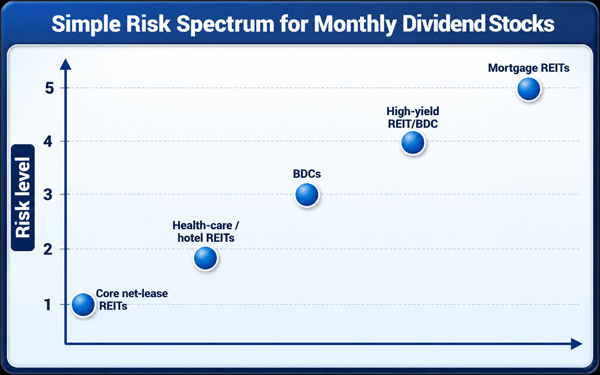
Figure 2: Monthly dividend stocks sit on a risk spectrum. The biggest mistake is treating a 10%-15% yield as automatically better than a 4%-6% yield.
3.2 Realty Income (O) - Core income
Realty Income is the classic monthly dividend stock. It owns thousands of single-tenant commercial properties and leases them to retailers, service businesses, and other operators under long-term net leases. A net lease usually means the tenant, not the landlord, pays many property-level costs such as taxes, insurance, and maintenance.
Why beginners like it: the story is easy to understand. Realty Income collects rent and sends part of that cash flow to shareholders every month. The company also markets itself as The Monthly Dividend Company and has declared hundreds of consecutive monthly dividends.
What to check before buying: do not judge Realty Income by normal earnings payout alone. REITs are better analyzed using funds from operations (FFO) or adjusted FFO. Also watch interest rates because REIT prices often fall when bond yields rise.
| Approx. recent yield | 5.1% based on a $63.77 recent price and an annualized regular dividend of about $3.252 |
|---|---|
| Best use | Core income |
| Main strength | Long record of monthly dividends and gradual increases |
| Main risk | Interest-rate sensitivity; retail tenant concentration |
3.3 Agree Realty (ADC) - Core quality
Agree Realty is another net-lease REIT, but it is often viewed as a more quality-focused cousin to larger retail REITs. It owns properties leased to retail tenants and has a monthly dividend policy.
Why it can fit a beginner portfolio: ADC may offer a lower yield than riskier REITs, but the business model is cleaner than many high-yield alternatives. For readers building a long-term passive income portfolio, a slightly lower yield with better tenant quality can be more useful than a flashy yield that later gets cut.
What to check: valuation, acquisition spreads, tenant concentration, and the AFFO payout ratio. If the stock gets expensive, the yield may become less attractive even if the business remains strong.
| Approx. recent yield | 4.1% based on a $77.99 recent price and an annualized regular dividend of about $3.204 |
|---|---|
| Best use | Core quality |
| Main strength | Retail property focus with investment-grade bias |
| Main risk | Lower yield than riskier REITs |
3.4 Main Street Capital (MAIN) - Balanced income
Main Street Capital is a business development company. BDCs lend to or invest in smaller and middle-market businesses. In return, they can generate high interest income and distribute much of it to shareholders.
Why it stands out: MAIN has a reputation as one of the better-run BDCs and pays regular dividends monthly. For July, August, and September 2026, it declared regular monthly dividends of $0.265 per share. It has also paid supplemental dividends at times, although beginners should treat extra dividends as a bonus, not something to rely on for bills.
What to check: net investment income coverage, non-accrual loans, leverage, and portfolio quality. A BDC can look great during easy credit conditions and then become stressed when borrowers struggle.
| Approx. recent yield | 6.0% based on a $53.09 recent price and an annualized regular dividend of about $3.18 |
|---|---|
| Best use | Balanced income |
| Main strength | Monthly regular dividends plus history of supplementals |
| Main risk | BDC earnings can fall when credit losses rise |
3.5 EPR Properties (EPR) - Higher yield
EPR Properties is an experiential REIT. It owns properties tied to entertainment, recreation, theaters, attractions, ski assets, and education-related real estate. This makes it different from a normal apartment, office, or warehouse REIT.
Why income investors watch it: the yield is higher than many safer REITs, and the company pays monthly. If consumer spending remains healthy, experiential assets can produce strong rent collection.
Why it is not for everyone: EPR carries more business-specific risk. Movie theaters and leisure properties are more vulnerable to recessions, tenant problems, and changing consumer habits. It is better as a researched satellite holding than a beginner's largest position.
| Approx. recent yield | 6.2% based on a $59.54 recent price and an annualized regular dividend of about $3.72 |
|---|---|
| Best use | Higher yield |
| Main strength | Cinemas, attractions, ski, education and leisure assets |
| Main risk | Consumer discretionary and tenant health risk |
3.6 LTC Properties (LTC) - Defensive income
LTC Properties is a healthcare REIT focused on senior housing and skilled nursing. The long-term demand story is easy to understand: the U.S. population is aging, and care facilities are essential infrastructure.
Why it can be useful: the monthly dividend has been steady, and the sector can be less tied to normal retail trends. This gives income investors a different type of real estate exposure.
What to check: tenant/operator coverage, rent collection, Medicare/Medicaid reimbursement pressure, and facility occupancy. Healthcare real estate can be defensive, but operators can face labor cost and reimbursement problems.
| Approx. recent yield | 5.7% based on a $40.03 recent price and an annualized regular dividend of about $2.28 |
|---|---|
| Best use | Defensive income |
| Main strength | Senior housing and skilled nursing exposure |
| Main risk | Operator health and reimbursement risk |
3.7 Apple Hospitality REIT (APLE) - Cyclical income
Apple Hospitality owns a large portfolio of mostly Marriott- and Hilton-branded hotels. It pays monthly distributions, but hotel REITs are more cyclical than net-lease REITs.
Why it belongs on the watchlist: hotel revenue can recover quickly when travel demand is strong. APLE gives monthly income investors exposure to lodging without buying a hotel directly.
What to check: revenue per available room, occupancy, travel trends, debt, and whether the monthly distribution is covered by adjusted FFO. This is not the first stock a very conservative retiree should buy, but it can be useful for investors who understand cyclicality.
| Approx. recent yield | 5.8% based on a $16.68 recent price and an annualized regular dividend of about $0.96 |
|---|---|
| Best use | Cyclical income |
| Main strength | Large portfolio of Marriott/Hilton-branded hotels |
| Main risk | Travel demand and recession sensitivity |
3.8 Gladstone Commercial (GOOD) - High yield
Gladstone Commercial is a REIT with industrial and office properties. It pays monthly dividends and usually offers a high yield compared with larger REITs.
Why some investors like it: the monthly cash flow is attractive, and the company has a long operating history in its niche. For income-focused investors, the yield can look compelling.
Main caution: high yield needs extra due diligence. Office real estate remains challenged in many markets, and small-cap REITs may have less financial flexibility than large investment-grade REITs. A beginner should size this conservatively.
| Approx. recent yield | 9.5% based on a $12.57 recent price and an annualized regular dividend of about $1.2 |
|---|---|
| Best use | High yield |
| Main strength | Monthly payer with industrial and office properties |
| Main risk | Office exposure and high yield risk |
3.9 Gladstone Capital (GLAD) - High yield BDC
Gladstone Capital is a BDC that provides debt and equity capital to middle-market companies. It pays monthly distributions and has a high current yield.
Why it can be attractive: monthly cash flow plus BDC income can be appealing when interest rates are favorable. The company is part of the broader Gladstone group, which emphasizes monthly dividends across its public funds.
What to check: portfolio credit quality, non-accruals, net asset value trend, and whether the dividend is covered by net investment income. BDCs are not bank accounts; they are credit investments.
| Approx. recent yield | 9.1% based on a $19.80 recent price and an annualized regular dividend of about $1.8 |
|---|---|
| Best use | High yield BDC |
| Main strength | Middle-market lender with monthly distributions |
| Main risk | Small-cap BDC and credit cycle risk |
3.10 Gladstone Investment (GAIN) - BDC income + specials
Gladstone Investment is another BDC, but it often combines debt investments with equity upside in private companies. It pays a monthly regular dividend and may pay supplemental distributions when exits are successful.
Why it is interesting: GAIN can provide more than simple coupon income if portfolio companies are sold at gains. That can support special dividends over time.
What to check: do not annualize special dividends as if they are guaranteed. Focus on the regular monthly payout, net asset value, realized gains, leverage, and portfolio company performance.
| Approx. recent yield | 5.8% based on a $16.52 recent price and an annualized regular dividend of about $0.96 |
|---|---|
| Best use | BDC income + specials |
| Main strength | Monthly regular payout with occasional extras |
| Main risk | Private company valuation and exit timing risk |
3.11 PennantPark Floating Rate Capital (PFLT) - Speculative high yield
PennantPark Floating Rate Capital is a BDC focused on floating-rate loans to middle-market companies. Floating-rate assets can help when rates are higher because loan income may rise with benchmark rates.
Why it attracts attention: the yield can be very high and the stock pays monthly. For investors seeking high monthly income, it is hard to ignore.
Why beginners must be careful: very high yield usually means higher risk. In 2026, the distribution details deserve close checking because regular and supplemental components may be presented separately. Treat PFLT as speculative income, not a safe core holding, and confirm the latest declaration directly with the company.
| Approx. recent yield | 13.4% based on a $7.18 recent price and an annualized regular dividend of about $0.96 |
|---|---|
| Best use | Speculative high yield |
| Main strength | Floating-rate middle-market loans |
| Main risk | Recent distribution change and credit risk |
4. Monthly Dividend Stocks vs Quarterly Dividend Stocks
Monthly dividends feel smoother, but they are not automatically better. A strong quarterly payer can be safer than a weak monthly payer. The payment schedule should be a convenience, not the main reason to buy.
A monthly payer can help retirees or side-income investors match income to bills. A quarterly payer may have a better business, stronger balance sheet, or faster dividend growth. Beginners should compare total return, dividend safety, and valuation, not just payment frequency.
5. Beginner Example: How Much Money Do You Need?
Suppose a reader wants $500 per month in dividend income before taxes. At a 5% portfolio yield, they would need about $120,000 invested. At a 7% yield, they would need about $85,714. At a 10% yield, they would need $60,000. The 10% example looks easier, but it usually comes with more risk of dividend cuts and price losses.
A practical beginner approach is to start with a target income number, then work backward. Do not force the yield to meet the goal. If the portfolio needs a 12% yield to produce enough income, the goal may be too aggressive for a conservative investor.
6. How to Use Monthly Dividend Stocks
There are three common ways to use monthly dividend stocks. First, spend the cash as income, which is common for retirees. Second, reinvest dividends through a dividend reinvestment plan, or DRIP, which automatically buys more shares. Third, collect the cash and manually reinvest it into the most attractive opportunity each month.
For beginners still building wealth, reinvestment is often more powerful than spending. For retirees, a cash bucket strategy can help: keep several months of living expenses in cash, then use dividends to refill the bucket instead of selling shares during market drops.
7. Dividend Safety Checklist
Before buying any monthly dividend stock, check five things: payout coverage, debt, business quality, dividend history, and valuation. For REITs, use AFFO payout ratio rather than only net income payout. For BDCs, use net investment income coverage and non-accrual trends. For mortgage REITs, watch book value, leverage, hedging, and spread income.
A simple warning rule: if the yield is more than twice the yield of similar companies, ask why. Sometimes the market is offering a bargain. Often it is pricing in a future dividend cut.
8. Sample Monthly Dividend Portfolio Ideas
Conservative income example: 35% Realty Income, 25% Agree Realty, 15% Main Street Capital, 10% LTC Properties, 10% Apple Hospitality, 5% cash or short-term Treasury ETF. This example favors lower volatility and simpler businesses.
Balanced income example: 25% Realty Income, 20% Agree Realty, 20% Main Street Capital, 10% EPR Properties, 10% LTC Properties, 5% Apple Hospitality, 5% Gladstone Investment, 5% cash. This adds more yield but still avoids making the riskiest names too large.
Aggressive income example: 15% Realty Income, 15% Main Street Capital, 15% EPR Properties, 10% LTC Properties, 10% Gladstone Commercial, 10% Gladstone Capital, 10% Gladstone Investment, 10% PennantPark Floating Rate Capital, 5% cash. This is only for investors who can handle cuts and price swings.
9. Tax and Account Considerations
Monthly dividends may be taxed differently depending on the company type and the investor's country. REIT dividends are often taxed differently from qualified dividends. BDC distributions may include ordinary income, capital gains, or return of capital components. Investors using a taxable brokerage account should review 1099 tax forms carefully.
In the U.S., some investors prefer holding high-income REITs and BDCs in tax-advantaged accounts such as an IRA or Roth IRA. That can simplify taxation, but it depends on the investor's personal situation. Readers should consult a qualified tax professional for personal advice.
10. What Beginners Should Compare Before Buying
| Question | Why it matters | Good sign | Warning sign |
|---|---|---|---|
| Is the dividend covered? | Income must come from cash flow, not hope. | AFFO/NII comfortably covers dividend. | Dividend exceeds recurring cash flow. |
| Is debt manageable? | High leverage can force cuts. | Investment-grade debt or conservative leverage. | Heavy refinancing needs at high rates. |
| Is the business stable? | Stable cash flow supports monthly payouts. | Diversified tenants/borrowers. | Few tenants or weak borrowers. |
| Is yield reasonable? | Extreme yield may signal danger. | Yield is in line with peers. | Yield is far above peers without clear reason. |
| Is valuation fair? | Even good stocks can be bad buys at high prices. | Yield and multiples are near historical range. | Price assumes perfect conditions. |
11. FAQs
11.1 Are monthly dividend stocks good for passive income?
They can be useful because they create regular cash flow, but they are not guaranteed. The best monthly dividend stocks combine a reasonable yield with solid cash-flow coverage and a business model you understand.
11.2 Can I live off monthly dividends?
Yes, some investors do, but it usually requires a large portfolio, diversification, cash reserves, and realistic spending. A $500 monthly income target might require around $85,000 to $120,000 depending on yield and risk.
11.3 What is a safe dividend yield?
There is no single safe number. In 2026, many quality monthly payers sit around 4% to 7%. Yields above 9% or 10% require extra caution because the market may be pricing in risk.
11.4 Should beginners buy the highest-yield monthly dividend stock?
Usually no. Beginners should prioritize dividend safety, business quality, and diversification. A 15% yield that gets cut can be worse than a 5% yield that grows slowly.
11.5 Are REITs better than BDCs for monthly income?
REITs and BDCs serve different roles. REITs provide real estate income. BDCs provide credit exposure to private and middle-market companies. A balanced income portfolio may use both, but neither should be bought without understanding the risks.
11.6 What happened to STAG Industrial as a monthly dividend stock?
STAG was widely known as a monthly dividend REIT, but in January 2026 it announced a shift from monthly to quarterly dividends. That is why it should not be treated as a current monthly dividend stock for a 2026 list.
12. Final Takeaway
The best monthly dividend stock is not always the one with the highest yield. For most beginners, a strong monthly dividend portfolio starts with understandable businesses such as net-lease REITs and high-quality BDCs, then adds smaller positions in higher-yield names only after proper research.
A practical 2026 watchlist could start with Realty Income, Agree Realty, Main Street Capital, LTC Properties, and Apple Hospitality for the more stable side, then EPR Properties, Gladstone Commercial, Gladstone Capital, Gladstone Investment, and PennantPark Floating Rate Capital for investors who accept more risk. The right mix depends on whether the reader wants safer retirement income, faster income growth, or higher current cash flow.
The honest rule is simple: build income slowly, diversify across sectors, reinvest when possible, and never buy a dividend stock just because the payment comes every month.
Sources Consulted and Checked
These sources were consulted and checked while preparing this article and reviewing its accuracy. Company filings, investor-relations pages, and current market data should be checked again before publication or any investment decision.
- Realty Income investor page and dividend declaration: https://www.realtyincome.com/
- Agree Realty dividend history: https://investors.agreerealty.com/stock-info/dividend-history/default.aspx
- Main Street Capital dividend page: https://www.mainstcapital.com/investors/listed-securities-information/dividends
- EPR Properties dividend page: https://investors.eprkc.com/dividends/default.aspx
- LTC Properties dividend declaration: https://ir.ltcreit.com/news-events/news/detail/451/ltc-declares-its-monthly-common-stock-cash-dividend-for-the-first-quarter-of-2026
- Apple Hospitality REIT dividend history: https://ir.applehospitalityreit.com/stock-information/dividend-history/default.aspx
- Gladstone Commercial dividend history: https://www.gladstonecommercial.com/investors/stock-data/dividend-history
- Gladstone Capital dividend history: https://www.gladstonecapital.com/investors/stock-data/dividend-history
- Gladstone Investment dividend history: https://www.gladstoneinvestment.com/investors/stock-data/dividend-history
- PennantPark Floating Rate Capital dividends: https://pflt.pennantpark.com/stock-information/dividends-splits
- STAG Industrial dividend cadence change announcement: https://www.stagindustrial.com/2026/01/08/stag-industrial-increases-dividend-and-shifts-from-monthly-to-quarterly-cadence/
- Recent market prices checked on July 15, 2026 through current U.S. market data; prices and calculated yields may change at any time.
Reader Advice
This article is provided solely for educational and informational purposes and does not constitute financial, investment, tax, legal, or other professional advice. It is not a recommendation to buy, sell, or hold any security. The inclusion of any company or stock in this “10 Best Monthly Dividend Stocks for Passive Income in 2026” list reflects the author’s research and editorial assessment for informational purposes only and should not be interpreted as an endorsement, guarantee, or prediction of future performance or income. The terms “best” and “passive income” are subjective, and monthly dividend payments are not guaranteed; companies may reduce, suspend, or discontinue dividends at any time, so actual income and returns may vary.
Dividend payments, yields, share prices, company fundamentals, tax treatment, market conditions, and applicable rules may change at any time, and past performance or dividend growth does not guarantee future results. Before making any decision, readers should conduct independent research, verify all facts and figures through current official sources and company filings, consider their objectives, risk tolerance, time horizon, diversification, and personal circumstances, and seek advice from an appropriately qualified and regulated professional where necessary. Investing involves risk, including the possible loss of principal.