10 Best Dividend Stocks to Buy in 2026
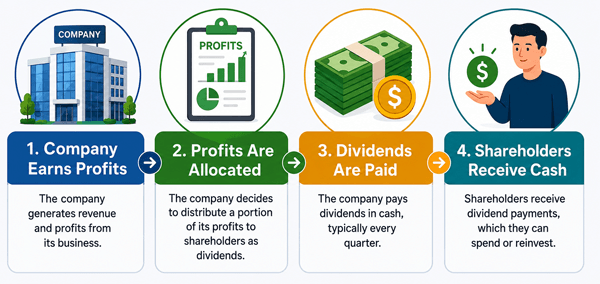
Dividend stocks are shares of companies that return part of their profits to shareholders in cash. For beginners, they can feel easier to understand than many fast-growth stocks because the investor sees a real payment arrive, usually every quarter. But the safest dividend strategy is not simply buying the stock with the biggest yield. A high yield can mean a bargain, or it can be a warning sign that investors expect the dividend to be reduced.
This guide explains dividend stocks in plain language and then gives a focused 2026 watchlist of ten high-quality U.S. dividend stocks. The list balances dependable blue-chip dividend payers, dividend growth stocks, real estate income, energy income, banking income, and technology companies that still return cash to shareholders. The goal is practical education: what each business does, why income investors like it, what could go wrong, and which type of beginner it may fit.
1. Key takeaways for beginners
- A dividend is not free money. When a stock goes ex-dividend, the share price often adjusts by roughly the dividend amount, and the real benefit comes from total return: dividends plus long-term price appreciation.
- Dividend yield shows the income you receive compared with the stock price, but dividend safety depends on cash flow, debt, payout ratio, business quality, and management discipline.
- A balanced dividend portfolio usually combines higher-yield income stocks with lower-yield dividend growth stocks. That helps avoid depending on one sector or one type of company.
- Beginners should start with position sizing, diversification, dividend reinvestment, and a checklist. Do not buy only because a stock appears in any article, including this one.
- For 2026, the most useful dividend-stock question is not 'Which stock pays the most?' It is 'Which companies can keep paying and possibly raising dividends through different economic conditions?'
2. The 2026 watchlist at a glance
| Rank | Stock | Ticker | Sector | Approx. yield* | Why it stands out | Best for |
|---|---|---|---|---|---|---|
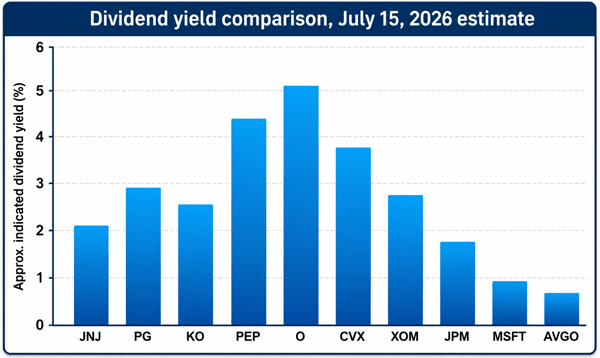
| 1 | Johnson & Johnson | JNJ | Healthcare | ~2.1% | Dividend King / healthcare stability | Conservative income and defensive exposure |
| 2 | Procter & Gamble | PG | Consumer staples | ~2.9% | Everyday products and long dividend record | Beginners who want simple businesses |
| 3 | Coca-Cola | KO | Beverages | ~2.6% | Global brand and cash generation | Brand-focused dividend growth |
| 4 | PepsiCo | PEP | Snacks & beverages | ~4.4% | Higher yield than many staples peers | Income plus consumer-staples diversification |
| 5 | Realty Income | O | Net-lease REIT | ~5.1% | Monthly dividend stock | Monthly cash-flow investors |
| 6 | Chevron | CVX | Integrated energy | ~3.8% | Oil/gas cash flow and buybacks | Energy income with a major balance sheet |
| 7 | Exxon Mobil | XOM | Integrated energy | ~2.8% | Scale and long dividend-growth streak | Energy exposure with global scale |
| 8 | JPMorgan Chase | JPM | Banking | ~1.8% | High-quality bank with dividend growth | Financial-sector exposure |
| 9 | Microsoft | MSFT | Technology | ~0.9% | Low yield, strong cash machine | Dividend growth with AI/cloud exposure |
| 10 | Broadcom | AVGO | Semiconductors/software | ~0.7% | Low yield, high growth profile | Growth investors who still want dividends |
*Approximate indicated yields use recent regular dividend rates and July 15, 2026 stock prices. Yields change daily as prices and dividends change.
3. What is a dividend stock?
A dividend stock is a company share that pays part of the company’s cash to shareholders. If a company pays $1.00 per share every quarter and you own 100 shares, you receive $100 each quarter before any tax withholding or account rules. Some investors take the cash as income. Others reinvest it through a dividend reinvestment plan, often called a DRIP, so the dividend buys more shares automatically.
The basic idea is simple: you buy a piece of a business, and the business shares part of its profits with owners. The difficult part is choosing businesses that can keep doing it. A company can pay a dividend for years and still cut it if profits fall, debt rises, or management decides cash is needed elsewhere.
3.1 How dividend payments work: the four dates beginners must know
| Dividend date | What it means |
|---|---|
| Declaration date | The company announces the dividend amount and schedule. |
| Ex-dividend date | You generally must own the stock before this date to receive the next dividend. |
| Record date | The company checks which shareholders are on record. |
| Payment date | Cash reaches your brokerage account, or is reinvested if you use DRIP. |
3.2 The beginner dividend formula
Dividend yield = Annual dividend per share / Current share price. Example: if a stock pays $4 per year and trades at $100, the dividend yield is 4%. If the price falls to $80 and the dividend stays $4, the yield becomes 5%. That higher yield may be attractive, but it may also mean the market is worried about the company.
4. How to judge a dividend stock before buying
| Checklist item | Beginner-friendly explanation |
|---|---|
| Dividend safety | Look at payout ratio, free cash flow, debt, and earnings stability. A payout that consumes nearly all cash flow leaves little room for mistakes. |
| Dividend growth | A long record of increases is useful, but never enough by itself. Ask whether future profits can support future increases. |
| Business quality | Prefer companies with strong brands, scale, recurring demand, pricing power, or difficult-to-copy advantages. |
| Valuation | Even a great dividend stock can disappoint if bought at an extreme price. Compare yield, earnings multiple, and growth prospects. |
| Sector risk | REITs, banks, utilities, energy, staples, and tech behave differently. Do not let one sector dominate your income plan. |
| Tax and account type | Qualified dividends, REIT dividends, foreign withholding, retirement accounts, and taxable accounts may be treated differently. |
5. 10 best dividend stocks to buy in 2026: detailed analysis
5.1 Johnson & Johnson (JNJ)
Johnson & Johnson is one of the most recognizable healthcare dividend stocks. It sells pharmaceuticals and medical technology products, which gives it exposure to areas where demand can be more resilient than many consumer-cyclical businesses. For a beginner, the appeal is its long dividend history, global scale, and role as a defensive holding when markets become nervous.
Why consider it in 2026: JNJ has a long record of raising dividends, and its latest quarterly dividend was $1.34 per share in 2026. Healthcare can be less dependent on consumer moods than restaurants, travel, or luxury goods. That does not make it risk-free; drug pipelines, patent cliffs, lawsuits, and regulation all matter.
Practical use: JNJ can work as a core defensive income stock rather than a quick-growth idea. A beginner might compare it with other healthcare names and ask whether the dividend yield, growth rate, and legal risks fit their comfort level.
- Beginner checklist: read the latest 10-K or annual report, confirm the current dividend declaration, compare the payout ratio with peers, review debt levels, and decide whether the stock is being used for income, growth, or diversification.
5.2 Procter & Gamble (PG)
Procter & Gamble sells everyday household and personal-care products. The business is easy to understand: people buy detergent, shampoo, razors, diapers, and cleaning products in good economies and weak economies. That is why PG often appears in lists of best dividend stocks for beginners.
Why consider it in 2026: P&G highlights 68 years of dividend increases and 134 years of dividend payments. That history does not guarantee the future, but it shows a culture of returning cash to shareholders. The main tradeoff is valuation and growth. A stable company can still be a poor investment if bought at too high a price.
Practical use: PG is best viewed as a quality consumer-staples dividend stock. It may not excite growth traders, but it can help balance a portfolio that is too concentrated in technology or cyclical stocks.
- Beginner checklist: read the latest 10-K or annual report, confirm the current dividend declaration, compare the payout ratio with peers, review debt levels, and decide whether the stock is being used for income, growth, or diversification.
5.3 Coca-Cola (KO)
Coca-Cola is a global beverage company with one of the strongest brands in the world. Many investors like KO because the business generates cash from everyday consumption and distribution partnerships. The company has also been a classic dividend growth stock for decades.
Why consider it in 2026: Coca-Cola remains a Dividend King-type name with a long history of annual increases. Its current indicated yield is moderate rather than extremely high, which is often a healthier starting point than a distressed 8% or 10% yield.
Practical use: KO can be paired with another consumer-staples stock, but beginners should avoid overloading on similar companies. Compare revenue growth, currency exposure, payout ratio, and valuation against PepsiCo and other staples.
- Beginner checklist: read the latest 10-K or annual report, confirm the current dividend declaration, compare the payout ratio with peers, review debt levels, and decide whether the stock is being used for income, growth, or diversification.
5.4 PepsiCo (PEP)
PepsiCo is more than cola. It owns a large snacks business along with beverages, which makes it different from Coca-Cola. That mix can help because snacks and drinks may perform differently across markets and consumer cycles.
Why consider it in 2026: PepsiCo announced that 2026 marked its 54th consecutive annual dividend increase and said the annualized dividend was expected to rise 4% beginning with the June 2026 payment. At recent prices, its indicated yield was higher than many high-quality consumer-staples peers.
Practical use: PEP may fit investors who want consumer-staples income but prefer a higher starting yield than KO or PG. Watch for volume trends, pricing power, commodity costs, and consumer pushback against higher food prices.
- Beginner checklist: read the latest 10-K or annual report, confirm the current dividend declaration, compare the payout ratio with peers, review debt levels, and decide whether the stock is being used for income, growth, or diversification.
5.5 Realty Income (O)
Realty Income is a real estate investment trust, or REIT, known as “The Monthly Dividend Company.” It owns properties leased to tenants, and it pays dividends monthly rather than quarterly. For people building passive income, monthly payments are psychologically attractive and easier to map against monthly expenses.
Why consider it in 2026: Realty Income says it has declared hundreds of consecutive monthly dividends and increased its dividend for more than 31 consecutive years. Its yield is higher than most names on this list, but the risks are different: interest rates, real estate valuations, tenant health, and access to capital.
Practical use: O can be a useful income holding, but beginners should understand that REIT dividends may have different tax treatment from qualified corporate dividends. It should not be judged only against regular corporations.
- Beginner checklist: read the latest 10-K or annual report, confirm the current dividend declaration, compare the payout ratio with peers, review debt levels, and decide whether the stock is being used for income, growth, or diversification.
5.6 Chevron (CVX)
Chevron is an integrated energy major. It explores for, produces, refines, and markets energy products. Energy stocks can pay strong dividends because they generate large cash flow in favorable commodity cycles, but profits can swing with oil and gas prices.
Why consider it in 2026: Chevron has emphasized dividend growth and shareholder returns, including a long record of increasing dividends. Its indicated yield is attractive compared with the broader market, while its scale gives it resilience smaller energy companies may not have.
Practical use: CVX can add income and inflation-sensitive exposure, but beginners should keep energy position sizes reasonable. Oil prices, political risk, capital spending, and environmental liabilities can change the investment case quickly.
- Beginner checklist: read the latest 10-K or annual report, confirm the current dividend declaration, compare the payout ratio with peers, review debt levels, and decide whether the stock is being used for income, growth, or diversification.
5.7 Exxon Mobil (XOM)
Exxon Mobil is another global integrated energy company, and it is one of the largest public energy businesses in the world. It has upstream, downstream, and chemical operations, giving it a broad footprint across the energy value chain.
Why consider it in 2026: Exxon declared a second-quarter 2026 dividend of $1.03 per share and reported strong balance-sheet metrics in its first-quarter 2026 update. It has also grown its annual dividend per share for decades. The yield is not the highest in energy, but the company’s scale and capital discipline matter.
Practical use: XOM is a more global-scale energy income option. Investors choosing between XOM and CVX should compare balance sheet, production outlook, capital return plan, valuation, and their desired sector exposure.
- Beginner checklist: read the latest 10-K or annual report, confirm the current dividend declaration, compare the payout ratio with peers, review debt levels, and decide whether the stock is being used for income, growth, or diversification.
5.8 JPMorgan Chase (JPM)
JPMorgan Chase is the largest U.S. bank by many measures and is often treated as a quality benchmark for the banking sector. Banks make money through lending, fees, cards, trading, investment banking, asset management, and other financial services.
Why consider it in 2026: JPMorgan declared a quarterly common dividend of $1.50 per share in March 2026. Its starting yield is lower than many income stocks, but the attraction is business quality, scale, and potential dividend growth over time.
Practical use: JPM is not a bond substitute. Bank earnings can be hurt by recessions, credit losses, regulation, and sudden stress in financial markets. It can be a financial-sector dividend holding for investors who want quality over maximum yield.
- Beginner checklist: read the latest 10-K or annual report, confirm the current dividend declaration, compare the payout ratio with peers, review debt levels, and decide whether the stock is being used for income, growth, or diversification.
5.9 Microsoft (MSFT)
Microsoft is not a high-yield dividend stock. It belongs here because dividend investing is not only about high yield; it is also about durable cash generation and dividend growth. Microsoft’s cloud, software, productivity, gaming, and AI-related businesses generate large cash flows.
Why consider it in 2026: Microsoft’s investor materials show a quarterly dividend of $0.91 per share, and the company returned billions to shareholders through dividends and buybacks in fiscal 2026. The yield is low, but the balance sheet and earnings power make it a different kind of dividend stock.
Practical use: MSFT is best for investors who want dividend growth and business quality, not immediate income. It can balance higher-yield holdings that may have slower growth.
- Beginner checklist: read the latest 10-K or annual report, confirm the current dividend declaration, compare the payout ratio with peers, review debt levels, and decide whether the stock is being used for income, growth, or diversification.
5.10 Broadcom (AVGO)
Broadcom is a semiconductor and infrastructure software company. It is more volatile than classic consumer-staples dividend stocks, but it has become important in AI infrastructure, networking, custom chips, and enterprise software.
Why consider it in 2026: Broadcom approved a quarterly cash dividend of $0.65 per share for fiscal 2026 and has been returning cash while investing in growth areas. Its dividend yield is low because the stock price reflects high growth expectations.
Practical use: AVGO is a dividend growth and capital appreciation candidate, not a high-yield income stock. Beginners should be careful with valuation and volatility. A small allocation may make more sense than treating it like a stable utility.
- Beginner checklist: read the latest 10-K or annual report, confirm the current dividend declaration, compare the payout ratio with peers, review debt levels, and decide whether the stock is being used for income, growth, or diversification.
6. Best use case comparison
| Goal | Stocks to compare | Why it matters |
|---|---|---|
| Most beginner-friendly business models | PG, KO, PEP | Everyday consumer products are easier to understand than banks, REITs, or semiconductors. |
| Best monthly dividend candidate | O | Realty Income pays monthly, but REIT risk and tax treatment must be understood. |
| Best dividend growth plus tech exposure | MSFT, AVGO | Low current yields, but stronger growth potential than many traditional income stocks. |
| Best energy income candidates | CVX, XOM | Attractive cash returns, but sensitive to commodity cycles. |
| Best defensive healthcare candidate | JNJ | Healthcare demand can be resilient, but litigation and drug-pipeline risk matter. |
| Best financial-sector candidate | JPM | Quality bank exposure, not a guaranteed income substitute. |
7. How beginners can actually use dividend stocks
Start with a written plan. Decide whether the dividend portfolio is for retirement income, side income, reinvested compounding, or lower-volatility long-term investing. A person who needs current income may prefer higher-yield names and dividend ETFs, while a younger investor may prefer lower-yield dividend growth stocks.
Use diversification. A simple beginner approach is to avoid putting more than 10% of a portfolio into any one dividend stock and avoid putting too much into one sector. A group of stocks spread across different industries is generally less concentrated than a group of high-yield names from the same stressed industry, although diversification cannot eliminate loss.
Use dividend reinvestment carefully. DRIP can build wealth because every payment buys more shares, but automatic reinvestment into an overvalued stock is not always ideal. Some investors let dividends accumulate as cash and redeploy into the most attractive opportunity each month or quarter.
8. A practical $10,000 example portfolio
This is only an educational example, not a recommendation. A beginner with $10,000 could split money across five buckets: defensive staples, healthcare, real estate income, energy income, and growth dividends. For example, $1,500 each in JNJ, PG, PEP, O, and XOM; $1,000 each in CVX and JPM; and $750 each in MSFT and AVGO. The result is not maximum yield, but a blend of current income and dividend growth.
The smarter lesson is not the exact allocation. The lesson is that dividend investing works best when the investor knows why each stock is there. If two stocks do the same job, compare them and keep the better fit. If one position becomes too large, rebalance. If the dividend thesis breaks, do not hold just because the company used to be famous.
9. Red flags that a dividend may be unsafe
A very high yield compared with peers is the first warning sign. It may mean the stock price has fallen because investors expect trouble. Other warning signs include a payout ratio above sustainable levels, rising debt, declining revenue, weak free cash flow, repeated restructuring, credit-rating pressure, and management language that says capital allocation is being “reviewed.”
Beginners should also watch for dividend traps in sectors under pressure. A 9% yield is not helpful if the stock falls 40% and the dividend is cut. The best dividend investors are usually more interested in getting paid reliably than getting the highest advertised yield.
10. Dividend stocks vs dividend ETFs
Individual dividend stocks give more control and can produce higher conviction, but they require monitoring. Dividend ETFs are easier because one purchase gives instant diversification. A beginner who does not want to analyze financial statements may be better served by using a low-cost dividend ETF as the core and adding a few individual stocks only after learning the basics.
Popular dividend ETF ideas to research include dividend aristocrat ETFs, broad dividend growth ETFs, high-dividend ETFs, and covered-call income ETFs. Covered-call ETFs can show high distributions, but their income is created differently and can limit upside. Beginners should learn the strategy before buying.
11. Frequently asked questions
11.1 Are dividend stocks safe?
No stock is completely safe. Dividend stocks can still fall in price, and companies can reduce or suspend dividends. Safety depends on business quality, cash flow, debt, valuation, and diversification.
11.2 Should beginners buy the highest-yield dividend stocks?
Usually no. A high yield can be a sign of risk. Beginners should focus on dividend sustainability before yield size.
11.3 How many dividend stocks should I own?
There is no perfect number, but many beginners use 10 to 20 stocks or a dividend ETF to avoid relying on one company.
11.4 Do dividends create passive income?
They can create cash income, but they still require research and monitoring. Passive does not mean risk-free.
11.5 Should I reinvest dividends?
Reinvesting can compound wealth over time, especially for long-term investors. Income-focused investors may prefer taking cash. The right choice depends on goals and taxes.
11.6 Are REIT dividends different?
Often yes. REITs have special distribution rules and tax treatment. Check your local tax rules or ask a qualified tax professional.
11.7 What is better, dividend growth or high yield?
Dividend growth is usually better for long-term compounding. High yield can be useful for current income, but only when the payout is sustainable.
11.8 Can I live off dividends?
Some investors do, but it usually requires a large portfolio, careful diversification, tax planning, and realistic spending. Beginners should build gradually.
12. Final thoughts: the best dividend stock is the one you understand
The best dividend stocks to buy in 2026 are not automatically the stocks with the biggest yields. The strongest candidates are companies with durable cash flow, sensible payout policies, manageable debt, shareholder-friendly management, and valuations that leave room for future returns.
For beginners, dividend investing should start with education. Learn the business, confirm the dividend, understand the risks, compare alternatives, and build slowly. A good dividend portfolio is not a lottery ticket; it is a long-term cash-flow plan that should survive different market conditions.
Sources Consulted and Checked
These sources were consulted and checked while preparing this article to support accuracy, clarity, and factual verification.
- S&P Dow Jones Indices: S&P 500 Dividend Aristocrats methodology and definition.
- S&P Dow Jones Indices research: dividends contributed approximately 31% of S&P 500 total return from 1926 to February 2025.
- FINRA investor education: stock investing involves price volatility and may be risky for short-term goals.
- Johnson & Johnson Investor Relations: 2026 dividend history and quarterly dividend amount.
- P&G Investor Relations: dividend history, years of increases, and years of dividend payments.
- Coca-Cola Investor Relations: dividend information and dividend declaration policy.
- PepsiCo press release, February 2026: 54th consecutive annual dividend increase and expected annualized dividend increase.
- Realty Income Investor Relations: monthly dividend record and 2026 operating results / AFFO payout context.
- Chevron Investor Relations: stock and dividend information and shareholder return commentary.
- Exxon Mobil Investor Relations: first-quarter 2026 results and declared second-quarter dividend.
- JPMorgan Chase Investor Relations: March 2026 common stock dividend declaration.
- Microsoft Investor Relations: quarterly dividend amount and fiscal 2026 shareholder returns.
- Broadcom Investor Relations: fiscal 2026 quarterly dividend announcement.
- Current stock prices from market data as of July 15, 2026, for approximate indicated yield calculations.
Reader Advice
This article is provided solely for educational and informational purposes and does not constitute financial, investment, tax, legal, or other professional advice. It is not a recommendation to buy, sell, or hold any security. The inclusion of any company or stock in this “10 Best Dividend Stocks to Buy in 2026” list reflects the author’s research and editorial assessment for informational purposes only and should not be interpreted as an endorsement, guarantee, or prediction of future performance. The terms “best” and “to buy” are subjective and do not imply that any featured stock is suitable for every investor or will provide positive returns or continued dividend payments in 2026 or beyond.
Dividend payments, yields, share prices, company fundamentals, tax treatment, market conditions, and applicable rules may change at any time, and past performance or dividend growth does not guarantee future results. Before making any decision, readers should conduct independent research, verify all facts and figures through current official sources and company filings, consider their objectives, risk tolerance, time horizon, diversification, and personal circumstances, and seek advice from an appropriately qualified and regulated professional where necessary. Investing involves risk, including the possible loss of principal.