Dividend Aristocrats List 2026
1. What Are Dividend Aristocrats?
Dividend Aristocrats are not just “stocks that pay dividends.” The official S&P 500 Dividend Aristocrats Index tracks companies inside the S&P 500 that have increased their dividends every year for at least 25 consecutive years. In plain English, a company has to keep raising its shareholder payout through good economies, recessions, inflation shocks, rate cycles, and market sell-offs. S&P Dow Jones Indices also describes the index as equal weighted, meaning each company is treated as a distinct investment opportunity instead of being dominated by the largest market-cap names.
That makes the list useful for income investors, dividend growth investors, and beginners who want to understand reliable dividend-paying companies. But it is not a magic buy list. A Dividend Aristocrat can still be overvalued, financially stretched, or facing a slow-growth future.
Official definition source: S&P Dow Jones Indices, S&P 500 Dividend Aristocrats.
2. How a Company Qualifies
| Rule | Beginner explanation |
|---|---|
| S&P 500 membership | The company must be in the S&P 500, so it is generally a large, established U.S.-listed business. |
| 25+ annual dividend increases | It must raise dividends every year for at least 25 consecutive years. |
| Dividend growth, not just high yield | A stock can have a low yield and still qualify if the dividend keeps rising. |
| Equal-weight index design | The index does not let one giant company dominate the portfolio. |
| Reconstitution risk | Companies can be removed if they stop raising the dividend, cut the dividend, or leave the S&P 500. |
3. Dividend Aristocrats vs. Dividend Kings vs. High-Yield Stocks
| Type | What it means | Common use |
|---|---|---|
| Dividend Aristocrats | S&P 500 companies with 25+ consecutive years of dividend increases. | Quality dividend growth screen. |
| Dividend Kings | Companies with 50+ consecutive years of dividend increases; not necessarily limited to S&P 500 membership. | Longest dividend histories, often mature businesses. |
| High-yield dividend stocks | Stocks with above-average dividend yields, regardless of growth streak. | Income today, but can include yield traps. |
| Dividend growth ETFs | Funds that hold baskets of companies selected by dividend growth rules. | Diversification and easier execution for beginners. |
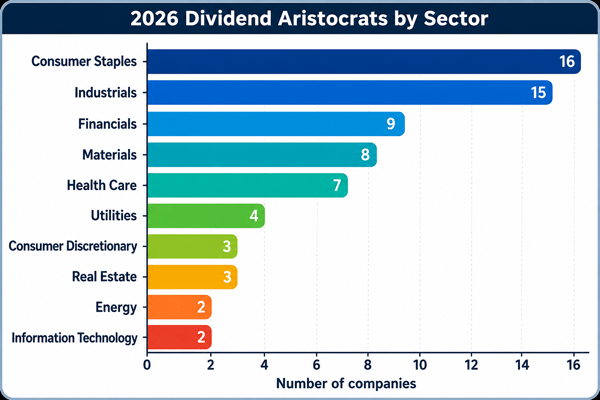
Figure: Sector distribution calculated from the 69 index holdings shown in ProShares/S&P Dow Jones holdings dated February 1, 2026.
4. 2026 Dividend Aristocrats List: Complete Ranking by Dividend Growth Streak
The table below ranks the 2026 S&P 500 Dividend Aristocrats by the number of consecutive years of dividend growth. It is best used as a research watchlist, not as a recommendation to buy every name. “New for 2026” marks companies shown as new in the ProShares holdings document.
| Rank | Company | Ticker | Sector | Years | 2026 note |
|---|---|---|---|---|---|
| 1 | Coca-Cola Co. | KO | Consumer Staples | 63 | |
| 2 | Colgate-Palmolive Co. | CL | Consumer Staples | 63 | |
| 3 | Dover Corp. | DOV | Industrials | 63 | |
| 4 | Emerson Electric Co. | EMR | Industrials | 63 | |
| 5 | Genuine Parts Co. | GPC | Consumer Discretionary | 63 | |
| 6 | Johnson & Johnson | JNJ | Health Care | 63 | |
| 7 | Procter & Gamble Co. | PG | Consumer Staples | 63 | |
| 8 | Nordson Corp. | NDSN | Industrials | 60 | |
| 9 | Stanley Black & Decker Inc. | SWK | Industrials | 58 | |
| 10 | Hormel Foods Corp. | HRL | Consumer Staples | 57 | |
| 11 | Becton Dickinson & Co. | BDX | Health Care | 54 | |
| 12 | Illinois Tool Works Inc. | ITW | Industrials | 54 | |
| 13 | PPG Industries Inc. | PPG | Materials | 54 | |
| 14 | Target Corp. | TGT | Consumer Staples | 54 | |
| 15 | W.W. Grainger Inc. | GWW | Industrials | 54 | |
| 16 | AbbVie Inc. | ABBV | Health Care | 53 | |
| 17 | Abbott Laboratories | ABT | Health Care | 53 | |
| 18 | Federal Realty Investment Trust | FRT | Real Estate | 53 | |
| 19 | Kimberly-Clark Corp. | KMB | Consumer Staples | 53 | |
| 20 | PepsiCo Inc. | PEP | Consumer Staples | 53 | |
| 21 | Nucor Corp. | NUE | Materials | 52 | |
| 22 | S&P Global Inc. | SPGI | Financials | 52 | |
| 23 | Archer-Daniels-Midland Co. | ADM | Consumer Staples | 51 | |
| 24 | Automatic Data Processing Inc. | ADP | Industrials | 51 | |
| 25 | Consolidated Edison Inc. | ED | Utilities | 51 | |
| 26 | Lowe's Cos Inc. | LOW | Consumer Discretionary | 51 | |
| 27 | Clorox Co. | CLX | Consumer Staples | 49 | |
| 28 | McDonald's Corp. | MCD | Consumer Discretionary | 49 | |
| 29 | Pentair plc | PNR | Industrials | 49 | |
| 30 | Walmart Inc. | WMT | Consumer Staples | 49 | |
| 31 | Medtronic plc | MDT | Health Care | 48 | |
| 32 | Sherwin-Williams Co. | SHW | Materials | 46 | |
| 33 | Sysco Corp. | SYY | Consumer Staples | 45 | |
| 34 | Franklin Resources Inc. | BEN | Financials | 44 | |
| 35 | Aflac Inc. | AFL | Financials | 43 | |
| 36 | Air Products and Chemicals Inc. | APD | Materials | 43 | |
| 37 | Cincinnati Financial Corp. | CINF | Financials | 43 | |
| 38 | Exxon Mobil Corp. | XOM | Energy | 43 | |
| 39 | Amcor plc | AMCR | Materials | 42 | |
| 40 | Brown-Forman Corp. | BF.B | Consumer Staples | 41 | |
| 41 | Cintas Corp. | CTAS | Industrials | 41 | |
| 42 | Ecolab Inc. | ECL | Materials | 40 | |
| 43 | McCormick & Co. Inc. | MKC | Consumer Staples | 40 | |
| 44 | T. Rowe Price Group Inc. | TROW | Financials | 39 | |
| 45 | Atmos Energy Corp. | ATO | Utilities | 38 | |
| 46 | Cardinal Health Inc. | CAH | Health Care | 38 | |
| 47 | Chevron Corp. | CVX | Energy | 38 | |
| 48 | General Dynamics Corp. | GD | Industrials | 34 | |
| 49 | A. O. Smith Corp. | AOS | Industrials | 33 | |
| 50 | Linde plc | LIN | Materials | 33 | |
| 51 | Roper Technologies Inc. | ROP | Information Technology | 33 | |
| 52 | West Pharmaceutical Services Inc. | WST | Health Care | 33 | |
| 53 | Brown & Brown Inc. | BRO | Financials | 32 | |
| 54 | Caterpillar Inc. | CAT | Industrials | 32 | |
| 55 | Chubb Ltd. | CB | Financials | 32 | |
| 56 | Albemarle Corp. | ALB | Materials | 31 | |
| 57 | Essex Property Trust Inc. | ESS | Real Estate | 31 | |
| 58 | Expeditors International of Washington Inc. | EXPD | Industrials | 31 | |
| 59 | Realty Income Corp. | O | Real Estate | 31 | |
| 60 | International Business Machines Corp. | IBM | Information Technology | 30 | |
| 61 | NextEra Energy Inc. | NEE | Utilities | 30 | |
| 62 | Church & Dwight Co. Inc. | CHD | Consumer Staples | 29 | |
| 63 | C.H. Robinson Worldwide Inc. | CHRW | Industrials | 28 | |
| 64 | J.M. Smucker Co. | SJM | Consumer Staples | 28 | |
| 65 | Kenvue Inc. | KVUE | Consumer Staples | 28 | |
| 66 | Fastenal Co. | FAST | Industrials | 27 | |
| 67 | Erie Indemnity Co. | ERIE | Financials | 26 | New for 2026 |
| 68 | Eversource Energy | ES | Utilities | 26 | New for 2026 |
| 69 | FactSet Research Systems | FDS | Financials | 26 | New for 2026 |
5. Quick Rankings Beginners Actually Need
A beginner should not rank Dividend Aristocrats only by yield. The most useful first ranking is a blended quality screen: dividend streak, balance sheet, dividend safety, earnings durability, valuation, and business momentum. Because live yields and valuation ratios change daily, readers should verify current yield, payout ratio, forward P/E, and debt metrics before making a decision.
| Ranking angle | Examples | How to use it |
|---|---|---|
| Longest streaks | KO, CL, DOV, EMR, GPC, JNJ, PG | Shows durability, but does not automatically mean best future return. |
| Most defensive sectors | Consumer Staples, Health Care, Utilities | Often more resilient, but can become expensive when investors seek safety. |
| More cyclical Aristocrats | Industrials, Materials, Energy, Consumer Discretionary | Can offer better upside in strong economies, but earnings may swing more. |
| ETF route | NOBL | Simple way to own the group, but includes fund fees and equal-weight rebalancing effects. |
| Watchlist route | Pick 10-20 names, then research fundamentals | More work, but allows valuation discipline and personal risk control. |
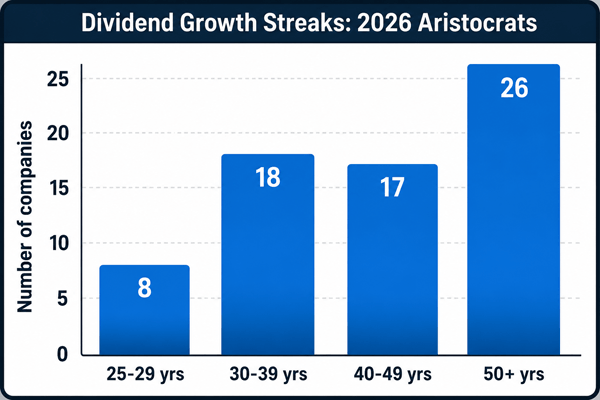
Figure: Dividend growth streak buckets calculated from the 2026 holdings list.
6. How Beginners Can Use the Dividend Aristocrats List
6.1 Use It as a Quality Filter, Not a Buy Button
Start with the list to find companies that have a long record of shareholder-friendly capital allocation. Then research whether the business is still growing and whether the stock price is reasonable.
6.2 Check Dividend Safety Before Yield
A high dividend yield can be attractive, but it can also be a warning sign if the market expects a dividend cut. Look at payout ratio, free cash flow, debt maturities, credit quality, and whether earnings are rising or shrinking.
6.3 Compare Dividend Growth with Inflation
A 2.5% yield growing 7% per year may become more powerful over time than a 5% yield that never grows. This is why dividend growth investing is different from pure income chasing.
6.4 Decide Between Individual Stocks and an ETF
Individual stocks give control but require research. An ETF such as NOBL offers broad exposure to the S&P 500 Dividend Aristocrats, but the fund has fees and will not let you avoid names you dislike.
6.5 Build a Watchlist and Wait for Fair Prices
Many experienced dividend investors do not buy a great company at any price. They keep a watchlist and wait for earnings disappointments, market pullbacks, or temporary sector weakness to create better entry points.
7. Practical Example: Comparing Two Dividend Stocks
Imagine Stock A yields 4.8% but has flat earnings, a payout ratio near 90%, and heavy debt. Stock B yields 2.4%, grows earnings steadily, raises the dividend 6% a year, and pays out only half of earnings. A beginner may be tempted by Stock A because the current income is higher. A patient dividend growth investor may prefer Stock B because the dividend has more room to grow and less risk of being cut.
| Metric | Stock A: high yield | Stock B: dividend growth | Beginner takeaway |
|---|---|---|---|
| Current yield | 4.8% | 2.4% | Yield alone is not enough. |
| Payout ratio | 90% | 50% | Lower payout may be safer. |
| Dividend growth | 1% | 6% | Growth can compound income. |
| Balance sheet | High debt | Moderate debt | Debt matters when rates rise. |
| Best fit | Income seekers accepting higher risk | Long-term dividend growth investors | Match the stock to your goals. |
8. Simple Due Diligence Checklist Before Buying Any Dividend Aristocrat
- Is the company still growing revenue and earnings?
- Is free cash flow covering the dividend comfortably?
- Is the payout ratio reasonable for the industry?
- Has debt increased faster than earnings?
- Is the dividend growth rate slowing?
- Is the stock valuation reasonable versus its own history and peers?
- Is the business being disrupted by technology, regulation, or changing customer behavior?
- Would you still hold the stock if the price dropped 25% but the dividend remained intact?
9. Common Mistakes to Avoid
- Buying the highest yield without checking dividend safety.
- Assuming a 25-year dividend streak guarantees future performance.
- Ignoring valuation because the company is famous.
- Owning too many stocks from the same sector.
- Forgetting taxes: qualified dividends, retirement accounts, and taxable brokerage accounts can have different after-tax outcomes.
- Treating dividends as free money; a dividend is part of total return, and the stock price can still decline.
10. Frequently Asked Questions
10.1 What Is the Dividend Aristocrats List 2026?
It is the 2026 group of S&P 500 companies that have raised dividends for at least 25 consecutive years. The list includes 69 companies based on the ProShares/S&P Dow Jones holdings dated February 1, 2026.
10.2 Are Dividend Aristocrats Safe Investments?
They are often mature and financially disciplined, but they are not risk-free. Stock prices can fall and dividends can be reduced.
10.3 What Is the Best Dividend Aristocrat to Buy Now?
There is no single best stock for everyone. Beginners should compare valuation, dividend safety, earnings growth, debt, and sector exposure before choosing.
10.4 Can I Invest in All Dividend Aristocrats at Once?
Yes, investors often use an ETF such as ProShares S&P 500 Dividend Aristocrats ETF (NOBL) to get broad exposure, but they should review fees, holdings, and risks.
10.5 Are Dividend Aristocrats Good for Retirement Income?
They can be useful in a retirement portfolio because of their dividend growth history, but retirees should still diversify across asset classes and avoid relying on one income source.
10.6 How Often Does the List Change?
The list can change when companies qualify, fail to raise dividends, cut dividends, or leave the S&P 500. Always verify the latest official holdings before investing.
Sources Consulted and Checked
The following authoritative sources were consulted and checked while preparing this article and verifying its factual accuracy:
- S&P Dow Jones Indices - S&P 500 Dividend Aristocrats official index page: https://www.spglobal.com/spdji/en/indices/dividends-factors/sp-500-dividend-aristocrats/
- ProShares - Dividend Aristocrats Index Holdings dated February 1, 2026: https://www.proshares.com/globalassets/proshares/pdfs/fund-marketing/dividend_aristocrats_holdings_nobl.pdf
- ProShares - NOBL ETF page: https://www.proshares.com/our-etfs/strategic/nobl
- S&P Dow Jones Indices research paper, “S&P 500 Dividend Aristocrats: The Importance of Stable Dividend Income”: https://www.spglobal.com/spdji/en/documents/research/research-sp500-dividend-aristocrats.pdf
Reader Advice
This article is provided solely for educational and informational purposes and does not constitute personalized investment, financial, tax, or legal advice. Dividend-paying stocks and exchange-traded funds can lose value, dividends may be reduced or suspended, and past dividend growth or investment performance does not guarantee future results.
Before making any investment or financial decision, readers should evaluate their own objectives, time horizon, financial circumstances, and tolerance for risk, and should consider consulting an appropriately qualified professional. Index rules, company eligibility, fund holdings, fees, tax treatment, market prices, yields, payout ratios, and other facts and figures may change because of rebalancing, corporate actions, regulation, market conditions, or other factors. Readers should therefore verify all current information directly from official index providers, fund sponsors, company filings, tax authorities, and other authoritative sources before acting.