Dividend Kings List 2026: Complete List and Key Facts
Dividend Kings are companies that have increased their dividend every year for at least 50 consecutive years. In plain English, these are businesses that kept raising their shareholder payouts through recessions, inflation, wars, market crashes, rate cycles, and many changes in customer behavior. That does not make them risk-free, but it does tell you something useful: management has treated the dividend as a serious long-term commitment.
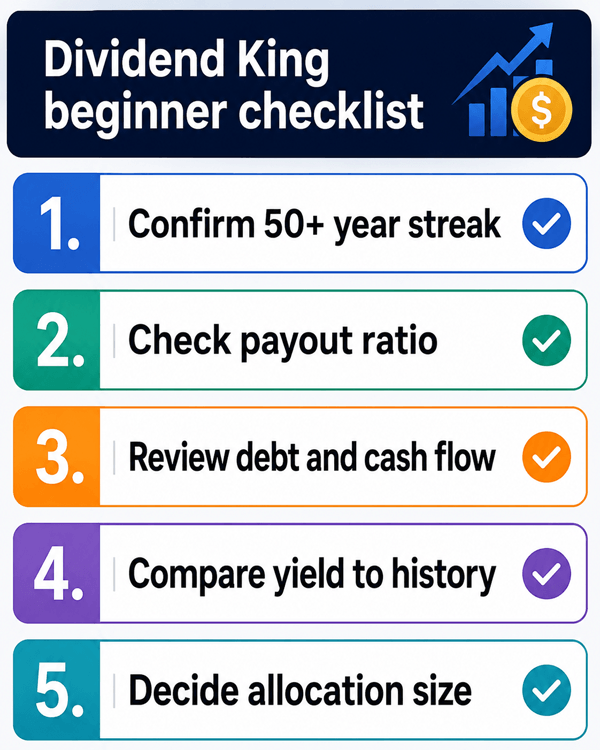
For a beginner, the Dividend Kings list is best used as a starting point for research, not as a buy list. A company can have a 50-year dividend growth streak and still be expensive, slow-growing, heavily indebted, or facing a business problem. The smartest approach is to use the list to find durable companies, then check dividend safety, valuation, balance sheet strength, earnings growth, and portfolio fit.
Quick answer: what is a Dividend King?
A Dividend King is usually defined as a publicly traded company that has raised its regular dividend for 50 or more consecutive years. The key word is raised. A company that merely pays a dividend for 50 years is not enough. It must increase the dividend year after year.
- 50+ years of annual dividend increases is the core requirement.
- Dividend Kings do not have to be in the S&P 500.
- There is no official single Dividend Kings index maintained by one global authority, so published lists can differ.
- The list is popular with dividend growth investors, retirees, and investors seeking rising portfolio income.
- A Dividend King can still cut its dividend in the future, so due diligence matters.
1. Why do 2026 Dividend Kings counts differ across websites?
You may see 54, 57, or 58 Dividend Kings in 2026 depending on the publisher and methodology. This is normal. The differences often come from how each list treats non-U.S. companies, spinoffs, mergers, ticker changes, and very recent additions. For example, one 2026 source lists 57 Dividend Kings, Sure Dividend refers to 58, and StockAnalysis.com shows a U.S.-market list of 54 stocks. A careful article should explain the difference rather than pretending every list agrees.
Because published counts and market data can change, treat the table below as a strong working list and verify the figures against current company disclosures and reliable financial sources before making an investment decision.
2. How dividends work, in beginner language
A dividend is a portion of a company’s profit paid to shareholders. If you own 10 shares and the company pays $1 per share annually, your annual dividend is $10 before taxes. Dividends are often paid quarterly in the U.S., but payment schedules vary by company and country.
Dividends are not free money. When a company pays cash to shareholders, that cash leaves the company. The stock price can also adjust around the ex-dividend date. The real long-term value comes when a company can keep earning, reinvesting, and raising its dividend without weakening the business.
3. Why investors care about Dividend Kings
People like Dividend Kings because the list filters for companies that survived many economic environments. A long dividend growth streak can signal durable demand, disciplined capital allocation, and a board that values shareholders. For retirees, rising dividends may help offset inflation. For younger investors, reinvested dividends can compound over time.
However, investor experience also shows the other side: some “safe-looking” dividend stocks become value traps. A high yield may look attractive after the share price falls, but the fall may be warning that the dividend is under pressure. Beginners should avoid buying only because a yield is high.
4. Dividend Kings vs Dividend Aristocrats
Dividend Aristocrats are often confused with Dividend Kings. Both describe long-term dividend growers, but the rules are different. The Dividend Aristocrats require at least 25 consecutive years of dividend increases and S&P 500 membership. Dividend Kings require a much longer streak, usually 50+ years, but do not require S&P 500 membership.
This means a smaller company can be a Dividend King even if it is not an S&P 500 company. It also means some Dividend Kings may be less liquid, less followed by Wall Street, or more concentrated in slower-growth sectors.
| Feature | Dividend Kings | Dividend Aristocrats | What it means for beginners |
|---|---|---|---|
| Dividend growth streak | 50+ years | 25+ years | Kings have a longer history, but not always better future returns. |
| Index rule | No single S&P 500 requirement in common usage | Must be in S&P 500 | Aristocrats are usually larger and more index-screened. |
| Official status | Unofficial list; publishers may differ | Formal S&P Dow Jones index methodology | Always check source methodology. |
| ETF access | No pure Dividend Kings ETF is widely recognized | ETFs such as NOBL track Aristocrats | Kings often require individual stock research. |
5. Dividend Kings List 2026: working complete list
The table below is designed for readers who want the complete list in one place. Yields are approximate snapshots from 2026 source material and may change with market prices and dividend declarations.
| Ticker | Company | Sector | Streak | Yield* | Business in simple words |
|---|---|---|---|---|---|
| PNR | Pentair | Industrials | 50 | 1.4% | Water equipment and filtration |
| MGEE | MGE Energy | Utilities | 50 | 2.6% | Regulated electric and gas utility |
| RLI | RLI | Financials | 50 | 1.4% | Specialty property and casualty insurance |
| ADP | Automatic Data Processing | Industrials | 51 | 2.9% | Payroll, HR software, employer services |
| UBSI | United Bankshares | Financials | 51 | 3.6% | Regional banking |
| ED | Consolidated Edison | Utilities | 51 | 3.4% | Regulated electric, gas and steam utility |
| FTS | Fortis | Utilities | 52 | 3.5% | Canadian and U.S. regulated utility |
| SPGI | S&P Global | Financials | 52 | 0.9% | Ratings, indexes and financial data |
| WMT | Walmart | Consumer Staples | 52 | 0.9% | Global discount retail and groceries |
| ADM | Archer-Daniels-Midland | Consumer Staples | 52 | 2.5% | Agricultural processing and ingredients |
| KMB | Kimberly-Clark | Consumer Staples | 52 | 5.2% | Tissue, diapers and hygiene products |
| NUE | Nucor | Materials | 52 | 0.9% | Steel manufacturing and recycling |
| PEP | PepsiCo | Consumer Staples | 52 | 4.2% | Snacks and beverages |
| RPM | RPM International | Materials | 52 | 2.1% | Coatings, sealants and building materials |
| ABBV | AbbVie | Healthcare | 53 | 3.3% | Biopharmaceuticals |
| ABT | Abbott Laboratories | Healthcare | 53 | 2.9% | Medical devices, diagnostics and nutrition |
| BDX | Becton Dickinson | Healthcare | 53 | 2.9% | Medical devices and lab supplies |
| CDUAF | Canadian Utilities | Utilities | 53 | 3.8% | Regulated Canadian utility |
| GRC | Gorman-Rupp | Industrials | 53 | 1.0% | Pump and fluid-handling systems |
| GWW | W.W. Grainger | Industrials | 53 | 0.8% | Maintenance and operating supplies distribution |
| ITW | Illinois Tool Works | Industrials | 53 | 2.6% | Diversified industrial products |
| MSEX | Middlesex Water | Utilities | 53 | 2.8% | Regulated water and wastewater utility |
| PPG | PPG Industries | Materials | 53 | 2.5% | Paints and coatings |
| TGT | Target | Consumer Staples | 53 | 3.7% | General merchandise and essentials retail |
| TNC | Tennant | Industrials | 53 | 1.5% | Commercial cleaning equipment |
| BKH | Black Hills | Utilities | 54 | 4.0% | Regulated electric and gas utility |
| FUL | H.B. Fuller | Materials | 55 | 1.6% | Adhesives and sealants |
| MO | Altria | Consumer Staples | 55 | 6.2% | Tobacco and nicotine products |
| NFG | National Fuel Gas | Utilities | 55 | 2.8% | Gas utility, pipelines and production |
| UVV | Universal | Consumer Staples | 55 | 6.1% | Tobacco leaf merchant |
| SYY | Sysco | Consumer Staples | 56 | 3.0% | Foodservice distribution |
| ABM | ABM Industries | Industrials | 57 | 3.0% | Facility services |
| CBSH | Commerce Bancshares | Financials | 57 | 2.1% | Regional banking |
| CWT | California Water Service | Utilities | 57 | 3.1% | Water utility |
| FRT | Federal Realty Investment Trust | Real Estate | 57 | 3.8% | Retail and mixed-use REIT |
| HTO | H2O America | Utilities | 57 | 3.1% | Water utility, formerly SJW Group |
| SWK | Stanley Black & Decker | Industrials | 57 | 4.3% | Tools, storage and industrial products |
| MSA | MSA Safety | Industrials | 58 | 1.3% | Safety equipment |
| SCL | Stepan | Materials | 58 | 3.0% | Specialty chemicals |
| TR | Tootsie Roll | Consumer Staples | 59 | 0.9% | Confectionery |
| HRL | Hormel Foods | Consumer Staples | 60 | 5.0% | Packaged foods |
| CL | Colgate-Palmolive | Consumer Staples | 62 | 2.4% | Oral care, personal care and pet nutrition |
| FMCB | Farmers & Merchants Bancorp | Financials | 62 | 1.6% | California community bank |
| KO | Coca-Cola | Consumer Staples | 62 | 2.7% | Global beverages |
| MZTI | Marzetti | Consumer Staples | 62 | 3.7% | Specialty foods and dressings |
| NDSN | Nordson | Industrials | 62 | 1.2% | Precision dispensing equipment |
| JNJ | Johnson & Johnson | Healthcare | 63 | 2.4% | Pharmaceuticals and medtech |
| KVUE | Kenvue | Consumer Staples | 63* | 4.8% | Consumer health products; streak treatment depends on spinoff methodology |
| CINF | Cincinnati Financial | Financials | 64 | 2.4% | Property and casualty insurance |
| LOW | Lowe's | Consumer Discretionary | 65 | 2.4% | Home improvement retail |
| GPC | Genuine Parts | Consumer Discretionary | 69 | 4.4% | Auto and industrial parts distribution |
| DOV | Dover | Industrials | 69 | 1.0% | Diversified industrial equipment |
| PG | Procter & Gamble | Consumer Staples | 69 | 3.1% | Household and personal care brands |
| PH | Parker-Hannifin | Industrials | 69 | 1.0% | Motion and control technologies |
| EMR | Emerson Electric | Industrials | 69 | 1.6% | Automation and control systems |
| NWN | Northwest Natural | Utilities | 70 | 4.1% | Gas and water utility |
| AWR | American States Water | Utilities | 71 | 2.6% | Water utility and military-base services |
6. What the 2026 list tells us
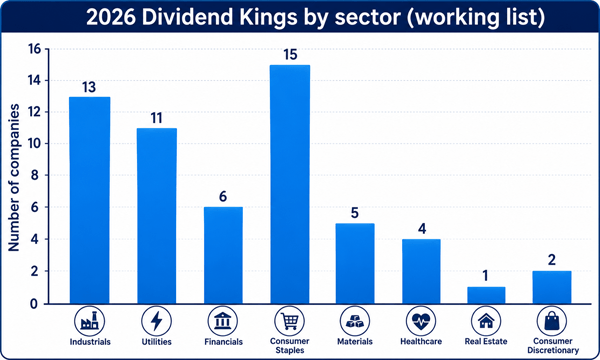
The list is heavily tilted toward consumer staples, industrials, utilities, financials, healthcare, and materials. That is not an accident. These sectors often include mature businesses that sell necessary products or operate regulated infrastructure. They may not grow as fast as technology stocks, but many have steadier cash flows.
This sector mix is also a warning. A portfolio made only of Dividend Kings can be underweight technology, communication services, and newer growth industries. Beginners should think in terms of total portfolio construction, not just dividend history.
7. How beginners can use the Dividend Kings list
- Use it as a watchlist of proven dividend growers, not as a buy-now list.
- Start with businesses you can understand in one sentence.
- Compare today’s dividend yield with the company’s own 5-year or 10-year yield history.
- Check payout ratio using earnings and free cash flow, not just one number from a stock screener.
- Look for a reasonable debt load, especially in utilities, REITs, telecom, and consumer staples.
- Read the latest annual report and earnings call summary to understand current risks.
- Diversify across sectors instead of buying five companies that all face the same risk.
- Use position sizing. A “safe” dividend stock should not become too large in your portfolio.
8. A practical screening checklist
| Question | Why it matters | Beginner-friendly rule of thumb |
|---|---|---|
| Is the payout ratio reasonable? | A company cannot safely pay out more cash than it can generate forever. | Be cautious when payout ratios are very high or rising fast. |
| Is free cash flow covering dividends? | Accounting earnings can differ from cash generation. | Look for dividends paid from recurring cash flow, not debt. |
| Is debt manageable? | Debt can pressure dividends when rates rise or earnings fall. | Compare debt levels with peers and credit ratings. |
| Is the yield unusually high? | A high yield can signal opportunity or danger. | Ask why the market is offering a high yield. |
| Is the business still growing? | A streak can hide a slowing business. | Look for realistic earnings and revenue growth. |
| Is valuation fair? | A great company can be a poor investment at the wrong price. | Compare P/E, dividend yield, and cash flow multiples with history. |
9. Practical example: how dividend growth can change income
Assume an investor buys $10,000 of a dividend stock with a 3% starting yield. The first-year income is $300. If the dividend grows 5% per year and the investor holds the same shares, the annual income from the original investment rises over time. This is the idea behind dividend growth investing.
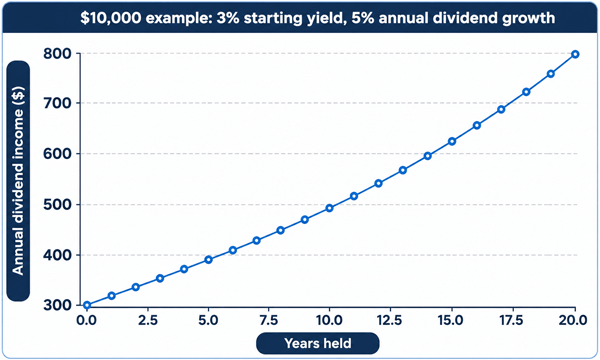
This example is simplified. It does not include taxes, stock price changes, reinvestment, dividend cuts, or trading costs. In real life, total return matters. A stock that pays a dividend but loses a lot of market value can still be a disappointing investment.
10. Common beginner mistakes with Dividend Kings
- Chasing the highest yield without checking why the yield is high.
- Assuming a 50-year streak guarantees the next 10 years.
- Ignoring valuation because the company is famous.
- Putting too much money in slow-growth sectors.
- Forgetting taxes on dividends in taxable accounts.
- Not checking whether the dividend is funded by free cash flow.
- Confusing dividend income with total return.
11. What experienced dividend investors often learn the hard way
- A low yield can still be attractive if dividend growth is strong and valuation is reasonable.
- A very high yield often deserves extra skepticism, not excitement.
- Dividend safety can deteriorate slowly before a cut happens suddenly.
- Sector concentration can feel safe until the entire sector falls out of favor.
- Reinvestment works best when the underlying business continues to compound value.
12. How to build a simple Dividend Kings research process
12.1 Pick 10 names, not 57
Start with companies you understand. A beginner might choose a retailer, a beverage company, a utility, a healthcare company, and an industrial distributor to learn different business models.
12.2 Read the latest annual report
Focus on revenue drivers, debt, cash flow, risks, and management’s capital allocation priorities.
12.3 Check dividend safety
Review payout ratio, free cash flow coverage, debt maturities, and whether management is raising dividends faster than earnings.
12.4 Compare valuation
Look at current P/E, free cash flow yield, dividend yield versus history, and analyst growth expectations. Avoid buying only because a stock is on the list.
12.5 Decide position size
A beginner might start small and diversify rather than trying to pick one perfect Dividend King.
12.6 Review yearly
Dividend investing is not set-and-forget. Check whether the original investment thesis still holds.
13. Pros and cons of Dividend Kings
| Potential advantages | Potential risks |
|---|---|
| Long record of shareholder-friendly dividend policy | Past dividend growth does not guarantee future increases |
| Often mature businesses with durable demand | Can be overvalued or slow-growing |
| Can support a rising-income strategy | High yields can signal financial stress |
| May be less volatile than many non-dividend growth stocks | Sector concentration can reduce diversification |
| Easy starting universe for dividend research | Individual stock risk remains real |
14. FAQ: Dividend Kings List 2026
14.1 Are Dividend Kings safe?
They are often financially durable, but they are not risk-free. A long dividend streak is one useful signal, not a guarantee.
14.2 Should beginners buy every Dividend King?
No. The list is a research universe. Beginners should compare valuation, payout safety, debt, sector exposure, and personal goals.
14.3 Do Dividend Kings beat the S&P 500?
Not always. In tech-led bull markets, Dividend Kings may lag because the group is concentrated in mature sectors. Their appeal is often consistency and rising income, not maximum short-term performance.
14.4 Is there a Dividend Kings ETF?
There is no widely recognized pure ETF that only tracks Dividend Kings. Investors often use dividend growth ETFs or buy individual stocks after research.
14.5 What is the highest-yielding Dividend King?
The answer changes with prices and dividend declarations. In 2026 snapshots, tobacco and some consumer staples names often appeared among the higher-yielding Kings, but high yield should be checked carefully for safety.
14.6 How often should I update a Dividend Kings article?
At least quarterly, and ideally whenever a company announces a dividend increase, cut, merger, spinoff, or ticker change.
Sources Consulted and Checked
The following sources were consulted and cross-checked while preparing this article to support accuracy, clarity, and responsible presentation of the information.
- Investor.gov: dividend definition and investor education glossary.
- Fidelity: discussion of why dividends matter, compounding, volatility, and the relationship between dividends and market value.
- Sure Dividend, “2026 Dividend Kings List | Updated Daily | All 58 Analyzed,” updated June 4, 2026. Used for definition, count discrepancy, metrics referenced, sector observations, and note that there is no official single Dividend King ETF/list authority.
- Simply Safe Dividends, “2026 Dividend Kings List: All 57 Ranked & Analyzed,” June 2, 2026. Used as the main working list for table construction, including sectors, streaks, yield snapshots, and spinoff note on Kenvue.
- The Motley Fool, “Dividend Kings of 2026,” updated June 3, 2026. Used for definition, Dividend Kings vs Dividend Aristocrats explanation, and note about 57 qualifying stocks depending on interpretation.
- StockAnalysis.com, “Dividend Kings List,” accessed June 2026. Used to cross-check U.S.-market names and illustrate why counts differ across sources.
Reader Advice
This article is provided solely for educational and informational purposes and does not constitute personalized financial, investment, tax, accounting, or legal advice. Dividend streaks, yields, share prices, payout ratios, company fundamentals, tax rules, index methodologies, ticker symbols, mergers, spinoffs, and regulatory requirements may change over time and may also differ among data providers.
Readers should independently verify all facts and figures through official company filings, investor-relations materials, regulatory disclosures, and other reliable primary sources before acting. No stock, dividend, or investment return is guaranteed, and past performance or a long dividend-growth record does not ensure future results. Consider personal objectives, risk tolerance, time horizon, diversification, costs, and tax circumstances, and seek advice from a suitably qualified professional before making any financial decision. Any affiliate relationship or commercial link associated with the published article should be disclosed clearly and prominently.