What Is DRIP Investing? How Dividend Reinvestment Works
Quick answer: What is DRIP investing?
DRIP investing means using your cash dividends to automatically buy more shares of the same investment instead of taking the dividend as cash. DRIP stands for dividend reinvestment plan. In plain English, it is a simple “set it and keep adding” method: your investment pays you a dividend, and that dividend is used to buy more of the investment that paid it.
For beginners, the main attraction is that DRIPs make compounding easier. You do not need to manually place a trade every time a dividend arrives. Over time, more shares can lead to larger future dividends, and those larger dividends can buy even more shares. This cycle is the heart of dividend reinvestment.
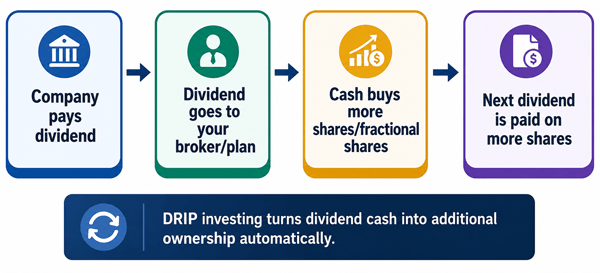
1. How dividend reinvestment works, step by step
- You buy a dividend-paying stock, ETF, mutual fund, or other eligible investment in a brokerage account or company plan.
- The company or fund declares a dividend. For example, it may pay $0.50 per share each quarter.
- On the payment date, cash is credited to your account.
- If DRIP is turned on, that cash is automatically used to buy additional shares of the same investment.
- If the dividend is not enough to buy a full share, many modern brokerage DRIPs can buy fractional shares, such as 0.036 shares.
- The next dividend payment is calculated on your new, larger share count.
Simple example
Imagine you own 100 shares of a company. The company pays a $1 annual dividend per share, so you receive $100 in dividends for the year. If the share price is $50 and you reinvest the full $100, you buy 2 more shares. You now own 102 shares. If the company keeps paying $1 per share, your next annual dividend would be $102 instead of $100, even if you did not add new cash from your paycheck.
| Item | Without DRIP | With DRIP |
|---|---|---|
| Starting shares | 100 | 100 |
| Dividend received | $100 cash | $100 reinvested |
| Share price at reinvestment | $50 | $50 |
| New shares purchased | 0 | 2 |
| Shares after dividend | 100 | 102 |
| Next $1/share dividend | $100 | $102 |
2. Why investors use DRIPs
People usually choose dividend reinvestment for one of five reasons: automation, compounding, discipline, fractional-share investing, and lower cash drag. A DRIP is not magic, and it does not make a bad investment good. But it can remove friction from a sensible long-term plan.
- Automation: The dividend is reinvested without the investor needing to remember payment dates.
- Compounding: Reinvested dividends may buy more shares, which may generate more dividends later.
- Discipline: DRIPs reduce the temptation to spend dividend cash or time the market.
- Fractional shares: Many plans can use almost every dollar of the dividend, even when it is too small for a full share.
- Long-term habit building: Beginners can see ownership slowly grow, which makes investing feel more concrete.
3. DRIP investing vs taking dividends as cash
| Choice | Best for | Main benefit | Main drawback |
|---|---|---|---|
| Reinvest dividends automatically | Long-term wealth building, investors still accumulating assets | Keeps money working and supports compounding | Can increase concentration in the same stock or fund |
| Take dividends as cash | Retirees, income investors, people funding expenses | Creates usable cash flow | Cash may sit idle if not used or reinvested elsewhere |
| Receive cash and manually reinvest | Investors who rebalance intentionally | More control over where new money goes | Requires more effort and discipline |
4. Illustrative compounding example
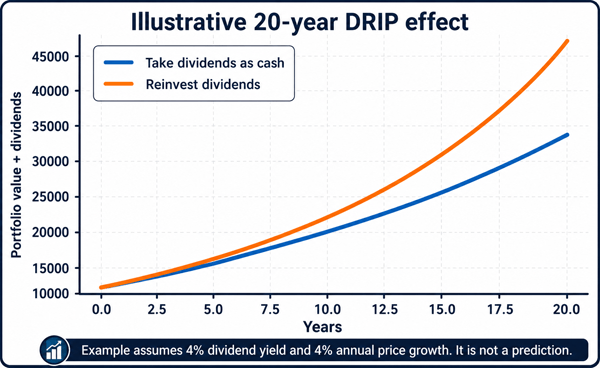
The chart below shows a simplified 20-year illustration. It assumes a $10,000 starting investment, a 4% dividend yield, and 4% annual price growth. Real investments will not move in a straight line, dividends can be cut, and returns are never guaranteed. The point is only to show why reinvesting dividends can matter over long periods.
| Scenario after 20 years | Approximate result |
|---|---|
| Take dividends as cash and do not reinvest them | $39,112 total value plus cash dividends |
| Reinvest dividends automatically | $46,610 portfolio value |
| Difference in this example | About $7,498 more from reinvestment |
This kind of difference is why many long-term investors reinvest while they are building wealth, then switch to cash dividends later when they need income.
5. Types of DRIPs
| Type of DRIP | How it works | Beginner notes |
|---|---|---|
| Brokerage DRIP | Your broker automatically reinvests dividends from eligible stocks, ETFs, or funds. | Usually the easiest option. Check whether fractional shares, ETFs, and all securities are eligible. |
| Company-sponsored DRIP | A company or transfer agent runs the plan directly for shareholders. | May allow direct stock purchases, but can have plan rules, fees, enrollment steps, or sale restrictions. |
| Mutual fund/ETF reinvestment | Fund distributions are reinvested into additional fund shares. | Common for index funds and retirement accounts. Capital gains distributions may also be reinvested. |
| Synthetic/manual DRIP | You collect dividends as cash and manually buy more shares. | Useful when you want to rebalance into undervalued or underweight positions. |
6. How beginners can start using DRIP investing
- Choose the account type first. A taxable brokerage account, IRA, Roth IRA, or employer retirement plan can all treat dividends differently for tax purposes.
- Pick diversified investments before chasing yield. A broad dividend ETF or index fund may be easier for beginners than a small list of individual high-yield stocks.
- Check whether your broker offers automatic dividend reinvestment for the specific investment.
- Turn on reinvestment in account settings. Some brokers let you choose reinvestment security by security.
- Review every few months. Confirm dividends were reinvested, cost basis was updated, and the position has not become too large in your portfolio.
- Rebalance when needed. DRIP does not replace asset allocation. If one stock grows too large, consider directing future dividends elsewhere.
Beginner rule of thumb
DRIP works best when the investment is something you would be happy to buy more of at today’s price. If you would not buy more shares manually, automatic reinvestment may not be the best choice.
7. What beginners should know before turning on DRIP
7.1 Dividends are not free money
A dividend is part of a company’s value being paid out to shareholders. On the ex-dividend date, the stock price often adjusts downward by roughly the dividend amount, although market movement can hide this. The real benefit of a DRIP is not that dividends create instant profit. The benefit is that you keep reinvesting cash into more ownership over time.
7.2 High dividend yield can be a warning sign
Many beginners search for the highest dividend yield and assume it is the best passive income investment. That can be risky. A very high yield may mean the share price has fallen because the business is struggling. A company can cut or suspend dividends at any time. Look at dividend safety, earnings, cash flow, debt, payout ratio, and business quality, not yield alone.
7.3 DRIP can make your portfolio less diversified
Automatic reinvestment buys more of the same investment. That is convenient, but it can also make a winning stock become too large or keep adding to a weak company. Investors often share the same experience: DRIP feels effortless until one stock quietly becomes an outsized position. This is why portfolio reviews matter.
7.4 Taxes still matter
In a taxable account, reinvested dividends are generally still taxable. The IRS explains that reinvested dividends are reported with other dividends. In other words, you may owe tax even though you did not receive spendable cash. In tax-advantaged accounts, such as many retirement accounts, the tax timing may be different.
7.5 Cost basis becomes more detailed
Every reinvested dividend is usually treated like a new purchase lot. Your broker may track this automatically, but it is still wise to keep statements. Reinvested dividends can increase your overall cost basis because they are used to buy more shares.
8. Tax basics: how reinvested dividends are usually treated
| Account type | Typical treatment | What beginner should remember |
|---|---|---|
| Taxable brokerage account | Dividends are generally taxable in the year paid, even if reinvested. | Do not assume “reinvested” means “not taxed.” Watch Form 1099-DIV. |
| Traditional IRA/401(k)-type account | Dividends usually are not taxed when paid inside the account; withdrawals may be taxable depending on rules. | Tax is often deferred, but account rules matter. |
| Roth IRA/Roth-type account | Qualified withdrawals may be tax-free under applicable rules. | DRIP can be powerful when combined with long time horizons, but contribution and withdrawal rules apply. |
| Non-U.S. investors or foreign dividends | Withholding tax, treaty rules, and local reporting may apply. | Check country-specific tax treatment before relying on DRIP. |
9. DRIP advantages and disadvantages
| Pros | Cons |
|---|---|
| Makes reinvestment automatic and simple. | Can keep buying an overvalued or deteriorating investment. |
| Supports long-term compounding. | Can create tax bills without cash in taxable accounts. |
| Often uses fractional shares efficiently. | Can complicate cost-basis tracking. |
| Reduces emotional timing decisions. | May reduce portfolio diversification over time. |
| May be no-fee or no-commission through many brokers. | Some company-run plans may have fees or restrictions. |
10. DRIP investing compared with other beginner strategies
| Strategy | How it differs from DRIP | When it may be better |
|---|---|---|
| Dollar-cost averaging | You invest new money at regular intervals. DRIP reinvests dividends already generated by investments. | When you have salary savings to invest monthly. |
| Dividend income investing | Focuses on receiving cash flow. DRIP focuses on reinvesting cash flow. | When you need current income. |
| Growth investing | Often targets companies that reinvest profits rather than pay dividends. | When you want companies focused on expansion, not income. |
| Index investing | Uses broad market funds. Many index funds can also reinvest dividends. | When diversification and simplicity are the priority. |
| Manual rebalancing | Uses dividends/cash to buy underweight assets instead of the same payer. | When portfolio allocation is more important than automatic reinvestment. |
11. A practical checklist before enabling DRIP
- Is this a high-quality investment I want to own for years?
- Is the dividend sustainable, or is the yield unusually high because the price fell?
- Does my broker reinvest into fractional shares, or only whole shares?
- Are there fees, spreads, plan charges, or sale restrictions?
- Will I owe taxes on reinvested dividends in this account?
- Will automatic reinvestment make one position too large?
- Would I rather use dividends to rebalance into other assets?
- Do I have an emergency fund outside my investment account so I am not forced to sell during a downturn?
12. Common beginner mistakes
| Mistake | Why it hurts | Better approach |
|---|---|---|
| Chasing the highest yield | High yield can signal dividend risk or business trouble. | Focus on dividend quality, cash flow, payout ratio, debt, and total return. |
| Ignoring taxes | You may owe tax even without taking cash. | Plan for taxable-account dividends and keep records. |
| Reinvesting blindly forever | Portfolio concentration can build quietly. | Review allocation at least quarterly or annually. |
| Confusing dividend yield with return | A stock can pay dividends and still lose value. | Track total return: price change plus dividends. |
| Using DRIP for money needed soon | Market declines can happen before you need the cash. | Keep short-term money in safer, liquid places. |
| Not reading plan details | Some company DRIPs have fees or special rules. | Read the broker or transfer-agent disclosure before enrolling. |
13. Real-world investor experiences: what people often learn
Investor discussions often reveal the same practical lessons. Many beginners like DRIP because it makes investing feel automatic and reduces the urge to spend dividend cash. Long-term investors often appreciate that fractional shares make small dividends productive. But experienced investors also warn that DRIP can be too automatic: it may keep buying a company after the original investment thesis has changed.
A balanced approach is to use DRIP for diversified funds or core holdings, while manually directing dividends from riskier individual stocks. Another common approach is to reinvest during wealth-building years and later switch dividends to cash during retirement or when income becomes the main goal.
14. When DRIP investing may make sense
- You are investing for a long-term goal, such as retirement or financial independence.
- You do not need the dividend income for current expenses.
- You own diversified funds or high-quality companies you are comfortable accumulating.
- Your broker offers low-cost or no-fee dividend reinvestment.
- You are willing to review tax forms, cost basis, and portfolio concentration.
15. When taking dividends as cash may be better
- You need the cash for living expenses or retirement income.
- A position is already too large in your portfolio.
- You want to rebalance into bonds, cash, international funds, or other underweight assets.
- The stock’s fundamentals have weakened and you do not want to buy more.
- You are in a taxable account and need cash to cover dividend taxes.
16. FAQ: DRIP investing for beginners
16.1 Is DRIP investing good for beginners?
It can be, especially when used with diversified, low-cost investments and a long-term plan. It is not automatically good for every stock. Beginners should avoid using DRIP as an excuse to ignore research, diversification, or taxes.
16.2 Can you lose money with DRIP investing?
Yes. DRIP buys more shares, but those shares can fall in value. Reinvesting dividends does not remove market risk, company risk, interest-rate risk, or fund risk.
16.3 Does DRIP create passive income?
DRIP can help build future income potential, but while reinvesting, you are not actually taking the dividends as spendable cash. It is better described as a passive reinvestment strategy than current passive income.
16.4 Are reinvested dividends taxable?
In many taxable accounts, yes. Reinvested dividends are generally reported as dividend income even if used to buy more shares. Rules vary by account and country.
16.5 Do I pay fees for DRIP?
Many brokerage DRIP programs are no-fee or no-commission, but not all plans are identical. Company-sponsored plans may have enrollment, purchase, sale, or processing fees. Always read the plan details.
16.6 Is DRIP better than buying more shares manually?
DRIP is easier. Manual buying gives more control. If you want simplicity, DRIP may win. If you want to rebalance or compare opportunities, manual reinvestment may be better.
16.7 Should I DRIP ETFs?
Many beginners prefer reinvesting ETF distributions because ETFs can provide diversification. Still, check fees, tax treatment, asset allocation, and whether the ETF fits your plan.
16.8 What happens if the dividend is smaller than one share?
Many brokers use fractional shares, so the dividend can buy part of a share. Some plans reinvest only whole shares and leave the rest as cash. Broker rules matter.
16.9 Can DRIP make me rich?
DRIP alone will not guarantee wealth. It can support long-term compounding when combined with regular saving, diversified investing, reasonable costs, time, and disciplined behavior.
16.10 Can I turn DRIP off?
Usually yes. Most brokers let you switch dividends from reinvestment to cash. The change may apply only to future dividends, and timing around record/payment dates can matter.
17. Conclusion: the smart way to think about DRIP investing
DRIP investing is one of the simplest ways to make dividends work harder. Instead of letting dividend cash sit idle, a dividend reinvestment plan automatically buys more shares. For long-term investors, this can turn small payments into a larger ownership base over many years.
The honest view is that DRIP is a tool, not a complete investment plan. It works best when the underlying investment is sound, fees are low, taxes are understood, and the investor reviews diversification. Beginners should start with the question: “Do I want to own more of this investment today?” If the answer is yes, DRIP can be a practical, low-maintenance way to keep compounding. If the answer is no, taking dividends as cash and reallocating them may be the wiser move.
Sources Consulted and Checked
The following authoritative sources were consulted and checked while preparing this article and reviewing its accuracy:
- SEC Investor.gov, Glossary: Dividend Reinvestment Plans (DRIPs), investor.gov.
- FINRA, “Investing in Fractional Shares,” June 26, 2025.
- IRS, “Stocks (options, splits, traders) 2,” updated November 20, 2025.
- IRS, Topic No. 404, Dividends and Other Corporate Distributions.
- Vanguard, “Reinvest dividends to stretch your investment dollars.”
- Vanguard, “What is cost basis for taxes?”
- Charles Schwab, “How a Dividend Reinvestment Plan Works,” October 30, 2025.
Reader Advice
This article is provided solely for general educational and informational purposes. It does not constitute personalized financial, investment, legal, accounting, or tax advice, and it should not be treated as a recommendation to buy, sell, or hold any security or to use any particular investment strategy. Investment values and dividend payments can rise or fall, dividends may be reduced or discontinued, and past or illustrative results do not guarantee future performance.
Tax laws, brokerage practices, plan eligibility, fees, account rules, and regulatory requirements may change and may differ by country, jurisdiction, account type, investment, broker, transfer agent, and individual circumstances. Before making a financial decision, readers should independently verify current facts, figures, dates, fees, tax treatment, and plan terms through official sources and applicable disclosure documents. Readers should also consider their objectives, time horizon, risk tolerance, diversification, liquidity needs, and personal circumstances, and seek advice from appropriately qualified financial, legal, or tax professionals where necessary.