How Does Value Investing Work? Principles and Strategies Explained
1. Quick Answer: What Is Value Investing?
Value investing is an investment strategy where you try to buy a good asset, usually a stock, for less than it is reasonably worth. In simple words, it is like buying a quality product during a sale, but with one big difference: in the stock market, the sale sign is not always obvious. You have to study the business, estimate its value, and decide whether the current stock price gives you enough room for error.
A value investor does not buy a stock only because the price has fallen. The real question is: has the price fallen below the value of the business, or has the business itself become weaker? That difference is the heart of value investing.
2. Why Value Investing Exists: Price and Value Are Not Always the Same
In daily life, price and value often separate. A winter coat may cost $200 in December and $80 in April. The coat did not become useless; the market situation changed. Stocks can behave the same way. A company may face temporary bad news, a slow quarter, negative headlines, or broad market fear. Its share price can fall faster than its long-term business value.
Value investors try to use that gap. They believe the market is sometimes emotional in the short term but more reasonable over the long term. The goal is to buy when pessimism is too high, then hold patiently while the market recognizes the company’s real earning power, assets, dividends, or cash flow.
3. How Value Investing Works Step by Step
The process is simple to describe but difficult to practice. A beginner can think of value investing as a five-step workflow: find possible cheap stocks, understand the business, estimate intrinsic value, require a margin of safety, and monitor the investment after buying. The discipline matters more than the formula.
You begin with a screen or idea list. You might look for companies with low price-to-earnings ratios, low price-to-book ratios, steady free cash flow, modest debt, reliable dividends, or temporary negative sentiment. Screening is only the start. A low ratio can be a clue, not proof. After that, you read financial statements, annual reports, investor presentations, industry news, and competitor information. Then you estimate what the business could reasonably be worth. Finally, you buy only if the stock price is meaningfully below that estimate.
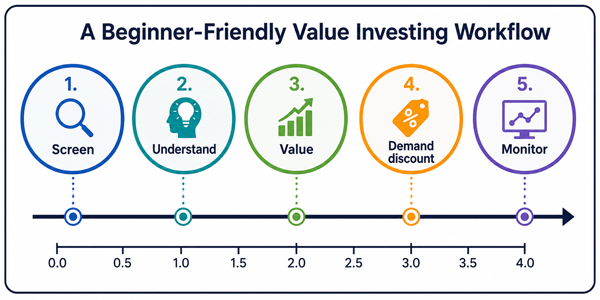
Figure 1: A practical value investing workflow for beginners. Original educational illustration.
| Principle | What it means | Beginner-friendly example |
|---|---|---|
| Intrinsic value | A reasoned estimate of what the business is worth based on earnings, assets, cash flow, dividends, and future prospects. | You estimate a company is worth about $100 per share after reviewing its earnings and balance sheet. |
| Margin of safety | Buying below your estimated value to protect yourself from mistakes, bad luck, or unexpected business weakness. | If your estimate is $100, you may only consider buying near $70 or lower. |
| Business quality | Cheap is not enough. A durable, understandable company is usually safer than a weak company that only looks statistically cheap. | A profitable consumer brand with manageable debt may be better than a shrinking company with a very low P/E. |
| Patience | Value gaps can take months or years to close. The market does not follow your spreadsheet on command. | A stock may stay unpopular for two years before earnings recover. |
| Independent thinking | Value investing often feels uncomfortable because you may buy when others are negative. | You study whether bad news is temporary instead of copying social media panic. |
4. The Key Idea: Intrinsic Value
Intrinsic value is the estimated true worth of a stock or business. It is not a magic number. It is a range based on assumptions. Two honest analysts can value the same company differently because they may use different growth rates, profit margins, discount rates, or risk assumptions.
A practical beginner should not pretend to know exact value. Instead, use a conservative range. For example, after studying a company, you might think it is worth between $85 and $110 per share. If the stock trades at $60, the opportunity may be interesting. If it trades at $95, the decision is less obvious because there is less room for error.
| Valuation method | Best used for | Beginner warning |
|---|---|---|
| P/E comparison | Profitable companies with stable earnings. | A low P/E can mean the business is cheap, but it can also mean earnings are about to fall. |
| Price-to-book | Banks, insurers, asset-heavy businesses. | Less useful for software, brand-heavy, or service businesses where assets are not fully shown on the balance sheet. |
| Discounted cash flow (DCF) | Companies with forecastable free cash flow. | Small changes in growth or discount rate can change the result a lot. Use conservative ranges. |
| Dividend discount model | Mature companies with stable and growing dividends. | Not suitable for companies that do not pay dividends or have unstable payouts. |
| Sum-of-the-parts | Conglomerates or companies with separate business units. | Requires careful segment assumptions and can create false precision. |
5. Margin of Safety: The Beginner’s Best Friend
Margin of safety means you do not buy at your exact value estimate. You demand a discount because your estimate may be wrong. This is one of the most important risk-management ideas in value investing. It accepts a simple truth: investors are human, forecasts are uncertain, and businesses can disappoint.
If your estimated intrinsic value is $100, buying at $98 gives you almost no protection. Buying at $70 gives you a 30% cushion. That cushion does not guarantee profit, but it can reduce the damage if your assumptions are too optimistic.
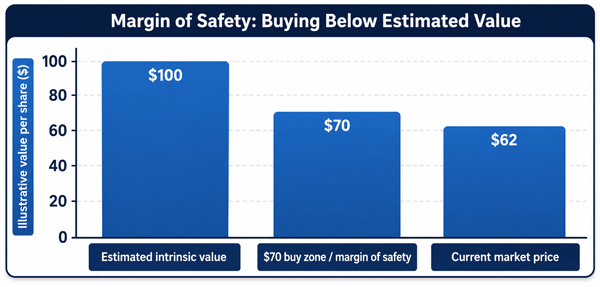
Figure 2: Margin of safety illustrated with a simple estimated value and buy-zone example. Original educational illustration.
6. Practical Example: A Simple Value Investing Case Study
Assume there is a fictional company called SafeHome Tools. It sells repair tools, has been profitable for 15 years, carries moderate debt, and pays a small dividend. Recently, the stock fell because one quarter was weak and investors became worried about slower consumer spending.
| Item | Fictional figure | Why it matters |
|---|---|---|
| Current stock price | $48 | This is what the market asks you to pay today. |
| Earnings per share | $6 | At $48, the P/E ratio is 8. |
| Average industry P/E | 12 | If quality is similar, the market may be pricing SafeHome cheaply. |
| Free cash flow per share | $5.50 | Cash earnings support dividends, debt repayment, and reinvestment. |
| Debt-to-equity | 0.45 | Debt exists but does not look extreme in this simplified example. |
| Estimated intrinsic value range | $65-$75 | Based on conservative earnings and cash-flow assumptions. |
| Beginner buy zone | Below $52 | This gives a margin of safety against the low end of the value range. |
A value investor would not stop at the table. They would ask: Is the weak quarter temporary or a sign of permanent decline? Are competitors taking market share? Is management honest about problems? Is debt manageable if sales fall? Does the company still generate cash? If the answers are encouraging and the price remains below the buy zone, the stock may deserve deeper research.
7. Main Value Investing Strategies
| Strategy | How it works | Best for | Main risk |
|---|---|---|---|
| Classic deep value | Buy statistically cheap stocks, often with low P/E, low P/B, or low price-to-cash-flow. | Experienced investors who can handle ugly-looking companies. | Cheap stocks can be value traps. |
| Quality value | Buy strong businesses only when they trade below reasonable value. | Beginners who want fewer business-quality mistakes. | High-quality companies may rarely become very cheap. |
| Dividend value | Look for undervalued companies with sustainable dividends. | Income-focused investors and retirement investing research. | A high dividend yield can signal distress if the payout is unsafe. |
| Asset-based value | Focus on assets such as cash, real estate, inventory, or book value. | Banks, insurers, industrials, and liquidation-style analysis. | Assets may be overstated or hard to sell at book value. |
| Contrarian value | Buy when sentiment is overly negative but fundamentals remain intact. | Patient investors who can tolerate being early. | Bad news may be worse than it first appears. |
| GARP | Growth at a reasonable price; seeks growth without overpaying. | Investors who want a middle ground between value and growth. | Growth assumptions can become too optimistic. |
8. Value Investing vs Growth Investing vs Index Investing
| Approach | Simple explanation | Who may prefer it | Common mistake |
|---|---|---|---|
| Value investing | Buy businesses below estimated worth. | People willing to research companies and wait patiently. | Buying low-quality companies just because they look cheap. |
| Growth investing | Buy companies expected to grow earnings or revenue faster than average. | People comfortable paying higher prices for future growth. | Overpaying for a great story. |
| Index investing | Buy a broad market fund and accept market returns. | Beginners who want simplicity, diversification, and less company-specific work. | Assuming broad diversification removes all risk. It reduces some risks, not all. |
| Trading | Try to profit from short-term price moves. | People with a defined system, risk controls, and emotional discipline. | Confusing short-term price movement with business value. |
9. What Beginners Should Know Before Trying Value Investing
First, value investing is not a shortcut to quick money. It is research-heavy and emotionally difficult. Many beginners imagine buying a cheap stock and watching it recover quickly. In reality, cheap stocks can stay cheap, fall further, or become permanently impaired.
Second, the hardest part is not math. The hardest part is judgment. You must decide whether a company is temporarily misunderstood or permanently damaged. That requires reading, comparing, and thinking like a business owner.
Third, diversification matters. Even skilled investors make mistakes. A beginner should avoid putting too much money into one idea, especially when they are still learning financial statements and valuation.
10. How to Start Practically Without Taking Unnecessary Risk
A sensible beginner path is to learn with small position sizes, paper portfolios, or diversified value ETFs before making concentrated individual-stock decisions. Build a checklist. Write down why you are buying, what could go wrong, what would make you sell, and what price gives you a margin of safety.
Start with companies you can understand. A bank, insurer, or commodity company can be difficult for beginners. A simple consumer, retail, industrial, or service business may be easier to analyze, although no stock is automatically safe.
Use multiple sources. Read the company’s annual report, quarterly filings, competitor reports, analyst summaries, and credible financial education resources. Do not rely on one YouTube video, one tweet, one stock screener, or one valuation ratio.
11. A Beginner Value Investing Checklist
Use this checklist before researching any stock. It will not guarantee success, but it can reduce emotional decisions and obvious errors.
| Question | Why it matters |
|---|---|
| Do I understand how this company makes money? | If you cannot explain the business simply, your valuation may be fragile. |
| Is revenue stable, growing, or shrinking? | A cheap stock with falling revenue may deserve a low price. |
| Is the company consistently profitable? | Long-term losses make valuation harder and riskier. |
| Does it generate free cash flow? | Cash flow supports dividends, debt repayment, buybacks, and reinvestment. |
| How much debt does it carry? | High debt can turn a temporary business problem into a permanent shareholder loss. |
| Is management shareholder-friendly? | Capital allocation, honesty, and incentives matter. |
| What is the company worth under conservative assumptions? | Avoid relying on best-case forecasts. |
| What margin of safety do I need? | More uncertainty should mean a bigger required discount. |
| What would prove my thesis wrong? | A sell rule helps prevent denial. |
| How does this fit my portfolio? | One attractive stock should not break your risk-management plan. |
12. Useful Value Investing Ratios Explained Simply
| Ratio | Formula in plain English | What it can tell you | Limitations |
|---|---|---|---|
| P/E ratio | Stock price divided by earnings per share. | How much investors pay for one dollar of earnings. | Can look low right before earnings collapse. |
| P/B ratio | Stock price compared with book value per share. | Whether a company trades below or above accounting net assets. | Book value may not reflect brand, software, or asset quality. |
| EV/EBITDA | Enterprise value compared with operating earnings before interest, taxes, depreciation, and amortization. | Useful for comparing companies with different debt levels. | Can ignore real capital spending needs. |
| Free cash flow yield | Free cash flow divided by market value. | How much cash the business generates relative to price. | Cash flow can be temporarily high or low. |
| Debt-to-equity | Debt compared with shareholder equity. | Basic balance-sheet leverage clue. | Acceptable debt varies by industry. |
| Dividend yield | Annual dividend divided by stock price. | Income return at today’s price. | High yield can be a warning if dividend is not sustainable. |
12.1 Where to Find Key Financial Figures
Use company filings as the primary source for financial figures, then compare them with reliable third-party data. The same number may be presented differently across platforms, so confirm definitions and reporting periods.
| Figure | Where to check | What to verify |
|---|---|---|
| Revenue and earnings | Income statement | Whether results are annual, quarterly, reported, or adjusted. |
| Cash flow | Cash-flow statement | Operating cash flow, capital expenditure, and free-cash-flow calculation. |
| Debt and equity | Balance sheet and debt notes | Total debt, cash, interest costs, maturity dates, and industry-specific accounting. |
| Dividends | Cash-flow statement and shareholder disclosures | Payment history, payout coverage, and whether the dividend appears sustainable. |
13. Common Value Investing Mistakes
| Mistake | What happens | Better habit |
|---|---|---|
| Buying only because the stock is down | A falling price may reflect a falling business. | Separate temporary price weakness from permanent business damage. |
| Trusting one valuation ratio | A low P/E or P/B can mislead. | Use several measures and read the business story behind the numbers. |
| Ignoring debt | Debt can destroy equity value in downturns. | Check interest coverage, maturity schedule, and cash flow. |
| No sell discipline | Investors hold losers because admitting a mistake hurts. | Write a thesis and sell if the facts break it. |
| Overconfidence in DCF models | Small assumption changes create big valuation changes. | Use conservative ranges and sensitivity analysis. |
| Confusing value investing with penny stocks | Low share price does not mean undervalued. | Focus on business value, not whether the share price looks small. |
13.1 Value Trap Warning Signs
A low valuation should trigger investigation, not automatic buying. Several warning signs appearing together may indicate that the apparent bargain reflects lasting business weakness.
| Warning sign | Why it matters |
|---|---|
| Revenue and cash flow decline repeatedly | The business may be shrinking rather than experiencing a temporary setback. |
| Debt rises while profits fall | Financial pressure can reduce flexibility and increase shareholder risk. |
| Management repeatedly changes adjusted metrics | Changing definitions can make underlying deterioration harder to see. |
| The industry is being structurally disrupted | Past earnings may not represent future earning power. |
| The investment case depends on one optimistic assumption | A fragile thesis offers little protection when conditions change. |
14. The Psychology of Value Investing
Value investing often feels lonely. You may buy when headlines are negative and avoid popular stocks that everyone praises. This requires emotional control. The best value investors usually keep written notes, avoid constant price-checking, and focus on business progress rather than daily market noise.
A useful habit is to ask: would I buy the entire business at this price if the stock market closed for five years? This question shifts your mind from short-term price movement to long-term ownership.
15. When Value Investing Works Best
Value investing can work well when fear, neglect, temporary earnings weakness, or industry pessimism pushes prices below reasonable business value. It can also work when investors overlook boring companies because they prefer exciting stories. Boring does not mean bad. A slow-growing company with steady cash flow, honest management, and a low price can sometimes be more attractive than a fashionable company priced for perfection.
16. When Value Investing Can Fail
Value investing fails when the investor is wrong about value. This can happen because the business deteriorates, technology changes the industry, debt becomes too heavy, management wastes capital, or the investor underestimates competition. It can also fail when a stock is cheap for a valid reason. These are called value traps. A value trap looks cheap but keeps getting cheaper because the underlying business keeps weakening.
17. How Much Money Do You Need to Start?
You do not need a large amount of money to learn value investing. Many brokerage accounts allow small investments, and paper portfolios cost nothing. The bigger requirement is time and discipline. However, beginners should be careful with fees, taxes, and concentration risk. If you only have a small amount to invest and cannot spend time researching companies, a diversified low-cost fund may be more practical while you learn.
18. Value Investing and Financial Planning
Value investing should fit inside a broader financial planning framework. Before choosing individual stocks, a person should usually think about emergency savings, high-interest debt, insurance needs, retirement goals, taxes, and time horizon. A stock can be undervalued and still be unsuitable for someone who needs the money soon. Risk management is not separate from investing; it is part of investing.
19. Ethical and Honest Practices for Readers
Avoid pump-and-dump groups, guaranteed-return claims, secret stock tips, and anyone pushing urgency. Honest value investing is based on research, uncertainty, and patience. No serious analyst can guarantee that a stock will rise. A trustworthy article, advisor, or investment service should explain risks clearly, disclose conflicts, and avoid presenting education as personalized financial advice.
20. 30-Day Beginner Learning Plan
| Week | Focus | Practical task |
|---|---|---|
| Week 1 | Basic terms | Learn stock, market cap, earnings, cash flow, debt, dividend, valuation, and risk. |
| Week 2 | Financial statements | Read one annual report and summarize how the business makes money. |
| Week 3 | Valuation practice | Estimate a rough value range using P/E, free cash flow yield, and conservative assumptions. |
| Week 4 | Paper portfolio | Create a watchlist of 5 companies, write buy zones, and track what happens without risking money. |
21. FAQs About Value Investing
21.1 Is value investing good for beginners?
It can be, if beginners treat it as a learning process rather than a quick-profit method. Beginners should start small, diversify, and avoid complex businesses until they understand financial statements.
21.2 Is value investing the same as buying cheap stocks?
No. A cheap stock is low in price or valuation. A value investment is cheap compared with a reasonable estimate of business value. Some cheap stocks are poor businesses.
21.3 How long does value investing take to work?
It can take months or years. The market may not recognize value quickly, and sometimes the investor’s thesis is wrong. Patience and review discipline are essential.
21.4 What is the most important value investing principle?
Margin of safety is often the most practical principle for beginners because it protects against valuation mistakes and unexpected problems.
21.5 Can value investing be used with ETFs?
Yes. Some investors use value ETFs to get diversified exposure to companies with value characteristics. This reduces single-company risk but does not remove market risk.
21.6 Should I use a financial advisor?
A qualified investment advisor can help with portfolio management, taxes, risk tolerance, retirement planning, and suitability. Check credentials, fees, and conflicts before relying on any professional.
22. Final Thoughts
Value investing works by treating stocks as pieces of real businesses, not lottery tickets. The investor estimates what a business is worth, buys only when the price is meaningfully lower, and waits patiently for value to be recognized. The approach is simple in theory but demanding in practice because it requires research, emotional discipline, and humility.
For beginners, the safest mindset is not ‘How can I find the next big winner?’ but ‘How can I avoid overpaying, avoid weak businesses, and make decisions I can explain clearly?’ That mindset is useful whether you choose individual stocks, value ETFs, index funds, or professional portfolio management.
Sources Consulted and Checked
The following sources were consulted while preparing and checking this article for clarity, accuracy, and responsible educational presentation.
- SEC Investor.gov - Introduction to Investing: Official investor education resource explaining investing basics, risk, returns, fees, diversification, and protecting your money.
- Investopedia - Value Investing Definition, How It Works, Strategies, and Risks: Reference overview for value investing, intrinsic value, ratios, and margin of safety.
- Investopedia - Margin of Safety: Background on margin of safety as a risk-management concept.
- Wall Street Prep - Value Investing Guide: Educational finance reference discussing DCF, fundamental analysis, contrarian investing, and long-term focus.
- BlackRock iShares - What Is Value Investing?: Asset-manager education page describing value investing as buying stocks cheap compared with real worth.
- Financial Post / Ivey PDF - Beginner guide to value investing: Beginner-focused explanation referencing Benjamin Graham’s idea of buying $1 of value for less.
Reader Advice
This article is provided solely for general educational and informational purposes. It is not personalized financial, investment, legal, tax, accounting, insurance, retirement, or other professional advice, and it does not recommend or endorse any particular security, fund, broker, advisor, product, service, or strategy. Investing involves risk, including the possible loss of principal, and past performance does not guarantee future results.
Examples and figures in this article are simplified or fictional unless clearly stated otherwise. Rules, regulations, taxes, fees, market conditions, company information, and product features may change over time and may differ by country, jurisdiction, provider, and individual circumstances. Before making any financial decision, readers should independently verify current facts and figures through official filings, regulators, tax authorities, and other primary sources; consider their objectives, time horizon, financial position, and risk tolerance; and seek advice from appropriately qualified and licensed professionals where necessary.