What Are Mega-Cap Stocks? Definition and Examples
Mega-cap stocks are the giants of the stock market. These are companies so large that their value is measured in hundreds of billions - and often trillions - of dollars. When beginners hear names like Apple, Microsoft, NVIDIA, Amazon, Alphabet, Meta, Berkshire Hathaway, Tesla, Broadcom, or Eli Lilly, they are usually hearing about mega-cap companies.
The idea sounds complex, but it is simple: market cap is the market value of a company. If a company has a very high market cap, investors are saying, through stock prices, that the business is worth a huge amount. Mega-cap status does not automatically mean a stock is cheap, safe, or guaranteed to rise. It only tells you the company is very large by market value.
This guide explains mega-cap stocks in plain English. You will learn how market cap is calculated, why mega-cap stocks matter, how they behave in real portfolios, how beginners can get exposure through individual stocks or ETFs, and what mistakes to avoid before buying.
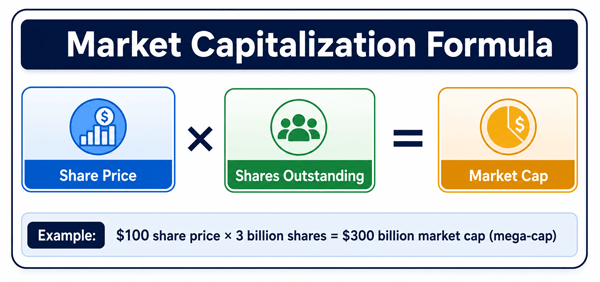
Iillustration: market capitalization is share price multiplied by shares outstanding.
1. What Is a Mega-Cap Stock?
Mega-cap stock means the stock of a company with an extremely large market capitalization. A common rule of thumb used by investor education sources is $200 billion or more. FINRA describes mega-cap companies as those with market value of $200 billion or more, while large-cap generally refers to $10 billion to $200 billion. Investopedia uses the same common $200 billion-plus threshold.
The word “cap” is short for capitalization, not price. A $500 stock is not automatically bigger than a $50 stock. The company with the larger market capitalization is the bigger company in stock-market terms.
Mega-cap companies are usually mature, widely followed, highly liquid, and included in major indexes. Many are global brands with multiple business lines, deep balance sheets, huge customer bases, and access to low-cost financing. That said, they are still stocks, and stocks can fall sharply when earnings disappoint, interest rates rise, valuations become stretched, or investor expectations change.
2. How Market Cap Works
Market capitalization is calculated by multiplying the current stock price by the number of shares outstanding. If a company has 3 billion shares and each share trades at $100, the company has a $300 billion market cap. That would place it in the mega-cap category under the common $200 billion threshold.
Market cap changes every trading day because the stock price changes. A company can move into or out of mega-cap status without issuing new shares simply because investors push the stock price higher or lower. Share buybacks, stock issuance, stock splits, and mergers can also affect the calculation, but daily movement mostly comes from price changes.
Important beginner point: Market cap is not the same as revenue, profit, cash, or book value. A company can have a huge market cap because investors expect strong future profits, not because it already has the highest current revenue. That is why fast-growing technology or healthcare companies can sometimes trade at very high values.
3. Why Mega-Cap Stocks Matter
Mega-cap stocks matter because their size gives them weight. In market-cap-weighted indexes, larger companies receive larger weights. This means a small move in a very large stock can affect the S&P 500, Nasdaq-100, global equity ETFs, retirement accounts, and even financial headlines.
For a beginner, this creates a practical reality: you may already own mega-cap stocks if you hold a broad-market index fund, an S&P 500 ETF, a total U.S. stock market fund, or a global equity fund. Many investors think they are avoiding individual stock risk, but their index fund may still have meaningful exposure to the largest companies.
Mega-cap stocks also attract heavy analyst coverage, institutional money, media attention, and options trading. This can make them easier to research than smaller companies, but it also means good news is often already priced in quickly.
4. Market Cap Categories: Mega-Cap vs Large-Cap vs Small-Cap
| Category | Common market cap range | Plain-English meaning | Typical beginner takeaway |
|---|---|---|---|
| Mega-cap | $200B or more | The largest public companies in the market | Often stable and liquid, but not automatically cheap or risk-free |
| Large-cap | $10B-$200B | Big established companies | Can be mature, but usually less dominant than mega-caps |
| Mid-cap | $2B-$10B | Medium-sized public companies | May offer a balance of growth and stability |
| Small-cap | $250M-$2B | Smaller public companies | Potentially higher growth, but usually higher volatility and business risk |
| Micro-cap | Below $250M | Very small public companies | Often risky, less liquid, and harder to research |
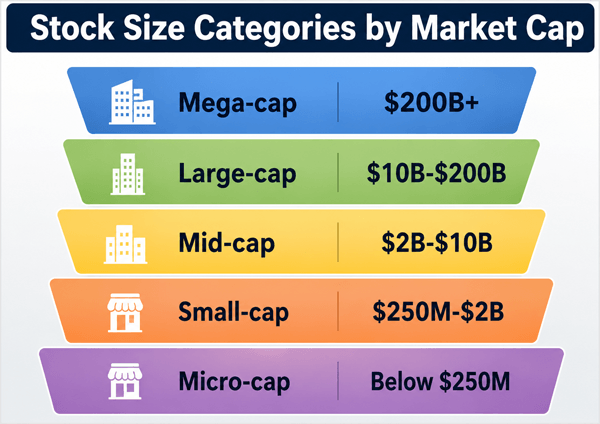
Illustration: mega-cap stocks sit at the top of the market-cap size pyramid.
5. Examples of Mega-Cap Stocks
Mega-cap lists change because stock prices change. As of 2026 market data, some commonly cited mega-cap examples include the following. Treat this as an educational snapshot, not a buy list.
| Company | Ticker | Why beginners recognize it | What to watch |
|---|---|---|---|
| NVIDIA | NVDA | AI chips, data-center GPUs, accelerated computing | AI demand, margins, competition, valuation expectations |
| Apple | AAPL | iPhone, services, ecosystem, consumer technology | Product cycles, services growth, China exposure, valuation |
| Microsoft | MSFT | Windows, Office, cloud, AI software, enterprise tools | Cloud growth, AI monetization, margins, antitrust/regulation |
| Alphabet | GOOGL/GOOG | Google Search, YouTube, cloud, AI products | Advertising trends, AI disruption, regulatory risk |
| Amazon | AMZN | E-commerce, AWS cloud, advertising, logistics | Retail margins, cloud growth, capital spending |
| Meta Platforms | META | Facebook, Instagram, WhatsApp, ads, AI tools | Ad market, user engagement, Reality Labs spending |
| Berkshire Hathaway | BRK.A/BRK.B | Insurance, cash, wholly owned businesses, public stock portfolio | Succession, insurance cycles, capital allocation |
| Tesla | TSLA | Electric vehicles, energy storage, software/robotics narrative | Margins, delivery growth, competition, valuation |
| Broadcom | AVGO | Semiconductors, infrastructure software, networking chips | AI networking demand, integration risk, cyclicality |
| Eli Lilly | LLY | Pharmaceuticals, diabetes and weight-loss drugs | Drug pipeline, pricing, competition, regulatory approvals |
6. Benefits of Mega-Cap Stocks
Mega-cap stocks can be useful because they are usually liquid. That means many buyers and sellers are active, spreads are often narrow, and it is usually easier to enter or exit a position compared with thinly traded small stocks.
They often have strong competitive positions. Many mega-cap businesses have network effects, global brands, patents, distribution networks, switching costs, massive data advantages, or economies of scale. These advantages can help them survive recessions better than weaker companies.
They are generally easier to research. Beginners can find annual reports, earnings calls, analyst commentary, investor presentations, independent research, and news coverage. This does not guarantee success, but it reduces the “unknown unknowns” that often exist in obscure companies.
Mega-cap stocks can fit long-term portfolios, especially when bought through diversified index funds or low-cost ETFs. They can provide exposure to leading sectors such as technology, healthcare, consumer platforms, financial services, and industrial infrastructure.
7. Risks and Drawbacks Beginners Should Know
Mega-cap stocks can still be volatile. A trillion-dollar company can lose hundreds of billions of dollars in market value if investors worry about earnings, AI spending, interest rates, regulation, product demand, or management decisions.
Valuation risk is real. When investors expect perfection, even a small disappointment can hurt the stock. A mega-cap company can grow profits and still see its share price fall if the stock was too expensive relative to future expectations.
Index concentration can sneak into your portfolio. A beginner might own an S&P 500 ETF, a Nasdaq-100 ETF, a technology ETF, and several individual mega-cap stocks - and unknowingly hold the same companies many times. That can make the portfolio less diversified than it looks.
Regulatory risk is higher for dominant companies. The biggest firms often face antitrust investigations, privacy rules, tax debates, drug pricing pressure, labor scrutiny, export controls, or geopolitical issues.
Size can slow growth. A company already worth trillions may need enormous profit growth to double again. Mega-cap stocks can still perform well, but the law of large numbers matters.
8. Mega-Cap Stocks vs Mega-Cap ETFs
| Choice | How it works | Best for | Main risk |
|---|---|---|---|
| Individual mega-cap stock | You buy shares of one company, such as Microsoft or Apple | Investors willing to research businesses and accept company-specific risk | Bad news at one company can hurt your position heavily |
| S&P 500 ETF | You buy a basket of large U.S. companies, heavily weighted toward mega-caps | Beginners wanting broad U.S. market exposure | Top holdings may dominate returns |
| Nasdaq-100 ETF | You buy a tech-heavy basket of large non-financial companies | Investors comfortable with growth/technology concentration | Higher sector concentration and valuation risk |
| Total market ETF | You buy mega, large, mid, and small companies in one fund | Long-term investors wanting simple diversification | Still market-cap weighted, so mega-caps remain important |
| Equal-weight ETF | Each company gets a similar weight instead of largest firms dominating | Investors who want less mega-cap concentration | Can lag when mega-cap leaders outperform |
9. How Beginners Can Use Mega-Cap Stocks Practically
Beginner investors usually use mega-cap stocks in one of three ways: through broad index funds, through sector or thematic ETFs, or through direct individual stock ownership. The simplest route is often a low-cost diversified ETF inside a brokerage account, retirement account, or tax-advantaged investment account, because it reduces single-company risk.
If you want to buy individual mega-cap stocks, use a checklist. Understand how the company makes money, what drives revenue growth, what the balance sheet looks like, what valuation you are paying, how much of your portfolio the position will represent, and what would make you sell. Avoid buying only because a stock is popular on social media or because it recently went up.
A practical beginner approach is “core and satellite.” The core might be a diversified index fund. The satellite portion might be a small allocation to individual mega-cap stocks you understand well. This lets you learn stock analysis without making your entire portfolio depend on one company.
| Investor situation | Possible use of mega-caps | Practical caution |
|---|---|---|
| New investor with no stock experience | Start with diversified ETFs that already include mega-caps | Do not confuse ETF diversification with zero risk |
| Investor who likes researching companies | Pick 1-3 mega-cap stocks and track earnings, valuation, and risks | Keep position sizes reasonable |
| Retirement-focused investor | Use low-cost index funds for broad exposure | Avoid chasing performance after big rallies |
| Income-focused investor | Look at mature mega-caps that pay dividends, if suitable | Dividend yield alone is not enough; check cash flow and payout sustainability |
| Tech-growth investor | Use mega-cap tech stocks or tech ETFs carefully | Watch concentration and valuation risk |
10. A Simple Mega-Cap Stock Analysis Checklist
| Checklist item | Question to ask before buying |
|---|---|
| Business model | Can you explain how the company makes money in one sentence? |
| Revenue growth | Is growth coming from volume, pricing, new products, subscriptions, advertising, cloud, drugs, or acquisitions? |
| Profit quality | Are margins stable? Is free cash flow strong? |
| Balance sheet | Does the company have manageable debt and enough cash? |
| Valuation | Are you paying a reasonable price compared with earnings, cash flow, and growth? |
| Competitive moat | Why might competitors struggle to take share? |
| Regulatory risk | Could antitrust, privacy, tax, drug pricing, or export rules hurt the business? |
| Portfolio role | Is this a core holding, a small satellite position, or a short-term idea? |
| Exit plan | What facts would prove your thesis wrong? |
11. Common Mistakes People Make With Mega-Cap Stocks
11.1 Thinking “big” means “safe.”
Mega-cap companies can be financially strong, but their stocks can still fall 20%, 30%, or more. Stock price risk and business quality are related, but they are not the same thing.
11.2 Buying after headlines without checking valuation.
News can be true and still already priced into the stock. A great AI story, a popular product, or a famous CEO does not guarantee future returns.
11.3 Accidentally owning the same stock everywhere.
A portfolio can look diversified across many funds while being dominated by the same top holdings. Always check fund holdings.
11.4 Ignoring taxes and trading costs.
Frequent trading can create taxes and reduce returns. Long-term investors usually benefit from a clear plan and lower turnover.
11.5 Using market cap as the only ranking tool.
Market cap tells you size. It does not tell you whether a stock is undervalued, overvalued, high-quality, or suitable for your goals.
12. Practical Example: Is a $300 Billion Company Always Better Than a $30 Billion Company?
No. Suppose Company A is worth $300 billion and grows profits 5% per year. Company B is worth $30 billion and grows profits 20% per year. Company A is a mega-cap and may be more stable, but Company B may have more room to grow. The better investment depends on price, quality, growth, risk, and your time horizon.
This is why beginners should avoid treating market cap as a scorecard. Market cap is a starting point for understanding size and risk profile. It is not a complete investment decision.
| Company | Market cap | Profit growth | What it suggests |
|---|---|---|---|
| Company A | $300B | 5% per year | Large, mature, likely more stable but slower growth |
| Company B | $30B | 20% per year | Smaller, potentially faster growth but likely higher risk |
| Lesson | Not enough information | Need valuation and business quality | Bigger is not automatically better |
13. FAQ: Mega-Cap Stocks for Beginners
13.1 Are mega-cap stocks good for beginners?
They can be easier to understand and research than obscure stocks, but beginners should usually start with diversified funds unless they are ready to analyze individual companies.
13.2 Are mega-cap stocks the same as blue-chip stocks?
They overlap, but they are not identical. Mega-cap refers to market size. Blue-chip usually refers to reputation, stability, and long operating history.
13.3 Can a mega-cap stock be overvalued?
Yes. A company can be excellent and still trade at a price that assumes too much future growth.
13.4 Do mega-cap stocks pay dividends?
Some do, such as many mature companies. Others reinvest cash into growth, buybacks, acquisitions, research, or infrastructure.
13.5 What is the easiest way to invest in mega-cap stocks?
For many beginners, the easiest route is a broad-market ETF or index fund that already includes mega-cap companies.
13.6 How many mega-cap stocks should I own?
There is no universal number. The key is position sizing and diversification. Owning five mega-cap tech stocks may still be concentrated if they all depend on similar market themes.
13.7 Can mega-cap stocks crash?
Yes. They can fall due to earnings misses, recessions, interest-rate changes, regulation, product problems, or valuation resets.
13.8 Are mega-cap stocks better than small-cap stocks?
Not always. Mega-caps are usually more established and liquid. Small-caps can offer higher growth potential but typically come with higher risk and less information.
Sources Consulted and Checked
The following sources were consulted when preparing and checking this article for clarity and accuracy. Because market values, regulations, fund holdings, and company circumstances can change, readers should confirm current information directly with official or primary sources.
- FINRA - Market Cap Explained: https://www.finra.org/investors/insights/market-cap
- Investopedia - Mega Cap: Companies With Market Caps Above $200 Billion: https://www.investopedia.com/terms/m/megacap.asp
- Investopedia - Market Capitalization: What It Is, Formula for Calculating It: https://www.investopedia.com/investing/market-capitalization-defined/
- SEC Investor.gov - Updated Investor Bulletin: Exchange-Traded Funds (ETFs): https://www.investor.gov/introduction-investing/general-resources/news-alerts/alerts-bulletins/investor-bulletins-24
- CompaniesMarketCap - Largest Companies by Market Cap: https://companiesmarketcap.com/
- S&P Dow Jones Indices - S&P U.S. Indices Methodology / MegaCap consultation materials: https://www.spglobal.com/spdji/en/methodology/article/sp-us-indices-methodology/
Reader Advice
This article is provided solely for general educational and informational purposes. It does not constitute personalized investment, financial-planning, tax, accounting, or legal advice, and it is not a recommendation or solicitation to buy, sell, or hold any security, fund, or other financial product.
Investment decisions should be based on your own objectives, financial circumstances, risk tolerance, time horizon, and independent research. Market prices, market-cap classifications, index holdings, laws, regulations, tax rules, product terms, and company information may change at any time and may differ by country or personal circumstances. Verify important facts and figures with official company filings, regulators, fund providers, and other primary sources before acting. Consider consulting appropriately qualified financial, tax, or legal professionals when advice tailored to your circumstances is needed. All investing involves risk, including possible loss of principal.