What Is Value Investing? A Beginner's Guide for Stock Investors
1. Quick Answer
Value investing is a long-term stock investing strategy where you try to buy shares of good companies for less than they are reasonably worth. Instead of chasing hot stocks, daily price moves, or social media hype, a value investor asks: “What is this business worth, and is the stock price low enough to give me a cushion if I am wrong?”
In simple words, value investing is like buying a quality product on sale. The sale price alone is not enough. You still need to check whether the product is useful, durable, and honestly discounted. In the stock market, that means studying the company's earnings, cash flow, debt, competitive position, management, and valuation before you buy.
- Value investing focuses on the gap between a company's estimated intrinsic value and its market price.
- The margin of safety is the discount you demand before buying, because every estimate can be wrong.
- A cheap stock is not always a good value; weak businesses can stay cheap or become cheaper.
- Beginners should start with simple businesses, conservative assumptions, diversification, and a written investment checklist.
- The goal is not to predict next week's stock price. The goal is to make patient, evidence-based decisions over years.
2. What Value Investing Means in Everyday Language
Imagine two stores selling the same durable backpack. One store sells it for $100, and another sells it for $65 because shoppers are currently ignoring that brand. If the backpack is real, undamaged, and likely to last, the $65 price may be a bargain. But if it is cheap because the zipper is broken, the discount is not value - it is a warning.
Stocks work in a similar way. A stock price is what the market is asking today. Business value is what the company may reasonably be worth based on its future profits, assets, cash generation, and competitive strength. Value investing sits between those two numbers. You are looking for situations where price is lower than value for a reason that is temporary, emotional, misunderstood, or fixable.
The U.S. SEC's investor education site reminds beginners that investing is putting money into assets such as stocks or bonds with the expectation of returns over time, and that all investments involve risk. That risk reminder matters because value investing is not a magic formula. It is a disciplined way to think about price, value, and risk.
3. How Value Investing Works
The basic process is simple, but doing it well takes patience:
- Find a stock that looks inexpensive using basic valuation ratios such as price-to-earnings, price-to-book, free cash flow yield, dividend yield, or enterprise value to EBITDA.
- Understand the business: how it makes money, who its customers are, what could hurt it, and why it might still be strong in five or ten years.
- Estimate intrinsic value using conservative assumptions about earnings, cash flow, assets, and growth.
- Compare your estimated value with the current market price.
- Buy only if the price is meaningfully below value, giving you a margin of safety.
- Hold patiently while regularly checking whether your original thesis remains true.
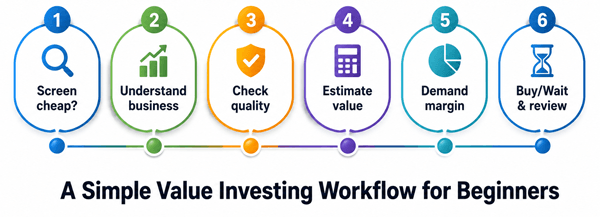
Figure 1: A beginner-friendly value investing workflow. Use it as a decision process, not as a promise of profits.
4. The Three Core Ideas: Price, Value, and Margin of Safety
4.1 Price is visible. Value is estimated.
The stock price is easy to see in a brokerage account. Intrinsic value is harder because it is an estimate of what the business is worth based on fundamentals. Two honest investors can calculate different values for the same stock because they may use different assumptions about future sales, profit margins, interest rates, competition, and risk.
4.2 A good company can be a bad investment at the wrong price.
Beginners often confuse “great company” with “great stock.” A company can have excellent products, strong branding, and loyal customers, yet still be overvalued if the market price already assumes years of perfect growth. Value investors care about business quality and the price paid for that quality.
4.3 Margin of safety protects you from being too confident.
Margin of safety is the buffer between your estimated value and the price you pay. If you think a stock is worth $100 and you buy at $95, you have little room for error. If you buy at $65 or $70, you have more protection against mistakes, bad news, or slower-than-expected growth. It does not eliminate risk, but it makes the decision more conservative.
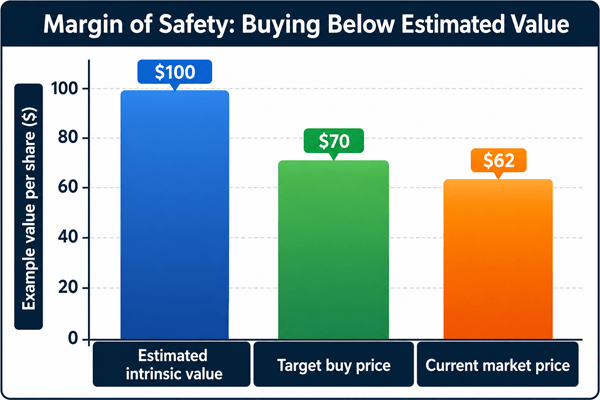
Figure 2: In this example, the investor estimates fair value at $100 but only wants to buy around $70 or below.
5. Value Investing vs. Growth Investing vs. Index Investing
| Aspect | Value investing | Growth investing | Index investing |
|---|---|---|---|
| Main question | Is the stock cheaper than the business is worth? | Can the company grow fast enough to justify a high price? | Can I own the broad market at low cost? |
| Typical focus | Valuation, balance sheet, cash flow, downside risk | Revenue growth, market size, innovation, reinvestment | Diversification, low fees, long-term market returns |
| Investor mindset | Patient bargain hunter | Future-growth buyer | Long-term market participant |
| Common risk | Value trap: cheap for a good reason | Overpaying for growth that slows | Market-wide declines still hurt |
| Beginner fit | Good if you enjoy research and patience | Harder if you cannot judge expectations | Often easiest core strategy for passive investors |
A practical beginner does not need to choose only one camp forever. Many investors use broad index funds as a core portfolio and study individual value stocks with a smaller, controlled portion of their money. This can reduce the pressure to be right on every stock while still allowing learning through real analysis.
6. Why Stocks Become Undervalued
A stock can become undervalued when investors are overly pessimistic, distracted, or focused on short-term problems. The key is to separate temporary trouble from permanent damage.
| Situation | Possible value opportunity | Possible value trap |
|---|---|---|
| Bad quarterly earnings | One weak quarter due to temporary costs or inventory issues | Repeated decline in demand or loss of key customers |
| Industry fear | Entire sector sells off even though the company has strong finances | The industry is structurally shrinking and the firm has no plan |
| Legal or regulatory news | Manageable fine or temporary uncertainty | Business model may be permanently impaired |
| High debt concern | Debt is falling and cash flow covers interest comfortably | Debt maturities are near and refinancing is uncertain |
| Management change | New leader has credible record and clear plan | Accounting concerns or poor capital allocation history |
7. Important Metrics Beginners Should Know
No single ratio tells the whole story. Ratios are starting points, not final answers. A stock with a low P/E ratio can still be expensive if earnings are about to fall, and a stock with a higher P/E ratio may be reasonable if the company is unusually stable and profitable. Use metrics together with business understanding.
| Metric | Simple meaning | Why value investors use it | Beginner caution |
|---|---|---|---|
| P/E ratio | Price divided by earnings per share | How much investors pay for $1 of earnings | Low P/E can reflect real business trouble |
| P/B ratio | Price divided by book value | Useful for banks, insurers, and asset-heavy firms | Less useful for software or brand-heavy companies |
| Free cash flow yield | Free cash flow divided by market value | Shows cash generation relative to price | Cash flow can be temporarily inflated or depressed |
| Debt-to-equity | Debt compared with shareholder equity | Signals financial leverage | Industry norms matter; utilities differ from retailers |
| Current ratio | Current assets divided by current liabilities | Short-term liquidity check | Too high can also mean idle assets |
| Return on invested capital | Profit generated on capital used | Helps identify quality businesses | Accounting differences can distort comparisons |
| Dividend yield | Dividend per share divided by price | Income relative to price | Very high yield may signal a dividend cut risk |
8. A Practical Example: Is This Stock a Value?
Let's use a simplified fictional company called SteadyTools Inc. It sells industrial tools, has been profitable for many years, and is temporarily unpopular because one large customer delayed orders. The numbers below are simplified for education.
| Item | Example value |
|---|---|
| Current stock price | $42 |
| Shares outstanding | 100 million |
| Market value | $4.2 billion |
| Normal annual free cash flow | $500 million |
| Cash | $300 million |
| Debt | $900 million |
| Estimated fair value range | $55-$65 per share |
| Beginner target buy price with margin of safety | $40 or lower |
A beginner might reason this way: if the business can normally generate about $500 million of free cash flow, and similar stable companies trade around 10 to 12 times free cash flow, the operating business might be worth roughly $5.0 to $6.0 billion. After adjusting for debt and cash, the equity value might be around $4.4 to $5.4 billion, or about $44 to $54 per share. If the investor also believes earnings will recover, they may estimate a value range near $55 to $65. But because this is uncertain, they should not pay the full estimate. They may require a 25%-35% margin of safety and only consider buying near $40 or below.
The important lesson is not the exact math. The lesson is the discipline: use conservative assumptions, compare value with price, and refuse to buy when the discount is not wide enough.
9. Beginner Checklist Before Buying a Value Stock
- Can I explain the business in two sentences?
- Does the company make money through normal operations, not just accounting adjustments?
- Has revenue or cash flow been stable enough to estimate with some confidence?
- Is debt manageable even if business conditions get worse?
- Do I understand why the stock is cheap?
- Is the problem temporary, fixable, or already reflected in the price?
- What would prove my thesis wrong?
- Am I buying with a margin of safety, or just hoping the price rebounds?
- How much of my portfolio will this one stock represent?
- Have I written down my reason for buying before placing the trade?
10. How Beginners Can Use Value Investing Safely
10.1 Start with education before stock picking.
Read annual reports, investor presentations, and financial statements. Learn what revenue, operating income, free cash flow, debt, and share count mean. Do not rush into complex banks, biotech companies, commodity producers, or highly leveraged turnarounds until you understand their special risks.
10.2 Build a watchlist, not a shopping list.
A watchlist is a list of good businesses you would like to own at the right price. The watchlist mindset helps beginners avoid forcing trades. You can track valuation, business quality, and news without feeling that every stock must be bought today.
10.3 Use position sizing.
Even careful analysis can be wrong. Beginners should avoid putting a large portion of their money into one idea. Diversification can reduce the damage from a single mistake. Investor.gov explains diversification with the familiar idea of not putting all your eggs in one basket, and FINRA emphasizes that allocation depends on risk tolerance and investment horizon.
10.4 Avoid leverage and margin loans.
Borrowing to buy stocks can turn a temporary price decline into a forced sale. The SEC warns that investors buying stocks on margin may be required to repay the margin loan quickly if prices fall sharply. For beginners, avoiding leverage is usually one of the simplest risk controls.
10.5 Keep an investment journal.
Write the date, stock price, intrinsic value estimate, margin of safety, key assumptions, risks, and reason for buying. Later, review what you got right and wrong. This turns investing experience into a feedback loop instead of a series of emotional decisions.
11. Common Beginner Mistakes in Value Investing
| Mistake | Why it hurts | Better habit |
|---|---|---|
| Buying only because the price fell | A falling price may mean the business is deteriorating | Ask what changed in earnings power, debt risk, or competitive position |
| Using only one ratio | A low P/E can hide collapsing earnings | Combine valuation, quality, debt, and industry analysis |
| Ignoring debt | Debt can wipe out shareholders in a downturn | Check interest coverage, maturities, and cash flow |
| Being too optimistic | Small valuation changes can create false bargains | Use conservative assumptions and a wide value range |
| Averaging down blindly | Adding to a mistake increases damage | Add only if the thesis is stronger, not merely because the price is lower |
| Confusing patience with stubbornness | Some cheap stocks never recover | Define sell rules before emotions take over |
12. Value Trap: The Biggest Danger for Beginners
A value trap is a stock that looks cheap but is cheap because the business is getting worse. It may have a low P/E ratio, a high dividend yield, or a low price-to-book ratio, yet still destroy capital because future earnings fall faster than the price discount protects you.
Warning signs of a value trap include shrinking revenue, rising debt, repeated one-time charges, weak cash flow, customer losses, poor management credibility, or an industry being replaced by better technology. A stock that is down 60% is not automatically safer than before. It may be less risky if the business is intact and the market overreacted. It may be more risky if the price decline reflects permanent damage.
13. A Simple Intrinsic Value Method for Beginners
You do not need a complicated spreadsheet to begin. Start with a rough value range and improve over time.
1. Estimate normal earnings or free cash flow. Avoid using one unusually good year.
2. Choose a reasonable valuation multiple based on business quality, stability, and industry comparisons.
3. Adjust for net cash or net debt.
4. Divide by shares outstanding.
5. Apply a margin of safety before buying.
Example formula: Fair equity value = normal free cash flow x reasonable multiple + cash - debt. Fair value per share = fair equity value divided by shares outstanding. This is not perfect, but it teaches the right habit: value the business first, then compare with price.
14. When Should a Value Investor Sell?
Selling is often harder than buying. A beginner can use four practical sell rules:
- Sell if the stock reaches or exceeds your conservative estimate of intrinsic value and no longer offers a good expected return.
- Sell if the original thesis is broken, such as debt becoming dangerous or the competitive advantage disappearing.
- Sell if you find a clearly better opportunity and need capital, after considering taxes and risk.
- Sell if the position becomes too large for your portfolio and creates uncomfortable concentration risk.
Avoid selling only because the stock moved a little higher or lower. Price movement alone is not a thesis. Revisit the business, valuation, and risk.
15. How Long Does Value Investing Take to Work?
Value investing usually requires a multi-year mindset. The market may recognize value in six months, or it may take several years. Sometimes the market never agrees because the investor's estimate was wrong. That is why margin of safety, diversification, and ongoing review matter. The strategy rewards patience, but it should not reward denial.
16. Portfolio Construction for Beginners
A beginner should think like a risk manager before thinking like a stock picker. Decide how much of your total investment portfolio should be in individual stocks versus diversified funds, bonds, cash, or other assets. The right mix depends on goals, risk tolerance, time horizon, income stability, and emotional comfort with market declines.
| Investor situation | Practical approach | Why it helps |
|---|---|---|
| Very new investor | Mostly diversified funds; small learning account for stocks | Reduces pressure while building skill |
| Beginner stock picker | 10-20 researched stocks over time, none too large | Controls single-company risk |
| Experienced value investor | More concentrated only if skill, process, and temperament are proven | Concentration can improve returns but also increases damage from errors |
| Money needed soon | Avoid volatile individual stocks for near-term goals | Short time horizons reduce ability to wait out declines |
17. Frequently Asked Questions
17.1 Is value investing good for beginners?
It can be, if beginners focus on simple businesses, conservative assumptions, diversification, and patience. It is not ideal for people who want quick profits or do not want to read financial statements.
17.2 What is intrinsic value in stocks?
Intrinsic value is an estimate of what a business is worth based on fundamentals such as earnings, cash flow, assets, debt, growth, and risk. It is not a precise number; it is usually better treated as a range.
17.3 What is margin of safety?
Margin of safety is the discount between estimated value and the price you pay. It gives room for mistakes, bad luck, and market volatility.
17.4 Are low P/E stocks always value stocks?
No. A low P/E stock may be cheap because earnings are about to decline, debt is high, or the company is losing relevance. Low valuation is only the beginning of research.
17.5 Can value investing beat the market?
Some investors have done well with value investing, but there is no guarantee. Results depend on skill, discipline, costs, taxes, diversification, and market conditions.
17.6 How much money do I need to start value investing?
You can start learning with a small amount or even a paper portfolio. The more important starting point is a process: watchlist, checklist, valuation method, and risk limits.
17.7 What tools help with value investing?
Helpful tools include annual reports, company filings, stock screeners, brokerage research, financial statement databases, spreadsheet templates, portfolio trackers, and, when appropriate, a qualified financial advisor.
17.8 Is value investing the same as dividend investing?
No. Dividend investing focuses on income from dividends. Value investing focuses on buying below intrinsic value. Some value stocks pay dividends, but not all do.
18. Final Beginner Summary
Value investing is not about buying the cheapest stock on the screen. It is about thinking like a business owner, estimating value conservatively, demanding a margin of safety, and staying patient when the market is emotional. For beginners, the best approach is simple: learn the language of financial statements, avoid debt-heavy situations you do not understand, diversify, keep notes, and never confuse a low price with low risk.
The strongest value investors are not just good with numbers. They are honest about uncertainty. They avoid pretending that a spreadsheet can predict the future perfectly. They know that the market can stay irrational longer than expected, that some bargains are traps, and that protecting capital matters as much as chasing returns. That honest, careful mindset is what makes value investing useful for beginners - even before they buy their first individual stock.
19. Appendix: One-Page Value Stock Worksheet
| Question | Notes |
|---|---|
| Company name / ticker | |
| What does the company do? | |
| Why is the stock cheap? | |
| Normal earnings or free cash flow estimate | |
| Debt and liquidity concerns | |
| Estimated intrinsic value range | |
| Required margin of safety | |
| Target buy price | |
| Main risks | |
| What would prove me wrong? | |
| Position size limit | |
| Review date |
Sources Consulted and Checked
These sources were consulted and checked while preparing this article to support accuracy, clarity, and responsible investor education.
- Investor.gov (U.S. SEC), Introduction to Investing: investing definition, risk, asset allocation, and diversification.
- SEC, Beginners' Guide to Asset Allocation, Diversification, and Rebalancing: diversification as a risk-reduction practice.
- Investor.gov, Asset Allocation and Diversification: risk tolerance and time horizon concepts.
- FINRA, Risk and Asset Allocation & Diversification investor education pages: risk-return relationship and portfolio allocation basics.
- SEC, Saving and Investing: margin account risks and the danger of being required to repay margin loans after sharp price declines.
- Investopedia, Value Investing and Margin of Safety educational references: intrinsic value, margin of safety, and value investing framework.
- CFA Institute Enterprising Investor, Margin of Safety discussion: fair value must exceed market price by the investor's chosen buffer.
Disclaimer
This article is provided solely for educational and informational purposes. It does not constitute personalized investment, financial, tax, accounting, or legal advice, and it is not a recommendation or solicitation to buy, sell, or hold any security or financial product. Investing involves risk, including the possible loss of principal. Before making any investment or financial decision, readers should consider their own objectives, financial circumstances, time horizon, risk tolerance, diversification needs, costs, and tax position, and should seek advice from appropriately qualified professionals where necessary.
Laws, regulations, market conditions, company information, financial figures, and product features may change over time or differ by jurisdiction and individual circumstances. Readers should therefore verify material facts, figures, filings, rules, and current requirements through official and up-to-date sources before acting. Past performance and illustrative examples do not guarantee future results.