What Are Cyclical Stocks? Definition, Examples, Risks, and Beginner-Friendly Strategy
1. Introduction: Why Cyclical Stocks Matter
A cyclical stock is a stock that tends to rise and fall with the economy. When people feel confident, jobs are strong, credit is available, and households are spending money, cyclical companies often do better. When the economy slows, unemployment rises, interest rates hurt spending, or consumers become cautious, these same companies can struggle.
The easiest way to understand cyclical stocks is to think about what people buy when life feels financially comfortable. A family may book a vacation, upgrade a car, renovate a kitchen, buy new furniture, eat out more often, or spend on luxury items. But if that same family becomes worried about income, those purchases are often delayed. Businesses that depend on this kind of optional spending are usually cyclical.
For beginners, cyclical stocks can be exciting because they can rebound strongly when the economy improves. They can also be frustrating because their prices may fall sharply before the bad news is obvious. The goal is not to guess the economy perfectly. The goal is to understand what drives the business, avoid common traps, and use cyclical stocks in a balanced, risk-aware way.
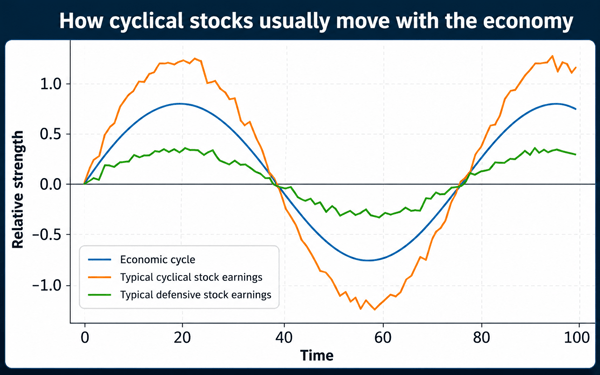
Illustration: cyclical companies usually show larger swings in sales and earnings than defensive companies.
2. What Are Cyclical Stocks? Simple Definition
Cyclical stocks are shares of companies whose revenue, profits, and stock prices are strongly affected by the business cycle. A business cycle is the natural pattern of economic expansion, peak, slowdown, recession, and recovery.
In simple words: a cyclical company usually sells something customers can postpone, reduce, or cancel when money gets tight. That is why cyclical stocks often perform well when the economy is growing and perform poorly when the economy is contracting.
| Simple question | What it tells you |
|---|---|
| Can customers delay this purchase? | If yes, the company may be cyclical. Cars, vacations, home renovations, and luxury products can often be delayed. |
| Does demand depend on consumer confidence? | If yes, the company may be cyclical. Confident consumers spend more freely. Worried consumers save more. |
| Do profits rise sharply in good times and fall sharply in bad times? | Large earnings swings are a common sign of cyclical exposure. |
| Does the business depend on credit or interest rates? | Autos, housing, construction, banking, and many industrial businesses are sensitive to financing conditions. |
3. How Cyclical Stocks Work
Cyclical stocks work through a chain reaction. The economy affects people and businesses, which affects spending, which affects company sales, which affects profits, which finally affects stock prices.
| Economic condition | What often happens | Effect on cyclical companies |
|---|---|---|
| Expansion | Jobs are strong, wages improve, borrowing is easier, consumers feel confident. | Demand rises. Revenue and earnings may grow quickly. Stock prices often improve before reported results look perfect. |
| Peak | Sales may still look good, but costs, wages, interest rates, or inventory may start rising. | Margins can get squeezed. Stocks may become expensive if investors expect perfect growth to continue. |
| Slowdown or recession | Consumers delay big purchases, companies cut budgets, lenders become cautious. | Sales fall, inventories build, discounts increase, profits decline, and weaker balance sheets become risky. |
| Recovery | Bad news is widely known, rates may ease, demand begins to stabilize. | The best cyclical stocks can recover early, sometimes before economic headlines turn positive. |
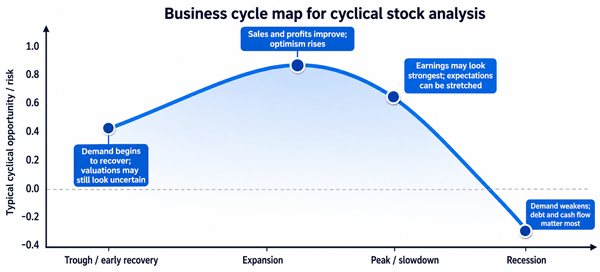
Illustration: cyclical stocks can become attractive before the economy feels strong, but they can also become risky when earnings look best.
4. Common Cyclical Stock Examples by Sector
Not every company in these sectors behaves the same way, but the following areas are commonly considered cyclical because their demand is tied to economic confidence, discretionary spending, capital spending, or borrowing conditions.
| Cyclical sector | Why it is cyclical | Practical examples of businesses |
|---|---|---|
| Automobiles and auto parts | People can delay buying a new car when rates are high or job security feels weak. | Car makers, auto parts suppliers, car dealerships, tire companies. |
| Airlines, hotels, and travel | Vacations and business travel are easy to cut during weak periods. | Airlines, cruise operators, hotels, booking platforms, theme parks. |
| Luxury goods and premium retail | Luxury spending depends heavily on wealth effects and confidence. | Luxury fashion, jewelry, premium handbags, high-end watches. |
| Restaurants and entertainment | Consumers eat out and spend on experiences more when budgets are healthy. | Restaurant chains, cinemas, casinos, live entertainment businesses. |
| Housing and construction | Home buying and construction are sensitive to interest rates, mortgages, and confidence. | Homebuilders, building materials, furniture, home improvement retailers. |
| Industrials and machinery | Businesses buy equipment when demand is strong and cut orders when they expect weakness. | Machinery, transportation, freight, manufacturing equipment. |
| Banks and financials | Loan growth, credit losses, and interest rate cycles affect profits. | Banks, lenders, investment firms, credit card companies. |
| Commodities and materials | Demand and prices often rise in expansions and fall during slowdowns. | Steel, chemicals, copper, cement, energy-related companies. |
| Semiconductors and hardware | Demand can swing with consumer electronics, data-center cycles, inventory cycles, and capital spending. | Chipmakers, equipment suppliers, hardware producers. |
5. Cyclical vs Defensive Stocks
The opposite of a cyclical stock is often called a defensive stock or non-cyclical stock. Defensive companies sell products or services people need in both good and bad economies. They may still fall in a market crash, but their business demand is usually steadier.
| Feature | Cyclical stocks | Defensive stocks |
|---|---|---|
| Demand driver | Wants, upgrades, big purchases, travel, business expansion. | Needs such as food, medicine, electricity, basic household goods. |
| Economic sensitivity | High. Results can change quickly with the economy. | Lower. Demand is usually more stable. |
| Typical sectors | Autos, travel, luxury, restaurants, housing, industrials, banks, materials. | Utilities, consumer staples, healthcare, basic telecom, some essential services. |
| Potential upside | Can rebound strongly during recoveries and expansions. | Usually steadier but may have less explosive upside. |
| Main risk | Buying late in the cycle, debt problems, earnings collapse, high volatility. | Overpaying for stability, slower growth, regulation, interest-rate sensitivity. |
6. What Beginners Should Know Before Buying Cyclical Stocks
6.1 A cheap P/E ratio can be misleading
With cyclical stocks, earnings are often highest near the top of the cycle. That can make the price-to-earnings ratio look cheap exactly when risk is rising. A low P/E does not automatically mean a bargain. It may mean investors expect earnings to fall.
6.2 A high P/E ratio is not always bad
Near the bottom of a cycle, profits may be temporarily depressed. A good cyclical company can look expensive on current earnings because current earnings are unusually low. Investors sometimes look at normalized earnings, book value, cash flow, or earnings power across a full cycle instead.
6.3 Debt matters more than usual
A cyclical company with too much debt can be forced to cut investment, issue shares, sell assets, or even face bankruptcy during a downturn. Always check debt levels, interest costs, refinancing needs, and cash reserves.
6.4 Timing is difficult
Cyclical stocks often start recovering before economic news becomes positive. They can also start falling while reported profits still look strong. Beginners should avoid all-or-nothing bets based on one economic prediction.
6.5 The best company in a cyclical sector is not always the cheapest
Quality matters. Strong brands, cost advantages, flexible expenses, low debt, and good management can help a company survive downturns and gain share when weaker competitors struggle.
6.6 Cyclical does not mean bad
Some investors avoid cyclical stocks because they are volatile. That is too simple. Cyclical stocks can be useful when bought with discipline, sized properly, and combined with more stable assets.
7. A Practical Checklist for Analyzing a Cyclical Stock
| Checklist item | Beginner-friendly question | Why it matters |
|---|---|---|
| Demand cycle | Are customers likely to buy more in good times and cut back in bad times? | This tells you how cyclical the business is. |
| Revenue history | Did sales fall badly in past recessions or slowdowns? | Past stress periods show how the business behaves under pressure. |
| Profit margins | Do margins expand in booms and collapse in downturns? | Margin swings drive stock volatility. |
| Balance sheet | Can the company survive a weak year or two without raising emergency capital? | Financial strength separates survivors from value traps. |
| Inventory | Is inventory building faster than sales? | Inventory problems can lead to discounts and profit warnings. |
| Order book | Are new orders rising or falling? | For industrials and construction suppliers, orders may lead revenue. |
| Interest rates | Does demand depend on mortgages, auto loans, credit cards, or business borrowing? | Rate changes can strongly affect cyclical demand. |
| Valuation across the cycle | Is the stock cheap based on normal-cycle earnings, not only last year earnings? | Current earnings can be unusually high or low. |
| Management quality | Did management protect cash and avoid reckless expansion in previous cycles? | Good operators are easier to trust during downturns. |
| Portfolio fit | Would a 30% to 50% decline damage your plan emotionally or financially? | Position sizing is part of risk management. |
8. How Beginners Can Use Cyclical Stocks
8.1 Option 1: Use diversified ETFs instead of single stocks
A beginner who wants exposure to cyclical sectors but does not want to pick individual companies can use sector or broad-market ETFs. For example, a consumer discretionary ETF, industrial ETF, financial ETF, materials ETF, or broad index fund may provide diversified exposure. This can reduce single-company risk, though it does not remove market risk.
8.2 Option 2: Build a balanced portfolio
Cyclical stocks are often easier to hold when they are only one part of a portfolio. A balanced portfolio may include broad index funds, defensive stocks, dividend stocks, bonds, cash reserves, and cyclical exposure. The exact mix depends on age, goals, income stability, and risk tolerance.
8.3 Option 3: Dollar-cost average carefully
Instead of trying to buy the exact bottom, a beginner may invest gradually over time. This can reduce regret and timing risk. However, dollar-cost averaging does not guarantee profit and does not protect against buying a weak business.
8.4 Option 4: Create a watchlist before the downturn
Many investors only study cyclical companies after prices have already moved. A better habit is to build a watchlist in advance. Know which companies have strong balance sheets, good brands, and durable competitive advantages before the market offers a better price.
9. Practical Examples: How Cyclical Stocks Behave
9.1 Example 1: A car company
Imagine a car company selling vehicles at high profit margins during a strong economy. Customers have jobs, banks approve loans, and dealers move inventory quickly. The stock price rises because investors expect earnings growth. Then interest rates rise, monthly car payments become expensive, and buyers delay purchases. Inventory builds. The company offers discounts. Margins fall. The stock may drop even before annual profits fully show the damage.
9.2 Example 2: A hotel chain
A hotel chain benefits when consumers travel, businesses hold conferences, and companies spend on corporate trips. During a recession, leisure travel slows and companies reduce travel budgets. Occupancy falls, room rates weaken, and profits decline. In recovery, even a small improvement in occupancy can create a sharp profit rebound because many hotel costs are fixed.
9.3 Example 3: A homebuilder
A homebuilder is sensitive to mortgage rates, land costs, employment, and consumer confidence. When rates are low and buyers feel secure, orders rise. When mortgage payments become unaffordable, orders slow. Investors should watch cancellation rates, new orders, inventory, land exposure, and incentives offered to buyers.
10. Main Risks of Cyclical Stocks
| Risk | What it means | How a beginner can manage it |
|---|---|---|
| Economic risk | A recession or slowdown can reduce demand. | Do not rely on one forecast. Diversify across sectors and asset classes. |
| Timing risk | The stock can fall after you buy or recover before you feel ready. | Use staged buying, clear valuation ranges, and realistic holding periods. |
| Earnings risk | Profits can collapse faster than expected. | Study past downturns and avoid assuming peak margins last forever. |
| Debt risk | Debt can become dangerous when cash flow falls. | Prefer companies with manageable leverage and strong liquidity. |
| Valuation trap | A stock may look cheap because earnings are temporarily high. | Use normalized earnings, cash flow, and balance sheet analysis. |
| Emotional risk | Volatility can push investors into panic selling. | Keep position sizes small enough to hold through normal cyclical swings. |
11. Economic Indicators Cyclical Investors Watch
Beginners do not need to become economists, but they should understand the signals that often affect cyclical stocks.
| Indicator | Why it matters |
|---|---|
| Interest rates | Higher rates can hurt autos, housing, banks, and capital-intensive businesses. Lower rates can support recoveries. |
| Consumer confidence | Confident consumers are more likely to spend on travel, cars, restaurants, and discretionary goods. |
| Unemployment | Job security affects household spending and loan repayment. |
| Manufacturing activity | Industrial orders and production can signal strength or weakness in cyclical sectors. |
| Housing starts and mortgage rates | Important for homebuilders, building materials, furniture, and home improvement. |
| Credit conditions | When lenders tighten standards, cyclical demand can weaken. |
| Commodity prices | Materials and energy businesses may benefit from higher prices but can suffer when demand weakens. |
12. Common Beginner Mistakes
12.1 Mistake 1: Buying only because the stock has fallen
A 40% decline does not automatically make a cyclical stock cheap. The business may be entering a deeper downturn, or past profits may have been unsustainably high.
12.2 Mistake 2: Ignoring the balance sheet
Many cyclical disasters come from companies that looked fine during good times but had too much debt when demand fell.
12.3 Mistake 3: Confusing a cyclical problem with a permanent problem
Some companies recover when the cycle turns. Others are damaged by technology shifts, competition, poor management, or changing consumer behavior. A cheap stock in a shrinking business is not the same as a strong cyclical company in a temporary downturn.
12.4 Mistake 4: Overconcentrating in one sector
Owning airlines, hotels, cruise lines, and luxury retail at the same time may feel diversified, but all may depend on consumer travel and confidence.
12.5 Mistake 5: Chasing headlines
By the time headlines say the economy is booming, many cyclical stocks may already reflect that optimism. By the time headlines say recession is over, some stocks may have already rebounded.
13. Frequently Asked Questions
13.1 Are cyclical stocks good for beginners?
They can be, but only when used carefully. Beginners should start with education, diversified funds, small position sizes, and a clear understanding that these stocks can be volatile.
13.2 Are cyclical stocks good during inflation?
It depends. Some cyclical companies can pass on higher prices, while others suffer from higher costs and weaker demand. Inflation often leads to higher interest rates, which can hurt rate-sensitive cyclical sectors.
13.3 Are banks cyclical stocks?
Many banks are cyclical because loan growth, credit losses, capital markets activity, and economic confidence affect profits. However, bank behavior varies by business model and balance sheet quality.
13.4 Is technology cyclical?
Some technology companies are cyclical, especially hardware, semiconductors, advertising-driven platforms, and enterprise software tied to corporate budgets. Other technology businesses may be more stable if their products are essential and subscription-based.
13.5 What is the difference between cyclical and seasonal stocks?
Seasonal patterns repeat during parts of the year, such as holiday retail or summer travel. Cyclical patterns are tied to the broader economy and can last months or years.
13.6 Can cyclical stocks pay dividends?
Yes. Some cyclical companies pay dividends, but dividends can be less reliable if earnings fall sharply. Beginners should check payout ratios, cash flow, debt, and dividend history across downturns.
13.7 What are consumer cyclical stocks?
Consumer cyclical stocks are companies that sell discretionary products or services to consumers, such as cars, apparel, restaurants, hotels, entertainment, furniture, and travel.
14. Final Thoughts
Cyclical stocks are not mysterious. They are simply businesses that feel the economy more strongly than average. When consumers and companies are confident, they can grow quickly. When confidence weakens, their sales and profits can fall quickly.
The beginner-friendly way to approach cyclical stocks is to focus on business quality, balance sheet strength, valuation across a full cycle, and portfolio fit. Do not buy only because a stock looks cheap. Do not assume strong current earnings will last forever. And do not put money into cyclical stocks that you cannot emotionally or financially afford to see fluctuate.
Used wisely, cyclical stocks can add growth and recovery potential to a diversified investment portfolio. Used carelessly, they can become painful lessons in timing, leverage, and market volatility.
Sources Consulted and Checked
The following sources were consulted and checked while preparing this article to support its accuracy and educational value.
- Investopedia - Cyclical Stocks: Definition, Examples, and Growth Potential: https://www.investopedia.com/terms/c/cyclicalstock.asp
- Corporate Finance Institute - Cyclical Stocks: https://corporatefinanceinstitute.com/resources/equities/cyclical-stocks/
- Investopedia - Cyclical vs. Non-Cyclical Stocks: https://www.investopedia.com/articles/00/082800.asp
- Yahoo Finance - Consumer Cyclical sector overview: https://finance.yahoo.com/sectors/consumer-cyclical/
- IG - Cyclical stocks and industries overview: https://www.ig.com/en/trading-strategies/cyclical-stocks-and-industries-what-you-need-to-know-200703
Reader Advice
This article is provided solely for educational and informational purposes. It does not constitute personal financial, investment, legal, tax, or professional advice, and it should not be treated as a recommendation to buy, sell, or hold any security. Investment outcomes are not guaranteed, and all investments involve risk, including possible loss of principal. Readers should consider their own objectives, financial circumstances, risk tolerance, and time horizon and, where appropriate, seek guidance from a qualified financial adviser or other relevant professional before making any decision.
Market conditions, company classifications, laws, regulations, tax rules, product features, and published facts or figures may change over time or vary by jurisdiction and individual circumstances. Readers should therefore verify material information with current official sources, regulatory filings, and qualified professionals before acting.