What Are Penny Stocks? Risks and Rewards Explained
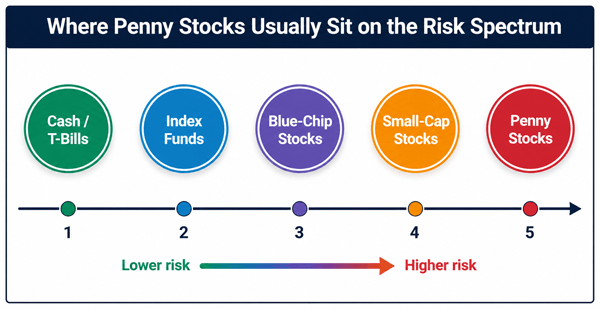
Penny stocks typically sit at the speculative end of the investing spectrum.
1. What Are Penny Stocks?
Penny stocks are shares of small public companies that trade at a very low price, commonly under $5 per share in the United States. Many are also microcap stocks, meaning the company itself is small, often with limited revenue, limited operating history, and fewer public details than larger listed companies.
The word “penny” can be misleading. A stock priced at $0.40 is not automatically cheap, and a stock priced at $80 is not automatically expensive. Price per share is only one piece of the puzzle. What matters is the company’s real value, financial health, share count, liquidity, management quality, and whether the business can survive long enough to grow.
A penny stock is usually a tiny company’s stock with a low share price. It can move fast, but it can also fall fast, become hard to sell, or be used in scams.
Some penny stocks trade on major exchanges, but many trade over the counter, often called OTC markets. OTC stocks do not always have the same level of reporting, analyst coverage, institutional ownership, or liquidity that investors expect from larger exchange-listed companies.
2. How Penny Stocks Work
Penny stocks work like other stocks in one basic way: you buy shares, and if the market price rises, your position gains value. If the price falls, your position loses value. The difference is that penny stocks often trade with much less information, fewer buyers and sellers, and wider bid-ask spreads.
| Concept | Plain-English meaning | Why it matters |
|---|---|---|
| Bid price | What buyers are currently willing to pay | You may have to sell lower than the last quoted price. |
| Ask price | What sellers are asking for | You may pay more than the price you just saw on a chart. |
| Spread | Gap between bid and ask | A wide spread acts like a hidden trading cost. |
| Volume | How many shares trade | Low volume can make it hard to enter or exit. |
| Float | Shares available for public trading | Small floats can move sharply on hype or panic. |
| Market cap | Share price multiplied by shares outstanding | Shows company size better than share price alone. |
Imagine a penny stock quoted at $0.50, but the bid is $0.46 and the ask is $0.54. If you buy at $0.54 and immediately try to sell, you might only get $0.46. The stock has not “crashed,” but the spread alone created a loss. This is one reason market orders can be dangerous in thinly traded penny stocks.
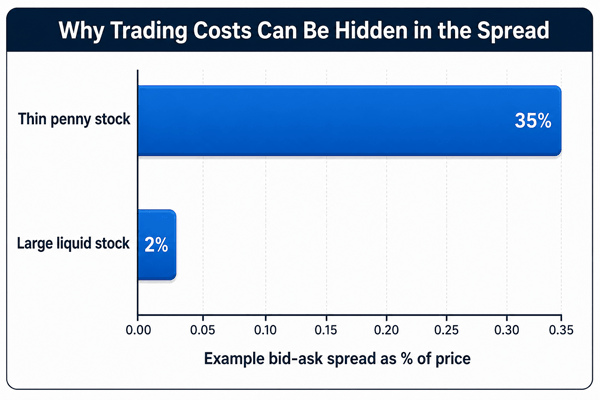
Wide spreads can quietly increase the real cost of penny stock trading.
3. Why People Buy Penny Stocks
Most people are attracted to penny stocks because the low share price makes big percentage moves look possible. A move from $0.20 to $0.40 is a 100% gain. That sounds exciting, especially to beginners with a small brokerage account. But the same math works in reverse: a drop from $0.20 to $0.10 is a 50% loss.
The best reason to study penny stocks is not “easy money.” A more realistic reason is to understand speculative investing, learn how liquidity works, and recognize how market psychology can push prices far away from business reality. Some small companies do become successful over time, but most low-priced stocks never turn into long-term winners.
| Potential attraction | Reality check |
|---|---|
| Low share price | A low price does not mean undervalued. The company may have billions of shares outstanding. |
| Huge upside stories | Most exciting stories never become profitable businesses. |
| Fast movement | Fast gains can turn into fast losses. |
| Small account friendly | Low entry cost can encourage overtrading. |
| Early-stage opportunity | Early-stage companies often need more financing, which can dilute shareholders. |
4. The Rewards: What Can Go Right?
A penny stock can reward investors when a real business improves faster than the market expected. Examples include a small biotech company reporting positive trial news, a junior mining company confirming a valuable deposit, or a small technology company winning a meaningful contract. In these cases, the stock may rise because the business outlook genuinely changed.
The key word is genuinely. A real catalyst is supported by verifiable filings, credible customers, audited financials, and progress that can be checked. A fake catalyst is usually built around vague press releases, anonymous social media accounts, “guaranteed” price targets, or emotional messages that pressure people to buy before doing research.
Practical mindset
The reward is not the low price. The reward comes only if the underlying business becomes more valuable and the market recognizes it. Treat every big claim as unproven until you verify it.
5. The Risks: What Can Go Wrong?
Penny stocks are high-risk because several dangers can happen at the same time. The company may be weak, the stock may be illiquid, the information may be incomplete, and the trading activity may be manipulated. Beginners often focus only on price movement and ignore the structure behind the trade.
| Risk | How it hurts beginners | Practical protection |
|---|---|---|
| Low liquidity | You cannot sell at the price shown on screen. | Check average daily volume and use limit orders. |
| Wide spreads | You start with an immediate hidden cost. | Compare bid and ask before placing an order. |
| Weak financials | The company may run out of cash. | Read balance sheet, cash flow, and going-concern warnings. |
| Dilution | New shares can reduce the value of existing shares. | Look for share issuance, warrants, convertibles, and reverse splits. |
| Promotion risk | Hype can lift price temporarily, then collapse. | Avoid unsolicited tips and paid promotions. |
| Limited disclosure | You may not know what is really happening. | Prefer companies with current, audited, and easy-to-find filings. |
| Volatility | Normal price swings can be emotionally hard. | Size positions small and define exit rules. |
Regulators such as the SEC and FINRA have repeatedly warned investors about microcap and low-priced stock fraud, especially pump-and-dump schemes. In a pump-and-dump, promoters spread misleading excitement, buyers rush in, insiders or promoters sell into the demand, and late buyers are left holding a falling stock.
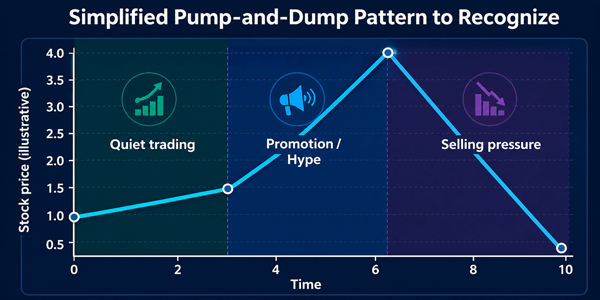
A simplified illustration of how a promotion-driven price spike can collapse.
6. Practical Example: A Beginner Sees a $0.25 Stock
Suppose you see a penny stock trading at $0.25. A social media post says it could go to $1.00 after “big news.” That sounds like a 300% gain. Before buying, a careful investor would slow down and ask a few simple questions.
| Question | What to check | Possible warning sign |
|---|---|---|
| Is the company real? | Website, filings, business address, management history | No current filings or vague business description |
| Does it have money? | Cash balance, debt, cash burn | Only a few months of cash left |
| Why is the stock moving? | News source, filing, contract details | Only social media hype, no official filing |
| Can I sell later? | Volume, bid-ask spread, order book | Very low volume or huge spread |
| Who benefits from the promotion? | Disclaimers, paid newsletters, insider ownership | Paid promotion or undisclosed compensation |
Now add real numbers. You plan to buy 4,000 shares at $0.25, so the position costs $1,000 before commissions and fees. If the stock falls to $0.15, the loss is $400, or 40%. If the bid is only $0.14 when you want to sell, the realized loss may be even larger. If the company issues more shares at a discount, the price may keep falling even if the story sounds good.
This example shows why position sizing matters. For many beginners, a $1,000 penny stock position is not “small” if it can realistically lose 50% or more. A safer learning approach is to paper trade first, then use only a tiny portion of a diversified investment portfolio if you decide to participate at all.
7. How to Research Penny Stocks Before Buying
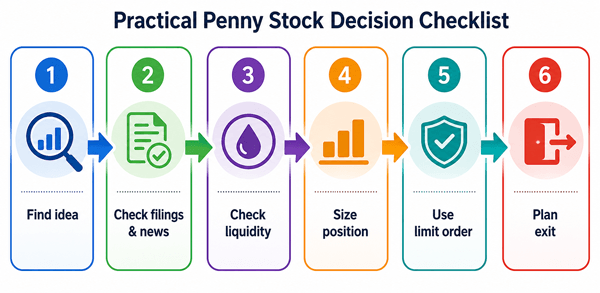
A simple research workflow before considering a penny stock trade.
Researching penny stocks is not about finding the loudest story. It is about trying to disprove the story before risking money. If the investment idea still makes sense after you look for problems, it may deserve more study. If the idea falls apart quickly, that is useful information.
| Research step | What to do | Why it matters |
|---|---|---|
| Read filings | Look for 10-K, 10-Q, 8-K, annual reports, OTC disclosures, and audited statements. | Filings show facts that promotions may omit. |
| Check cash runway | Compare cash on hand with operating losses. | Companies with little cash may dilute shareholders. |
| Review share structure | Look at shares outstanding, float, warrants, convertibles, and reverse split history. | A low stock price can hide a bloated share count. |
| Study management | Search management names, past companies, legal issues, and track record. | Repeat promoters often move from one story to another. |
| Check liquidity | Review average volume, spread, and trading halts. | A good idea is not useful if you cannot exit. |
| Verify catalyst | Use official filings and credible news, not anonymous posts. | Real catalysts leave a paper trail. |
| Compare peers | Compare revenue, margins, valuation, and cash position with similar companies. | Prevents buying only because the stock looks cheap. |
8. How Beginners Can Use Penny Stocks Safely, If They Use Them at All
Many beginners should avoid penny stocks until they understand basic investing, diversification, and risk management. If you still want to learn, start with education before capital. Use a watchlist, write down your thesis, track what happened, and review your mistakes without risking real money.
A practical beginner framework is: paper trade first, use a reputable online brokerage account, avoid market orders, cap penny stocks at a very small percentage of your portfolio, never borrow money to trade them, and never average down just because the price looks cheaper.
| Rule | Beginner-friendly version |
|---|---|
| Position size | Risk only a small amount you can lose without affecting rent, bills, emergency savings, or long-term investing. |
| Order type | Prefer limit orders so you control the maximum buy price or minimum sell price. |
| Exit plan | Decide before buying where you will take profit, cut loss, or re-evaluate. |
| Diversification | Do not let one speculative stock dominate your investment portfolio. |
| No borrowed money | Avoid margin and loans for high-risk penny stock trading. |
| No tips-only buying | Never buy only because someone online says “big news soon.” |
9. Penny Stocks vs Blue-Chip Stocks vs ETFs
| Feature | Penny stocks | Blue-chip stocks | Broad-market ETFs |
|---|---|---|---|
| Typical company size | Very small or early-stage | Large, established companies | Basket of many securities |
| Liquidity | Often low | Usually high | Usually high for popular ETFs |
| Information quality | Can be limited | Generally strong | Depends on fund holdings and issuer disclosures |
| Risk level | Very high | Moderate to high depending on company | Varies, often diversified |
| Best use case | Speculation or advanced research | Long-term stock investing | Diversified portfolio building |
| Beginner suitability | Low | Medium | Often higher for long-term beginners |
This comparison does not mean blue-chip stocks or ETFs are risk-free. They can lose money too. The difference is that penny stocks often combine business risk, liquidity risk, information risk, and fraud risk in one place. That combination is what makes them especially dangerous for beginners.
10. Red Flags That Should Make You Walk Away
- Someone promises guaranteed returns or “no-risk” profits.
- The investment pitch comes through WhatsApp, Telegram, Discord, spam email, or an unsolicited direct message.
- The company has no clear revenue, no current filings, or a confusing business model.
- Promoters use urgent language such as “buy before news drops” or “last chance.”
- The stock has a sudden price spike without credible news.
- The company frequently changes business focus to hot themes such as AI, crypto, lithium, biotech, or cannabis without proof of execution.
- There are repeated reverse splits, heavy dilution, or convertible debt.
- You cannot easily find audited financial statements or management history.
11. Practical Checklist Before Placing a Trade
- Can I explain the business in one sentence?
- Have I read the latest filings or official disclosures?
- Do I know how the company makes money?
- Do I know how much cash and debt it has?
- Is there enough trading volume to exit?
- Is the bid-ask spread acceptable?
- Is the stock being promoted by paid newsletters or anonymous accounts?
- Have I written my risk amount and exit plan?
- Would I still buy this if the stock were priced at $25 instead of $0.25?
- Am I buying because of research, not FOMO?
12. Common Beginner Mistakes
| Mistake | Why it happens | Better habit |
|---|---|---|
| Thinking cheap means undervalued | Beginners focus on price per share. | Study market cap, revenue, cash flow, and share count. |
| Chasing green candles | Fast gains create fear of missing out. | Wait for research and avoid emotional entries. |
| Using market orders | The trading platform makes it easy. | Use limit orders, especially in illiquid stocks. |
| Ignoring dilution | Share issuance is not obvious on price charts. | Read filings for warrants, convertibles, and new offerings. |
| Believing anonymous tips | Stories feel more exciting than financial statements. | Verify claims through official sources. |
| Holding losers forever | People hope the stock “comes back.” | Set rules and review the thesis objectively. |
13. Frequently Asked Questions
13.1 Are penny stocks good for beginners?
Usually, no. They can be useful to study, but they are often too risky for beginners because they require strong research skills, emotional control, and an understanding of liquidity, dilution, and fraud risk.
13.2 Can you make money with penny stocks?
Yes, some traders and investors make money, but many lose money. The possibility of a large percentage gain is exactly why these stocks attract attention. The same volatility can also create large losses.
13.3 Are all penny stocks scams?
No. Some are legitimate small companies. The problem is that the penny stock area has more room for weak businesses, low-quality disclosures, aggressive promotions, and manipulation. Investors should treat every claim as something to verify.
13.4 What is the safest way to learn penny stock trading?
Use a watchlist or paper trading first. Track entries, exits, volume, spreads, news, filings, and outcomes. Learn the mechanics before using real money.
13.5 Should I use a stop-loss order?
A stop-loss can help manage risk, but in thin penny stocks it may execute at a poor price if liquidity disappears. Many traders combine position sizing, limit orders, and pre-planned exits instead of relying only on stop orders.
13.6 What is better than penny stocks for most beginners?
For long-term wealth building, many beginners start with diversified ETFs, retirement accounts, emergency savings, and basic stock market investing education before touching speculative low-priced stocks.
14. Final Takeaway
Penny stocks are not magic tickets to fast wealth. They are high-risk, low-priced securities where price can move quickly because of small company size, low liquidity, limited information, and sometimes aggressive promotion. The reward is real only when the business value improves; the risk is real every time you enter the trade.
A beginner should approach penny stocks with caution, skepticism, and a written plan. Research the company, verify the catalyst, check liquidity, use limit orders, size positions small, and walk away from hype. The goal is not to find the loudest stock tip. The goal is to protect your capital while learning how markets actually work.
Sources Consulted and Checked
These sources were consulted and checked while preparing this article to support its accuracy, clarity, and reliability. Readers should also review the latest official information because rules, market practices, and regulatory guidance may change over time.
- SEC Investor.gov - Pump and Dump Schemes: https://www.investor.gov/introduction-investing/investing-basics/glossary/pump-and-dump-schemes
- FINRA - Low-Priced Stocks Can Spell Big Problems: https://www.finra.org/investors/insights/low-priced-stocks-big-problems
- SEC - Microcap Stock: A Guide for Investors: https://www.sec.gov/about/reports-publications/investorpubsmicrocapstock
- Investor.gov - Microcap Fraud: https://www.investor.gov/additional-resources/spotlight/microcap-fraud
- OTC Markets - Investor Protection: https://www.otcmarkets.com/learn/investor-protection
- Schwab - OTC Stocks and OTC Markets: https://www.schwab.com/stocks/understand-stocks/otc-markets
Reader Advice
This article is provided solely for educational and informational purposes and does not constitute personal financial, investment, legal, tax, or professional advice. Penny stocks are highly speculative and may involve substantial losses, limited liquidity, incomplete information, dilution, volatility, and fraud risk. Before making any decision, readers should assess their own circumstances, conduct independent research, read current company filings and official disclosures, and consider consulting a qualified financial advisor or other appropriate professional.
Rules, definitions, brokerage requirements, market conditions, company information, prices, fees, and regulatory guidance can change based on jurisdiction, platform, security, and other factors. Verify all facts, figures, claims, and requirements through current official sources, including the relevant regulator, exchange or market operator, company filings, and brokerage provider. Never invest money needed for living expenses, emergency savings, debt payments, or other essential obligations, and never act solely on promotional material, social-media posts, or promises of guaranteed returns.