What Are Mid-Cap Stocks? Definition, Examples, Risks, and Beginner Guide
1. Quick Answer: What Is a Mid-Cap Stock?
A mid-cap stock is the stock of a publicly traded company with a medium-sized market value. In simple terms, it is usually bigger and more established than a small-cap company, but not as large as a giant large-cap or mega-cap company. A common rule of thumb defines mid-cap companies as those with a market capitalization between about $2 billion and $10 billion. Some index providers use wider or shifting ranges, so the exact cutoff depends on the market and index methodology.
Market capitalization, or market cap, is calculated like this:
Market Cap = Current Share Price x Shares Outstanding
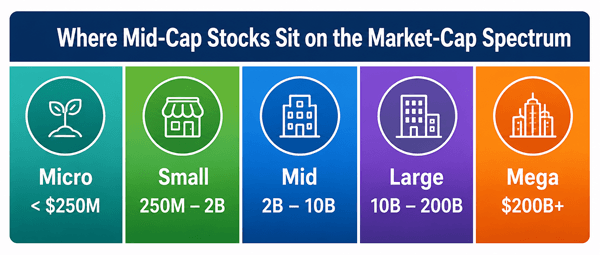
Figure 1. Mid-cap stocks sit between small-cap and large-cap companies. The dollar ranges are common rules of thumb, not permanent laws.
2. An Easy Example
Imagine a company has 100 million shares trading at $50 per share. Its market cap is:
$50 x 100,000,000 = $5 billion
That company would usually be considered a mid-cap stock. Notice that market cap changes every trading day because the share price changes. A company can move from small-cap to mid-cap as it grows, or from mid-cap to large-cap if investors value it much more highly. It can also move down if the business weakens or the stock price falls.
3. Why Mid-Cap Stocks Matter
Many beginners hear about the S&P 500, Apple, Microsoft, Nvidia, Tesla, or other giant companies first. But the stock market is not only made of mega-cap stocks. Mid-cap companies often represent businesses that have already survived the risky early stage and are still trying to expand into bigger markets.
This is why investors often describe mid-caps as the “middle ground” of the stock market: they can offer more growth potential than mature large-cap stocks, but they may be less fragile than very small companies. That does not make them safe. It means they deserve a different type of research and position sizing.
| Company size | Common market-cap range | Typical profile | Main attraction | Main risk |
|---|---|---|---|---|
| Small-cap | About $250M-$2B | Younger, niche, or less proven businesses | Higher growth potential | Higher volatility, less liquidity, weaker access to capital |
| Mid-cap | About $2B-$10B | Established but still expanding companies | Balance of growth and business maturity | Can be volatile and sensitive to rates, industry cycles, and execution mistakes |
| Large-cap | About $10B-$200B | Mature national or global businesses | Stability, liquidity, analyst coverage | Growth may be slower; valuations can become crowded |
| Mega-cap | $200B+ | Dominant global businesses | Scale, brand strength, deep liquidity | Concentration risk if a few giants dominate a portfolio |
4. How Mid-Cap Stocks Work in Real Life
Mid-cap stocks work like any other publicly traded stock: investors buy and sell shares through a brokerage account, the stock price moves based on supply and demand, and the business reports financial results. What makes the mid-cap category special is the company’s stage of development.
A mid-cap company may already have real revenue, customers, distribution, and management experience. But it may still be opening new stores, entering new regions, launching new products, improving margins, or trying to become a large-cap company. Investors are often paying for that next stage of growth.
Because expectations matter, a mid-cap stock can move sharply when results are better or worse than expected. A strong earnings report may convince investors that the company can scale. A weak report may raise concerns that the growth story is slowing.
5. Mid-Cap Stock Examples
Examples change over time because stock prices and shares outstanding change. The examples below are for education only, not buy recommendations. Always check the latest market cap before calling any stock small-cap, mid-cap, or large-cap.
| Example type | Why it can be useful for learning | What to check before investing |
|---|---|---|
| Consumer brands such as eyewear, restaurants, apparel, or specialty retail | Beginners can understand the product, store growth, pricing, customer loyalty, and margins. | Same-store sales, customer acquisition cost, debt, profitability, brand durability, and whether valuation assumes perfect growth. |
| Industrial and infrastructure businesses | They may benefit from construction, manufacturing, energy, defense, or supply-chain trends. | Backlog, cyclicality, contracts, margins, capital spending, and customer concentration. |
| Software, cloud, and digital platform companies | They can grow quickly if customers renew and expand usage. | Revenue growth, free cash flow, retention, competition, stock-based compensation, and valuation multiples. |
| Healthcare, biotech, and medical device companies | A successful product or approval can change the company’s future. | Regulatory risk, trial results, balance sheet, product pipeline, and whether the business already has revenue. |
| Regional banks and financial companies | They can be easier to understand than complex global banks and often reflect regional economies. | Credit quality, deposits, interest-rate sensitivity, capital ratios, and commercial real estate exposure. |
A practical way to find examples is to look at mid-cap indexes and ETFs, such as the S&P MidCap 400, Russell Midcap Index, Vanguard Mid-Cap ETF, iShares Core S&P Mid-Cap ETF, or SPDR S&P MidCap 400 ETF. These are not recommendations; they are useful research starting points because they show what professional index providers currently classify as mid-cap exposure.
6. Benefits of Mid-Cap Stocks
6.1 They may still have room to grow
A large company may already dominate its market. A mid-cap company may still be expanding into new cities, countries, product categories, or customer segments.
6.2 They may be more proven than small caps
Many mid-cap companies have survived the startup phase. They may have real customers, public financial statements, and enough scale to access capital markets.
6.3 They can improve portfolio diversification
A portfolio made only of mega-cap technology stocks may not be as diversified as it looks. Adding mid-cap exposure can broaden sector, size, and business-model exposure.
6.4 They may be acquisition targets
Some mid-cap companies become attractive takeover candidates for larger firms. This can help returns, but it should never be the only reason to buy a stock.
6.5 They are often under-owned by beginners
New investors often jump from famous large-cap stocks to risky penny stocks. Mid-caps can offer a more balanced research universe.
7. Risks Beginners Should Understand First
| Risk | What it means | Beginner-friendly way to manage it |
|---|---|---|
| Volatility | The stock may rise or fall faster than a large-cap stock. | Use smaller position sizes; avoid investing money needed soon. |
| Liquidity risk | Some mid-caps trade less actively than large caps, making price moves sharper. | Use limit orders when buying individual stocks; avoid chasing spikes. |
| Execution risk | The company may fail to expand profitably. | Read earnings reports and track whether management delivers what it promised. |
| Valuation risk | A good company can still be a bad investment if bought at an extreme price. | Compare valuation to growth, margins, peers, and history. |
| Debt and rate risk | Debt can become expensive when interest rates are high or credit conditions tighten. | Check debt-to-equity, interest coverage, refinancing dates, and cash flow. |
| Sector risk | Many mid-caps are tied to economic cycles, commodities, consumer spending, or regulation. | Diversify across sectors or use a broad mid-cap ETF. |
8. How to Analyze a Mid-Cap Stock Step by Step
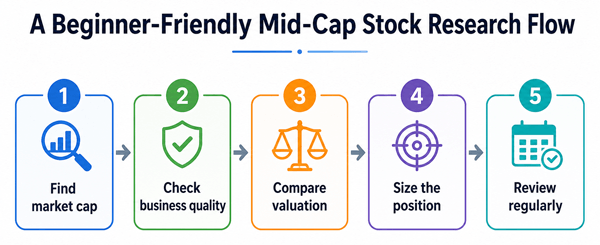
Figure 2. A simple research process helps beginners avoid hype-driven decisions.
8.1 Confirm the market cap
Use a reliable finance site or brokerage platform. Multiply share price by shares outstanding if you want to verify it manually. Remember that market cap changes daily.
8.2 Understand how the company makes money
Do not buy a mid-cap stock unless you can explain the business in one or two sentences. Ask: Who are the customers? What problem does the company solve? Why do customers choose it?
8.3 Check revenue growth and profitability
Growth is good only if it can eventually create profit and cash flow. A company growing revenue while losing more money each year may need extra caution.
8.4 Look at the balance sheet
Debt is not automatically bad, but too much debt can reduce flexibility. Check cash, total debt, interest expense, and upcoming debt maturities.
8.5 Compare valuation
Common valuation tools include price-to-earnings ratio, price-to-sales ratio, enterprise value to EBITDA, free-cash-flow yield, and price-to-book for financial companies.
8.6 Read management commentary
Quarterly earnings calls and annual reports can reveal whether management is realistic or promotional. Look for clear goals, honest discussion of risks, and consistent execution.
8.7 Decide how it fits your portfolio
A mid-cap stock should have a job in your portfolio. Is it growth exposure, diversification, sector exposure, or a long-term compounder? If you cannot answer, you may not need it.
9. Important Metrics for Mid-Cap Investors
| Metric | Why it matters | Healthy sign | Warning sign |
|---|---|---|---|
| Revenue growth | Shows whether demand is expanding. | Growth is consistent and supported by real customers. | Growth depends on one product, one customer, or heavy discounts. |
| Gross margin | Shows pricing power and cost control. | Margins are stable or improving. | Margins fall while management still promises aggressive growth. |
| Operating margin | Shows whether the business model can scale. | Expenses grow slower than revenue over time. | Revenue grows but losses keep widening. |
| Free cash flow | Shows cash left after operating and capital needs. | Positive or improving cash flow. | Company constantly needs new debt or share issuance. |
| Debt-to-EBITDA | Shows leverage relative to earnings power. | Debt is manageable for the industry. | Debt is high and profits are cyclical. |
| Return on invested capital | Shows whether management uses capital well. | ROIC is above cost of capital. | Growth requires huge spending with weak returns. |
| Insider ownership | Shows whether leaders have skin in the game. | Meaningful ownership with responsible governance. | Insiders sell heavily while public messaging is promotional. |
10. How Beginners Can Use Mid-Cap Stocks
There are two practical ways to get mid-cap exposure: buying individual mid-cap stocks or buying a diversified mid-cap ETF or mutual fund. For most beginners, a fund is usually easier because it spreads money across many companies instead of depending on one business.
| Approach | Best for | Pros | Cons |
|---|---|---|---|
| Mid-cap ETF or mutual fund | Beginners who want broad exposure | Instant diversification, lower research burden, easy to add to retirement portfolios or taxable brokerage accounts | You own both strong and weak companies; returns follow the index or fund strategy |
| Individual mid-cap stocks | Investors willing to research businesses deeply | Potential to focus on higher-quality companies and avoid weaker names | Higher company-specific risk; requires ongoing monitoring |
| Combination approach | Investors who want a core-satellite strategy | ETF as the core, a few researched stocks as smaller satellite positions | Still requires discipline and position sizing |
11. A Simple Portfolio Example
This example is educational, not personalized financial advice. A beginner with a long time horizon might build a diversified stock allocation like this:
| Portfolio sleeve | Example allocation | Purpose |
|---|---|---|
| U.S. large-cap or total-market fund | 50%-70% | Core stability and broad market exposure |
| Mid-cap ETF or mutual fund | 10%-20% | Growth and diversification beyond mega-cap stocks |
| Small-cap fund | 0%-10% | Higher-risk growth exposure |
| International stock fund | 10%-30% | Geographic diversification |
| Bonds or cash | Depends on age, goals, and risk tolerance | Stability and liquidity |
A more conservative investor may use less mid-cap exposure. A younger investor with a long time horizon may use more. The right asset allocation depends on time horizon, risk tolerance, income stability, and whether the money is needed soon.
12. Practical Case Study: Two Mid-Cap Investors
| Investor | Mistake or good habit | Likely outcome |
|---|---|---|
| Investor A buys one “hot” mid-cap stock after a social media post. | No valuation check, no understanding of debt, puts 25% of portfolio in one stock. | Even if the company is real, one bad earnings report can seriously damage the portfolio. |
| Investor B uses a mid-cap ETF for 15% of a diversified portfolio and researches one individual stock as a 3% position. | Uses diversification, position sizing, and a written reason for buying. | Still can lose money, but one mistake is less likely to ruin the plan. |
The lesson is simple: mid-cap stocks can be useful, but they should not become a gambling substitute. The best investors treat them as businesses, not lottery tickets.
13. Mid-Cap vs Small-Cap vs Large-Cap Stocks
| Question | Small-cap | Mid-cap | Large-cap |
|---|---|---|---|
| Which has the highest growth potential? | Often highest, but least proven | Often strong, with more evidence of product-market fit | Often slower, unless entering a major new growth cycle |
| Which is usually most stable? | Least stable | Middle ground | Usually most stable |
| Which is easiest to research? | Often harder due to less coverage | Moderate coverage | Usually easiest due to heavy analyst coverage |
| Which is best for beginners? | Usually small allocation only | Good as diversified ETF exposure or carefully researched stock | Common core portfolio building block |
| Which has more liquidity? | Lower | Moderate | Higher |
14. Common Beginner Mistakes With Mid-Cap Stocks
14.1 Thinking “mid-cap” means safe
Mid-cap only describes company size. It does not guarantee quality, profitability, or low risk.
14.2 Ignoring valuation
A great business can disappoint investors if expectations are already too high.
14.3 Buying too much of one stock
Position sizing is risk management. A single mid-cap stock should usually be a small part of a beginner portfolio.
14.4 Confusing a product you like with a stock you should own
A popular brand can still be overvalued, unprofitable, or poorly managed.
14.5 Not reading the latest earnings report
Mid-cap stories can change quickly. Read revenue, margins, cash flow, debt, and management guidance.
14.6 Selling only because the price fell
A falling price is not automatically a reason to sell. The better question is whether the original investment thesis is broken.
15. Mid-Cap Stock Checklist Before You Invest
- I can explain the business in plain English.
- I know the company’s current market cap and sector.
- I understand how the company makes money.
- Revenue growth is supported by real demand, not only hype.
- Margins and free cash flow are stable or improving, or I understand why they are not.
- Debt looks manageable for the industry.
- The valuation makes sense compared with growth and risk.
- I know the main risks that could break the investment thesis.
- The position size is small enough that a loss would not damage my financial plan.
- I have compared the stock with a mid-cap ETF alternative.
16. Frequently Asked Questions
16.1 What is a mid-cap stock in simple words?
A mid-cap stock is a share of a medium-sized publicly traded company. It is usually larger than a small company but smaller than a large, established giant.
16.2 What is the market cap range for mid-cap stocks?
A common rule of thumb is about $2 billion to $10 billion, but index providers may use different and changing ranges.
16.3 Are mid-cap stocks good for beginners?
They can be useful for beginners when used carefully, especially through diversified ETFs or mutual funds. Individual mid-cap stocks require more research and risk control.
16.4 Are mid-cap stocks risky?
Yes. They can lose value, sometimes sharply. They may be more volatile than large caps and more sensitive to business execution, interest rates, and economic cycles.
16.5 How do I invest in mid-cap stocks?
You can buy individual mid-cap stocks through a brokerage account, or buy a mid-cap ETF or mutual fund for diversified exposure.
16.6 Are mid-cap ETFs better than individual stocks?
For many beginners, mid-cap ETFs are simpler because they diversify across many companies. Individual stocks can offer more control but also more risk.
16.7 Do mid-cap stocks pay dividends?
Some do, but many reinvest cash for growth. Dividend policy depends on the company’s profitability, industry, and capital needs.
16.8 Can a mid-cap become a large-cap stock?
Yes. If the business grows and investors value it more highly, the market cap can rise above the mid-cap range.
16.9 Can mid-cap stocks be used in a retirement portfolio?
They can be part of a diversified retirement portfolio, but the allocation should match risk tolerance, time horizon, and overall asset allocation.
16.10 What is the safest way to start learning about mid-caps?
Study a broad mid-cap ETF’s holdings, read annual reports of a few companies, and practice comparing growth, profitability, valuation, and debt before investing real money.
17. Final Takeaway
Mid-cap stocks are the middle layer of the stock market: not tiny, not giant, and often still growing. They can bring useful diversification and growth potential to an investment strategy, but they also carry real risks. Beginners should start with the basics: understand market cap, compare mid-caps with small and large caps, use diversified funds when appropriate, and research individual companies with discipline. The goal is not to find the flashiest stock. The goal is to build a portfolio that can survive mistakes and compound over time.
Sources Consulted and Checked
These sources were consulted while preparing this article and checking its accuracy. Readers should still confirm time-sensitive facts, classifications, fees, holdings, and rules directly with official sources before acting.
- FINRA, “Market Cap Explained”: Common market-cap categories including mid-cap range of $2B-$10B.
- FINRA, “Asset Allocation and Diversification”: Asset allocation and diversification basics for investors.
- SEC Investor.gov, “Beginners’ Guide to Asset Allocation, Diversification, and Rebalancing”: Risk tolerance, time horizon, and asset allocation education.
- FINRA, “Risk”: Reminder that stocks, mutual funds, and ETFs can lose value.
- S&P Dow Jones Indices, “S&P MidCap 400”: Benchmark description for 400 mid-sized U.S. companies.
- BlackRock/iShares Russell Mid-Cap Index Fund materials, 2026: Russell Midcap Index methodology and example range information; index ranges change over time.
- Vanguard Mid-Cap ETF portfolio page, holdings as of May 31, 2026: Used as an example of where investors can research current mid-cap ETF holdings.
- Charles Schwab, “How Well Do You Know Market Cap?”: Market-cap categories, examples, and liquidity/volatility risk discussion.
Reader Advice
This article is provided solely for educational and general informational purposes. It is not personalized financial, investment, legal, accounting, or tax advice, and it does not recommend buying, selling, or holding any particular security, fund, or strategy.
Financial markets involve risk, including the possible loss of principal. Company sizes, market-cap classifications, prices, index methodologies, fund holdings, fees, tax rules, regulations, and economic conditions can change. Before making any decision, verify current facts and figures through official company filings, regulators, index providers, and fund issuers, and consider your objectives, time horizon, financial circumstances, and risk tolerance.
For significant investments, retirement decisions, tax-sensitive transactions, or concentrated positions, consider consulting an appropriately qualified and licensed financial adviser, tax professional, or other relevant professional. Avoid guaranteed-return claims, pressure to act immediately, unverified tips, and other potentially misleading or manipulative promotions.