What Are Blue-Chip Stocks? Benefits and Examples for Investors
1. What Are Blue-Chip Stocks?
A blue-chip stock is a share of a high-quality, well-established company with a strong reputation, a large market value, and a history of dependable business performance. Think of companies that sell products people use every day, operate across many countries, generate large amounts of cash, and have survived multiple economic cycles.
The term “blue chip” comes from poker, where blue chips traditionally had the highest value. In investing, it does not mean a guaranteed winner. It means the company is generally considered financially strong, established, and important in its industry.
Investor.gov describes blue-chip stocks as shares in large, well-known companies with a solid history of growth that generally pay dividends. S&P Dow Jones Indices describes the Dow Jones Industrial Average as a price-weighted measure of 30 U.S. blue-chip companies. These descriptions are useful because they show the two most common ideas behind the phrase: quality and market leadership.
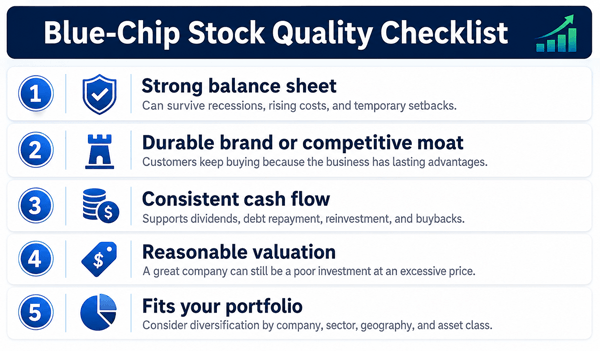
2. Blue-Chip Stocks in One Simple Example
Imagine a company that sells everyday products in more than 100 countries. It has been profitable for decades, carries manageable debt, owns famous brands, and pays shareholders a dividend every quarter. During a recession, sales may slow, but people still buy many of its products. The stock price can fall, but the business is less likely to disappear than a tiny unprofitable startup. That is the basic idea of a blue-chip stock.
Now compare that with a small speculative company that has one promising product, no steady profits, and depends on new funding to survive. That company may grow faster, but it can also fail faster. Blue-chip investing is usually less about chasing the next 10x stock and more about owning proven businesses that can compound steadily over time.
3. Common Features of Blue-Chip Companies
| Feature | What it means | Why it matters for beginners |
|---|---|---|
| Large market capitalization | The company is worth tens or hundreds of billions of dollars. | Large size usually means easier trading, more analyst coverage, and stronger access to capital. |
| Recognized brand | Customers know and trust the company. | Brand loyalty can protect sales and pricing power. |
| Stable revenue and profits | The business has a long operating history. | Consistency helps investors estimate future performance more realistically. |
| Strong balance sheet | Debt is manageable compared with cash flow and assets. | Financial strength helps a company survive downturns. |
| Dividend history | Many blue chips share profits through dividends. | Dividends can support income-focused investing, but they are never guaranteed. |
| Industry leadership | The company has scale, distribution, technology, patents, or customer relationships. | Leadership can create a competitive moat. |
4. How Blue-Chip Stocks Work
When you buy a blue-chip stock, you buy partial ownership in a real business. If the business grows its earnings and investors remain willing to pay a fair price for those earnings, the stock can rise over time. If the company pays dividends, you may also receive cash payments while you hold the shares.
A blue-chip stock can reward investors in three main ways: capital appreciation, dividends, and dividend growth. Capital appreciation happens when the stock price rises. Dividends are cash distributions from company profits. Dividend growth happens when the company raises its dividend over time, which can increase an investor’s income without buying more shares.
However, the stock price can still move sharply in the short term. Even excellent companies can fall 20%, 30%, or more during bear markets, recessions, lawsuits, product failures, management mistakes, or periods when the stock was simply too expensive.
5. Benefits of Blue-Chip Stocks
5.1 Stability compared with speculative stocks
Blue-chip companies usually have stronger finances, more diversified revenue, and better access to credit than small or early-stage businesses. This does not make them safe like a bank deposit. It simply means the business may be more durable than a speculative stock with no profits.
5.2 Dividend income potential
Many blue-chip stocks pay dividends, which can be attractive for investors who want income or who reinvest dividends to buy more shares. Dividend reinvestment can be powerful over long periods because each new share can produce its own future dividends. Still, dividends can be cut if profits fall, debt rises, or management decides cash is needed elsewhere.
5.3 Easier research for beginners
Blue-chip companies usually publish detailed financial reports, receive wide media coverage, and are followed by many analysts. Beginners still need to do their own research, but information is easier to find than it is for obscure micro-cap companies.
5.4 Liquidity
Large blue-chip stocks are usually easy to buy and sell during market hours because many investors trade them. This liquidity can reduce the risk of getting stuck in a position with a wide bid-ask spread.
5.5 A practical building block for long-term portfolios
Blue chips can work as part of a diversified portfolio, especially when paired with broad index funds, bonds, cash reserves, and other assets. FINRA explains that asset allocation, diversification, and rebalancing are important tools for managing investment risk.
6. Risks and Limitations Beginners Must Know
| Risk | Plain-English meaning | How to reduce it |
|---|---|---|
| Overpaying | A famous company can still be too expensive. | Compare valuation with earnings growth, cash flow, dividend yield, and history. |
| Single-stock risk | One company can disappoint badly. | Limit position size and diversify across companies and sectors. |
| Slow growth | Mature companies may grow slower than younger firms. | Set realistic expectations and combine with broad market exposure. |
| Dividend cuts | A dividend can be reduced or stopped. | Check payout ratio, free cash flow, debt, and earnings stability. |
| Disruption risk | A leader today can lose to new technology or competitors. | Review whether the company still has a strong moat. |
| False confidence | “Blue chip” is not an official safety rating. | Do not buy only because a company is famous or appears in an index. |
FINRA reminds investors that all investments carry some degree of risk, and stocks, bonds, mutual funds, and ETFs can lose value if market conditions sour. That warning applies to blue-chip stocks too.
7. Examples of Blue-Chip Stocks
Examples often mentioned by investors include companies such as Apple, Microsoft, Coca-Cola, Johnson & Johnson, Procter & Gamble, JPMorgan Chase, Visa, Walmart, Chevron, McDonald’s, and Berkshire Hathaway. These examples are not recommendations to buy. They are familiar companies that illustrate the qualities investors usually associate with blue chips: scale, brand power, long operating history, and broad market relevance.
The Dow Jones Industrial Average is often used as a shorthand list of U.S. blue-chip companies. It contains 30 companies and is price-weighted. The index is not a perfect definition of “blue chip,” but it is a useful reference point because its components are large, established U.S. businesses. S&P Dow Jones Indices announced that Nvidia and Sherwin-Williams replaced Intel and Dow Inc. in November 2024 to improve semiconductor and materials sector representation, a reminder that even blue-chip lists change over time.
| Company type | Example qualities to look for | Beginner takeaway |
|---|---|---|
| Consumer staples | Everyday products, repeat purchases, global distribution | Often defensive, but growth may be modest. |
| Technology leader | Large ecosystem, recurring revenue, high cash generation | Can grow faster, but valuation risk can be high. |
| Healthcare leader | Patents, scale, essential products, research pipeline | Can be resilient, but faces regulation and litigation risk. |
| Financial services | Large deposit base, payments network, credit discipline | Can benefit from scale, but is sensitive to credit cycles and regulation. |
| Energy or industrial leader | Hard assets, global operations, cyclical demand | Can pay strong dividends, but earnings may move with commodity or economic cycles. |
8. Blue-Chip Stocks vs Other Investments
| Investment | Main appeal | Main risk | Best used for |
|---|---|---|---|
| Blue-chip stock | Ownership in a proven company; possible dividends and growth | Single-company risk and market volatility | Long-term investors who can research and diversify |
| Growth stock | Higher growth potential | High valuation and larger price swings | Investors with higher risk tolerance |
| Dividend stock | Income potential | Dividend cuts and slow growth | Income-focused investors |
| Penny stock | Low share price and speculative upside | High failure, fraud, liquidity, and volatility risk | Generally unsuitable for most beginners |
| Blue-chip ETF | Diversified exposure through one fund | Fund fees and market risk | Beginners who want simplicity and diversification |
| Bond | Income and lower volatility than stocks in many conditions | Interest-rate, credit, and inflation risk | Stability, income, and portfolio balance |
9. How Beginners Can Use Blue-Chip Stocks
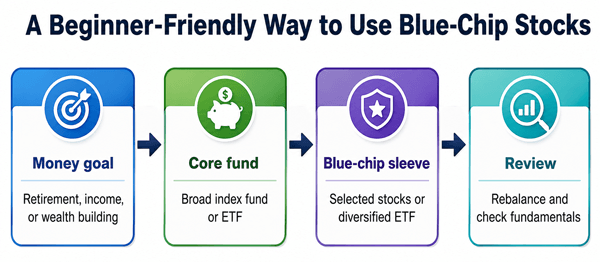
9.1 Start with your goal, not a ticker symbol
Before buying any stock, decide why you are investing. A person investing for retirement in 25 years may make different choices from someone saving for a home down payment in two years. Stocks are usually better suited for long-term goals because short-term prices can be unpredictable.
9.2 Build a core before picking individual stocks
Many beginners are better served by using a broad index fund or ETF as the core of the portfolio, then adding a smaller blue-chip stock sleeve if they want to learn individual stock investing. This approach reduces the chance that one bad stock decision damages the whole plan.
9.3 Use position sizing
A practical beginner rule is to avoid putting too much money into one stock. For example, an investor might limit each individual stock to 3% to 5% of the portfolio, depending on experience and risk tolerance. The exact number is personal, but the principle is simple: one company should not decide your financial future.
9.4 Diversify by sector
Owning five blue-chip technology stocks is not the same as being diversified. Sector concentration can hurt when one industry falls out of favor. A more balanced approach may include companies from technology, healthcare, consumer staples, financials, industrials, energy, and communications, or simply use an ETF that does this automatically.
9.5 Reinvest dividends if you do not need the income
For long-term investors, reinvesting dividends can help compound returns. If you need income, dividends can be taken as cash. If you are still building wealth, automatic dividend reinvestment through a brokerage account or retirement account can be a simple habit.
10. A Practical Blue-Chip Stock Research Checklist
| Question | Why it matters | What beginners can check |
|---|---|---|
| Is revenue growing over time? | A healthy company should generally increase sales across cycles. | Five-year revenue trend and management commentary. |
| Are profits and free cash flow consistent? | Cash flow funds dividends, debt repayment, and reinvestment. | Operating cash flow, free cash flow, net income trend. |
| Is debt manageable? | Too much debt can pressure dividends and flexibility. | Debt-to-equity, interest coverage, credit rating if available. |
| Is the dividend sustainable? | High yield can be a warning sign if unsupported by profits. | Payout ratio, dividend history, free cash flow coverage. |
| Does the company have a moat? | A moat protects profits from competition. | Brand strength, switching costs, patents, scale, network effects. |
| Is the valuation reasonable? | Even great businesses can underperform if bought too expensively. | P/E ratio, price-to-free-cash-flow, dividend yield vs history. |
| What could go wrong? | Good investing requires downside thinking. | Regulatory risk, lawsuits, disruption, cyclicality, management issues. |
11. Blue-Chip ETFs: The Easier Route for Many Beginners
A blue-chip ETF or large-cap index ETF can be a simpler way to invest in established companies without choosing each stock yourself. An ETF holds a basket of stocks, so one company’s bad results have less impact than they would in a single-stock portfolio. This can be especially useful for beginners who want exposure to high-quality companies but do not yet feel comfortable reading annual reports.
The trade-off is that you give up some control. You may own companies you would not personally choose, and you will pay an expense ratio. Still, for many investors, a low-cost diversified ETF is more practical than trying to pick the best blue-chip stocks one by one.
12. Common Beginner Mistakes
| Mistake | Why it hurts | Better habit |
|---|---|---|
| Buying only because the company is famous | Famous brands can still be overpriced or declining. | Check financials, valuation, and future prospects. |
| Chasing high dividend yield | A very high yield may signal distress. | Look for sustainable dividends backed by cash flow. |
| Ignoring taxes and account type | Dividends and gains may be taxed differently by account and country. | Consider whether a taxable brokerage account or retirement account fits the goal. |
| Selling during every market drop | Volatility is normal in stocks. | Use a written plan and invest money you do not need soon. |
| Holding too few stocks | One company problem can damage the portfolio. | Diversify with funds or a basket of stocks. |
| Confusing “safe company” with “safe stock price” | The business can be strong while the stock is expensive. | Always consider valuation and margin of safety. |
13. Real-World Investor Experiences: What People Usually Learn
Many long-term investors learn that blue-chip stocks feel boring during speculative bull markets. Smaller companies, meme stocks, crypto-related assets, or high-growth technology names may rise faster for a while. But when markets turn down, investors often appreciate companies with real earnings, strong balance sheets, and products people still buy.
Another common experience is that dividends can make holding easier during weak markets. A falling stock price is never pleasant, but receiving dividends can remind investors that the underlying business is still operating. The danger is becoming too attached to the dividend and ignoring warning signs such as rising debt, falling cash flow, or a payout ratio that is too high.
Experienced investors also learn that patience matters. Blue-chip investing is rarely about excitement. It is about buying quality at a sensible price, holding through normal volatility, and reviewing the business periodically instead of reacting to every headline.
14. Are Blue-Chip Stocks Good for Beginners?
Blue-chip stocks can be good for beginners if they are used carefully. They are easier to understand than many complex investments, and the companies are usually more transparent than tiny speculative businesses. But beginners should not assume blue chips are automatically safe or that a list of “best blue-chip stocks” is enough research.
A sensible beginner approach is to start with financial basics: emergency savings, high-interest debt management, clear goals, and a diversified investment plan. After that, blue-chip stocks can be added gradually, preferably with small position sizes and a long-term mindset.
15. Sample Beginner Portfolio Ideas
These examples are educational only, not personal financial advice. The right portfolio depends on age, income, goals, country, tax situation, risk tolerance, and investment horizon.
| Investor type | Possible structure | Why it may work |
|---|---|---|
| Hands-off beginner | 80% broad market ETF, 20% bond or cash-like allocation depending on risk tolerance | Simple, diversified, low maintenance. |
| Beginner who wants to learn stocks | 70% broad market ETF, 20% bonds/cash, 10% individual blue-chip stocks | Keeps most money diversified while allowing learning. |
| Income-focused investor | Core diversified funds plus dividend-focused blue chips or dividend ETF | Can create income, but dividend sustainability must be checked. |
| Higher-risk long-term investor | Broad equity ETF core plus selected blue-chip growth and dividend names | More stock exposure may increase long-term return potential but also volatility. |
16. Frequently Asked Questions About Blue-Chip Stocks
16.1 What does blue-chip stock mean?
A blue-chip stock is a share of a large, established, financially strong company with a long record of business performance and market leadership.
16.2 Are blue-chip stocks safe?
No stock is completely safe. Blue-chip stocks are often considered more stable than speculative stocks, but they can still lose value and dividends can be cut.
16.3 Do all blue-chip stocks pay dividends?
No. Many do, but not all. Some companies prefer to reinvest profits, buy back shares, or fund growth instead of paying large dividends.
16.4 What are the best blue-chip stocks for beginners?
There is no universal best list. Beginners should look for strong finances, durable competitive advantages, reasonable valuation, and portfolio fit. Many beginners may prefer a diversified ETF instead of picking individual stocks.
16.5 Can blue-chip stocks make you rich?
They can help build wealth over time if bought at sensible prices and held as part of a disciplined plan. But they are not a shortcut, and returns are never guaranteed.
16.6 How many blue-chip stocks should I own?
There is no perfect number. Owning several companies across different sectors, or using a diversified ETF, can reduce single-stock risk.
16.7 Are blue-chip stocks better than ETFs?
Not necessarily. Individual blue-chip stocks give more control but require research and carry company-specific risk. ETFs offer instant diversification and may be easier for beginners.
17. Final Takeaway
Blue-chip stocks are not magic, and they are not guaranteed winners. They are simply shares of established companies that have usually earned investor trust through scale, financial strength, brand power, and long operating histories. For beginners, the smartest use of blue-chip stocks is not to chase hype, but to build a diversified, long-term investment plan around quality, valuation, risk control, and patience.
The best mindset is simple: buy businesses you understand, avoid overconcentration, keep costs and taxes in mind, reinvest patiently when appropriate, and review your holdings with honest discipline. A famous name can open the door to research, but it should never replace research.
Sources Consulted and Checked
The following authoritative sources were consulted and checked while preparing this article and reviewing its factual accuracy.
- Investor.gov, “Stocks - FAQs”: blue-chip stocks are large, well-known companies with a solid history of growth and generally pay dividends.
- Investor.gov, “Introduction to Investing”: time horizon, risk tolerance, asset allocation, and diversification are core investing concepts.
- Investor.gov, “Diversification”: diversification means spreading money among investments so losses in one may be offset by others.
- FINRA, “Risk”: all investments carry some risk; stocks, bonds, mutual funds, and ETFs can lose value.
- FINRA, “Asset Allocation and Diversification”: asset allocation, diversification, and rebalancing are tools for managing investment risk.
- S&P Dow Jones Indices, “Dow Jones Industrial Average”: The Dow is a price-weighted measure of 30 U.S. blue-chip companies.
- S&P Dow Jones Indices, “The S&P 500 and The Dow”: The Dow contains 30 stocks and its components are large, well-known companies often described as blue chips.
- S&P Global press release, Nov. 1, 2024: Nvidia and Sherwin-Williams were set to replace Intel and Dow Inc. in the Dow Jones Industrial Average to improve sector representation.
Reader Advice
This article is provided solely for educational and general informational purposes. It does not constitute personalized investment, financial, legal, accounting, or tax advice, and it should not be relied upon as the sole basis for any decision. Investments involve risk, including the possible loss of principal, and past performance does not guarantee future results.
Readers should assess their own goals, financial circumstances, risk tolerance, time horizon, tax position, and local laws before acting. Market conditions, company circumstances, index constituents, tax treatment, regulations, fees, and other relevant facts may change over time or vary by country and account type. Therefore, readers should verify current facts, figures, rules, and product details through official or primary sources and, where appropriate, consult a suitably qualified and registered financial, legal, or tax professional before making a decision.