What Are Defensive Stocks? Why Investors Buy Them
1. Quick Answer: What Is a Defensive Stock?
A defensive stock is a share of a company whose products or services people usually keep buying even when the economy slows down. Think electricity, toothpaste, medicine, groceries, basic household goods, and essential healthcare. These businesses may not grow as fast as flashy technology or luxury brands during boom times, but they are often more stable when consumers and companies cut spending.
Investors buy defensive stocks because they want their portfolio to be less sensitive to recessions, inflation scares, interest-rate shocks, layoffs, and stock market volatility. Defensive stocks are not magic shields. They are simply businesses with demand that tends to be more consistent than the demand for cars, travel, luxury goods, advertising, construction, or other cyclical products.
| In one sentence | Plain-English meaning |
|---|---|
| Defensive stock | A stock that may hold up better because the company sells things people need, not just things they want. |
| Cyclical stock | A stock that usually does better when the economy is strong and worse when the economy is weak. |
| Low-volatility stock | A stock that has historically moved less sharply than the market, though this can change. |
| Dividend stock | A company that pays part of its profits to shareholders, often quarterly. Some defensive companies pay dividends, but not all do. |
Source note: Industry references commonly group consumer staples, utilities, and healthcare as defensive areas because these sectors provide essential goods and services. S&P Global has also found that these sectors have historically shown more defensive characteristics during market slowdowns. See the source list at the end.
2. Why Are They Called “Defensive”?
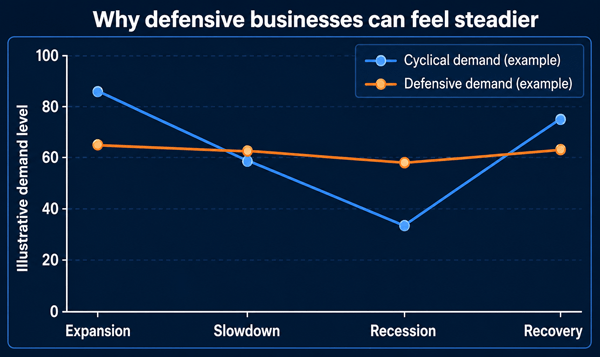
The word defensive does not mean the stock cannot fall. It means the business is built around products or services that defend revenue better than many other businesses when life gets difficult. In a recession, a family may delay buying a new car, cancel a holiday, or stop upgrading electronics. But the same family still pays the electricity bill, buys food, refills prescriptions, purchases soap, and visits doctors when needed.
That steady customer demand can create steadier sales, steadier cash flow, and sometimes steadier dividends. In the stock market, that often translates into smaller price swings compared with high-growth or highly cyclical companies. “Often” is the key word. Valuation, debt, regulation, lawsuits, management mistakes, product disruption, and interest rates can still hurt a defensive stock.
3. How Defensive Stocks Work
A defensive stock works through business resilience, not through a guaranteed investment return. The company sells essential goods or services. Because customers need those things, revenue may decline less during hard times. If the company also has strong margins, manageable debt, reliable free cash flow, and disciplined management, it may keep paying dividends and funding operations while weaker companies struggle.
| Business feature | Why it matters for beginners | Example |
|---|---|---|
| Essential demand | Customers buy the product in good and bad economies. | Food, electricity, medicine, hygiene products |
| Recurring revenue | Cash comes in repeatedly, not only from one-time purchases. | Utility bills, prescriptions, insurance renewals |
| Pricing power | The company may raise prices without losing many customers. | A strong household brand or regulated utility |
| Strong balance sheet | Lower debt can reduce pressure when rates rise or sales slow. | Companies with comfortable interest coverage |
| Dividend discipline | A sustainable payout can attract income investors. | Long dividend histories, but only if cash flow supports them |
4. Common Defensive Sectors
Defensive stocks are usually found in sectors where demand is tied to necessity. The most commonly cited defensive sectors are consumer staples, utilities, and healthcare. Some investors also consider telecom, insurance, certain real estate, and defense contractors defensive in specific conditions, but those categories can be more complicated.
| Sector | Why it can be defensive | Beginner caution |
|---|---|---|
| Consumer staples | People keep buying food, beverages, cleaning supplies, toiletries, and basic household goods. | Growth can be slow, and strong brands can become overpriced. |
| Utilities | Homes and businesses still need electricity, gas, and water. | Utilities often carry high debt and can be sensitive to interest rates and regulation. |
| Healthcare | People still need medicine, hospitals, diagnostics, and health services. | Patent expirations, lawsuits, pricing pressure, and regulation can hurt returns. |
| Telecom | Phone and internet access are close to essential for many households. | High capital spending, debt, and intense competition can reduce safety. |
| Discount retail | Consumers may trade down to cheaper stores during downturns. | Margins can be thin, and execution matters. |
5. Defensive Stocks vs. Cyclical Stocks
The easiest way to understand defensive stocks is to compare them with cyclical stocks. A cyclical company is tied closely to the economic cycle. When consumers feel confident and businesses are spending, cyclical companies can grow quickly. When the economy weakens, they can suffer sharply.
| Feature | Defensive stocks | Cyclical stocks |
|---|---|---|
| Typical demand | Stable because products are essential | Rises and falls with economic confidence |
| Examples | Groceries, utilities, medicine, household goods | Cars, airlines, hotels, luxury goods, industrial machinery |
| Best environment | Volatile markets, recessions, defensive rotations | Economic expansions and strong consumer spending |
| Typical investor goal | Stability, income, lower drawdowns | Growth, upside, economic recovery exposure |
| Main risk | Overpaying for “safety” and missing upside | Large losses when the cycle turns down |
6. Why Investors Buy Defensive Stocks
Investors usually buy defensive stocks for one or more of five reasons: to reduce volatility, seek income, prepare for recessions, diversify away from aggressive growth stocks, or stay invested without feeling fully exposed to the market.
- Portfolio protection: They may lose less than the broader market during certain downturns.
- Income potential: Many mature defensive companies pay dividends, which can be useful for income-focused investors.
- Lower emotional pressure: A steadier portfolio can help beginners avoid panic selling.
- Diversification: Defensive sectors often behave differently from technology, consumer discretionary, and other growth-heavy areas.
- All-weather exposure: Investors who do not want to leave the stock market completely may shift part of their allocation toward defensive names.
Real investor experience
Many beginners discover defensive stocks after their first painful market drop. They may have owned only exciting growth stocks, watched the portfolio fall quickly, and then realized that “good company” and “stable investment” are not always the same thing. Defensive stocks are often less exciting, but boring can be valuable when markets are stressful.
7. Practical Example: Two Beginner Portfolios
Imagine two new investors each start with $10,000. This is only an illustration, not a forecast.
| Portfolio | Allocation | What may happen in a downturn | What may happen in a strong bull market |
|---|---|---|---|
| Aggressive growth only | $10,000 in high-growth technology and consumer discretionary stocks | Could fall sharply if valuations compress or earnings disappoint. | Could outperform if growth expectations improve. |
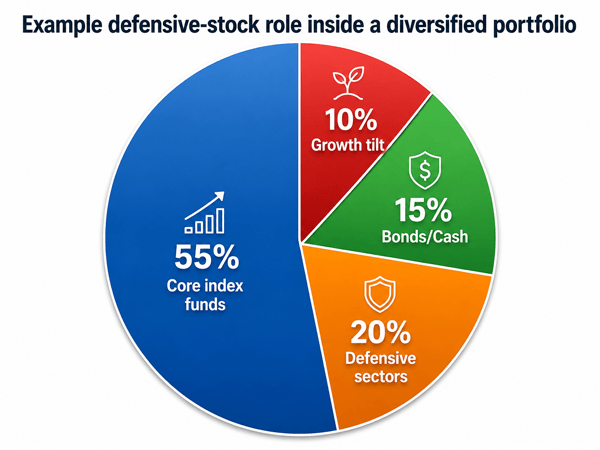
| Balanced with defensive tilt | $6,000 broad index fund, $2,000 defensive sectors, $1,500 bonds/cash, $500 growth tilt | May still fall, but defensive and bond/cash exposure may soften the hit. | May lag a pure growth portfolio if markets surge. |
The lesson is not that defensive stocks are always better. The lesson is that portfolio design should match the investor’s real behavior. If a beginner cannot emotionally handle a 35% drop, a slightly lower-return but more stable allocation may be more useful than a theoretically higher-return portfolio they abandon at the worst time.
8. How Beginners Can Use Defensive Stocks
8.1 Use them as a stabilizer, not as a prediction tool
A common mistake is buying defensive stocks only after bad news is everywhere. By then, many defensive shares may already be expensive. A better approach is to decide in advance what role defensive stocks should play in your portfolio.
8.2 Start with funds if individual stock research feels difficult
Beginners can get defensive exposure through sector ETFs, low-volatility ETFs, dividend ETFs, or broad index funds that already include defensive sectors. Funds reduce single-company risk, though they still carry market risk, sector risk, fees, and tracking differences.
8.3 Check valuation before calling something safe
A defensive business bought at a very high price can become a poor investment. Look at valuation ratios, dividend yield, dividend growth, earnings quality, debt, and cash flow. Safety in the business does not automatically mean safety in the stock price.
8.4 Do not confuse high dividend yield with defensive quality
A very high yield can be a warning sign. Sometimes the dividend looks high because the stock price has already fallen due to business problems. Beginners should look at payout ratio, free cash flow, debt, and dividend history rather than chasing yield alone.
8.5 Rebalance instead of reacting emotionally
If defensive stocks rise and become too large a share of your portfolio, rebalance. If growth stocks rise and defensive exposure becomes too small, rebalance. FINRA describes rebalancing as regular adjustments to keep your target allocation on track.
9. A Simple Checklist Before Buying a Defensive Stock
| Question | What a good answer may look like | Red flag |
|---|---|---|
| Is the product essential? | Customers need it in most economic conditions. | Demand depends on luxury spending or trends. |
| Is revenue stable? | Sales have been resilient through prior slowdowns. | Revenue swings heavily from year to year. |
| Is debt manageable? | Interest costs are covered comfortably by operating income. | Debt is high and rates are rising. |
| Is the dividend sustainable? | Payout is supported by earnings and free cash flow. | Dividend is funded by borrowing or asset sales. |
| Is valuation reasonable? | Price reflects realistic growth expectations. | Investors are paying too much for safety. |
| Is the business protected? | Brand, scale, regulation, network, or cost advantage helps defend profits. | Easy for competitors to copy or replace. |
10. Risks and Downsides of Defensive Stocks
Defensive stocks can reduce some risks, but they introduce others. A balanced article must say this clearly.
- They can underperform in strong bull markets because investors may prefer faster-growing companies.
- They can become overpriced when many investors rush toward safety at the same time.
- Utilities and telecom companies can be hurt by rising interest rates because they often use debt to fund infrastructure.
- Healthcare companies face regulation, patent cliffs, lawsuits, and political pricing pressure.
- Consumer staples companies may struggle if private-label brands gain share or input costs rise faster than selling prices.
- Dividends are not guaranteed. Companies can reduce or suspend payouts during stress.
- A defensive sector ETF can still fall if the whole market sells off or if valuations are too high.
11. Defensive Stocks, Bonds, Cash, and Gold: What Is the Difference?
| Asset | Main role | Income potential | Main risk |
|---|---|---|---|
| Defensive stocks | Stock-market exposure with potentially lower volatility | Dividends possible | Still equity risk; can lose money |
| Bonds | Income and capital preservation depending on bond type | Interest payments | Interest-rate, credit, and inflation risk |
| Cash | Liquidity and emergency safety | Usually low | Inflation can reduce purchasing power |
| Gold | Alternative store-of-value hedge for some investors | No business cash flow or dividend | Can be volatile and sentiment-driven |
For beginners, defensive stocks should not replace an emergency fund. Cash is for near-term needs. Bonds may help manage portfolio risk. Defensive stocks are still stocks, so they belong in the investment part of a plan, not in money needed for rent, school fees, medical bills, or emergencies.
12. Where Defensive Stocks Fit in a Portfolio
There is no perfect percentage for everyone. A young investor with a stable income and long time horizon may hold only a modest defensive tilt inside a broad stock portfolio. A retiree or conservative investor may prefer a larger allocation to defensive sectors, dividend-paying companies, bonds, and cash reserves. The right mix depends on goals, time horizon, income needs, and risk tolerance.
| Investor type | Possible use of defensive stocks | What to avoid |
|---|---|---|
| Beginner in accumulation phase | Use broad funds first; add defensive sector exposure only if it improves behavior and diversification. | Putting everything into one famous consumer brand. |
| Income-focused investor | Look for sustainable dividends and balance-sheet strength. | Chasing the highest yield. |
| Pre-retiree or retiree | Use defensive stocks as one part of a broader income and risk-control plan. | Replacing cash needs with stocks. |
| Active investor | Rotate cautiously when valuations and economic conditions justify it. | Market timing based on headlines alone. |
13. Best Defensive Stocks for Beginners?
Many people search for “best defensive stocks,” “best recession stocks,” or “best dividend stocks to buy now.” The honest answer is that the best defensive stock depends on price, quality, risk, and your portfolio. A famous brand can still be a bad buy if it is overpriced. A cheap-looking utility can still be risky if debt is too high. A high-yield dividend stock can still be dangerous if cash flow is weakening.
Instead of copying a list, beginners should build a watchlist using defensive sectors and then compare companies on quality, valuation, debt, dividend safety, and business durability. This approach is more trustworthy and more aligned with responsible investing content than promising guaranteed safe stocks.
14. Beginner-Friendly Research Process
| Step | Action | Why it helps |
|---|---|---|
| 1 | Identify the sector: consumer staples, utilities, healthcare, or another defensive category. | Confirms the company has defensive demand. |
| 2 | Read the latest annual report and investor presentation. | Shows revenue sources, risks, debt, and management priorities. |
| 3 | Check five-year revenue, earnings, free cash flow, and dividend trend. | Reveals whether stability is real or only a story. |
| 4 | Compare valuation with history and peers. | Prevents overpaying for a safe-sounding company. |
| 5 | Review debt and interest-rate sensitivity. | Important for utilities, telecom, and REIT-like businesses. |
| 6 | Limit position size and diversify. | Protects against company-specific surprises. |
15. Common Mistakes Beginners Make
- Buying defensive stocks after they have already become crowded and expensive.
- Assuming “defensive” means “cannot fall.”
- Putting too much money into one stock because the brand feels familiar.
- Chasing dividend yield without checking payout safety.
- Ignoring interest-rate risk in utilities and telecom.
- Selling all growth exposure and becoming too conservative for long-term goals.
- Forgetting taxes, trading costs, fund fees, and currency risk where applicable.
16. Frequently Asked Questions
16.1 Are defensive stocks safe?
They are usually considered safer than highly cyclical stocks, but they are not risk-free. Stock prices can fall, dividends can be cut, and individual companies can fail.
16.2 Do defensive stocks go up during a recession?
Sometimes they outperform the market during recessions, but outperforming can still mean falling less. They do not always rise.
16.3 Are dividend stocks the same as defensive stocks?
No. Many defensive companies pay dividends, but a dividend stock is not automatically defensive. A company can pay a dividend and still be cyclical or risky.
16.4 Can beginners buy defensive stocks through ETFs?
Yes. Sector ETFs, dividend ETFs, and low-volatility ETFs can provide diversified exposure, but investors should still review fees, holdings, concentration, and risk.
16.5 What is the biggest risk with defensive stocks?
Overpaying for stability. A strong business can become a weak investment if bought at an unrealistic valuation.
16.6 Should I buy only defensive stocks before a crash?
Usually no. Concentrating in one theme can create new risks. A diversified portfolio built before stress is generally more reliable than sudden market timing.
17. Final Takeaway
Defensive stocks are shares of companies that sell products and services people continue to need in almost every economy. They are popular because they can add stability, income potential, and diversification during uncertain markets. But the best way to use them is not to treat them as guaranteed safe stocks. Use them as one tool inside a diversified plan, check valuation carefully, avoid dividend traps, and remember that every investment carries risk.
For a beginner, the most practical path is simple: build a diversified core first, understand your risk tolerance, then use defensive stocks or defensive sector funds as a stabilizer if they fit your goals. The goal is not to avoid every market decline. The goal is to own a portfolio you can stick with through both good and bad markets.
Sources Consulted and Checked
These sources were consulted and checked while preparing this article to support clarity and accuracy.
- Investor.gov, “Diversification”: Defines diversification as spreading money among investments so losses in one area may be offset by others.
- FINRA, “Asset Allocation and Diversification”: Explains asset allocation, diversification, and rebalancing as important risk-management tools.
- Investor.gov, “What is Risk?”: Explains that all investments involve risk and potential financial loss.
- S&P Global, “Have Defensive Sectors Stood the Test of Time in Global Markets?”: Discusses consumer staples, healthcare, and utilities as sectors with defensive characteristics during market slowdowns.
- Investopedia, “Defensive Stock”: Describes defensive stocks as non-cyclical companies commonly found in consumer staples, utilities, and healthcare.
- Investopedia, “Consumer Staples”: Explains consumer staples as essential products such as food, beverages, and hygiene items that remain in demand across economic conditions.
Reader Advice
This article is provided solely for educational and informational purposes and does not constitute financial, investment, tax, or legal advice. Defensive stocks, exchange-traded funds, bonds, and all other investments can lose value; dividends may be reduced or suspended; and past performance does not guarantee future results. Before making any decision, readers should consider their objectives, financial circumstances, risk tolerance, time horizon, fees, taxes, currency exposure, and diversification needs, and should seek guidance from a suitably qualified professional where appropriate.
Market conditions, company fundamentals, laws, regulations, tax rules, product features, and published data may change over time or differ by country and investor circumstances. Readers should therefore verify current facts, figures, terms, and requirements through official regulators, fund providers, company filings, and other authoritative sources.