What Are Large-Cap Stocks? Definition, Examples, Benefits, Risks, and Beginner Guide
1. What Are Large-Cap Stocks?
Large-cap stocks are shares of large publicly traded companies. The word “cap” is short for market capitalization, which is the stock market’s estimate of a company’s total equity value. In simple terms, market capitalization answers this question: “How much is the whole company worth in the stock market right now?”
A company is usually called large-cap when its market capitalization is $10 billion or more. Some sources also separate the very biggest companies into a “mega-cap” group, often $200 billion or more. These thresholds are guidelines, not permanent laws. They can vary by country, index provider, and market condition.
For a beginner, the easiest way to think about large-cap stocks is this: they are often the household-name companies that have already grown big, have established customers, and are widely followed by investors. Examples may include companies in technology, banking, healthcare, consumer products, energy, and retail.
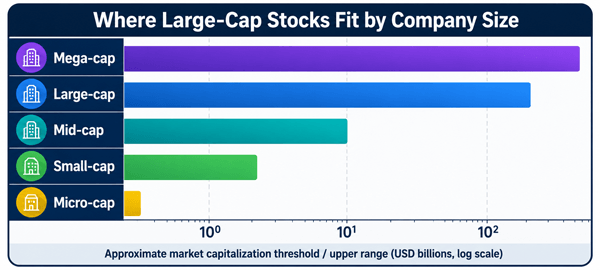
Figure 1. Approximate market-cap categories. Thresholds are guidelines and may vary by source, country, and market conditions.
2. Large-Cap Stocks Definition in One Sentence
A large-cap stock is a stock of a publicly traded company with a large market value, commonly $10 billion or more, calculated by multiplying the current share price by the total number of shares outstanding.
3. How Market Capitalization Works
Market capitalization is not the same as revenue, profit, assets, or brand value. It is calculated from the company’s share price and the number of shares investors collectively own.
Example: Suppose a company has 300 million shares outstanding and each share trades at $50. Its market capitalization is $15 billion. That would usually place it in the large-cap category.
| Item | Example |
|---|---|
| Share price | $50 |
| Shares outstanding | 300 million |
| Formula | $50 × 300,000,000 |
| Market capitalization | $15 billion |
| Category | Usually large-cap |
4. Large-Cap, Mid-Cap, Small-Cap, and Mega-Cap: Quick Comparison
Beginners often hear large-cap, mid-cap, small-cap, and blue-chip used together. They are related, but not identical. Market cap describes company size; “blue chip” is an informal label for financially strong, well-known companies with long operating histories.
| Category | Common market-cap range | What it usually means |
|---|---|---|
| Micro-cap | Below about $250 million | Very small public companies; often thinly traded and speculative. |
| Small-cap | About $250 million to $2 billion | Smaller companies with higher growth potential but usually higher volatility. |
| Mid-cap | About $2 billion to $10 billion | Companies between early growth and established scale. |
| Large-cap | About $10 billion to $200 billion | Established companies with deeper liquidity, analyst coverage, and broader investor ownership. |
| Mega-cap | About $200 billion or more | The biggest public companies; often major index drivers. |
5. Real Large-Cap Stock Examples
Large-cap stock examples change as share prices move. A company can move between categories because its stock price rises or falls, new shares are issued, or shares are bought back. The following examples were large-cap or mega-cap U.S. companies based on market data checked on June 23, 2026.
| Company | Sector | Recent market cap | Beginner takeaway |
|---|---|---|---|
| NVIDIA (NVDA) | Technology / semiconductors | About $4.96 trillion | A mega-cap example; large-cap status does not mean low risk because valuation and earnings expectations still matter. |
| Apple (AAPL) | Consumer technology | About $4.40 trillion | A familiar brand with global products; still affected by growth expectations, regulation, and competition. |
| Microsoft (MSFT) | Software / cloud | About $2.78 trillion | Shows how a mature company can still be tied to growth themes like cloud and AI. |
| JPMorgan Chase (JPM) | Banking / financial services | About $917 billion | A financial-sector large-cap; banks are sensitive to credit quality, interest rates, and regulation. |
| Johnson & Johnson (JNJ) | Healthcare | About $577 billion | A healthcare large-cap; defensive reputation does not remove product, litigation, or valuation risk. |
These are examples for education, not recommendations to buy. A stock can be large and still be overpriced, under pressure, or unsuitable for a particular investor.
6. Why Large-Cap Stocks Matter
Large-cap stocks matter because they often make up a big part of major stock market indexes, retirement portfolios, mutual funds, exchange-traded funds, and financial news coverage. When people say “the stock market went up today,” they are often referring to indexes that are heavily influenced by large companies.
For example, the S&P 500 is widely used as a benchmark for large U.S. companies and is weighted by market capitalization. That means larger companies usually have a bigger impact on the index than smaller companies.
7. How Large-Cap Stocks Make Money for Investors
Investors can make money from large-cap stocks in two main ways: price appreciation and dividends. Price appreciation happens when the stock price rises above the investor’s purchase price. Dividends are cash payments some companies make to shareholders from profits or cash flow. Not every large-cap company pays dividends, and dividends can be reduced or stopped.
| Return source | Simple example | What drives it |
|---|---|---|
| Price appreciation | You buy at $100 and later sell at $130. | Growth in earnings, better margins, investor optimism, lower interest rates, or stronger industry demand. |
| Dividends | You receive periodic cash payments while holding the stock. | Company profitability, dividend policy, free cash flow, and board decisions. |
| Total return | Price gain plus dividends. | Long-term investors usually focus on total return rather than share price alone. |
8. What Beginners Should Know Before Buying Large-Cap Stocks
8.1 Large does not automatically mean safe
A common beginner mistake is assuming a famous company is automatically a safe investment. Large-cap companies can still lose market share, miss earnings expectations, face lawsuits, become overvalued, or decline during bear markets. Size can reduce some business risks, but it does not remove stock market risk.
8.2 The stock price alone tells you almost nothing
A $20 stock is not automatically cheaper than a $300 stock. What matters is the value of the whole business compared with its earnings, cash flow, assets, debt, and growth. Market capitalization helps you compare company size, but valuation metrics help you judge whether the price may be reasonable.
8.3 Large-cap stocks can be growth stocks or value stocks
Some large-cap companies grow quickly and trade at high valuation multiples. Others grow slowly, pay dividends, and trade at lower valuations. A large-cap label tells you company size, not investment style.
8.4 Index funds may already give you large-cap exposure
Many beginners already own large-cap stocks indirectly through a retirement plan, S&P 500 index fund, total stock market fund, or large-cap mutual fund. Before buying individual large-cap stocks, it is practical to check what you already own to avoid accidental overconcentration.
8.5 Fees, taxes, and time horizon matter
Even a good investment can disappoint if the investor pays high fees, trades too often, sells emotionally, or ignores taxes. Beginners usually benefit from simple rules: diversify, keep costs low, avoid margin, and invest with a time horizon that fits stock market volatility.
9. Benefits of Large-Cap Stocks
| Benefit | Why it matters |
|---|---|
| Established businesses | Many large-cap companies have proven products, global customers, and easier access to capital. |
| Higher liquidity | Large-cap shares are usually easier to buy and sell without a big difference between bid and ask prices. |
| More public information | Analysts, media, regulators, and investors follow them closely, so information is easier to find. |
| Potential dividends | Many mature large-cap companies return cash through dividends or buybacks, although neither is guaranteed. |
| Index exposure | They are often core holdings in broad-market ETFs and retirement funds. |
10. Risks of Large-Cap Stocks
| Risk | Beginner explanation |
|---|---|
| Valuation risk | A great company can be a poor investment if bought at an unrealistic price. |
| Slower growth | Very large companies may find it harder to grow quickly because they are already huge. |
| Concentration risk | Market-cap-weighted indexes can become heavily dependent on a few mega-cap stocks. |
| Business disruption | Technology, regulation, competition, and consumer behavior can hurt even dominant companies. |
| Market risk | Large-cap stocks can fall during recessions, interest-rate shocks, geopolitical stress, or broad selloffs. |
| Currency and global risk | Many large-cap companies earn revenue worldwide, so currency and international conditions can affect results. |
11. Large-Cap Stocks vs Blue-Chip Stocks
Large-cap and blue-chip are often used together, but they are not the same. Large-cap is based mainly on market value. Blue-chip is a reputation-based term for established, financially strong, widely respected companies. A blue-chip stock is usually large-cap, but not every large-cap stock deserves to be called blue-chip.
| Term | Meaning | Number-based? | Important note |
|---|---|---|---|
| Large-cap | Company size based on market capitalization. | Usually $10 billion or more. | Objective, but thresholds vary. |
| Blue-chip | Company quality and reputation. | No exact number. | Subjective; based on history, stability, brand strength, and financial resilience. |
12. Large-Cap Stocks vs Small-Cap Stocks
The choice between large-cap and small-cap stocks is not about which is “better.” It is about risk, return potential, diversification, and investor temperament. Many long-term portfolios include both.
| Factor | Large-cap stocks | Small-cap stocks |
|---|---|---|
| Company maturity | More established | Earlier-stage or niche |
| Volatility | Often lower, but still meaningful | Often higher |
| Information availability | More analyst coverage and filings discussion | Less coverage; more research burden |
| Growth potential | May be steadier but slower | Can be higher, but less predictable |
| Liquidity | Usually higher | Can be lower |
| Beginner suitability | Often easier to understand and research | Requires stronger risk control |
13. How Beginners Can Invest in Large-Cap Stocks
There are three common ways to get exposure: individual stocks, large-cap index funds/ETFs, and actively managed large-cap funds. For most beginners, a low-cost diversified fund is often easier to manage than picking individual companies.
| Method | How it works | Pros | Cons |
|---|---|---|---|
| Individual large-cap stocks | Buy shares of specific companies. | More control and learning experience. | Company-specific risk; requires research and emotional discipline. |
| Large-cap index fund or ETF | Buy a basket tracking an index such as a large-cap benchmark. | Instant diversification, low maintenance, usually lower cost. | Still exposed to market declines and index concentration. |
| Active large-cap mutual fund | A manager selects large-cap stocks. | Potential for professional research and different strategy. | Higher fees may reduce returns; manager may underperform. |
14. A Practical Beginner Framework: How to Evaluate a Large-Cap Stock
You do not need to become a Wall Street analyst to understand the basics. Use this simple checklist before buying any large-cap stock.
| Checklist item | Question to ask |
|---|---|
| Business model | How does the company make money? Can you explain it in one sentence? |
| Revenue and profit trend | Are sales and earnings growing, stable, or declining? |
| Competitive advantage | Does it have brand power, network effects, cost advantage, patents, data, scale, or customer loyalty? |
| Balance sheet | Is debt manageable? Does the company have enough cash and cash flow? |
| Valuation | What are investors paying for each dollar of earnings, sales, or cash flow? |
| Dividend quality | If it pays dividends, are they supported by cash flow? |
| Risks | What could go wrong over the next 3 to 5 years? |
| Portfolio fit | Does this add diversification, or does it duplicate what you already own? |
15. Example: Comparing Two Large-Cap Stocks
Imagine two large-cap companies. Company A has a $400 billion market cap, grows revenue 15% per year, but trades at a very high price-to-earnings ratio. Company B has a $90 billion market cap, grows revenue 4% per year, pays a dividend, and trades at a lower valuation. Both are large-cap stocks, but they are not the same investment.
| Factor | Company A | Company B |
|---|---|---|
| Market cap | $400 billion | $90 billion |
| Growth rate | High | Moderate |
| Dividend | Low or none | Meaningful dividend |
| Valuation | Expensive relative to earnings | More moderate |
| Likely investor type | Growth-focused investor | Income/value-focused investor |
| Main risk | Overpaying for future growth | Slow growth or industry pressure |
The lesson: market cap tells you size; it does not tell you whether the stock is attractively priced or right for your portfolio.
16. Common Beginner Mistakes with Large-Cap Stocks
| Mistake | Better habit |
|---|---|
| Buying only because the company is famous | A well-known brand can still be an overpriced stock. |
| Confusing stock price with company value | Use market cap and valuation metrics, not share price alone. |
| Putting too much money into one stock | Diversification protects you from one-company mistakes. |
| Ignoring overlap in funds | A total market fund and an S&P 500 fund may hold many of the same large-cap stocks. |
| Chasing recent winners | Strong past returns can create high expectations and future disappointment. |
| Selling during normal volatility | Large-cap stocks still move up and down; plan before emotions take over. |
17. How Large-Cap Stocks Fit in a Portfolio
Large-cap stocks often act as the core equity portion of a portfolio because they provide broad exposure to established companies. But a balanced portfolio may also include mid-cap stocks, small-cap stocks, international stocks, bonds, cash, or other assets depending on the investor’s goals.
A beginner with a long time horizon may use a broad low-cost index fund as a foundation, then add individual large-cap stocks only if they enjoy research and can keep position sizes reasonable. A retiree may care more about dividends, stability, and drawdown risk. There is no one perfect allocation for everyone.
18. Large-Cap ETFs and Index Funds: Why Many Beginners Start There
Large-cap ETFs and index funds are popular because they reduce single-company risk. Instead of betting everything on one company, the investor owns a basket. This does not guarantee profit, but it can make the investment process simpler and less dependent on picking winners.
| Fund selection tip | Why it matters |
|---|---|
| Look for low expense ratio | Lower fees leave more return for the investor over time. |
| Understand the index | Know whether the fund tracks the S&P 500, a total market index, growth index, value index, or dividend index. |
| Check concentration | See how much of the fund sits in the top 10 holdings. |
| Review sector exposure | A large-cap fund can be heavily tilted toward technology or another sector. |
| Avoid unnecessary trading | Frequent buying and selling can increase taxes and mistakes. |
19. Frequently Asked Questions
19.1 Are large-cap stocks good for beginners?
They can be a reasonable starting point because information is easier to find and many large-cap companies have established businesses. However, beginners should still diversify and avoid assuming that large means risk-free.
19.2 What market cap is considered large-cap?
A common guideline is $10 billion or more. Some providers classify mega-cap stocks separately at $200 billion or more. The exact cutoff can vary.
19.3 Can large-cap stocks lose money?
Yes. Large-cap stocks can fall due to weak earnings, recession fears, high valuation, regulation, lawsuits, competition, or broad market declines.
19.4 Do all large-cap stocks pay dividends?
No. Some mature companies pay dividends, while many growth-oriented large-cap companies reinvest cash instead. Dividend policies can also change.
19.5 Is the S&P 500 only large-cap stocks?
The S&P 500 is widely treated as a large-cap U.S. stock benchmark, but index membership depends on specific eligibility rules and committee decisions, not only size.
19.6 Should I buy individual large-cap stocks or an ETF?
For many beginners, a diversified ETF or index fund is simpler. Individual stocks can make sense for investors who understand the business, can evaluate valuation and risks, and keep position sizes modest.
20. Bottom Line
Large-cap stocks are shares of big publicly traded companies, commonly valued at $10 billion or more. They are often established, liquid, and widely followed, which makes them easier for beginners to research. But they are not automatically safe, cheap, or suitable for everyone.
The smartest way to use large-cap stocks is to understand what they do in a portfolio: they can provide core exposure to major companies, possible long-term growth, and in some cases dividends. The honest beginner approach is to diversify, keep fees low, avoid hype, understand valuation, and invest according to a clear plan rather than a headline.
Sources Consulted and Checked
The following sources were consulted and checked while preparing this article and reviewing its accuracy. Readers should use the latest official information because definitions, index rules, market values, and other facts may change over time.
- SEC Investor.gov: market capitalization definition and stock categories. https://www.investor.gov/introduction-investing/investing-basics/glossary/market-capitalization
- SEC Investor.gov: large cap, mid cap, small cap glossary. https://www.investor.gov/introduction-investing/investing-basics/glossary/large-cap-mid-cap-small-cap
- FINRA: Market Cap Explained, including common capitalization ranges. https://www.finra.org/investors/insights/market-cap
- Fidelity: Market cap explanation and common large-cap threshold. https://www.fidelity.com/learning-center/trading-investing/market-cap
- S&P Dow Jones Indices: S&P 500 index information and methodology context. https://www.spglobal.com/spdji/en/indices/equity/sp-500/
- Market data examples checked via current finance quotes on June 23, 2026 for NVDA, AAPL, MSFT, JPM, and JNJ. Market caps change throughout the trading day.
Reader Advice
This article is provided solely for educational and general informational purposes. It does not constitute personal investment, financial, tax, accounting, or legal advice, and it is not a recommendation or solicitation to buy, sell, or hold any security, fund, or other financial product. Before making a decision, readers should consider their own goals, financial circumstances, risk tolerance, time horizon, diversification, fees, taxes, and potential losses, and should seek advice from appropriately qualified professionals where necessary.
Market-cap classifications, company values, index eligibility rules, laws, regulations, tax treatment, product terms, and market conditions can change. Readers should therefore verify important facts, figures, dates, and requirements through current official sources and relevant regulatory or professional guidance. Past performance, company size, brand recognition, or inclusion in an index does not guarantee future results or protect against loss.