Tokenomics Explained: Meaning, How It Works, Examples, Benefits and Risks
1. Introduction
Tokenomics is one of the most important ideas to understand before buying, using, or evaluating a cryptocurrency token. A token may have exciting technology, a strong community, or a famous founder, but its long-term health often depends on a simple question: does the token's economic design make sense?
In plain English, tokenomics means the economics of a crypto token. It looks at how tokens are created, distributed, used, rewarded, locked, unlocked, burned, and traded. Good tokenomics can help align users, developers, investors, validators, and the project team. Weak tokenomics can create inflation, sell pressure, unfair ownership, poor incentives, or a token that has little reason to exist.
This guide explains tokenomics from the ground up, using practical examples and simple comparisons so beginners can understand what to look for and what to avoid.
2. What Is Tokenomics?
Tokenomics is the study and design of the economic rules behind a crypto token. It covers the token's supply, demand, utility, incentives, distribution, governance, and market behavior.
- Supply: How many tokens exist now, how many can exist in the future, and how quickly new tokens enter circulation.
- Utility: What the token is actually used for, such as paying fees, staking, voting, accessing a service, or rewarding users.
- Distribution: Who owns the tokens, how they received them, and when locked tokens become available.
- Incentives: How the system encourages useful behavior, such as validating transactions, providing liquidity, or contributing to a network.
- Demand drivers: Why users might want or need the token beyond speculation.
A simple way to think about tokenomics is this: if a crypto project is like a small digital economy, the token is its money, membership pass, voting tool, reward system, or fuel. Tokenomics defines the rules of that economy.
Quick Answer: Tokenomics means the economic design of a crypto token, including how it is created, supplied, distributed, used, rewarded, and governed. It helps people understand whether a token has healthy incentives, real utility, and sustainable supply-demand dynamics.
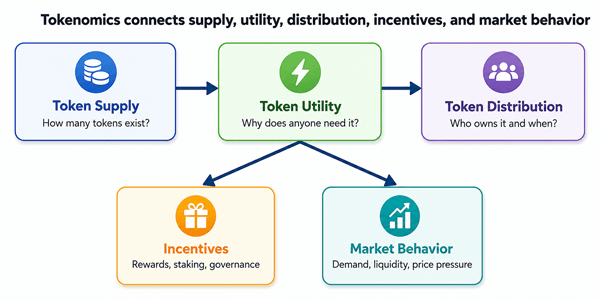
Diagram: The main parts of tokenomics and how they connect.
3. Why Tokenomics Matters
Tokenomics matters because price is not just about hype. Over time, a token's value is influenced by how many tokens exist, who holds them, how they enter the market, and whether the token has a meaningful role in the ecosystem.
- Investors use tokenomics to evaluate supply pressure, unlock schedules, and potential dilution.
- Users use tokenomics to understand fees, rewards, staking rules, and governance rights.
- Project teams use tokenomics to design incentives that keep networks secure and useful.
- Exchanges, analysts, and communities use tokenomics to compare one project with another.
Tokenomics does not guarantee success. A token with a clever design can still fail because of weak product-market fit, poor execution, security failures, regulation, or bad governance. But ignoring tokenomics is like buying a business without looking at its revenue, ownership, debt, or cash flow.
4. How Tokenomics Works: The Core Components
4.1 Token Supply
Token supply describes how many tokens exist and how many may exist in the future. This is usually the first thing beginners should check because supply affects scarcity and dilution.
| Supply term | Meaning | Why it matters |
|---|---|---|
| Max supply | The maximum number of tokens that can ever exist, if a cap exists. | A hard cap can create scarcity, but scarcity alone does not create value. |
| Total supply | All tokens created so far, excluding tokens that may have been burned depending on the data source. | Shows the full token base that may affect the market. |
| Circulating supply | Tokens currently available to the public market. | Often more relevant for current market value and price pressure. |
| Fully diluted valuation (FDV) | Token price multiplied by max or total future supply. | Useful for spotting expensive projects with many locked tokens still waiting to unlock. |
| Emission rate | How quickly new tokens are created or released. | High emissions can dilute holders if demand does not grow. |
Example: Bitcoin is famous for having a limited supply model, with the protocol designed around a maximum of about 21 million BTC and new issuance that decreases over time through halvings. This does not mean Bitcoin's price must always rise, but it does make its supply schedule easier to understand than many tokens with flexible issuance.
4.2 Token Utility
Utility means what the token is used for. A token with no clear use may depend mainly on speculation. Strong token utility connects the token to the actual activity of the network.
- Payment utility: The token is used to pay transaction fees or service fees.
- Access utility: The token gives access to a product, feature, game, data service, or membership.
- Staking utility: Users lock tokens to help secure a network or service and may earn rewards.
- Governance utility: Token holders vote on protocol decisions, upgrades, treasury spending, or parameters.
- Collateral utility: The token is used as collateral in lending, derivatives, or security mechanisms.
A practical test: ask, 'What can a user do with this token today besides sell it to someone else?' If the answer is unclear, the token's demand may be weak.
4.3 Token Distribution and Allocation
Distribution shows who received tokens at launch or over time. Common groups include the team, founders, investors, ecosystem funds, community rewards, liquidity providers, advisors, validators, and public sale participants.
| Allocation group | What to check | Possible concern |
|---|---|---|
| Team and founders | Percentage owned and vesting period. | Too much early control or short lockups can create sell pressure. |
| Private investors | Purchase price, unlock schedule, and allocation size. | Early investors may sell aggressively after large gains. |
| Community rewards | How users earn tokens and whether rewards are sustainable. | Rewards can attract mercenary users if there is no real product demand. |
| Treasury or foundation | How funds are governed and spent. | Poor transparency can lead to misuse or weak accountability. |
| Liquidity incentives | Rewards for market makers or liquidity providers. | Can temporarily boost liquidity but may disappear when rewards end. |
4.4 Vesting, Lockups, and Token Unlocks
Vesting is a release schedule that controls when locked tokens become available. It is often used for team members, advisors, and investors. A cliff is a period when no tokens are released, followed by a large unlock or a gradual release.
Unlock schedules matter because they can change circulating supply. If many tokens unlock at once, holders may worry about selling pressure. That does not always mean the price will fall, but it is a real risk to evaluate.
- Healthy sign: long vesting periods, transparent unlock dates, and gradual releases.
- Risk sign: large insider allocations unlocking soon with little explanation or poor communication.
- Beginner tip: compare market capitalization with fully diluted valuation. A very high FDV relative to market cap can mean many tokens are still locked.
4.5 Inflation, Deflation, and Token Burns
Token inflation means supply increases over time. This is not always bad. Inflation can pay validators, reward contributors, or support ecosystem growth. It becomes a problem when new supply grows faster than real demand.
Token deflation means supply decreases over time or grows more slowly than tokens are removed. A token burn permanently removes tokens from circulation. Ethereum's EIP-1559 introduced a mechanism where the base fee paid for transactions is burned, which can reduce net ETH supply during periods of high network activity.
| Model | How it works | Potential benefit | Potential risk |
|---|---|---|---|
| Fixed supply | No more than a set number of tokens can exist. | Clear scarcity narrative. | May not provide enough ongoing incentives without fees or other revenue. |
| Inflationary supply | New tokens are issued over time. | Can reward security, liquidity, or growth. | Can dilute holders if demand is weak. |
| Deflationary or burn model | Tokens are removed from supply through burns or fees. | Can offset emissions and signal usage. | Burns do not create value if the product has no demand. |
| Dynamic supply | Supply changes based on rules, demand, or governance. | Flexible economic management. | Complexity can confuse users and create governance risk. |
4.6 Incentives and Rewards
Crypto networks often use tokens to reward behavior that helps the system. For example, validators may earn rewards for securing a proof-of-stake network, liquidity providers may earn tokens for supplying trading liquidity, and users may earn tokens for participating in an ecosystem.
Good incentives reward behavior that creates lasting value. Weak incentives reward short-term activity that disappears when rewards stop.
4.7 Governance
Governance tokens allow holders to vote on project decisions. This can make a protocol more community-driven, but it also creates risks. If voting power is concentrated among insiders, whales, or venture investors, governance may not be as decentralized as it appears.
- Check whether one wallet or group can control proposals.
- Review voter participation. Low participation can let a small minority decide major changes.
- Look at what token holders can actually vote on. Some governance tokens have limited real power.
5. Real-World Tokenomics Examples
| Project or token type | Tokenomics lesson | Beginner takeaway |
|---|---|---|
| Bitcoin (BTC) | A capped supply and predictable issuance schedule make the scarcity model easy to understand. | Simple supply rules can build trust, but demand, security, adoption, and regulation still matter. |
| Ethereum (ETH) | ETH is used for gas, staking, and network security. EIP-1559 burns the base fee, while staking rewards issue ETH to validators. | A token can have both issuance and burns; net supply depends on network activity and rewards. |
| Governance tokens | Tokens may let holders vote on protocol changes or treasury spending. | Governance value depends on real decision power and broad participation. |
| Play-to-earn game tokens | Tokens may reward players and be spent inside a game economy. | If rewards exceed real demand for spending, the token can face heavy inflation. |
| Stablecoins | Tokens are designed to track another asset such as the U.S. dollar. | Tokenomics depends on reserves, redemption rules, collateral, audits, and market confidence. |
6. Tokenomics vs Traditional Economics
| Traditional economy concept | Tokenomics equivalent | Example |
|---|---|---|
| Money supply | Token supply, emissions, burns | A network issues new tokens to validators. |
| Share ownership | Token allocation and governance | Token holders vote on a protocol proposal. |
| Employee stock vesting | Team token vesting | Founders receive tokens gradually over four years. |
| Consumer loyalty points | Reward tokens | Users earn tokens for providing liquidity or using an app. |
| Central bank policy | Protocol rules or DAO governance | A DAO votes to change emissions or rewards. |
7. Benefits of Good Tokenomics
- Clear incentives: Users, developers, validators, and investors understand why the token exists and how to participate.
- Healthier supply management: Transparent emissions, burns, and unlocks reduce surprises.
- Stronger network security: Staking and validator rewards can encourage honest participation.
- Better community alignment: Governance and reward systems can give users a stake in the ecosystem.
- More informed decision-making: Investors can compare market cap, FDV, unlocks, and utility instead of relying only on price charts.
8. Risks and Limitations of Tokenomics
- High dilution: New tokens or unlocks can reduce each holder’s share of the network.
- Insider concentration: A small group may control supply, governance, or market liquidity.
- Weak utility: A token may exist mainly for fundraising or speculation rather than genuine use.
- Unsustainable rewards: Very high yields may be paid from new token issuance rather than real revenue.
- Liquidity risk: A token can show a high market cap but have thin trading volume, making it hard to buy or sell without moving the price.
- Smart contract and security risk: Bugs, hacks, or oracle failures can damage even a well-designed token economy.
- Regulatory risk: Some tokens may face changing legal treatment depending on their structure, marketing, and jurisdiction.
- Governance attacks: Large holders may influence votes for their own benefit.
The most important limitation is that tokenomics is only one part of project analysis. A beautiful token model cannot fix a product nobody uses, a dishonest team, poor security, or unclear legal exposure.
9. Common Tokenomics Mistakes Beginners Make
- Looking only at price. A cheap-looking token is not necessarily undervalued. Always check circulating supply and FDV.
- Ignoring unlock schedules. A token can look attractive today but face major sell pressure after a large unlock.
- Confusing burns with guaranteed value. Burns can help supply dynamics, but only if there is real demand for the token.
- Assuming high staking rewards are free income. Rewards often come from new issuance, which can dilute holders.
- Believing governance always means decentralization. Voting power may be concentrated among a few wallets.
- Forgetting liquidity. A token with low trading volume can be difficult to exit during stress.
- Treating tokenomics as a price prediction tool. It helps assess structure and incentives, not guaranteed future returns.
10. How to Evaluate Tokenomics Before Buying or Using a Token
Use this practical checklist before making a decision:
| Question | What a good answer looks like | Red flag |
|---|---|---|
| What is the token used for? | Clear demand tied to product usage, security, access, fees, or governance. | The only use case is selling to future buyers. |
| How many tokens exist now and later? | Transparent circulating, total, and max supply figures. | Unclear supply data or frequent unexplained changes. |
| Who owns the supply? | Balanced distribution with transparent wallets and fair community allocation. | Large hidden insider or whale concentration. |
| When do tokens unlock? | Gradual vesting with public schedules. | Large near-term unlocks and little communication. |
| Where do rewards come from? | Fees, revenue, useful work, or sustainable emissions. | Very high yields funded mainly by printing new tokens. |
| Can governance be captured? | Broad participation and safeguards. | A few wallets can pass major proposals alone. |
| Is there enough liquidity? | Healthy trading volume and transparent liquidity sources. | Thin markets, suspicious volume, or locked liquidity uncertainty. |
11. A Simple Tokenomics Scoring Framework
Beginners can use a simple 1-to-5 score for each area. This is not financial advice or a price model; it is a way to organize your thinking.
| Category | Score 1 means | Score 5 means |
|---|---|---|
| Utility | Unclear or speculative use. | Token is needed for meaningful network activity. |
| Supply clarity | Confusing or changing supply rules. | Transparent supply, emissions, burns, and caps. |
| Distribution | Highly concentrated or hidden. | Balanced, transparent, and well-vested. |
| Unlock risk | Large near-term unlocks. | Gradual, predictable unlocks. |
| Incentive quality | Rewards attract short-term farming only. | Rewards support useful, long-term behavior. |
| Governance quality | Whales or insiders dominate. | Broad, active, accountable participation. |
| Liquidity and market depth | Hard to trade safely. | Healthy, transparent markets. |
After scoring, look for patterns. A token with weak utility, high insider concentration, and major upcoming unlocks deserves extra caution, even if the community is excited.
12. Best Practices for Project Teams Designing Tokenomics
- Start with product utility, not a token. A token should solve a real coordination, access, incentive, or governance problem.
- Make supply rules simple and public. Users should not need advanced modeling skills to understand basic token flows.
- Avoid excessive insider allocation. Long vesting and transparent wallets can build trust.
- Design rewards around useful behavior. Reward retention, security, liquidity quality, or real contribution, not empty activity.
- Plan for sustainability. If incentives require constant emissions, explain what happens when rewards decline.
- Communicate unlocks early. Surprise unlocks damage trust.
- Stress-test bad scenarios. Model what happens if usage drops, rewards are farmed, or a large holder sells.
13. Best Practices for Investors and Users
- Read the project documentation, token allocation page, and governance forum before buying.
- Compare circulating market cap with fully diluted valuation.
- Check upcoming unlocks and emissions, not just current supply.
- Ask whether demand comes from real usage or mainly speculation.
- Look at wallet concentration and voting power concentration.
- Treat very high yields as a risk signal until you understand the source of rewards.
- Do not invest money you cannot afford to lose. Crypto assets can be highly volatile and may lack protections found in regulated markets.
14. Pros and Cons of Tokenomics Analysis
| Pros | Cons |
|---|---|
| Helps beginners understand supply, demand, and incentives. | Can become too technical or model-heavy. |
| Reveals dilution, unlock, and insider concentration risks. | Does not predict price with certainty. |
| Makes projects easier to compare. | Data sources may disagree or be incomplete. |
| Encourages long-term thinking beyond hype. | Good tokenomics cannot fix a weak product or bad team. |
15. Frequently Asked Questions About Tokenomics
15.1 What does tokenomics mean in simple words?
Tokenomics means the economic rules of a crypto token. It explains how the token is supplied, distributed, used, rewarded, locked, unlocked, burned, and governed.
15.2 Why is tokenomics important?
Tokenomics helps users and investors understand whether a token has real utility, fair distribution, sustainable incentives, and manageable supply pressure.
15.3 Is a low token price good?
Not necessarily. A token priced at $0.01 can still be expensive if there are billions or trillions of tokens. Market cap and fully diluted valuation are more useful than price alone.
15.4 Is a fixed supply always better?
No. Fixed supply can support scarcity, but some networks need inflation to pay validators or contributors. The key question is whether supply growth is justified by real network value.
15.5 Are token burns always bullish?
No. Burns reduce supply, but they do not guarantee higher value. Burns matter more when the token also has real demand and the burn mechanism is meaningful compared with total supply.
15.6 What is FDV in tokenomics?
FDV, or fully diluted valuation, estimates a token’s value if all planned tokens were circulating at the current price. It helps reveal future dilution risk.
15.7 What is a token unlock?
A token unlock happens when previously locked tokens become available to the team, investors, community, or other groups. Unlocks can increase circulating supply and may create sell pressure.
15.8 Can tokenomics tell me whether a token price will rise?
No. Tokenomics can help evaluate structure and risk, but price depends on many factors, including demand, liquidity, market cycles, security, regulation, and execution.
15.9 What is the biggest tokenomics red flag?
One major red flag is weak utility combined with high insider ownership and large upcoming unlocks. That combination can create strong sell pressure without real demand.
15.10 Where can I find tokenomics information?
Common sources include the project whitepaper, official documentation, token allocation pages, governance forums, block explorers, reputable token data platforms, and security or audit reports.
16. Conclusion
Tokenomics is the economic blueprint of a crypto token. It explains how supply works, why the token exists, who owns it, when locked tokens enter the market, how users are rewarded, and how decisions are governed.
For beginners, the goal is not to become a professional token economist overnight. The goal is to ask better questions. What is the token used for? Who controls the supply? Are rewards sustainable? Are unlocks transparent? Does demand come from real usage or mainly speculation?
Good tokenomics does not remove risk, but it can make a project easier to understand. Weak tokenomics, on the other hand, can turn even an exciting idea into an unhealthy economy. Before buying, staking, farming, or voting with any token, take time to study the rules behind it.
Sources Consulted and Checked
The following sources were consulted and checked while preparing this document and reviewing its accuracy.
- Bitcoin.org - Bitcoin overview and network design
- Ethereum EIP-1559 - Fee market change and base fee burn
- Coinbase - EIP-1559 educational explainer
- Chainlink - Chainlink Staking and token utility
- Messari Docs - Token unlocks and vesting data
- SEC - Crypto assets and investor protection resources
Reader Advice
This article is provided for educational and informational purposes only and is not personalized financial, legal, investment, tax, or regulatory advice or a recommendation to buy, sell, hold, stake, or use any crypto asset. Crypto assets and token-based projects can be highly volatile and may involve loss of capital, liquidity, cybersecurity, smart-contract, governance, counterparty, and regulatory risks. Rules, policies, laws, market data, and statistics can change over time and may vary by country or region, so readers should verify important information through current official sources and consider seeking advice from an appropriately qualified professional before making a decision.