Crypto Market Cycles: Complete Guide, Examples, Risks and Best Practices
1. Introduction: Why Crypto Market Cycles Matter
Crypto prices can feel random, especially to beginners. Bitcoin may rise quickly for months, social media may become full of predictions, and then the same market can fall sharply and stay quiet for a long time. This repeating pattern is what people usually mean when they talk about crypto market cycles.
A crypto market cycle is the broad pattern of rising prices, investor excitement, profit-taking, falling prices, fear, and eventual recovery that can happen across Bitcoin, Ethereum, altcoins, stablecoins, DeFi tokens, NFTs and other digital assets. The cycle is not a perfect clock. It does not guarantee that prices will rise after a certain date. But understanding cycles can help beginners avoid common emotional mistakes: buying only after a huge rally, selling in panic near a bottom, or assuming every project will recover.
2. What Is a Crypto Market Cycle?
A crypto market cycle is a multi-stage pattern in which prices, trading activity, liquidity, media attention, risk appetite and investor emotions move through phases. The four basic phases are usually described as accumulation, markup, distribution and markdown.
| Cycle phase | What usually happens | Common beginner mistake |
|---|---|---|
| Accumulation | Prices are flat or recovering slowly after a large decline. Serious builders and long-term investors may quietly return. | Ignoring the market because it feels boring or “dead.” |
| Markup / bull trend | Prices trend higher, liquidity improves, headlines become more positive and new participants enter. | Chasing every green candle without a plan. |
| Distribution | Early investors take profits while late buyers believe the trend can only go higher. | Confusing hype with safety. |
| Markdown / bear trend | Prices fall, leverage is unwound, weak projects fail and sentiment turns negative. | Panic selling quality assets or holding speculative assets with no risk controls. |
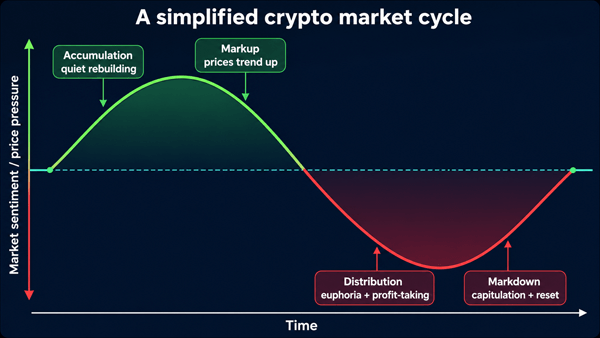
Figure: A simplified crypto market cycle. Real markets are messier, shorter or longer, and may skip or repeat phases.
3. How Crypto Market Cycles Work
Crypto cycles are driven by a mix of supply, demand, investor psychology, liquidity, regulation, technology adoption and macroeconomic conditions. No single factor explains every cycle.
3.1 Supply and Bitcoin Halvings
Bitcoin has a programmed supply schedule. Roughly every 210,000 blocks, the block reward paid to miners is cut in half. This event is called a halving. Past halvings happened in November 2012, July 2016, May 2020 and April 2024. After the April 2024 halving, the block reward fell from 6.25 BTC to 3.125 BTC. Halvings are important because they reduce the rate of new Bitcoin supply, but they do not guarantee immediate price increases.
3.2 Liquidity and Interest Rates
Crypto tends to be sensitive to global liquidity and risk appetite. When money is cheap, investors may be more willing to buy speculative assets. When interest rates rise or financial conditions tighten, investors often reduce exposure to risky assets. This does not mean crypto always moves exactly like stocks, but it often reacts to the same broader liquidity environment.
3.3 Narratives and New Use Cases
Each cycle often has a dominant story. Earlier cycles focused on Bitcoin as digital money. Later cycles included initial coin offerings, DeFi, NFTs, institutional adoption, layer-2 scaling, staking, real-world assets and exchange-traded products. Narratives can bring attention and capital, but they can also create bubbles when expectations run ahead of real usage.
3.4 Leverage and Liquidations
Leverage means borrowing or using derivatives to increase exposure. It can make rallies stronger and crashes faster. In bull markets, traders may borrow heavily because prices are rising. In sharp declines, forced liquidations can create a chain reaction as positions are closed automatically.
3.5 Human Psychology
Cycles are partly emotional. Fear, greed, regret, overconfidence and herd behavior affect decisions. Beginners often enter after seeing large gains and leave after large losses. A useful cycle framework helps you slow down and ask, “What phase might we be in, and what risks am I ignoring?”
4. The Four Main Phases of a Crypto Market Cycle
4.1 Phase 1: Accumulation
Accumulation usually comes after a painful bear market. Prices may move sideways for months. News coverage is quiet, and many people say crypto is over. Developers continue building, stronger companies survive, and long-term investors may gradually buy while interest is low.
- Sentiment: boredom, doubt, exhaustion.
- Typical behavior: fewer new users, lower trading volumes, more focus on fundamentals.
- Practical approach: research, build a watchlist, avoid rushing, and use small position sizes if investing.
4.2 Phase 2: Markup or Bull Market
The markup phase begins when demand increases and prices trend upward. More people pay attention, media coverage improves, apps gain users, venture funding may rise, and traders become more confident. Bitcoin often leads early, then large-cap crypto assets and eventually smaller altcoins may follow.
- Sentiment: cautious optimism turning into excitement.
- Typical behavior: more exchange signups, rising social media activity, stronger price momentum.
- Practical approach: avoid chasing, define profit-taking rules, and remember that unrealized gains can disappear quickly.
4.3 Phase 3: Distribution
Distribution is the stage where early buyers and professional traders may reduce exposure while late buyers are still entering. Prices can be volatile. There may be sharp pullbacks followed by new highs, which can make the market feel unstoppable. This is often when unrealistic price targets and “this time is different” arguments become common.
- Sentiment: confidence, euphoria, fear of missing out.
- Typical behavior: excessive leverage, celebrity promotions, copycat projects, aggressive price predictions.
- Practical approach: rebalance, protect capital, avoid leverage, and be skeptical of guaranteed-return claims.
4.4 Phase 4: Markdown or Bear Market
Markdown is the decline after excesses unwind. Prices fall, liquidity dries up, weaker projects fail, frauds are exposed, and highly leveraged traders are forced out. Bear markets are painful but useful because they reveal which projects have real users, secure infrastructure and responsible management.
- Sentiment: fear, anger, disbelief, capitulation.
- Typical behavior: lower volumes, layoffs, bankruptcies, legal actions, reduced media attention.
- Practical approach: review mistakes, preserve cash, focus on security and fundamentals, and avoid assuming every token will recover.
5. Real-World Examples of Crypto Market Cycles
5.1 Example 1: The 2017 ICO Boom and 2018 Bear Market
In 2017, initial coin offerings became a major crypto narrative. Many projects raised money by selling tokens directly to the public. Some funded useful infrastructure, but many had weak business models, unclear regulation or little more than a white paper. As speculation cooled in 2018, many tokens lost most of their value. The lesson: strong narratives can attract capital quickly, but not every project created during a bull market survives the next bear market.
5.2 Example 2: The 2020-2021 Bull Market
The 2020-2021 cycle included several powerful narratives: Bitcoin after the 2020 halving, very loose monetary conditions, DeFi growth, NFTs, meme coins and increased institutional attention. Many crypto assets rose sharply. But the same period also encouraged risky behavior, including leverage, unsustainable yields and speculation in low-quality tokens.
5.3 Example 3: The 2022 Deleveraging and Bear Market
In 2022, the crypto market faced tighter financial conditions and several major failures. The Terra/Luna ecosystem collapsed in May 2022, wiping out tens of billions of dollars in value. Later that year, FTX filed for U.S. bankruptcy protection on November 11, 2022. These events showed how quickly confidence, liquidity and counterparty trust can disappear in a stressed market.
5.4 Example 4: The 2024 Spot Bitcoin ETP Approval and Halving
On January 10, 2024, the U.S. Securities and Exchange Commission approved the listing and trading of a number of spot bitcoin exchange-traded product shares. The fourth Bitcoin halving followed on April 20, 2024. These events became important parts of the 2024 cycle narrative because they combined institutional access, supply reduction and renewed investor attention. However, even major positive catalysts do not remove volatility or guarantee future returns.
| Event | Why it mattered | Beginner lesson |
|---|---|---|
| Bitcoin halving | Reduced new BTC issuance approximately every four years. | A catalyst can matter without guaranteeing short-term gains. |
| ICO boom | Showed how quickly capital can flow into new token models. | Narrative strength is not the same as business quality. |
| Terra/Luna collapse | Demonstrated run risk and the danger of unsustainable yields. | High advertised yield usually means high hidden risk. |
| FTX bankruptcy | Exposed counterparty and custody risks on centralized platforms. | Where you hold assets matters as much as what you buy. |
| Spot bitcoin ETP approval | Expanded regulated access for some investors. | More access can increase demand, but volatility remains. |
6. Crypto Cycles vs Stock Market Cycles
| Feature | Crypto market cycles | Stock market cycles |
|---|---|---|
| Volatility | Often much higher; large drawdowns are common. | Usually lower for broad indexes, though individual stocks can be volatile. |
| Market hours | Trades 24/7 globally. | Usually trades during exchange hours, depending on market. |
| Drivers | Liquidity, adoption, narratives, regulation, tokenomics, security events. | Earnings, interest rates, economic growth, policy, sector trends. |
| Information quality | Varies widely; many projects have limited disclosure. | Public companies usually have regulated reporting requirements. |
| Custody risk | Users may self-custody or use exchanges; mistakes can be permanent. | Usually held through regulated brokers and custodians. |
7. Benefits of Understanding Crypto Market Cycles
- Better emotional control: You are less likely to mistake hype for safety or fear for permanent failure.
- Improved risk management: You can adjust position sizes and avoid overexposure during euphoric periods.
- More realistic expectations: You understand that large rallies and large declines are both normal in crypto.
- Better research habits: Bear markets can be useful times to study fundamentals without constant noise.
- Clearer decision-making: A cycle framework helps you separate long-term conviction from short-term price action.
8. Risks and Limitations of Crypto Market Cycles
Market cycles are useful, but they are not a prediction machine. Beginners should understand the limits.
- Cycles are easier to see in hindsight than in real time.
- A previous pattern may not repeat because market structure, regulation and participants change.
- Altcoins may not follow Bitcoin perfectly, and many never recover after a bear market.
- Unexpected events such as hacks, lawsuits, exchange failures or policy changes can break a cycle pattern.
- Using cycle charts as certainty can lead to overconfidence and excessive risk.
9. Common Misconceptions About Crypto Market Cycles
| Misconception | Reality |
|---|---|
| “The halving always causes an immediate bull market.” | Halvings reduce new supply, but price depends on demand, liquidity and expectations. |
| “Everything comes back in the next cycle.” | Many tokens never regain previous highs and some projects fail completely. |
| “Bear markets are only bad.” | They are painful, but they expose weak projects and create time for serious research. |
| “Bull markets mean low risk.” | Risk often rises in bull markets because valuations, leverage and fraud increase. |
| “I can identify the exact top or bottom.” | Even professionals rarely do this consistently. Planning matters more than perfect timing. |
10. How Beginners Can Analyze the Current Crypto Cycle
No single indicator tells you where the market is. Instead, use a checklist of signals. The goal is not to be perfectly right. The goal is to avoid being blindly emotional.
| Signal to watch | Possible meaning | What to ask yourself |
|---|---|---|
| Bitcoin trend and market breadth | Shows whether strength is broad or concentrated. | Are many assets rising, or only a few leaders? |
| Stablecoin supply and exchange liquidity | Can indicate available crypto-native buying power. | Is liquidity improving or drying up? |
| Funding rates and leverage | High leverage can make the market fragile. | Are traders crowded on one side? |
| Search interest and social media hype | Can show retail attention. | Is the conversation becoming unrealistic? |
| Developer activity and real users | Helps separate adoption from speculation. | Does the project solve a real problem? |
| Regulatory news | Can change access, compliance costs and investor confidence. | Is the risk project-specific or market-wide? |
11. A Practical Crypto Cycle Strategy for Beginners
The following framework is not a guarantee of profit. It is a risk-management approach for people who want to learn without making impulsive decisions.
- Define your purpose. Are you learning, investing long term, trading, or using crypto technology? Each goal requires a different approach.
- Decide how much you can afford to lose. Crypto should not replace emergency savings or money needed for bills, debt payments or short-term goals.
- Start with education before exposure. Learn wallet security, exchange risk, market orders, fees, taxes and scams before buying anything meaningful.
- Use position sizing. A small position that lets you sleep is better than a large position that causes panic decisions.
- Avoid leverage. Beginners usually underestimate how quickly leveraged positions can be liquidated.
- Create entry and exit rules. Decide in advance whether you will dollar-cost average, rebalance, take profits, or stop buying after a certain allocation.
- Keep records. Track why you bought, your thesis, risks, fees, taxes and exit plan.
- Review after each major market move. Ask what changed: price only, fundamentals, regulation, security, liquidity or your own risk tolerance?
12. Best Practices for Each Cycle Phase
| Cycle phase | Best practices | What to avoid |
|---|---|---|
| Accumulation | Study fundamentals, build a watchlist, learn custody, use small test transactions. | Buying weak projects just because they are down 90%. |
| Markup | Stick to allocation limits, take partial profits if planned, avoid emotional chasing. | Increasing risk only because recent returns look easy. |
| Distribution | Reduce leverage, rebalance, question hype, protect principal. | Assuming a popular token cannot fall sharply. |
| Markdown | Preserve capital, review security, harvest lessons, separate quality from speculation. | Panic selling without review or doubling down blindly. |
13. Risk Management Checklist
- Never invest money you cannot afford to lose.
- Use reputable platforms and understand custody risks before depositing funds.
- Enable strong security: hardware security keys or authenticator apps, unique passwords and withdrawal allowlists where available.
- Be careful with bridges, DeFi protocols and new tokens; smart-contract risk is real.
- Do not trust guaranteed returns, secret trading groups, celebrity endorsements or pressure to act immediately.
- Diversify carefully. Owning many highly correlated altcoins is not true diversification.
- Plan for taxes and recordkeeping before selling, swapping or staking.
- Keep some liquidity. Being fully invested can force poor decisions during downturns.
14. Pros and Cons of Using Market Cycles as a Framework
| Pros | Cons |
|---|---|
| Helps beginners understand why hype and fear repeat. | Can create false confidence if treated as a precise forecast. |
| Encourages planning instead of emotional buying and selling. | Cycle phases are often unclear until after they happen. |
| Supports better risk management and position sizing. | Different assets can be in different cycles at the same time. |
| Makes it easier to compare current conditions with past events. | Past performance does not guarantee future results. |
15. Beginner Scenario: Two Investors in the Same Cycle
Imagine two beginners, Aisha and Daniel, both discover crypto during a strong rally.
Aisha buys several tokens after seeing them rise on social media. She has no exit plan, uses leverage and keeps most funds on a platform she has not researched. When the market falls, she sells in panic and realizes she never understood what she owned.
Daniel starts smaller. He learns how Bitcoin, Ethereum, stablecoins and wallets work. He avoids leverage, keeps records, sets an allocation limit, and decides in advance to take partial profits if his portfolio grows beyond his target. When the market falls, he still loses money on paper, but he is not forced to sell and can review his positions calmly.
The difference is not that Daniel predicts the cycle perfectly. The difference is that he manages risk before emotions take over.
16. Actionable Takeaways
- Crypto market cycles are patterns, not guarantees.
- The four basic phases are accumulation, markup, distribution and markdown.
- Bitcoin halvings can be important catalysts, but demand and liquidity still matter.
- Bull markets can be more dangerous than they feel because hype, leverage and scams increase.
- Bear markets can be useful for research, but many assets will not recover.
- Beginners should prioritize security, position sizing, education and written plans over predictions.
17. FAQs About Crypto Market Cycles
17.1 How long does a crypto market cycle last?
There is no fixed length. Many people talk about roughly four-year Bitcoin-led cycles because of the halving schedule, but real cycles can be shorter, longer or influenced by macroeconomic events, regulation and liquidity.
17.2 Does the Bitcoin halving always start a bull market?
No. A halving reduces the rate of new Bitcoin issuance, but price depends on demand, investor expectations, global liquidity and broader market conditions. It is a catalyst, not a guarantee.
17.3 What is the safest phase to buy crypto?
There is no completely safe phase. Accumulation phases may offer better valuations, but uncertainty is high. The safer approach is to use position sizing, research, dollar-cost averaging where appropriate and avoid leverage.
17.4 Why do altcoins often rise after Bitcoin?
In many cycles, investors first move into Bitcoin because it is the most established crypto asset. If confidence grows, some capital rotates into Ethereum and then smaller altcoins. This rotation is common but not guaranteed.
17.5 Can a bear market be good for beginners?
It can be useful for learning because hype is lower and weak projects are easier to identify. But it is still risky. Prices can continue falling, and some projects may disappear.
17.6 What is capitulation?
Capitulation is a period of intense selling when many investors give up after large losses. It can happen near bottoms, but identifying it in real time is difficult.
17.7 Should beginners trade every phase of the cycle?
Usually no. Active trading is difficult and stressful. Many beginners are better served by learning fundamentals, managing risk and avoiding frequent emotional trades.
17.8 What is the biggest mistake beginners make in crypto cycles?
The biggest mistake is often buying aggressively during euphoria without understanding the asset, risk, custody, taxes or exit plan.
17.9 Do all cryptocurrencies follow the same cycle?
No. Bitcoin, Ethereum, stablecoins, DeFi tokens, NFTs and small altcoins can behave differently. Some assets may rise while others stagnate or fail.
17.10 How can I protect myself from scams during a bull market?
Be skeptical of guaranteed returns, unsolicited messages, fake support accounts, celebrity promotions, urgent deadlines and projects that cannot clearly explain how they work. Verify information through official channels.
Sources Consulted and Checked
These sources were consulted and checked while preparing this article to support accuracy and responsible presentation.
- U.S. Securities and Exchange Commission, Statement on the Approval of Spot Bitcoin Exchange-Traded Products, January 10, 2024
- SEC Investor.gov, Exercise Caution with Crypto Asset Securities, March 23, 2023
- SEC Investor Alert, 5 Ways Fraudsters May Lure Victims Into Scams Involving Crypto Asset Securities, May 29, 2024
- FINRA, Crypto Assets - Risks
- CoinGecko, Bitcoin Halving Countdown and Halving Dates
- MIT Sloan CFI, Anatomy of a Run: The Terra Luna Crash
- Reuters, Crypto exchange FTX files for bankruptcy, November 11, 2022
- Reuters, Crypto market capitalisation hits record $3.2 trillion, November 14, 2024
Reader Advice
This article is provided for educational and informational purposes only and is not personalized financial, investment, tax, legal or other professional advice or a recommendation to buy, sell or hold any crypto asset. Crypto markets are highly volatile, losses can be substantial, and risks may include scams, platform or custody failures, technical vulnerabilities, liquidity problems and regulatory action. Laws, rules, policies, tax treatment, market data and statistics can change over time and vary by country or region, so please verify important information through current official sources and consider advice from a suitably qualified professional before making decisions.