Liquidity in Crypto Markets: Complete Guide, Examples, Risks and Best Practices
Quick answer: Liquidity in crypto markets means how easily a crypto asset can be bought or sold without causing a large change in its price. A liquid market usually has many buyers and sellers, tight bid-ask spreads, strong trading volume, and enough order book depth to absorb trades. An illiquid market can be expensive and risky because orders may suffer from slippage, delays, price manipulation, and sudden price swings.
1. What Is Liquidity in Crypto Markets?
Liquidity is the ease with which you can buy or sell a crypto asset at a fair price. In a liquid market, there are enough buyers and sellers available, so trades can happen quickly and close to the price you expected. In an illiquid market, there may be too few orders. That means even a normal-sized trade can push the price up or down.
A simple way to think about liquidity is to imagine selling a popular smartphone versus selling a rare collectible. The popular phone has many potential buyers, so you can probably sell it quickly near the going market price. The rare collectible might be valuable, but finding the right buyer could take longer, and you may need to accept a lower price. Crypto markets work in a similar way.
| Market condition | What it usually looks like | What it means for a beginner |
|---|---|---|
| High liquidity | Many active buyers and sellers, tight spreads, large order book depth, high trading volume | You can usually enter or exit positions faster and closer to the displayed price. |
| Low liquidity | Few active orders, wide spreads, thin order book, low trading volume | Your trade may move the price, fill at a worse price, or become hard to exit quickly. |
2. Why Liquidity Matters in Crypto
Liquidity is one of the most important market quality signals in crypto. It affects trading cost, execution speed, price stability, and risk. Beginners often focus only on price, but liquidity can determine whether that price is actually available when they place an order.
- Better trade execution: Liquid markets make it more likely that your order fills near the price you saw before clicking buy or sell.
- Lower hidden costs: A tight spread and low slippage can reduce the cost of entering and exiting a position.
- More reliable prices: When many participants are trading, prices are harder for one small group to distort.
- Easier exits: Liquidity matters most when you need to sell. A token may look profitable on paper, but gains are not real if you cannot exit without crashing the price.
- Reduced manipulation risk: Thin markets are easier to move with relatively small orders, which can attract pump-and-dump schemes or wash trading.
3. How Crypto Liquidity Works
Crypto liquidity depends on the market structure. On centralized exchanges, liquidity usually comes from order books. On decentralized exchanges, liquidity often comes from liquidity pools. Both systems help buyers and sellers trade, but they work differently.
3.1 Order Books on Centralized Exchanges
An order book is a live list of buy and sell orders. Buyers place bids. Sellers place asks. The highest bid and the lowest ask form the visible market price range. The difference between them is called the bid-ask spread.
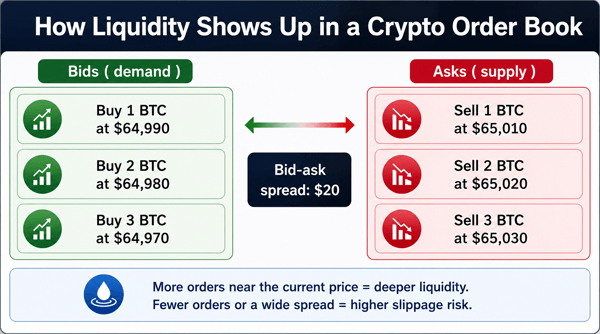
Figure 1: A simplified crypto order book showing bids, asks, spread, and depth.
Example: Suppose Bitcoin has a highest bid of $64,990 and a lowest ask of $65,010. The spread is $20. If you place a market buy order, you may buy at $65,010 or higher depending on how much liquidity is available at each price level. If the order book is deep, a large order may fill with little price movement. If it is thin, the same order may climb through several ask levels and fill at a much worse average price.
3.2 Liquidity Pools on Decentralized Exchanges
Many decentralized exchanges, or DEXs, do not use traditional order books. Instead, they use liquidity pools. A liquidity pool is a smart contract containing two or more assets, such as ETH and USDC. Users called liquidity providers deposit assets into the pool. Traders swap against the pool, and the price changes according to the pool formula and available reserves.
For beginners, the key point is simple: a larger, well-balanced pool usually provides better execution. A small pool may produce large price impact even for modest trades. Liquidity providers can earn fees, but they also face risks such as impermanent loss, smart contract bugs, and token price collapse.
| Feature | Centralized exchange order book | Decentralized exchange liquidity pool |
|---|---|---|
| Who provides liquidity? | Market makers, professional traders, institutions, retail limit orders | Liquidity providers who deposit assets into smart contracts |
| How trades execute | Against buy and sell orders in the order book | Against assets held in a pool using an automated formula |
| Common cost signals | Bid-ask spread, order book depth, trading fee, slippage | Pool depth, price impact, swap fee, slippage tolerance |
| Main risks | Exchange custody, outages, fake volume, sudden spread widening | Smart contract risk, impermanent loss, MEV/sandwich attacks, pool imbalance |
| Best for beginners? | Often simpler for spot trading on major assets | Useful for DeFi, but requires more care and wallet security |
4. Main Types of Liquidity in Crypto
4.1 Asset liquidity
How easily a specific cryptocurrency can be traded. Bitcoin and Ether are generally more liquid than small-cap tokens because they have larger markets and broader participation.
4.2 Exchange liquidity
How much usable liquidity exists on a specific exchange. The same token may be easy to trade on one exchange and difficult on another.
4.3 Pair liquidity
Liquidity depends on the trading pair, not just the asset. A token may have good liquidity against USDT but poor liquidity against BTC or a local currency.
4.4 On-chain liquidity
Liquidity available through decentralized exchanges, bridges, and DeFi protocols. This can vary widely by blockchain network.
4.5 Stablecoin liquidity
Stablecoins often act as the settlement currency of crypto markets. When stablecoin liquidity is strong, traders can move in and out of positions more easily. When confidence in a stablecoin weakens, liquidity can dry up quickly.
5. How to Measure Liquidity Before You Trade
No single metric proves a market is liquid. A practical liquidity check combines several signals. Beginners should especially watch spread, volume, market depth, and slippage estimates.
| Liquidity signal | What to check | Why it matters | Beginner tip |
|---|---|---|---|
| Bid-ask spread | Difference between best buy and sell prices | A wider spread means higher trading cost | Avoid market orders when spreads are wide. |
| 24-hour volume | How much value traded recently | Higher volume can indicate stronger participation | Compare volume across exchanges, not just one platform. |
| Order book depth | How many orders sit near current price | Shows how much the market can absorb | Look at depth within 0.5%, 1%, and 2% of current price. |
| Slippage estimate | Expected difference between quoted and executed price | Shows practical execution cost | Use limit orders or split orders when slippage is high. |
| Number of markets | How many reputable venues list the asset | More venues can improve resilience | Be careful when liquidity exists on only one obscure exchange. |
| DEX pool size | Total assets available in the pool | Small pools create large price impact | Check pool depth before swapping small-cap tokens. |
6. Practical Examples of Crypto Liquidity
6.1 Example 1: Buying a Highly Liquid Coin
A beginner wants to buy $500 worth of BTC on a large exchange. The spread is small, the order book is deep, and the expected slippage is close to zero. The trade is likely to execute near the displayed price. The main costs are the exchange fee and a small spread.
6.2 Example 2: Selling a Low-Liquidity Altcoin
Another beginner holds $2,000 worth of a small token. The price chart shows a 50% gain, but the order book has only $300 of buy orders near the current price. If the holder sells everything with a market order, the sale may push the price down sharply and the average exit price could be far below the last traded price.
6.3 Example 3: Swapping Through a Small DeFi Pool
A user swaps $1,000 of Token A for Token B in a small DEX pool. The interface warns of 7% price impact. That means the user may lose about $70 to price impact before considering fees or network costs. In this case, a better choice may be to reduce the trade size, wait for deeper liquidity, or use an aggregator to find a better route.
6.4 Example 4: Liquidity During Market Stress
Liquidity is not fixed. During panic selling, spreads can widen and order books can thin out. A market that looked liquid yesterday can become difficult today if market makers reduce risk, exchanges experience outages, or traders rush to the same exit.
7. Liquidity, Volume, Market Cap, and Volatility: Key Differences
| Term | Plain-English meaning | Common mistake |
|---|---|---|
| Liquidity | How easily you can trade without moving price much | Assuming a listed price is available for any trade size. |
| Trading volume | How much was traded over a period | Assuming high reported volume is always real or usable. |
| Market capitalization | Token price multiplied by circulating supply | Assuming a high market cap guarantees easy exits. |
| Volatility | How much price moves over time | Confusing price movement with liquidity. A market can be volatile and liquid, or volatile and illiquid. |
8. Benefits of High Liquidity
- Lower trading costs because spreads are usually tighter.
- Faster execution because there are more counterparties or deeper pools.
- More accurate prices because more participants contribute information.
- Less slippage for ordinary trade sizes.
- Better ability to enter, adjust, or exit positions during changing market conditions.
9. Risks and Limitations of Crypto Liquidity
Liquidity reduces some risks, but it does not remove risk. Crypto markets can change quickly, and liquidity can disappear when it is needed most.
9.1 Slippage risk
The final execution price may be worse than expected, especially with market orders, large orders, small pools, or fast-moving markets.
9.2 Liquidity illusion
A token may show a high market cap or a rising chart, but there may not be enough real buyers to exit. Some reported volume may be inflated or not accessible to ordinary traders.
9.3 Exchange concentration
If most liquidity sits on one venue, outages, withdrawal freezes, or delistings can create serious exit risk.
9.4 DeFi smart contract risk
Liquidity pools rely on code. Bugs, oracle failures, exploits, and admin-key abuse can harm traders and liquidity providers.
9.5 Impermanent loss
Liquidity providers in automated market maker pools may underperform simply holding the assets when relative prices change significantly.
9.6 MEV and sandwich attacks
On public blockchains, bots can sometimes reorder or surround trades, causing worse execution for users with high slippage tolerance.
9.7 Stablecoin depeg risk
If a stablecoin loses its peg or market confidence, liquidity can fragment and trading pairs using that stablecoin can become unreliable.
10. Best Practices for Beginners
- Check spread and depth before placing a trade, not only the chart price.
- Use limit orders when possible, especially in less liquid markets.
- Avoid large market orders in small-cap tokens or thin trading pairs.
- Split large trades into smaller orders if the market cannot absorb your full size.
- Compare liquidity across reputable exchanges and DEX aggregators.
- Be cautious with tokens that have most liquidity in one pool, one exchange, or one stablecoin pair.
- Set slippage tolerance carefully. Too low may fail; too high may invite bad execution or MEV attacks.
- Do not assume paper profits are real until you confirm exit liquidity.
- Watch liquidity during news events, token unlocks, exchange listings, delistings, hacks, or market crashes.
- For DeFi, understand pool size, impermanent loss, smart contract risk, and withdrawal conditions before providing liquidity.
11. Common Beginner Mistakes
| Mistake | Why it is risky | Better approach |
|---|---|---|
| Buying only because price is rising | Price can rise in a thin market and collapse when sellers appear | Check liquidity, depth, and holder concentration. |
| Using market orders in illiquid pairs | The order may fill far from the expected price | Use limit orders and smaller trade sizes. |
| Ignoring the exit | A token can be easy to buy but hard to sell | Plan how and where you would exit before entering. |
| Trusting reported volume blindly | Some venues or tokens may show inflated activity | Look for liquidity across reputable venues and real order book depth. |
| Setting slippage too high on DEXs | Bots or price movement can create poor execution | Use aggregators, smaller trades, and conservative slippage settings. |
12. How Market Makers Improve Crypto Liquidity
Market makers are professional traders or firms that continuously post buy and sell orders. Their goal is to earn the spread, collect incentives, or support market quality. In healthy markets, market makers can reduce spreads and improve depth. However, they may withdraw during extreme volatility, regulatory uncertainty, exchange problems, or when risk becomes too high. This is why liquidity can be strong in normal conditions but weaker during stress.
13. Liquidity and Regulation: Why It Matters
Regulation affects liquidity because it influences which institutions can participate, which products can be listed, how exchanges operate, and how stablecoins are supervised. For example, the U.S. Securities and Exchange Commission approved the listing and trading of spot Bitcoin exchange-traded product shares on January 10, 2024, which helped connect Bitcoin exposure to regulated exchange-traded markets. In the European Union, the Markets in Crypto-Assets Regulation, known as MiCA, introduced uniform rules covering areas such as transparency, disclosure, authorization, and supervision for many crypto-assets and service providers. Regulation does not eliminate liquidity risk, but clearer rules can affect market confidence and participation.
14. Pros and Cons of High-Liquidity Crypto Markets
| Pros | Cons or limits |
|---|---|
| Usually tighter spreads and lower slippage | Still vulnerable to crashes, exchange outages, and sudden liquidity withdrawal |
| Easier to enter and exit positions | Can attract high-frequency competition and complex market behavior |
| Prices are generally more reliable | Reported volume may still require verification |
| Better for larger trades and institutional participation | Liquidity can concentrate on a few major venues or stablecoin pairs |
15. Beginner Checklist: Is This Crypto Market Liquid Enough?
- Is the bid-ask spread narrow compared with the asset price?
- Is there enough order book depth within 1% to handle your trade?
- Is 24-hour volume strong across more than one reputable venue?
- Would your trade create noticeable price impact?
- Can you exit the position during normal and stressed conditions?
- Is liquidity dependent on one exchange, one pool, or one stablecoin?
- Are there upcoming events that could change liquidity, such as token unlocks or delistings?
- For DeFi, is the smart contract audited and is the pool deep enough?
16. FAQs About Liquidity in Crypto Markets
16.1 What is liquidity in crypto in simple terms?
Liquidity is how easily you can buy or sell a cryptocurrency without causing a big price change. High liquidity means trades are easier and usually cheaper. Low liquidity means trades may be slower, more expensive, and riskier.
16.2 Is high trading volume the same as high liquidity?
Not always. Volume shows how much traded over a period, while liquidity shows how much you can trade now at a reasonable price. A market can report high volume but still have poor order book depth.
16.3 Why does slippage happen?
Slippage happens when the price changes between the quote and the final execution, or when your order consumes multiple price levels in the order book or liquidity pool.
16.4 Are Bitcoin and Ethereum always liquid?
They are usually among the most liquid crypto assets, but liquidity still varies by exchange, trading pair, time of day, market stress, and order size.
16.5 What is a liquidity pool?
A liquidity pool is a smart contract that holds crypto assets for trading on a decentralized exchange. Traders swap against the pool, and liquidity providers deposit assets to earn fees while taking specific risks.
16.6 Can I lose money providing liquidity?
Yes. Liquidity providers can earn fees, but they can also lose money from impermanent loss, token price declines, smart contract exploits, or pool imbalance.
16.7 How much liquidity is enough?
It depends on your trade size. A market is liquid enough when your intended trade can execute with acceptable spread, fees, and slippage, and when you can reasonably exit later.
16.8 What is the safest order type for beginners?
A limit order is often safer than a market order because it lets you set the maximum price you will pay or the minimum price you will accept. The trade may not fill, but it protects you from unexpectedly bad execution.
16.9 Why do spreads widen during crashes?
During stress, market makers and traders may reduce risk or pull orders. When fewer orders remain, the gap between buyers and sellers can widen.
16.10 Does liquidity guarantee a crypto investment is safe?
No. Liquidity only helps with trading and execution. It does not protect against bad projects, hacks, regulatory changes, fraud, or market crashes.
17. Conclusion: Liquidity Is a Practical Risk Check, Not Just a Market Term
Liquidity is one of the first things every crypto beginner should learn to check. It affects the real cost of trading, the ability to exit, and the reliability of prices. A liquid market usually has tight spreads, deep order books or pools, strong participation, and manageable slippage. An illiquid market can turn a good-looking trade into a costly mistake.
The best habit is simple: before buying any crypto asset, ask, “Can I sell this later at a fair price?” If the answer is unclear, reduce your trade size, use limit orders, compare venues, or avoid the trade until you understand the liquidity risk.
Sources Consulted and Checked
The following sources were consulted and checked while preparing this article and reviewing its accuracy.
- U.S. Securities and Exchange Commission, “Statement on the Approval of Spot Bitcoin Exchange-Traded Products,” January 10, 2024.
- European Securities and Markets Authority, “Markets in Crypto-Assets Regulation (MiCA),” information page on EU crypto-asset rules.
- Central Bank of Ireland, “Markets in Crypto-Assets Regulation (MiCAR),” overview of MiCAR objectives including investor protection and financial stability.
- Reuters, “US SEC approves bitcoin ETFs in watershed for crypto market,” January 11, 2024.
- Bank of England stablecoin policy reporting, June 2026, for current context on stablecoin regulation and redemption/liquidity concerns.
Reader Advice
This article is provided for educational and informational purposes only and is not personalized financial, investment, legal, tax, or accounting advice or a recommendation to buy, sell, trade, or provide liquidity for any crypto asset. Crypto markets, exchanges, DeFi protocols, stablecoins, and liquidity pools involve significant risks, including loss of capital, slippage, market manipulation, smart-contract failures, impermanent loss, outages, and rapidly changing liquidity. Rules, policies, laws, market data, and statistics can change over time and vary by country or region, so readers should verify current information through official and reliable sources and consider qualified professional advice before making decisions.