Crypto Market Cap Explained: Meaning, How It Works, Examples, Benefits and Risks
1. Quick Answer: What Is Crypto Market Cap?
Crypto market cap, short for cryptocurrency market capitalization, is the estimated total value of a cryptocurrency that is currently in public circulation. It is usually calculated by multiplying the current price of one coin or token by the circulating supply.
Formula: Crypto market cap = current price x circulating supply
For example, if a token trades at $2 and has 10 million tokens circulating, its market cap is $20 million. This does not mean $20 million of cash is sitting inside the project. It means the market is valuing the circulating tokens at $20 million based on the latest traded price.
2. Why Crypto Market Cap Matters
Beginners often look only at coin price. That can be misleading. A coin priced at $0.05 is not automatically cheaper, smaller, or more likely to rise than a coin priced at $500. The number of coins in circulation matters just as much as the price.
Market cap helps you compare the relative size of different cryptocurrencies. It is one of the first metrics investors, analysts, exchanges, and data websites use to rank crypto assets. CoinMarketCap defines market capitalization as price multiplied by circulating supply, and CoinGecko describes it as the total value of a cryptocurrency in circulation.
3. How Crypto Market Cap Works
3.1 Price
Price is the most recent market price of one coin or token. On most crypto exchanges, price changes constantly as buyers and sellers trade. Because crypto markets trade around the clock, market cap can move quickly.
3.2 Circulating Supply
Circulating supply is the estimated number of coins or tokens available in the market and in the public's hands. It normally excludes tokens that are not yet issued, locked, reserved, or otherwise unavailable for public trading. CoinMarketCap notes that circulating supply is commonly used for market cap because it is similar to using public float in traditional stock markets.
3.3 The Formula
Once you know the price and circulating supply, the calculation is simple:
- Find the current price of one coin or token.
- Find the circulating supply.
- Multiply price by circulating supply.
The diagram below shows the basic relationship:
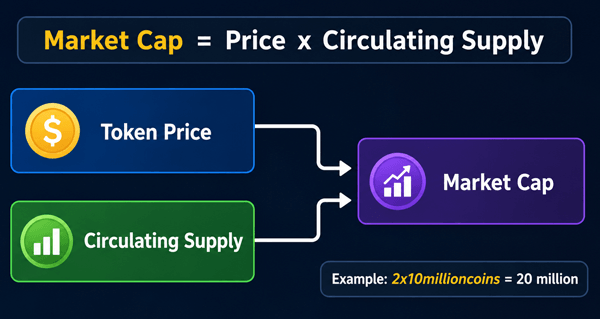
Figure 1: Crypto market cap is calculated from price and circulating supply.
4. Crypto Market Cap Examples
| Price per coin | Circulating supply | Market cap | What it shows |
|---|---|---|---|
| $2.00 | 10,000,000 tokens | $20,000,000 | A small or mid-sized project depending on the market |
| $0.10 | 1,000,000,000 tokens | $100,000,000 | Low price per token, but larger overall value |
| $500 | 100,000 coins | $50,000,000 | High price per coin, but smaller than the $0.10 token above |
This table shows why coin price alone can be misleading. A token can have a tiny price and still have a large market cap if the supply is huge. Another coin can have a high price but a smaller market cap if only a small number of coins exist.
5. Market Cap vs Coin Price: What Beginners Often Get Wrong
A common beginner mistake is thinking, "This coin is only $0.01, so it can easily reach $1." That may or may not be realistic. To judge the possibility, you need to calculate the market cap at the target price.
Example: A token has 100 billion tokens in circulation. At $0.01, its market cap is $1 billion. At $1, its market cap would be $100 billion. That means the project would need to be valued at 100 times more than before, assuming supply stays the same. The question is not just "Can the price reach $1?" The better question is "Would a $100 billion valuation make sense compared with similar assets, adoption, revenue, utility, liquidity, and risk?"
| Metric | Meaning | Why it matters |
|---|---|---|
| Coin price | The cost of one unit | Useful for buying and selling, but incomplete alone |
| Market cap | Estimated total value of circulating coins | Better for comparing the relative size of projects |
| Trading volume | Value traded over a period, often 24 hours | Shows liquidity and market activity |
| Fully diluted valuation | Value if all possible tokens existed at today's price | Helps estimate future supply dilution risk |
6. Types of Crypto Market Cap Metrics
6.1 Circulating Market Cap
This is the most common market cap shown on crypto data websites. It uses circulating supply, not the total number of tokens that might exist in the future.
6.2 Fully Diluted Valuation (FDV)
Fully diluted valuation estimates what the asset would be worth if all tokens that could exist were counted at today's price. The formula is: FDV = current price x maximum or fully diluted supply.
FDV is useful because many crypto projects release tokens gradually. If a project has a small circulating supply but a very large future supply, the market cap may look modest while the FDV is much higher. That can signal possible dilution risk if many new tokens enter the market later.
6.3 Total Crypto Market Cap
Total crypto market cap is the combined market cap of many cryptocurrencies across the market. It is often used as a broad indicator of market sentiment, similar to how stock indexes can indicate the direction of equity markets. However, it can be affected by double counting, stablecoins, thinly traded tokens, and data quality differences between providers.
7. Market Cap Categories: Large Cap, Mid Cap and Small Cap
There is no universal rule that every investor agrees on, but crypto assets are often grouped by size. These categories are rough guides, not guarantees of safety or performance.
| Category | Typical meaning | Beginner takeaway |
|---|---|---|
| Large-cap crypto | Usually the biggest and most established assets | Often more liquid and widely followed, but still volatile |
| Mid-cap crypto | Projects below the largest assets but with meaningful adoption or speculation | May offer growth potential but usually carries higher risk |
| Small-cap or micro-cap crypto | Smaller, newer, or less liquid projects | Can move sharply in either direction and may be easier to manipulate |
8. Benefits of Using Crypto Market Cap
- It helps compare projects more fairly than price alone.
- It gives a quick sense of relative size and market ranking.
- It helps identify whether a price target is realistic.
- It can be used with volume, supply, adoption, revenue, and tokenomics to form a more complete view.
- It helps beginners avoid the trap of assuming low-priced coins are automatically cheap.
9. Risks and Limitations of Crypto Market Cap
Market cap is useful, but it is not a complete measure of value, safety, or quality. Treat it as a starting point, not a final decision tool.
9.1 Market cap is not the same as money invested
If a token has a $1 billion market cap, that does not mean investors put exactly $1 billion into it. Market cap is based on the latest price multiplied by supply. If liquidity is thin, a small amount of trading can move the price and change the reported market cap dramatically.
9.2 Supply data can be imperfect
Crypto supply can be difficult to measure. Tokens may be locked, vested, bridged across chains, burned, lost, held by insiders, or controlled by smart contracts. Different data websites may use different methods, so figures may vary.
9.3 Low liquidity can make market cap misleading
A small token may show a high market cap after a few trades, but if there are not many buyers and sellers, large holders may not be able to sell without crashing the price.
9.4 Token unlocks can dilute holders
Some projects release tokens to founders, investors, teams, or ecosystem funds over time. When new tokens enter circulation, price may face pressure unless demand grows enough to absorb the new supply.
9.5 Market cap does not measure fundamentals
A large market cap does not automatically mean a project has strong technology, real users, revenue, good governance, or regulatory clarity. It only shows how the market currently values the circulating supply.
9.6 Crypto investing remains speculative and volatile
Regulators such as the U.S. SEC have repeatedly warned that crypto assets can be highly volatile and speculative, and that investors should watch for scams, custody risks, and platforms that may lack traditional investor protections.
10. How to Use Market Cap in Real-World Crypto Research
A practical way to use market cap is to combine it with other checks. Here is a beginner-friendly process:
- Compare market cap, not just price. Ask: how large is this asset compared with similar projects?
- Check circulating supply and fully diluted valuation. A big gap may mean future dilution risk.
- Look at 24-hour trading volume. Higher volume usually means better liquidity, though volume quality can vary.
- Review token unlock schedules. Find out whether large insider or investor unlocks are coming.
- Check holder concentration. If a few wallets control most supply, price manipulation risk may be higher.
- Study the project fundamentals. Look for real users, clear utility, transparent team communication, audits, and sustainable incentives.
- Consider security and custody. Use reputable platforms, enable multi-factor authentication, and never share seed phrases or private keys.
11. Practical Scenario: Comparing Two Tokens
Imagine you are comparing Token A and Token B:
| Asset | Price | Circulating supply | Market cap | FDV | Possible interpretation |
|---|---|---|---|---|---|
| Token A | $0.05 | 2 billion | $100 million | $150 million | High supply, modest FDV gap |
| Token B | $5.00 | 10 million | $50 million | $500 million | Higher price, lower current market cap, large FDV gap |
A beginner may think Token A is cheaper because it costs only $0.05. But Token A is already valued at $100 million based on circulating supply. Token B costs $5 per token, but its current market cap is $50 million. However, Token B has a much higher FDV, which may indicate future dilution if many more tokens unlock. The better choice cannot be decided from price alone.
12. Common Misconceptions About Crypto Market Cap
| Misconception | Reality | Why it matters |
|---|---|---|
| A low coin price means it is cheap | False | Supply matters. A $0.01 token with huge supply can already be expensive on a market-cap basis. |
| Market cap equals cash invested | False | It is a valuation estimate based on latest price and supply, not a bank balance. |
| Large-cap crypto is safe | False | Larger assets may be more liquid, but they can still fall sharply. |
| Small-cap crypto always has more upside | Misleading | It may have more room to grow, but also higher failure, liquidity, and manipulation risk. |
| FDV does not matter | False | FDV can reveal future dilution risk, especially in new token launches. |
13. Best Practices for Beginners
- Do not buy a crypto asset only because the unit price looks low.
- Use market cap to compare projects in the same category, such as layer-1 blockchains, decentralized exchanges, gaming tokens, or stablecoins.
- Check both market cap and FDV before buying newer tokens.
- Avoid projects with unclear supply, anonymous promises, guaranteed return claims, or pressure to buy quickly.
- Look for transparent tokenomics, credible security reviews, active development, real users, and clear risk disclosures.
- Never invest money you cannot afford to lose. Crypto prices can move sharply and losses can happen quickly.
- Keep custody seriously: protect seed phrases, use strong passwords, enable multi-factor authentication, and beware of phishing.
14. Crypto Market Cap vs Stock Market Cap
Crypto market cap is similar to stock market cap, but there are important differences.
| Area | Stocks | Crypto |
|---|---|---|
| Basic formula | Share price x shares outstanding | Token price x circulating supply |
| Supply changes | New shares may be issued, bought back, or split | Tokens may unlock, burn, mint, bridge, or be lost |
| Trading hours | Usually exchange hours | Usually 24/7 |
| Disclosure standards | Often regulated financial reporting for public companies | Varies widely by project and jurisdiction |
| Fundamental anchors | Revenue, cash flow, assets, dividends, business performance | Network usage, token utility, fees, security, adoption, speculation |
15. When Market Cap Is Most Useful
- Comparing two assets in the same crypto sector.
- Estimating how realistic a price target might be.
- Understanding whether a project is large, mid-sized, or small relative to the market.
- Spotting possible dilution by comparing market cap with FDV.
- Combining with volume to judge whether the valuation is supported by active trading.
16. When Market Cap Can Be Dangerous to Rely On
- When a token has very low trading volume.
- When most supply is held by insiders or a small number of wallets.
- When supply data is unclear or disputed.
- When a token recently launched and only a tiny percentage of supply is circulating.
- When the project has no clear utility, no users, or unrealistic marketing claims.
17. Simple Checklist Before You Trust a Crypto Market Cap
- What is the circulating supply?
- What is the total and maximum supply?
- How much supply is locked or scheduled to unlock?
- What is the FDV?
- Is trading volume high enough to support the valuation?
- Are top wallets heavily concentrated?
- Is the project transparent about tokenomics?
- Does the project have real usage, revenue, or credible adoption?
- What are the main security, regulatory, and custody risks?
18. FAQs About Crypto Market Cap
18.1 What does market cap mean in crypto?
It means the estimated total value of a cryptocurrency's circulating coins or tokens. It is calculated by multiplying current price by circulating supply.
18.2 Is a higher crypto market cap better?
Not always. A higher market cap can suggest a larger, more established asset, but it does not guarantee safety, growth, or quality.
18.3 Can a crypto with a low price have a high market cap?
Yes. If the circulating supply is very large, even a low-priced token can have a large market cap.
18.4 Is market cap the amount of money invested in a coin?
No. Market cap is a valuation estimate. It does not show the exact amount of money that entered the asset.
18.5 What is fully diluted valuation in crypto?
Fully diluted valuation, or FDV, estimates the value of a crypto asset if all possible tokens existed at today's price.
18.6 Why do market cap numbers differ across websites?
Data providers may use different methods for estimating price, circulating supply, excluded tokens, bridged tokens, or locked supply.
18.7 Should beginners buy only large-cap crypto?
Large-cap assets may be more liquid and established, but they still carry risk. Beginners should focus on education, risk management, and diversification rather than market cap alone.
18.8 What is the best metric besides market cap?
There is no single best metric. Useful related metrics include trading volume, FDV, supply unlocks, liquidity, holder concentration, revenue or fees, active users, and security history.
19. Final Takeaway
Crypto market cap is one of the simplest and most useful tools for understanding the relative size of a cryptocurrency. It helps beginners move beyond coin price and think in terms of overall valuation. But market cap has limits. It does not prove that a project is safe, fairly valued, liquid, or fundamentally strong.
The smartest approach is to use market cap as a starting point, then check supply, FDV, liquidity, token unlocks, project fundamentals, security, and personal risk tolerance. In crypto, a simple formula can teach you a lot - but it should never replace careful research.
Reader Advice
This article is provided for educational and informational purposes only and is not personalized financial, investment, tax, legal, or regulatory advice or a recommendation to buy, sell, or hold any crypto asset. Crypto markets are volatile and speculative, and losses, scams, liquidity problems, custody failures, token dilution, and regulatory changes are possible. Rules, policies, laws, market data, supply figures, and statistics can change over time and may vary by country or region, so verify important information through current official sources and consider qualified professional advice before making decisions. Never risk money you cannot afford to lose.
Sources Consulted and Checked
These sources were consulted and checked while preparing this article to support clarity and accuracy.
- CoinMarketCap FAQ: market capitalization is calculated by multiplying price by circulating supply.
- CoinMarketCap Support: circulating supply is an approximation of assets circulating in the market and public hands, and is commonly used for market capitalization.
- CoinGecko: crypto market cap is the total value of a cryptocurrency in circulation and is calculated from price and circulating supply.
- U.S. SEC Investor.gov: crypto assets can involve volatility, scams, custody issues, and investor protection concerns.