Why Crypto Prices Go Up and Down: Complete Guide, Examples, Risks and Best Practices
Quick answer: Crypto prices go up and down because buyers and sellers constantly disagree about what a coin or token is worth. Prices rise when demand is stronger than available supply, and they fall when selling pressure is stronger than buying demand. News, interest rates, regulation, security events, exchange liquidity, investor psychology, token supply, and large holders can all change that balance quickly.
1. What Does a Crypto Price Actually Mean?
A crypto price is the latest amount someone paid for one unit of a cryptocurrency on an exchange. For example, if the last completed Bitcoin trade happened at $64,000, many websites will show Bitcoin near $64,000. That does not mean every Bitcoin holder could instantly sell at exactly that price. It means the most recent trade happened around that level.
Crypto trades 24 hours a day, seven days a week, across many exchanges. Because there is no single global closing bell, prices can change at any time, including weekends and holidays.
| Term | Simple meaning | Why it matters |
|---|---|---|
| Price | The latest traded value of one coin or token | Shows what buyers and sellers recently agreed to pay |
| Market cap | Price multiplied by circulating supply | Helps compare the size of different crypto assets |
| Volume | How much was traded over a period | Higher volume usually means easier buying and selling |
| Liquidity | How easily you can trade without moving the price much | Low liquidity can cause sudden price jumps or drops |
| Volatility | How much and how fast price changes | High volatility creates opportunity and risk |
2. The Core Rule: Supply and Demand Move Crypto Prices
The most important idea is simple: price rises when demand is greater than supply at the current price, and price falls when supply is greater than demand. Everything else - news, hype, fear, interest rates, regulation, technology upgrades, exchange listings, and whale selling - affects either demand, supply, or both.
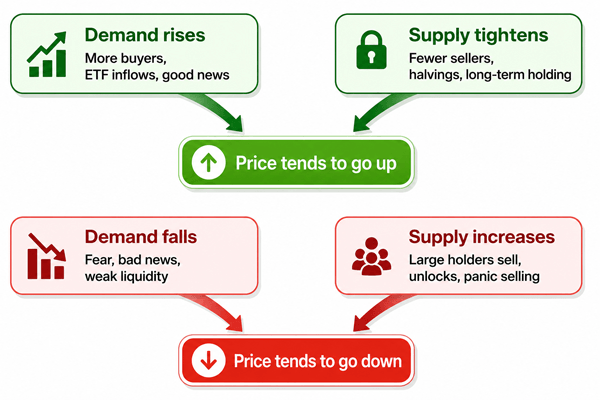
Diagram: The basic supply-and-demand logic behind crypto price movements.
3. Why Crypto Prices Go Up
3.1 More People Want to Buy
A coin can rise when more buyers enter the market. This may happen after positive news, a major exchange listing, a useful product launch, strong community growth, institutional interest, or a broader bull market. When many people want to buy and few people want to sell, buyers must offer higher prices.
Example: If a well-known company announces support for a crypto payment network, new buyers may believe the token has more future use. Demand can rise quickly, pushing price higher.
3.2 Supply Becomes Scarcer
Some cryptocurrencies have fixed or predictable supply rules. Bitcoin, for example, has a maximum supply limit built into its design. Other projects may reduce new issuance, lock tokens, burn tokens, or schedule vesting periods. When available supply becomes harder to get, price can rise if demand remains strong.
Important caution: Limited supply alone does not guarantee price growth. An asset also needs real demand. A rare token with no users, liquidity, or trust can still fall to near zero.
3.3 Positive Market Sentiment
Crypto is strongly influenced by investor psychology. When people feel optimistic, they are more willing to take risk. This can create a feedback loop: prices rise, more people notice, media coverage increases, and more buyers enter. That loop can be powerful, but it can also reverse sharply.
3.4 Easier Access for Investors
Prices may react when it becomes easier for large groups of investors to buy exposure. A major example is the U.S. approval of spot Bitcoin exchange-traded products in January 2024, which gave some investors a regulated market route to Bitcoin exposure. Access does not remove crypto risk, but it can affect demand and market structure.
3.5 Liquidity and Short Squeezes
In crypto derivatives markets, traders can use leverage. If many traders bet that a price will fall, but the price rises instead, their positions may be forced to close. This forced buying can push the price even higher for a short time. This is called a short squeeze.
4. Why Crypto Prices Go Down
4.1 More Sellers Than Buyers
A price falls when sellers are willing to accept lower prices and buyers are not willing to pay previous prices. Selling pressure can come from profit-taking, fear, forced liquidations, large holders selling, token unlocks, hacked funds moving, or weak market conditions.
4.2 Bad News or Loss of Trust
Trust is central in crypto. A security breach, exploit, exchange failure, lawsuit, delisting, stablecoin depeg, or misleading project update can quickly reduce confidence. Because crypto markets are always open, bad news can cause fast price moves before many beginners fully understand what happened.
4.3 Broader Economic Conditions
Crypto often behaves like a risk asset. When interest rates are high, liquidity is tight, or investors feel uncertain, speculative assets can suffer. When financial conditions are easier and investors are more willing to take risk, crypto may benefit. This relationship is not perfect, but macro conditions matter.
4.4 Token Unlocks and New Supply
Many crypto projects release tokens to teams, investors, foundations, or communities over time. If a large unlock happens and recipients sell, price can fall. Beginners often miss this because they only look at price charts and ignore tokenomics.
4.5 Leverage and Forced Liquidations
Leverage can make small price moves much larger. If traders borrow money to bet on a price increase and the price falls, exchanges may automatically close their positions. This forced selling can create a chain reaction and push prices down faster than expected.
5. Main Factors That Influence Crypto Prices
| Factor | Can push prices up when... | Can push prices down when... |
|---|---|---|
| Demand and adoption | More users, developers, institutions, or applications appear | Users leave, activity declines, or competitors gain share |
| Supply rules | Issuance slows, coins are locked, or holders stop selling | Large unlocks, miner selling, or insiders sell |
| News and sentiment | Positive coverage, partnerships, approvals, or upgrades occur | Hacks, lawsuits, failures, delistings, or rumors spread |
| Liquidity | Deep markets attract bigger buyers | Thin markets exaggerate drops and slippage |
| Macro economy | Risk appetite improves and capital is easier to access | Rates, uncertainty, or recession fears reduce risk appetite |
| Regulation | Clear rules increase confidence | Bans, enforcement, or uncertainty reduce confidence |
| Security and technology | Network proves reliable and useful | Bugs, outages, exploits, or centralization concerns arise |
6. Practical Examples: How Price Moves Happen
6.1 Scenario 1: Good News Creates a Rally
A project announces that a popular wallet, exchange, or payment company will support its network. More buyers expect future demand, so the price rises. Early buyers may profit, but late buyers can lose money if the news was already priced in or if the partnership is less important than people assumed.
6.2 Scenario 2: A Hack Causes Panic Selling
A DeFi protocol is exploited and users fear more losses. Holders sell the token because they worry about reputation, legal issues, or reduced usage. Liquidity dries up, bid prices fall, and panic selling accelerates the drop.
6.3 Scenario 3: Bitcoin Pulls the Market Down
Bitcoin often acts as a market leader. If Bitcoin drops sharply, many altcoins may fall even more because traders reduce risk across the whole crypto market. This is one reason beginners should not assume every coin moves only because of its own news.
6.4 Scenario 4: A Token Unlock Adds Selling Pressure
A project unlocks tokens for early investors. Some investors sell to realize gains. Even if the project is real, the sudden increase in available supply can pressure the price, especially if demand is not strong enough to absorb it.
7. Why Crypto Is Often More Volatile Than Stocks or Bonds
Crypto can move faster than many traditional markets because it is younger, more speculative, open 24/7, globally traded, and sometimes less liquid. Many crypto assets also lack long operating histories, audited financial statements, cash flows, or traditional valuation models. That makes prices more dependent on expectations and sentiment.
| Feature | Crypto | Traditional stocks |
|---|---|---|
| Trading hours | Usually 24/7 | Usually limited exchange hours |
| Valuation anchor | Often network use, supply, demand, sentiment, and speculation | Often earnings, cash flow, assets, and growth expectations |
| Investor protection | Varies by jurisdiction and platform | More mature rules in regulated markets |
| Volatility | Often high | Varies, but generally lower for large established companies |
| Liquidity | Strong for major coins, weak for many small tokens | Usually stronger for large listed companies |
8. Benefits of Understanding Crypto Price Movements
- You avoid buying only because a price is rising.
- You understand why hype, news, and leverage can create short-term moves.
- You can compare projects using supply, demand, liquidity, security, and real usage.
- You become less likely to panic during normal volatility.
- You can create a personal risk plan before investing any money.
9. Key Risks Beginners Should Know
Crypto can be useful and innovative, but it is not risk-free. Regulators such as the SEC, FINRA, FCA, and IOSCO have repeatedly warned that crypto assets can be extremely volatile, speculative, vulnerable to fraud, and different from traditional regulated investments.
| Risk | What it means | Beginner protection tip |
|---|---|---|
| Price volatility | Prices can rise or fall sharply in hours or days | Only invest money you can afford to lose |
| Platform risk | Exchanges, lenders, or apps can fail, freeze withdrawals, or be hacked | Use reputable platforms and avoid keeping large balances online |
| Private key loss | Losing wallet keys can mean losing funds permanently | Back up recovery phrases offline and never share them |
| Scams and fraud | Fake projects, phishing, pump-and-dumps, and impersonators are common | Verify links, teams, contracts, and claims independently |
| Liquidity risk | Small tokens may be hard to sell at the shown price | Check volume and order books before buying |
| Regulatory risk | Rules can change and affect access or prices | Follow local laws and tax rules |
| Leverage risk | Borrowed trading can wipe out funds quickly | Avoid leverage as a beginner |
10. Common Mistakes and Misconceptions
10.1 Mistake 1: Thinking a Cheap Coin Is Automatically a Bargain
A coin priced at $0.01 is not automatically cheaper than a coin priced at $1,000. You must compare market cap, circulating supply, liquidity, use case, and risk. A token can have billions or trillions of units, making a low unit price misleading.
10.2 Mistake 2: Ignoring Market Cap and Supply
Beginners often ask, "Can this coin reach $100?" The better question is, "What market cap would that require?" If a token has 100 billion circulating units, a $100 price would imply a $10 trillion market cap, which may be unrealistic.
10.3 Mistake 3: Buying Because of Social Media Hype
Influencers may be paid, biased, or already holding the token they promote. Hype can move prices, but it can also create exit liquidity for earlier buyers.
10.4 Mistake 4: Confusing a Good Technology With a Good Investment
A project can have interesting technology but still be a poor investment if the token has weak economics, poor governance, heavy insider allocations, low demand, or strong competition.
10.5 Mistake 5: Using Leverage Too Early
Leverage can make normal volatility dangerous. A small move against a leveraged trader can cause liquidation. Beginners are usually better served by avoiding leverage completely.
11. Best Practices Before Buying Any Cryptocurrency
- Understand what the asset does. Can you explain in one sentence why it exists?
- Check supply and tokenomics. Look at circulating supply, total supply, unlock schedules, and who owns large allocations.
- Review real usage. Check whether users, developers, transactions, revenue, or applications are actually growing.
- Check liquidity. A token with low volume can be difficult to sell without a large loss.
- Read security history. Look for audits, past exploits, outages, and how the team responded.
- Avoid promises of guaranteed returns. Crypto prices are uncertain; guaranteed profit claims are a red flag.
- Use position sizing. Decide the maximum amount you are willing to risk before buying.
- Use secure storage. Learn the difference between exchange custody and self-custody.
- Plan exits in advance. Decide when you would take profit, cut losses, or reassess your thesis.
- Keep records for taxes. Crypto transactions may create taxable events depending on your country.
12. A Simple Beginner Checklist
| Question | Why it matters |
|---|---|
| What problem does this crypto asset solve? | Avoids buying something you do not understand |
| Who uses it today? | Shows whether demand is real or mostly hype |
| How many tokens exist now and later? | Prevents supply surprises |
| Who controls large token amounts? | Large holders can affect price |
| Is trading volume healthy? | Low volume increases slippage and manipulation risk |
| Has it been hacked or halted? | Security history matters |
| What could make my thesis wrong? | Forces honest risk thinking |
13. Pros and Cons of Crypto Price Volatility
| Potential advantage | Potential disadvantage |
|---|---|
| Creates opportunities for disciplined long-term buyers | Can cause large losses quickly |
| Attracts traders and liquidity to major assets | Encourages gambling and emotional decisions |
| Can reward early adoption of useful networks | Can inflate bubbles and scams |
| Makes markets responsive to new information | Can overreact to rumors and fear |
14. How to Read Crypto Price Charts Without Getting Misled
Charts are useful, but they do not predict the future. A beginner should use charts to understand context, not to chase every move.
- Look at multiple time frames. A coin can look strong on a one-hour chart but weak on a one-year chart.
- Compare price with volume. A move with very low volume may be less reliable.
- Watch support and resistance carefully, but do not treat them as guarantees.
- Check whether Bitcoin and the broader market are moving in the same direction.
- Remember that charts do not show hidden risks such as token unlocks, hacks, or legal problems.
15. What Makes Bitcoin Different From Many Altcoins?
Bitcoin is the oldest and most widely recognized cryptocurrency. It has a fixed maximum supply and a large global market. Many smaller altcoins can move more dramatically because they have lower liquidity, smaller communities, newer technology, greater insider ownership, or less proven security. That does not mean Bitcoin is risk-free, and it does not mean all altcoins are bad. It means beginners should understand that smaller assets often carry higher risk.
16. Should Beginners Try to Time Crypto Prices?
Trying to perfectly buy the bottom and sell the top is extremely difficult. Beginners often do better by focusing on education, risk management, small position sizes, and long-term reasoning. Some investors use dollar-cost averaging, which means buying a fixed amount at regular intervals. This can reduce the stress of timing, but it does not guarantee profit or prevent losses.
17. Practical Risk Management Rules
- Never invest emergency savings in crypto.
- Do not borrow money to buy crypto.
- Avoid leverage unless you fully understand liquidation risk.
- Diversify, but do not buy dozens of assets you cannot monitor.
- Keep a written reason for each investment and review it when facts change.
- Use strong passwords, two-factor authentication, and hardware wallets for larger long-term holdings.
- Be skeptical of urgency, guaranteed returns, secret groups, and celebrity promotions.
18. FAQs About Why Crypto Prices Go Up and Down
18.1 Why do crypto prices change so fast?
Crypto trades 24/7, is highly speculative, and can be affected quickly by news, leverage, liquidity, and global investor sentiment. Smaller tokens can move especially fast because their markets are thinner.
18.2 Who decides the price of Bitcoin or any cryptocurrency?
No single person sets the price in an open market. The price is discovered through buying and selling on exchanges. Market makers, traders, investors, miners, institutions, and ordinary users all influence supply and demand.
18.3 Can crypto go to zero?
Yes. Many tokens can lose most or all of their value if demand disappears, the project fails, liquidity vanishes, or the asset is revealed to be a scam. Even large assets can experience severe drawdowns.
18.4 Does limited supply always make a crypto price go up?
No. Limited supply helps only if there is demand. Scarcity without usefulness, trust, liquidity, or buyer interest does not create lasting value.
18.5 Why do altcoins fall when Bitcoin falls?
Bitcoin often drives overall crypto sentiment. When Bitcoin drops sharply, traders may reduce risk across the market, causing altcoins to fall too. Some altcoins fall more because they are less liquid and more speculative.
18.6 Is crypto price movement the same as stock price movement?
Both are influenced by supply and demand, news, interest rates, and sentiment. But stocks often have earnings and cash flows, while many crypto assets rely more on network usage, token economics, and expectations.
18.7 What is the safest way to start learning?
Start with small amounts, avoid leverage, study Bitcoin and major crypto market basics first, learn wallet security, and never invest based only on social media hype.
18.8 Can technical analysis predict crypto prices?
Technical analysis can help traders understand trends, momentum, and risk levels, but it cannot predict the future with certainty. It should be combined with fundamental research and risk management.
19. Final Takeaway
Crypto prices go up and down because supply, demand, liquidity, expectations, and trust are constantly changing. Positive news, stronger adoption, limited available supply, easier access, and bullish sentiment can push prices higher. Bad news, weak demand, leverage liquidations, token unlocks, hacks, regulation concerns, or broader market stress can push prices lower. The best beginner approach is not to chase every move, but to understand the asset, manage risk, avoid scams, and make decisions before emotions take over.
Sources Consulted and Checked
These sources were consulted and checked while preparing this document to support accuracy and context.
- U.S. Securities and Exchange Commission investor alert on crypto asset securities and the risks of volatility and limited investor protections.
- U.S. Securities and Exchange Commission statement on the approval of spot Bitcoin exchange-traded products, January 10, 2024.
- FINRA investor guidance on crypto asset risks, including volatility, platform risk, fraud, and limited protections.
- U.K. Financial Conduct Authority consumer warning that cryptoasset investments are high risk and investors should be prepared to lose all their money.
- IOSCO investor education report on crypto-assets, including volatility, hacking, private-key loss, scams, and lack of recourse.
- CoinMarketCap market-data references for crypto market capitalization, Bitcoin dominance, volume, and exchange data.
Reader Advice
This article is provided for educational and informational purposes only and is not personalized financial, investment, legal, tax, or other professional advice or a recommendation to buy, sell, or hold any crypto asset. Crypto markets are highly volatile and may involve loss of some or all invested funds, platform failure, fraud, security, liquidity, custody, tax, and regulatory risks. Rules, policies, laws, market data, and statistics can change over time and may vary by country or region, so readers should verify current information through official regulators, tax authorities, exchanges, and other reliable sources and consider qualified professional advice before making decisions. Never invest money you cannot afford to lose.