Crypto Burn Mechanisms: Complete Guide, Examples, Risks and Best Practices
Quick answer: A crypto burn mechanism permanently removes tokens from usable supply, usually by sending them to an address no one can spend from or by destroying them through smart contract logic. Burns can support tokenomics, offset issuance, reduce spam, or create transparent supply rules. But a burn does not automatically make a token valuable. Price still depends on demand, utility, liquidity, market conditions, trust, and execution.
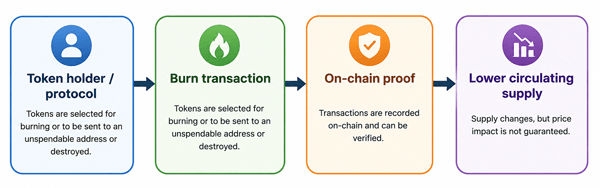
Figure 1: A simple crypto burn flow from token selection to on-chain verification.
1. What Is a Crypto Burn Mechanism?
A crypto burn mechanism is a process that permanently removes cryptocurrency tokens or coins from circulation. The goal is to make those tokens impossible to use again. In most cases, this is done by sending tokens to a burn address, sometimes called a dead address, null address, eater address, or blackhole address. These addresses are designed so that no one has the private key needed to move the tokens out.
Burning is common in tokenomics, which is the economic design of a cryptocurrency. A project may burn tokens once, on a fixed schedule, automatically through smart contracts, or as part of each transaction. Some blockchain protocols burn fees at the protocol level. Some projects use burns to reduce supply after a token sale, remove unsold tokens, or align long-term incentives.
The important beginner point is this: burning changes supply, not demand. A burn can reduce the number of tokens available, but it cannot guarantee a higher price, stronger adoption, or a healthier project.
2. How Crypto Burning Works in Simple Terms
Imagine a project has 1 billion tokens. It decides to burn 100 million tokens. After the burn, those 100 million tokens still appear on the blockchain, but they are locked forever in an address or contract state that cannot be spent. The effective usable supply is now lower.
A basic burn usually follows these steps:
- The project, user, or protocol selects the tokens to burn.
- A burn transaction is created and sent on-chain.
- The tokens are transferred to an unspendable address or destroyed by smart contract code.
- The transaction hash, burn address, and supply change can be checked on a block explorer.
- The circulating supply or total supply may be updated, depending on how the token contract and data providers track the burn.
For a user, the burn may look like a normal transfer. The difference is the destination: instead of going to another person, the tokens go somewhere they cannot be recovered from.
3. Common Types of Crypto Burn Mechanisms
| Burn type | How it works | Common use case | What beginners should check |
|---|---|---|---|
| Manual burn | A team manually sends tokens to a burn address. | Token sale cleanup, treasury reduction, marketing events. | Check the transaction hash, source wallet, burn address, and whether supply trackers changed. |
| Scheduled burn | Tokens are burned on a recurring schedule, such as monthly or quarterly. | Predictable long-term supply reduction. | Check whether the schedule is written in code or controlled by the team. |
| Transaction-fee burn | A portion of every transaction fee is burned automatically. | Network fee design, spam resistance, supply offset. | Check the percentage burned and whether high usage actually produces meaningful burns. |
| Buyback-and-burn | A project buys tokens from the market and burns them. | Similar in concept to a stock buyback, though crypto rules differ. | Check where funds come from, whether purchases are transparent, and whether this creates regulatory concerns. |
| Algorithmic burn | Burn amount changes based on formulas such as price, supply, activity, or block production. | More predictable and less discretionary tokenomics. | Check whether the formula is public, auditable, and difficult to manipulate. |
| Mint-and-burn | One token is burned to mint another token, redeem an asset, or move value between systems. | Stablecoins, wrapped assets, cross-chain systems, game items. | Check whether reserves, redemption rules, and bridge security are reliable. |
| NFT burn | An NFT is destroyed or locked forever. | Upgrades, redemptions, game mechanics, supply cleanup. | Check whether burning gives a new asset, access right, or only removes the NFT. |
4. Burn Address vs Smart Contract Burn: What Is the Difference?
A burn address is a wallet address that is practically impossible to control. Common examples include addresses made entirely of zeros or addresses ending in words such as dEaD. Tokens sent there remain visible on-chain but cannot be moved by any known owner.
A smart contract burn function works differently. Instead of transferring tokens to a dead address, the contract may reduce the token balance and lower the total supply variable. For example, an ERC-20 token can include a burn() function that subtracts tokens from a user balance and updates totalSupply. This is often cleaner because the contract directly records that the tokens no longer exist in the token accounting system.
| Method | What happens | Main advantage | Main limitation |
|---|---|---|---|
| Burn address | Tokens are sent to an unspendable wallet. | Easy to verify on a block explorer. | Total supply may not automatically change unless trackers subtract the burn address balance. |
| Smart contract burn | Contract logic destroys tokens and reduces supply accounting. | Cleaner token accounting when implemented correctly. | Requires trust that the contract code is correct and not upgradeable in a risky way. |
| Protocol-level fee burn | The blockchain protocol burns part of fees by rule. | Automatic and hard to avoid if enforced by consensus. | Impact depends on network usage and issuance rules. |
5. Real-World Examples of Crypto Burn Mechanisms
5.1 Ethereum: EIP-1559 Fee Burning
Ethereum introduced EIP-1559 as a major change to transaction fees. Under this design, each transaction includes a base fee that is burned by the protocol, while users can add a priority fee, or tip, for validators. This means part of ETH paid for network usage is permanently removed from circulation. The burn can offset new ETH issuance, but ETH is not automatically deflationary at all times; the net supply change depends on network activity and issuance.
5.2 BNB: Auto-Burn and Blackhole Address
BNB uses an Auto-Burn system that calculates quarterly burn amounts using factors such as BNB price and the number of blocks produced. BNB Chain describes the process as objective and auditable, and recent burns have occurred by sending BNB to a blackhole address. This is a good example of a scheduled and formula-based burn intended to be more transparent than purely discretionary manual burns.
5.3 Shiba Inu and Meme Token Burns
Many meme tokens use community or project-led burns. These burns can attract attention because the supply numbers are often very large. However, beginners should be careful: burning billions of tokens may sound impressive, but it may represent only a tiny percentage of total supply. Always compare the burn amount with total supply, circulating supply, and daily trading volume.
5.4 NFT Burns and Upgrade Mechanics
NFT projects may ask holders to burn an old NFT to receive a new NFT, claim a physical product, unlock access, or upgrade a game asset. This kind of burn is less about token price and more about access, scarcity, or utility. The key risk is irreversible loss: once an NFT is burned, it usually cannot be recovered.
6. Why Do Crypto Projects Burn Tokens?
Projects use burn mechanisms for several reasons. Some are practical, some are economic, and some are mostly marketing. A serious burn policy should clearly explain what problem it solves.
- Supply management: Reducing usable token supply or offsetting new issuance.
- Fee design: Burning part of transaction fees so network users remove supply as they use the system.
- Spam resistance: Making certain actions costly enough to discourage low-quality activity.
- Token sale cleanup: Burning unsold tokens so the team cannot later dump them into the market.
- Governance commitments: Showing that a DAO or project has permanently removed treasury tokens.
- Access or redemption: Burning tokens or NFTs to claim another asset, upgrade, or unlock a benefit.
- Narrative and marketing: Creating a scarcity story, which can be useful but is risky when not backed by real utility.
7. Does Burning Crypto Increase Price?
Not necessarily. This is the most common misconception. In simple economics, if supply falls while demand stays the same or rises, price may increase. But crypto markets are more complicated. Demand can fall, liquidity can disappear, investors can lose trust, or the burn may be too small to matter.
A burn is more meaningful when it is large relative to circulating supply, transparent, recurring or rule-based, connected to real usage, and supported by genuine demand. A burn is less meaningful when it is tiny, manually controlled, poorly documented, used mainly for hype, or offset by new minting elsewhere.
| Scenario | Likely interpretation |
|---|---|
| A protocol burns fees during high real usage. | Potentially meaningful because burn activity is tied to demand for the network. |
| A team burns a large amount of already locked or unsold tokens. | Can improve trust, but may not affect market liquidity if tokens were not circulating. |
| A meme token burns a huge number of tokens but tiny percentage of supply. | May sound impressive but have limited economic impact. |
| A project burns tokens while insiders receive new emissions. | Potential red flag unless emissions are transparent and justified. |
| A project announces a burn without transaction proof. | Do not treat it as real until verified on-chain. |
8. Crypto Burn Benefits
- Improves transparency when burns are recorded on-chain and easy to verify.
- Can reduce long-term supply pressure if burns are meaningful and not offset by excessive minting.
- May align token supply with network usage, especially in fee-burn models.
- Can strengthen trust when unsold or excess tokens are permanently removed.
- Can create clear token utility in redemption, upgrade, gaming, or NFT systems.
- May discourage spam when burning makes abusive actions more expensive.
9. Crypto Burn Risks and Limitations
- No guaranteed price increase: A lower supply does not create demand by itself.
- Marketing manipulation: Some projects use burn announcements to create hype without improving fundamentals.
- Irreversibility: Mistaken burns generally cannot be undone.
- Fake or misleading burns: A project may send tokens to a wallet it still controls or burn tokens that were never circulating.
- Centralization risk: Manual burns depend on team discretion unless rules are coded or governed transparently.
- Smart contract risk: A burn function may contain bugs, upgrade risks, or owner privileges that change the rules later.
- Data confusion: Total supply, max supply, and circulating supply may be reported differently by explorers and market-data sites.
- Regulatory risk: Buyback-and-burn programs may raise legal questions in some jurisdictions because they can resemble value-support mechanisms.
10. How to Verify a Crypto Burn
Do not rely only on social media posts. A real burn should be verifiable on-chain. Beginners can use this checklist:
- Find the official announcement and identify the claimed burn amount.
- Open the transaction hash on a trusted block explorer such as Etherscan, BscScan, Polygonscan, Solscan, or the relevant chain explorer.
- Confirm the token contract address matches the official token, not a fake copy.
- Check the sending wallet. Was it a project treasury, burn contract, user wallet, or exchange wallet?
- Check the destination. Is it a known burn address, blackhole address, or contract burn function?
- Compare the burned amount with total supply and circulating supply.
- Check whether new tokens can still be minted and who controls that permission.
- Review whether the project has repeated the process consistently or only during promotional periods.
11. Simple Example: Why Percentage Matters More Than Big Numbers
Suppose Token A burns 1 billion tokens and Token B burns 100,000 tokens. Token A sounds more impressive. But now compare the burn with supply:
| Token | Total supply before burn | Burn amount | Supply reduction |
|---|---|---|---|
| Token A | 1,000,000,000,000 | 1,000,000,000 | 0.10% |
| Token B | 1,000,000 | 100,000 | 10.00% |
Token B burned fewer tokens in absolute terms, but the burn was much larger relative to supply. This is why serious analysis focuses on percentages, liquidity, emissions, and demand - not just headline numbers.
12. Burns vs Buybacks vs Staking: Key Differences
| Mechanism | What it does | Main purpose | Key risk |
|---|---|---|---|
| Burning | Permanently removes tokens from usable supply. | Supply reduction or protocol fee design. | May not increase demand or price. |
| Buyback | Project buys tokens from the market; tokens may be held or burned. | Market support, treasury strategy, or supply reduction. | Can be discretionary, opaque, or legally sensitive. |
| Staking | Users lock tokens to help secure a network or earn rewards. | Network security and participation. | Tokens are usually not destroyed and may return to circulation. |
| Locking/vesting | Tokens are restricted for a period. | Reduce short-term sell pressure. | Tokens may enter circulation later. |
13. Best Practices for Crypto Projects Using Burn Mechanisms
A burn mechanism should be designed for trust, not just attention. Projects can improve credibility by following these practices:
- Publish a clear burn policy that explains the purpose, formula, schedule, and source of burned tokens.
- Use on-chain automation where possible instead of relying only on team discretion.
- Make burn addresses, transaction hashes, contract addresses, and calculations easy to verify.
- Avoid exaggerated claims such as “guaranteed price increase” or “risk-free deflation.”
- Show burn amounts as both token counts and percentages of circulating and total supply.
- Disclose minting rights, upgrade permissions, treasury balances, and future emissions.
- Get smart contracts audited when burns are handled by code.
- Use dashboards so users can track burns, supply, emissions, and treasury activity over time.
- Separate real tokenomics from marketing campaigns. Burns should support the product, not replace it.
14. Best Practices for Investors and Users
- Treat burns as one signal, not a reason to buy by itself.
- Check whether the burn is meaningful compared with circulating supply and daily volume.
- Look for recurring, rule-based burns tied to actual usage rather than one-time hype events.
- Verify burns on-chain before trusting announcements.
- Read the token contract or third-party audit to understand minting and owner controls.
- Watch for projects that burn tokens while insiders unlock large amounts.
- Compare market cap, fully diluted valuation, liquidity, token utility, and revenue model.
- Be careful with burn-to-claim events. Confirm you are using the correct official contract or website.
15. Common Mistakes and Misconceptions
| Misconception | Reality |
|---|---|
| “Burning always makes price go up.” | Price depends on demand, liquidity, trust, and market conditions. |
| “A bigger burn number is always better.” | Percentage of supply matters more than the headline token count. |
| “Burned tokens disappear from the blockchain.” | They remain visible on-chain but become unusable or are removed from token accounting. |
| “All burn addresses are safe.” | Some addresses may look like burn addresses but could be controlled. Use known addresses and contract logic. |
| “A burn means the project is healthy.” | A weak project can still burn tokens. Utility and execution matter more. |
| “Locked tokens are burned.” | Locked tokens may return later. Burned tokens should be permanently unrecoverable. |
16. Red Flags in Burn Announcements
- No transaction hash or block explorer link.
- Burn address is not clearly unspendable.
- The project burns tokens while quietly minting more.
- Burned tokens were never part of circulating supply.
- The burn is promoted as a guaranteed way to raise price.
- The token contract has powerful owner permissions but no clear governance safeguards.
- The project focuses more on burn countdowns than product usage, revenue, or community value.
17. Practical Checklist: Is a Burn Mechanism Healthy?
| Question | Why it matters |
|---|---|
| Is the burn verifiable on-chain? | Transparency reduces the chance of fake or misleading claims. |
| Is the burn automatic or discretionary? | Automatic rules are usually easier to trust than manual decisions. |
| Is the amount meaningful as a percentage? | Small percentages may have little economic effect. |
| Is the burn tied to real usage? | Usage-based burns can reflect actual demand for the network or product. |
| Can new tokens be minted? | Future minting can offset or reverse the burn impact. |
| Who controls the contract? | Admin keys and upgrade rights can change tokenomics. |
| Are unlocks or emissions coming? | New supply can outweigh burns. |
| Is communication honest? | Trustworthy projects explain limits, not only benefits. |
18. When Token Burns Make Sense
Token burns are most useful when they solve a clear economic or technical problem. For example, a fee-burning blockchain can link supply reduction to network demand. A game can use NFT burns to upgrade items and keep old assets from cluttering the economy. A project can burn unsold tokens after a sale to prove those tokens will not later be dumped.
Burns are weaker when they are used as a substitute for real adoption. A project with no users, no product-market fit, and no credible revenue model does not become strong simply because it burns tokens.
19. Beginner Summary
A crypto burn mechanism permanently removes tokens from usable circulation. Burns can be manual, scheduled, automatic, fee-based, algorithmic, or part of mint-and-burn systems. They can support better tokenomics, improve transparency, and reduce supply pressure. But burns are not magic. They do not guarantee price increases, and they can be misused as marketing.
The safest way to evaluate a burn is to ask: Is it real? Is it verifiable? Is it meaningful as a percentage of supply? Is it tied to genuine usage? Can new tokens offset it? Does the project communicate honestly? If the answer to those questions is clear, a burn can be a useful part of your analysis. If not, treat the announcement with caution.
20. FAQs About Crypto Burn Mechanisms
20.1 What does it mean to burn crypto?
It means permanently removing tokens from usable circulation, usually by sending them to an unspendable address or destroying them through smart contract logic.
20.2 Can burned crypto be recovered?
Usually no. A proper burn is designed to be irreversible. If someone can recover the tokens, it was not a true burn.
20.3 Does burning crypto reduce total supply or circulating supply?
It depends on the method and the token contract. A smart contract burn may reduce total supply directly. A burn-address transfer may require explorers and data providers to subtract that address balance from circulating supply.
20.4 Is crypto burning the same as deleting tokens?
In practical terms, yes, because the tokens become unusable. Technically, blockchain records remain visible, so the history is not deleted.
20.5 Why would a project burn tokens instead of giving them away?
Burning can reduce future sell pressure, improve supply transparency, or support a specific economic design. Giving tokens away may increase circulation and selling pressure.
20.6 Are burn mechanisms good or bad?
They can be good when transparent, meaningful, and connected to real utility. They can be bad when used mainly for hype or when they hide poor fundamentals.
20.7 How can I check if a burn happened?
Look for the transaction hash on the relevant block explorer, verify the official token contract, confirm the destination or burn function, and compare the amount with supply data.
20.8 What is a dead wallet?
A dead wallet is an address believed to be unspendable because no one has the private key. Tokens sent there are treated as permanently removed from circulation.
20.9 What is proof of burn?
Proof of burn is a less common consensus idea where participants burn coins to gain the right to participate in block creation or mining. It is different from ordinary token burns used for tokenomics.
20.10 Should I buy a token because it announced a burn?
No. A burn announcement is only one data point. Review demand, product utility, liquidity, token emissions, contract risks, team credibility, and market conditions before making any decision.
Sources Consulted and Checked
These sources were consulted and checked while preparing this document to support accuracy and clarity:
- Ethereum Improvement Proposal EIP-1559, which specifies that the base fee is burned by the protocol.
- Ethereum.org documentation on proof-of-stake and validator slashing concepts.
- BNB Chain documentation and blog posts describing BNB Auto-Burn and blackhole-address burns.
- Binance Academy educational material on BNB Auto-Burn and token burning.
- Block explorer verification practices used across networks such as Ethereum and BNB Chain.
Reader Advice
This article is for educational and informational purposes only and is not personalized financial, investment, legal, tax, or other professional advice or a recommendation to buy, sell, or hold any crypto asset. Crypto activities can involve volatility, fraud, smart-contract failures, irreversible loss, liquidity problems, and regulatory or tax consequences. Rules, policies, laws, project terms, and statistics change over time and vary by jurisdiction; verify important details through current official sources, relevant block explorers, and qualified professionals before making decisions or transferring assets. Never risk funds you cannot afford to lose.