Inflationary vs Deflationary Tokens: Key Differences, Pros, Cons, Risks and Best Use Cases
1. Quick Answer: What Is the Difference?
An inflationary token is a crypto token whose circulating supply can increase over time. A deflationary token is a crypto token whose supply is designed to decrease, or whose new issuance is lower than the amount removed from circulation. The difference matters because supply changes affect dilution, staking rewards, network security, user incentives, and sometimes market psychology.
The simplest way to think about it is this: inflationary tokenomics add tokens to support activity, rewards, and growth; deflationary tokenomics remove or limit tokens to create scarcity. Neither model is automatically good or bad. The better question is whether the supply design fits the token’s purpose.
2. Inflationary vs Deflationary Tokens: Side-by-Side Comparison
| Feature | Inflationary Tokens | Deflationary Tokens |
|---|---|---|
| Supply direction | Circulating supply can increase over time. | Supply is reduced, capped, or designed to shrink under certain conditions. |
| Common mechanisms | Mining rewards, staking rewards, emissions, minting, ecosystem incentives. | Token burns, buybacks and burns, fee burns, capped supply, reduced emissions. |
| Main goal | Fund security, growth, validators, liquidity, rewards, and ecosystem activity. | Create scarcity, reduce excess supply, reward holders, or align supply with network usage. |
| Main benefit | Can support participation and network security. | Can reduce dilution and create a clearer scarcity narrative. |
| Main risk | Holder dilution if new supply grows faster than demand. | Unsustainable scarcity marketing, weak incentives, or reduced liquidity. |
| Best suited for | Networks needing ongoing rewards, validators, contributors, or liquidity. | Tokens with strong utility, real fee activity, mature demand, or capped-supply monetary goals. |
| Price impact | Not automatically bad; demand can offset new supply. | Not automatically bullish; burns do not matter much without demand. |
3. What Is Tokenomics?
Tokenomics means the economic design of a crypto token. It answers basic questions such as how many tokens exist, how new tokens are created, who receives them, whether tokens can be burned, what the token is used for, and how incentives are distributed.
For beginners, tokenomics can look like a technical topic, but the core idea is simple: every token has rules for supply and demand. Supply rules decide how many tokens can exist and how they move into or out of circulation. Demand depends on why people need or want the token, such as paying fees, staking, voting, accessing a product, earning rewards, or holding it as a scarce asset.
A token can have a brilliant supply model and still fail if nobody uses it. A token can also have high emissions and still perform well if usage, revenue, or demand grows faster than supply. That is why inflationary versus deflationary is only one part of token analysis.
4. What Is an Inflationary Token?
An inflationary token is a token whose supply can increase. New tokens are created through a scheduled issuance, validator rewards, mining rewards, liquidity incentives, ecosystem grants, or governance-approved minting. Inflation does not always mean uncontrolled money printing. In well-designed tokenomics, inflation is planned, transparent, and tied to a purpose.
A simple example is a proof-of-stake blockchain that issues new tokens to validators and stakers. The network uses inflation to pay people who help secure the chain. Token holders may experience dilution, but stakers can offset some of that dilution by earning rewards.
4.1 How Inflationary Tokens Work
- New tokens are created according to a schedule or rule.
- Those tokens are distributed to miners, validators, stakers, teams, investors, users, liquidity providers, or ecosystem programs.
- The circulating supply increases unless tokens are locked, burned, or otherwise removed.
- The impact on each holder depends on whether they receive a share of the new issuance and whether demand grows fast enough to absorb it.
4.2 Common Inflationary Token Mechanisms
- Mining rewards: Proof-of-work networks issue new coins to miners who secure the network.
- Staking rewards: Proof-of-stake networks issue new tokens to validators or delegators.
- Ecosystem incentives: Projects distribute tokens to attract developers, users, liquidity, or partners.
- Liquidity mining: DeFi protocols reward users for providing liquidity or participating in markets.
- Governance minting: Some protocols allow token holders or administrators to approve new supply.
5. What Is a Deflationary Token?
A deflationary token is a token designed so that supply decreases over time or becomes scarcer through burns, capped supply, reduced issuance, or a combination of these mechanisms. In crypto, “deflationary” usually means token supply is reduced or supply growth becomes negative. It does not always mean the token price will rise.
A common deflationary mechanism is a token burn. Burning means sending tokens to an address or mechanism where they can no longer be used. This permanently removes tokens from the usable supply. Some projects burn a portion of transaction fees. Others use project revenue to buy back tokens and burn them. Some tokens are called deflationary because they have a hard cap and declining issuance, even if new tokens are still being created for now.
5.1 How Deflationary Tokens Work
- The token has a rule that removes supply or limits new supply.
- Tokens may be burned from transaction fees, protocol revenue, treasury decisions, or automated burn formulas.
- If the amount burned is greater than the amount minted, net supply decreases.
- If demand remains steady or increases, lower supply can support scarcity. But scarcity alone does not create value.
5.2 Common Deflationary Token Mechanisms
- Token burns: Tokens are permanently removed from circulation.
- Fee burns: A portion of transaction fees is burned automatically.
- Buyback and burn: A protocol or company uses revenue to buy tokens and burn them.
- Hard supply cap: The maximum supply cannot exceed a stated number under current rules.
- Halving or declining emissions: New issuance falls over time, reducing inflation pressure.
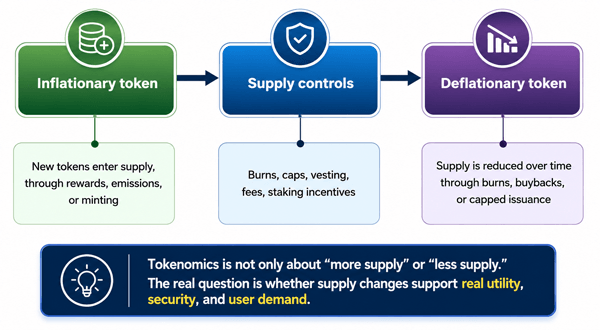
Figure: Inflationary and deflationary token design both depend on supply controls, incentives, and real demand.
6. Real-World Examples
6.1 Bitcoin: Capped Supply With Declining Issuance
Bitcoin is often discussed as a scarce crypto asset because its maximum supply is capped at 21 million BTC under the current protocol rules. New BTC is still issued to miners, so Bitcoin has issuance today, but the block reward halves roughly every 210,000 blocks, or about every four years. This means its rate of new supply declines over time. Bitcoin is best understood as a fixed-supply, disinflationary asset rather than a token that constantly burns supply.
6.2 Ethereum: Flexible Supply With Fee Burns
Ethereum does not have a fixed maximum supply like Bitcoin. Since EIP-1559, Ethereum burns the base fee from transactions. After Ethereum moved to proof of stake, issuance fell significantly compared with proof of work. When network activity and fee burns are high enough, ETH can become net deflationary. When burns are lower than issuance, ETH can become net inflationary again. This makes ETH a useful example of a token that can move between inflationary and deflationary conditions depending on usage.
6.3 Solana: Inflation to Reward Validators and Stakers
Solana is commonly described as inflationary because it issues new SOL to reward validators and stakers. Its inflation schedule is designed to decline over time toward a long-term lower rate. This model supports network security and staking participation, but non-stakers can be diluted if they do not earn rewards and if demand does not grow enough to offset issuance.
6.4 BNB: Burn Mechanisms to Reduce Supply
BNB uses burn mechanisms, including an Auto-Burn model that calculates burn amounts based on factors such as BNB price and blocks produced on BNB Chain. BNB Chain has described the long-term goal as reducing total supply toward 100 million BNB. This is a practical example of a token using programmed supply reduction as part of its tokenomics.
7. Pros of Inflationary Tokens
- They can fund network security by paying miners, validators, or stakers.
- They can reward users who actively contribute to the ecosystem.
- They can help new networks bootstrap liquidity and adoption.
- They can provide ongoing incentives instead of relying only on fees or treasury funds.
- They can be flexible during early growth stages when a project needs participation more than scarcity.
8. Cons and Risks of Inflationary Tokens
- Dilution: If your percentage ownership falls because new tokens are issued, you may need staking rewards or price growth to compensate.
- Sell pressure: Reward recipients may sell tokens to cover costs or take profit.
- Weak demand: Inflation becomes more harmful when new supply is not matched by real usage.
- Unclear schedules: Projects with vague minting rights or governance-controlled issuance can surprise holders.
- Misaligned incentives: Excessive rewards can attract short-term yield farmers rather than long-term users.
9. Pros of Deflationary Tokens
- They can reduce supply over time and create a stronger scarcity narrative.
- They can reduce dilution for long-term holders when burns are meaningful and transparent.
- Fee burns can connect network usage to token supply, making tokenomics easier to understand.
- Buyback-and-burn models can return some economic value to token holders, if supported by real revenue.
- Hard caps and declining emissions can make future supply easier to model.
10. Cons and Risks of Deflationary Tokens
- Burns do not guarantee price increases. Demand still matters.
- Projects may use burn marketing to distract from weak utility, low revenue, or poor product-market fit.
- Excessive deflation can reduce spending and liquidity if holders expect scarcity to do all the work.
- Buyback-and-burn models may raise regulatory or governance concerns depending on structure and jurisdiction.
- If rewards are too low, validators, miners, or liquidity providers may not be properly incentivized.
11. Key Differences That Matter Most for Beginners
11.1 Supply Growth vs Supply Reduction
Inflationary tokens increase supply. Deflationary tokens reduce supply or limit future supply. But the headline label can be misleading. A token can issue new supply and burn some of it at the same time. What matters is net supply change: minted tokens minus burned tokens.
11.2 Incentives vs Scarcity
Inflationary designs usually focus on incentives: paying participants to secure, use, or grow the network. Deflationary designs usually focus on scarcity: reducing available supply or making future supply more predictable. Good tokenomics often balances both.
11.3 Active Users vs Passive Holders
Inflationary tokens may reward active participants more than passive holders. For example, stakers may earn rewards while non-stakers are diluted. Deflationary tokens may favor holders if supply decreases, but holders still depend on real demand and market confidence.
11.4 Short-Term Yield vs Long-Term Sustainability
High emissions can create attractive yields, but those yields may be paid in a token that is losing value. Deflationary models can look safer, but a token with no useful purpose can still decline even if supply is shrinking.
12. Best Use Cases for Inflationary Tokens
- Layer-1 and layer-2 networks that need validator, sequencer, or miner incentives.
- New ecosystems trying to attract developers, liquidity, and early users.
- Proof-of-stake networks where staking rewards support security.
- Gaming or social platforms that need ongoing rewards for participation, if emissions are carefully controlled.
- DeFi protocols that use incentives temporarily to bootstrap markets, not permanently hide weak demand.
13. Best Use Cases for Deflationary Tokens
- Utility tokens where fees or revenue can support transparent burns.
- Mature protocols with real usage and less need for aggressive emissions.
- Capped-supply monetary assets where scarcity is central to the value proposition.
- Exchange or ecosystem tokens where burn mechanisms are tied to measurable activity.
- Governance tokens that want to reduce long-term dilution, provided governance remains healthy and decentralized.
14. Common Misconceptions
14.1 Misconception 1: Inflationary Tokens Are Always Bad
Inflation is not automatically bad. A network may need issuance to pay validators, secure the chain, reward users, or build liquidity. The real issue is whether new supply creates more value than it dilutes.
14.2 Misconception 2: Deflationary Tokens Always Go Up
A shrinking supply can help only if people actually want the token. If demand falls faster than supply, price can still decline. Burns are not magic. They are one input in a larger economic system.
14.3 Misconception 3: A Hard Cap Means No Inflation Today
A token can have a hard cap and still be inflationary today if new tokens are still entering circulation. Bitcoin is capped, but new BTC is issued until the mining schedule is complete. The rate of issuance decreases over time.
14.4 Misconception 4: High Staking APY Means High Real Return
A 10% staking reward does not automatically mean you are 10% richer in real terms. If supply inflation is high and the token price falls, the real return can be much lower or negative. Always compare staking yield with inflation, lockup risk, validator risk, and market risk.
15. How to Evaluate a Token’s Supply Model Before Buying or Using It
- Check the maximum supply, circulating supply, and fully diluted valuation.
- Read the issuance schedule: How many tokens enter circulation each month or year?
- Look for unlocks: Are team, investor, or treasury tokens becoming liquid soon?
- Understand who receives new tokens and why.
- Check whether burns are automatic, discretionary, or marketing-based.
- Compare inflation or burn rate with real demand, fees, revenue, users, and transaction activity.
- Ask whether the token is actually needed for the product or network.
- Look at governance risks: Can insiders change supply rules?
- Consider liquidity: Can you enter or exit without large slippage?
- Do not rely on a single metric such as APY, burn rate, or supply cap.
16. Practical Scenarios
16.1 Scenario 1: A New Blockchain With High Staking Rewards
A new proof-of-stake chain offers high staking rewards to attract validators. This can be reasonable early on because the network needs security and participation. But beginners should ask: Are rewards coming from real fees or new supply? How fast does inflation decline? Are users and developers actually growing?
16.2 Scenario 2: A Token Announces a Huge Burn
A project announces that it will burn a large number of tokens. This may reduce supply, but you should check whether the burned tokens were already circulating. Burning locked treasury tokens may have less market impact than burning tokens that were actually available to trade. Also check whether the project has real revenue or usage.
16.3 Scenario 3: A DeFi Protocol Pays Very High APY
A DeFi protocol pays high rewards in its own token. This can attract deposits quickly, but if most users sell the rewards, token price may fall. High APY can be useful during bootstrapping, but it is risky when emissions are the only reason people participate.
17. Actionable Best Practices
- For investors: Do not buy only because a token is deflationary. Confirm utility, demand, liquidity, governance, and unlock schedules.
- For users: If you hold an inflationary token, understand whether staking is needed to avoid dilution.
- For builders: Match token supply to the job the token must perform. Do not force burns into a model if the network still needs incentives.
- For analysts: Focus on net supply change, not labels. A token can be inflationary one month and deflationary the next.
- For beginners: Avoid projects that cannot clearly explain where new tokens come from, who receives them, and why burns happen.
18. Inflationary vs Deflationary Tokens: Which Is Better?
There is no universally better model. Inflationary tokens can be better for networks that need ongoing incentives, security, and growth. Deflationary tokens can be better for assets where scarcity, fee burns, and mature demand are central to the design. The best tokenomics model is the one that fits the product, aligns incentives, stays transparent, and supports long-term sustainability.
A practical rule: Inflation is acceptable when it buys useful security, growth, or participation. Deflation is valuable when it is tied to real usage, transparent rules, and genuine demand. Both models fail when they are used mainly as marketing.
19. FAQs
19.1 What is an inflationary token in simple terms?
An inflationary token is a token whose supply can increase over time. New tokens may be created to reward miners, validators, stakers, users, or ecosystem contributors.
19.2 What is a deflationary token in simple terms?
A deflationary token is a token designed to reduce supply or become scarcer over time. This often happens through token burns, fee burns, buybacks, hard caps, or declining emissions.
19.3 Can a token be both inflationary and deflationary?
Yes. A token can issue new tokens and burn tokens at the same time. The token is net inflationary if issuance is higher than burns, and net deflationary if burns are higher than issuance.
19.4 Do token burns increase price?
Not necessarily. Burns reduce supply, but price depends on supply and demand together. If demand is weak, a burn may have little or no lasting impact.
19.5 Is Bitcoin inflationary or deflationary?
Bitcoin has a fixed maximum supply of 21 million BTC, but new BTC is still issued through mining rewards until the issuance schedule ends. Its new supply rate declines through halvings, so it is often described as capped and disinflationary.
19.6 Is Ethereum inflationary or deflationary?
Ethereum can be either, depending on network conditions. ETH is issued to validators, but the base fee from transactions is burned. If burns exceed issuance, supply decreases. If issuance exceeds burns, supply increases.
19.7 Are deflationary tokens safer?
No. Deflationary tokenomics can reduce supply, but they do not remove market risk, smart contract risk, liquidity risk, governance risk, or regulatory risk.
19.8 What should beginners look at first?
Start with circulating supply, maximum supply, emission schedule, unlocks, burn rules, staking rewards, real utility, user demand, and governance control over supply changes.
20. Final Takeaway
Inflationary and deflationary tokens are two different ways to manage crypto supply. Inflationary tokens add supply, usually to fund rewards, security, or growth. Deflationary tokens reduce or limit supply, usually to create scarcity or connect usage to token value. The most important lesson is that supply design is not a shortcut for value. A good token needs real utility, transparent rules, healthy incentives, responsible governance, and demand that can support its economic model.
Sources Consulted and Checked
These sources were consulted and checked while preparing this article to support clarity and accuracy.
- Ethereum EIP-1559 specification
- Fidelity Digital Assets: Understanding Bitcoin and Ethereum Supply
- River: Can Bitcoin’s hard cap of 21 million be changed?
- Solana Compass: Solana tokenomics and inflation schedule
- BNB Chain: BNB Auto-Burn and burn updates
- Binance Academy: What Is BNB Auto-Burn?
Reader Advice
This article is provided for educational and informational purposes only and is not personalized financial, investment, legal, tax, or other professional advice or a recommendation to buy, sell, hold, or use any token. Crypto assets and tokenomics involve significant risks, including price volatility, loss of funds, dilution, liquidity limits, smart-contract failures, governance changes, scams, and regulatory uncertainty. Protocol rules, project policies, laws, and statistics can change over time and may vary by region, so verify important details through current official sources and consider advice from a suitably qualified professional before making decisions.