Bull Market vs Bear Market: Key Differences, Pros, Cons, Risks and Best Use Cases
Quick Answer: A bull market is a period when prices are generally rising and investors are optimistic. A bear market is a period when prices are generally falling and investors are pessimistic. A common rule of thumb is that a broad market index has entered a bull market after rising 20% or more over at least two months, while a bear market is often defined as a 20% or more decline over at least two months. These definitions are widely used, but they are not perfect timing tools.
1. Bull Market vs Bear Market at a Glance
| Factor | Bull Market | Bear Market |
|---|---|---|
| Basic meaning | A period of rising prices and positive sentiment. | A period of falling prices and negative sentiment. |
| Common threshold | Often described as a 20% or greater rise in a broad index over at least two months. | Often described as a 20% or greater fall in a broad index over at least two months. |
| Investor mood | Confidence, optimism, willingness to take risk. | Fear, caution, pessimism, risk reduction. |
| Typical behavior | More buying, higher valuations, stronger demand for growth assets. | More selling, lower valuations, greater interest in cash, bonds, and defensive assets. |
| Main opportunity | Portfolio growth and compounding. | Buying quality assets at lower prices and improving long-term positioning. |
| Main danger | Overconfidence, bubbles, chasing hot investments. | Panic selling, locking in losses, missing the recovery. |
| Best use case | Long-term growth investing with discipline. | Risk management, rebalancing, dollar-cost averaging, and finding value. |
2. What Is a Bull Market?
A bull market is a market phase where prices are moving upward for a sustained period. It is usually associated with optimism, stronger investor confidence, growing corporate profits, and a belief that future conditions will improve.
For beginners, the easiest way to understand a bull market is this: more investors want to buy than sell, and that demand pushes prices higher. The rise may happen across the whole stock market, a sector such as technology, or even another asset class such as commodities or crypto. However, when people say “the market is in a bull market,” they usually mean a broad stock market index is rising.
2.1. How a Bull Market Works
Bull markets are driven by a combination of fundamentals and psychology. Strong earnings, lower interest rates, economic growth, innovation, and consumer confidence can all support higher prices. At the same time, investor optimism can become self-reinforcing: rising prices attract more buyers, which can push prices even higher.
That does not mean prices rise every day. Even strong bull markets include pullbacks, corrections, bad weeks, and scary headlines. The key feature is the broader upward trend.
2.2. Signs of a Bull Market
- Broad market indexes are making higher highs over time.
- Corporate profits and earnings expectations are improving.
- Investors are more willing to buy stocks and other risk assets.
- Market corrections are often bought quickly.
- News coverage becomes more optimistic, and new investors may enter the market.
2.3. Pros of a Bull Market
- Portfolio values may grow, especially for diversified long-term investors.
- Businesses may raise capital more easily because investor demand is strong.
- Investor confidence can support spending, hiring, and business expansion.
- Long-term investors may benefit from compounding if they stay disciplined.
2.4. Cons and Risks of a Bull Market
- Overconfidence can lead investors to take more risk than they understand.
- High prices can reduce future expected returns if valuations become stretched.
- Speculative bubbles can form when buyers ignore fundamentals.
- Beginners may chase recent winners and buy near the top.
- Leverage, margin trading, and options can magnify losses if the trend reverses.
2.5. Best Use Cases in a Bull Market
A bull market is best used for disciplined growth, not emotional speculation. Beginners can focus on regular investing, diversification, rebalancing, and avoiding the temptation to put all their money into whatever performed best last month.
3. What Is a Bear Market?
A bear market is a market phase where prices are falling for a sustained period and investor sentiment is negative. A common definition is a 20% or greater decline in a broad index over at least two months. Bear markets can feel uncomfortable because portfolio values fall, headlines become negative, and uncertainty increases.
A bear market is not the same as a normal bad day or short-term dip. Markets can fall 5% or 10% without being in a full bear market. A bear market usually reflects a deeper shift in expectations, such as recession fears, falling earnings, high inflation, rising interest rates, financial stress, or a major shock.
3.1. How a Bear Market Works
Bear markets often begin when investors believe future profits, economic conditions, or liquidity will be worse than expected. Sellers become more aggressive, buyers become more cautious, and prices fall. As prices decline, fear can spread. Some investors sell to avoid further losses, while others are forced to sell because of leverage or liquidity needs.
The difficult part is that bear markets can also create opportunity. Lower prices may allow patient investors to buy strong assets at more attractive valuations. The challenge is emotional: it is hard to invest when news feels bad and account balances are down.
3.2. Signs of a Bear Market
- Broad market indexes are down sharply from recent highs.
- Investor sentiment is fearful or pessimistic.
- Earnings expectations are being reduced.
- Volatility rises and price swings become larger.
- Defensive assets and cash become more attractive to many investors.
3.3. Pros of a Bear Market
- Quality investments may become cheaper than they were during the bull market.
- Long-term investors can use lower prices to accumulate shares gradually.
- Weak business models and excessive speculation are often exposed.
- Investors may become more realistic about risk, diversification, and emergency savings.
3.4. Cons and Risks of a Bear Market
- Portfolio values can decline significantly, sometimes for months or longer.
- Panic selling can turn temporary losses into permanent losses.
- Job losses, recession, and lower business profits may occur alongside the downturn.
- Trying to “catch the bottom” can lead to frustration and poor timing.
- Risky strategies such as short selling can produce large or unlimited losses if used incorrectly.
3.5. Best Use Cases in a Bear Market
A bear market is best used for risk control, learning, and disciplined buying if your financial foundation is stable. This may include rebalancing a portfolio, continuing automated contributions, reviewing asset quality, and avoiding panic decisions. Money needed soon should not be exposed to high market risk.
4. Market Cycle Diagram
The chart below shows a simplified version of how bull and bear phases often fit into a wider market cycle. Real markets are messier, but the pattern helps beginners understand why both optimism and fear can become extreme.
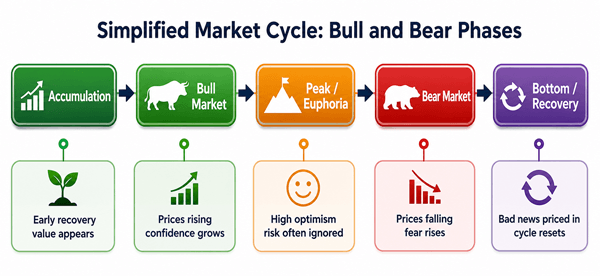
Simplified Market Cycle: Bull and Bear Phases
5. Key Differences Between Bull and Bear Markets
| Question | Bull Market Answer | Bear Market Answer |
|---|---|---|
| What is happening to prices? | Prices are generally rising. | Prices are generally falling. |
| What are investors feeling? | Optimism, confidence, fear of missing out. | Fear, caution, uncertainty, loss aversion. |
| What mistake is common? | Buying too aggressively after prices have already risen. | Selling too aggressively after prices have already fallen. |
| What should beginners focus on? | Stay diversified and avoid chasing hype. | Protect cash needs and avoid panic selling. |
| What is the best mindset? | Participate, but stay disciplined. | Stay calm, manage risk, and think long term. |
6. Practical Examples for Beginners
6.1. Example 1: Investing During a Bull Market
Imagine a beginner invests $300 per month into a diversified stock index fund. Over several years, the market rises, news is positive, and the account grows. The risk is that the investor may feel too confident and decide to move all savings into a few hot stocks. A better approach is to keep investing regularly, rebalance if one asset becomes too large, and avoid confusing a rising market with personal skill.
6.2. Example 2: Investing During a Bear Market
Now imagine the same investor sees the account fall by 25%. Selling everything may feel safe, but it can lock in losses and make it difficult to re-enter before recovery. If the investor has an emergency fund, a long time horizon, and a diversified plan, continuing monthly contributions can buy more shares at lower prices. The right move depends on personal goals, time horizon, and risk tolerance.
6.3. Example 3: Money Needed Soon
Suppose someone needs a house down payment in nine months. Whether the market is bullish or bearish, that money should usually not be placed in volatile stocks. Short-term goals need stability. This is one of the most important beginner lessons: the best investment is not only about market direction; it is about matching the investment to the time horizon.
7. Benefits and Limitations of Each Market Type
| Market Type | Benefits | Limitations |
|---|---|---|
| Bull market | Growth potential, positive momentum, easier participation for beginners, rising confidence. | Higher valuations, more hype, greater risk of bubbles, emotional buying. |
| Bear market | Lower entry prices, better long-term opportunities, clearer view of weak assets, useful for rebalancing. | Falling portfolio values, fear, uncertainty, possible recession, emotional selling. |
8. Common Mistakes to Avoid
8.1. Mistake 1: Thinking bull markets are risk-free
A rising market can make almost every decision look smart for a while. Risk has not disappeared; it may simply be hidden by momentum.
8.2. Mistake 2: Thinking bear markets are only bad
Bear markets are painful, but they can create better entry prices for patient investors with a long-term plan.
8.3. Mistake 3: Trying to perfectly time the top or bottom
Most people cannot consistently identify market turning points in real time. A practical plan usually beats all-or-nothing timing.
8.4. Mistake 4: Ignoring your time horizon
Money needed soon should be kept in more stable places. Long-term money can usually tolerate more volatility.
8.5. Mistake 5: Copying someone else’s strategy
A strategy that fits a 25-year-old investor may be wrong for someone retiring next year. Personal circumstances matter.
9. Best Practices for Beginners in Any Market
- Build an emergency fund before taking major investment risk.
- Use diversification across assets, sectors, and regions where appropriate.
- Invest according to goals and time horizon, not headlines.
- Consider dollar-cost averaging if you are nervous about investing a lump sum.
- Rebalance periodically so your portfolio does not drift too far from your plan.
- Avoid leverage unless you fully understand the risks.
- Write down your investment rules before markets become emotional.
- Remember that no article can replace personalized financial advice for complex situations.
10. Bull Market vs Bear Market: Which Is Better?
For portfolio values, a bull market feels better because prices rise. For new long-term contributions, a bear market can be useful because investments may be cheaper. The better market depends on your situation.
If you already own assets, a bull market helps your account grow. If you are still building wealth and have decades ahead, bear markets can provide attractive buying opportunities. If you need money soon, neither market should tempt you into taking risk you cannot afford.
11. How to Choose the Right Strategy
| Investor Situation | More Suitable Focus | Why |
|---|---|---|
| Beginner with stable income and long time horizon | Regular diversified investing | Reduces the pressure to time the market. |
| Investor near retirement | Risk control and rebalancing | Large losses close to withdrawals can be harder to recover from. |
| Money needed within 1-3 years | Capital preservation | Short-term goals should not depend on market recovery timing. |
| Experienced investor with high risk tolerance | Selective opportunities and disciplined risk limits | Advanced strategies require clear rules and loss control. |
| Nervous investor during downturns | Smaller automatic contributions and education | Staying engaged may be better than emotional all-or-nothing decisions. |
12. Important Misconceptions
12.1. “A bull market means everything will go up.”
Not true. Some stocks, sectors, or funds can perform poorly even during a strong bull market.
12.2. “A bear market means you should sell everything.”
Not necessarily. Selling may be appropriate if your plan was too risky, but panic selling can damage long-term results.
12.3. “A 20% move tells you exactly what happens next.”
No. The 20% threshold is a common definition, not a prediction system. Markets can recover quickly, fall further, or move sideways.
12.4. “Only stocks have bull and bear markets.”
The terms can apply to other assets too, including bonds, commodities, real estate, currencies, and crypto. The meaning is the same: a sustained rise or fall in prices.
13. FAQs
13.1. What is the main difference between a bull market and a bear market?
A bull market is generally a sustained period of rising prices and optimism. A bear market is generally a sustained period of falling prices and pessimism.
13.2. Why is it called a bull or bear market?
One common explanation is that a bull attacks upward with its horns, while a bear swipes downward with its paws. The image matches the direction of market movement.
13.3. Is a bear market the same as a recession?
No. A bear market refers to falling asset prices. A recession refers to a decline in economic activity. They can happen together, but they are not the same thing.
13.4. Can you make money in a bear market?
Yes, but it is harder and riskier. Long-term investors may benefit by buying quality assets at lower prices. Advanced tactics such as short selling or options carry significant risks and are not suitable for most beginners.
13.5. Should beginners invest during a bear market?
Beginners can invest during a bear market if they have an emergency fund, a long time horizon, and a diversified plan. They should avoid investing money they need soon.
15.6. How long do bull and bear markets last?
There is no fixed length. Bull markets and bear markets can last months or years. The exact duration is only clear after the fact.
15.7. What is a market correction?
A correction is usually a decline of about 10% from a recent high. It is smaller than the common 20% bear market threshold.
15.8. What is the safest strategy?
There is no completely safe market strategy, but beginners can reduce risk by diversifying, avoiding leverage, keeping cash for short-term needs, and following a written long-term plan.
16. Final Takeaway
Bull and bear markets are normal parts of investing. A bull market rewards patience but can tempt investors into overconfidence. A bear market is stressful but can create long-term opportunity for people who stay disciplined. The best approach for beginners is not to predict every market turn, but to build a plan based on goals, time horizon, diversification, and risk tolerance.
Sources Consulted and Checked
These sources were consulted and checked while preparing this article to support its accuracy and clarity.
- Investor.gov - Bull Market definition
- Investor.gov - Bear Market definition
- FINRA - Key Terms for Tough Times: The Vocabulary of Stressed Markets
Reader Advice
This article is provided for educational and informational purposes only and is not personalized financial, investment, legal, tax, or other professional advice or a recommendation to buy, sell, or hold any asset. Investing involves risk, including possible loss of principal, and strategies that suit one person may not suit another. Market definitions, rules, policies, laws, tax treatment, product terms, and statistics can change over time and may vary by country or region. Before making a financial decision, verify current information through official sources and consider seeking advice from a qualified professional who understands your goals, time horizon, finances, and risk tolerance.