Circulating Supply vs Total Supply: Key Differences, Pros, Cons, Risks and Best Use Cases
1. What You Need to Know First
Circulating supply and total supply are two of the most important numbers used to understand a cryptocurrency or token. They look simple, but beginners often misunderstand them. That can lead to poor comparisons, unrealistic price expectations, and underestimating future dilution.
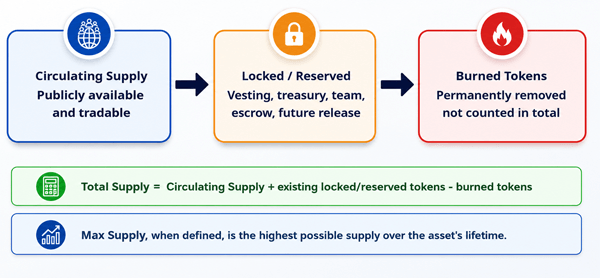
In simple terms, circulating supply is the amount of a coin or token that is publicly available in the market. Total supply is the amount that currently exists, after subtracting tokens that have been permanently burned. Total supply may include tokens that are locked, reserved, vested, or not yet freely tradable.
The key idea is this: circulating supply helps you understand the market today, while total supply helps you understand what already exists beyond the public float. To judge long-term risk, you should also look at maximum supply, token unlock schedules, vesting, burns, inflation, and who controls the locked tokens.
2. What Is Circulating Supply?
Circulating supply is the number of coins or tokens that are currently available to the public market. These tokens can usually be bought, sold, transferred, held in wallets, used in DeFi, or traded on exchanges.
It normally excludes tokens that are locked in vesting contracts, reserved for the team or foundation, held in escrow, or otherwise not freely available to public market participants. Market data platforms commonly use circulating supply to calculate market capitalization.
Formula: Market Cap = Current Price x Circulating Supply
2.1 Example of Circulating Supply
Imagine Token A has 1,000,000 tokens created. Of those, 400,000 are public and tradable, 500,000 are locked for the team and investors, and 100,000 have been burned. Its circulating supply is 400,000 tokens.
If Token A trades at $2, its market cap based on circulating supply is $800,000. That number describes the current public market valuation, not the value of every token that exists or may exist later.
3. What Is Total Supply?
Total supply is the number of tokens that currently exist, minus tokens that have been permanently burned. It includes circulating tokens and tokens that exist but are locked, reserved, vested, or held by the project, foundation, investors, ecosystem funds, or treasury.
Total supply does not always equal maximum supply. A project may have 100 million tokens currently issued but a maximum supply of 1 billion tokens if more can be minted or released in the future. Some assets have no fixed maximum supply at all.
Common formula: Total Supply = Existing Minted/Issued Tokens - Burned Tokens
4. Simple Supply Diagram
This diagram shows how the main supply categories relate to each other. It is simplified, but it helps explain why total supply can be higher than circulating supply.
5. How Supply Metrics Work in Real Life
Crypto supply changes because tokens can be mined, minted, unlocked, vested, burned, staked, bridged, or moved between wallets. The important question is not only how many tokens exist, but also when they can reach the market and who controls them.
For proof-of-work coins such as Bitcoin, new coins are issued through mining, and the issuance schedule is usually transparent. For many tokens, supply changes through smart contracts, vesting schedules, foundation allocations, treasury releases, ecosystem incentives, staking rewards, or governance decisions.
This is why two tokens with the same price can have very different risk profiles. A token with a small circulating supply and large locked supply may look cheap today, but future unlocks can create selling pressure if early investors or team wallets start selling.
6. Circulating Supply vs Total Supply: Key Differences
| Question | Circulating Supply | Total Supply | Why It Matters |
|---|---|---|---|
| What does it count? | Publicly available tokens. | All existing tokens minus burned tokens. | Shows the difference between public float and issued supply. |
| Does it include locked tokens? | Usually no. | Usually yes. | Locked tokens may become future supply pressure. |
| Used for market cap? | Yes, commonly. | Sometimes used for minted market cap, but not standard market cap. | Market cap based on circulation reflects current market value better. |
| Can it change? | Yes, through unlocks, issuance, burns, and reclassification. | Yes, through minting, burning, and token creation. | Supply is dynamic, not a one-time number. |
| Best for beginners? | Good for current valuation. | Good for spotting dilution risk. | Use both together, not separately. |
7. Pros and Cons of Using Circulating Supply
| Pros | Cons and Limitations |
|---|---|
| Useful for calculating current market capitalization. | May hide future dilution if many tokens are locked or reserved. |
| Helps compare assets based on the tokens actually available in the market. | Can be estimated differently by different data providers. |
| More relevant for short-term liquidity and trading analysis. | Does not show token unlock dates by itself. |
| Can reveal whether a token has a small public float. | Can change quickly after vesting, bridges, burns, or supply updates. |
8. Pros and Cons of Using Total Supply
| Pros | Cons and Limitations |
|---|---|
| Shows how many tokens already exist after burns. | Does not tell you when locked tokens will enter the market. |
| Helps identify locked, reserved, or non-circulating supply. | May not include future minting if max supply is higher or uncapped. |
| Useful for dilution analysis and treasury review. | Can exaggerate near-term valuation risk if locked tokens cannot be sold soon. |
| Can expose whether today's market cap understates future supply pressure. | Less useful than circulating supply for current market cap. |
9. Practical Examples and Real-World Scenarios
9.1 Scenario 1: Low Circulating Supply, High Total Supply
A new token has only 10% of its total supply circulating. The price rises quickly because there are not many tokens available. However, 90% of the supply is locked for investors, the team, and ecosystem incentives. If large unlocks happen soon, the market may face selling pressure. Best practice: check the vesting schedule before assuming the price can rise easily.
9.2 Scenario 2: Circulating Supply Nearly Equals Total Supply
A mature coin has most of its supply already circulating. Future dilution risk may be lower because fewer locked tokens remain. That does not make it risk-free, but it makes the supply picture easier to understand. Best practice: still check inflation, staking rewards, and whether new issuance can continue.
9.3 Scenario 3: Token Burns Reduce Total Supply
A project burns tokens permanently. If the burn is verifiable, total supply may decrease. This can support scarcity, but it does not automatically increase price. Demand, liquidity, revenue, narrative, utility, and market conditions still matter.
9.4 Scenario 4: Unlimited or Unclear Maximum Supply
Some projects do not have a hard maximum supply. That does not automatically make them bad, but it means you must understand issuance rules, governance control, inflation rate, and whether supply growth is predictable.
10. Main Risks Beginners Should Watch For
- Future dilution: If many tokens are locked today but scheduled to unlock later, each existing token may represent a smaller share of the network over time.
- Token unlock sell pressure: Large unlock events can increase available supply. If recipients sell, price can fall even when the project is still active.
- Misleading market cap comparisons: A token with a low circulating supply can appear smaller than it really is when compared only by current market cap.
- Fully diluted valuation confusion: FDV usually estimates value if all possible tokens were in circulation at the current price. It is useful, but it can be unrealistic if all tokens will not unlock for years.
- Data provider differences: CoinMarketCap, CoinGecko, exchanges, and project dashboards may classify circulating supply differently. Always compare sources.
- Centralized control: If a team, foundation, or small group controls large locked wallets, governance and sell-pressure risks may be higher.
- Bridge and wrapped token complexity: Tokens moving across chains can complicate supply tracking. Wrapped assets should be checked carefully to avoid double counting.
11. Common Mistakes and Misconceptions
Mistake 1: Thinking a low token price means a token is cheap. Price alone means little. A token priced at $0.01 can be expensive if there are billions or trillions of tokens.
Mistake 2: Ignoring the gap between circulating supply and total supply. A big gap can mean future unlocks, dilution, or treasury releases.
Mistake 3: Assuming burns always make price rise. Burns reduce supply, but price depends on both supply and demand.
Mistake 4: Treating total supply as maximum supply. Total supply is what currently exists after burns. Maximum supply is the possible lifetime cap, if one exists.
Mistake 5: Trusting one dashboard without checking the project documents, block explorer, token contract, vesting schedule, and data-provider methodology.
12. Best Use Cases for Each Metric
| Use Case | Best Metric | Why |
|---|---|---|
| Checking current market value | Circulating supply | Market cap generally uses tokens available in the public market. |
| Estimating dilution risk | Total supply plus unlock schedule | Locked tokens can later become circulating tokens. |
| Comparing long-term valuation | Maximum supply and FDV | Shows the possible value if all supply eventually enters circulation. |
| Evaluating scarcity | Circulating, total, and max supply together | Scarcity depends on what exists now and what can exist later. |
| Assessing tokenomics quality | All supply metrics plus allocation data | Supply numbers are only useful when combined with vesting and holder distribution. |
| Short-term trading | Circulating supply and liquidity | Available supply and exchange liquidity influence short-term price moves. |
13. Best Practices Before Buying or Comparing a Token
- Check circulating supply, total supply, and maximum supply, not just price.
- Calculate market cap and compare it with similar projects.
- Check fully diluted valuation, but do not treat it as a guaranteed future market cap.
- Read the token allocation table: team, investors, community, treasury, ecosystem, staking rewards, liquidity, and advisors.
- Look for token unlock dates and vesting cliffs. Large cliffs deserve extra caution.
- Check holder concentration. A token can be risky if a small number of wallets control a large share.
- Verify burns and supply changes with trusted sources or block explorers where possible.
- Read the project documentation and compare it with CoinMarketCap, CoinGecko, exchange listings, and the token contract.
- Avoid comparing two tokens by price alone. Compare market cap, FDV, supply schedule, liquidity, revenue, users, and adoption.
14. Beginner Checklist: Questions to Ask
- How much of the total supply is currently circulating?
- How much supply is locked, and who controls it?
- When are the next major unlocks?
- Can the project mint more tokens?
- Is there a fixed maximum supply?
- Are burns automatic, discretionary, or one-time marketing events?
- Does the token have real demand, or is price mainly driven by speculation?
- Do different data sites report different supply numbers? If yes, why?
15. FAQs About Circulating Supply vs Total Supply
15.1 Is circulating supply more important than total supply?
For current market cap, circulating supply is usually more important. For long-term risk, total supply and unlock schedules are also important. A smart analysis uses both.
15.2 Can circulating supply be higher than total supply?
Normally, no. Circulating supply should be part of total supply. If you see otherwise, it may be a data error, a classification issue, or a complicated wrapped/bridged token situation.
15.3 Does a lower circulating supply mean a higher price?
Not automatically. A lower supply can make price more sensitive to demand, but price also depends on liquidity, utility, market sentiment, holder behavior, and future unlocks.
15.4 Why do market caps use circulating supply?
Market cap based on circulating supply estimates the current market value of tokens available in the public market. It is more practical for today's valuation than counting every locked or future token.
15.5 What is fully diluted valuation?
Fully diluted valuation, or FDV, usually means current price multiplied by maximum supply or total possible supply. It helps estimate long-term dilution risk, but it can be misleading if supply unlocks slowly over many years.
15.6 Are locked tokens bad?
Not always. Locked tokens can support long-term development, incentives, and ecosystem growth. The risk depends on size, timing, transparency, and whether recipients are likely to sell.
15.7 Do burned tokens count in total supply?
In most common definitions, verifiably burned tokens are subtracted from total supply because they have been permanently removed.
15.8 Which metric should a beginner look at first?
Start with circulating supply and market cap. Then compare total supply, maximum supply, FDV, unlocks, and token allocation before making any conclusion.
16. Final Takeaway
Circulating supply tells you how many tokens are available in the market today. Total supply tells you how many tokens currently exist after burns, including tokens that may be locked or reserved. The difference between them is one of the fastest ways to spot possible future dilution.
For beginners, the safest approach is simple: never judge a crypto asset by price alone. Look at market cap, circulating supply, total supply, maximum supply, FDV, unlock schedules, token allocation, holder concentration, and real demand. Supply metrics do not predict price by themselves, but they help you ask better questions and avoid common valuation mistakes.
Sources Consulted and Checked
The following sources were consulted and checked while preparing this document and reviewing its accuracy.
- CoinMarketCap Support: Supply definitions for circulating, total, and max supply.
- CoinGecko Glossary: Circulating Supply definition.
- CoinGecko Supply Methodology.
- Binance Academy Glossary: Circulating Supply.
- Binance Academy Glossary: Total Supply.
- Binance Academy: Crypto Market Capitalization Explained.
- CoinGecko Learn: Market Cap in Crypto.
Reader Advice
This article is provided for educational and informational purposes only and is not personalized financial, investment, legal, tax, or professional advice or a recommendation to buy, sell, or hold any crypto asset. Crypto assets can be highly volatile, illiquid, and subject to loss, fraud, technical failures, token unlocks, dilution, and changing market conditions. Rules, policies, laws, definitions, and statistics may change over time and vary by country or region, so verify important information through current official sources and consider qualified professional advice before making decisions. Only risk funds you can afford to lose.