Tokenized Stocks and Securities in Crypto: Complete Guide, Examples, Risks and Best Practices
Tokenized stocks and securities are one of the clearest examples of how crypto technology is moving beyond coins, NFTs, and speculation. Instead of only trading native crypto assets such as Bitcoin or Ethereum, investors can now find blockchain-based tokens that track, represent, or provide economic exposure to traditional financial assets such as stocks, exchange-traded funds, bonds, treasury bills, private-company shares, and investment funds.
The idea sounds simple: take a traditional security and represent it as a token on a blockchain. In practice, it is much more nuanced. A tokenized stock may not give you the same legal rights as owning a share through a normal brokerage account. Some products are direct tokenized securities, while others are derivatives, tracker certificates, structured notes, or contracts that mirror the price of a stock. This difference matters because it affects ownership, dividends, voting rights, custody, taxes, investor protections, redemption, and what happens if the platform fails.
This guide explains tokenized stocks and securities in plain English. It covers how they work, where they are used, practical examples, benefits, risks, common misconceptions, and best practices for beginners who want to understand the sector without falling for hype.
1. What Are Tokenized Stocks and Securities?
Tokenized stocks and securities are digital tokens created on a blockchain to represent or track a traditional financial security. A security is a regulated financial instrument, such as a stock, bond, note, fund share, option, or investment contract. Tokenization means recording some form of ownership, claim, contract, or economic exposure as a blockchain token.
For example, a token might track the price of Apple stock, represent a claim on a share held by a custodian, or give exposure to a basket of U.S. Treasury bills. The blockchain token can then be held in a crypto wallet, transferred between approved parties, or traded on supported platforms, depending on the product design and legal restrictions.
A simple way to understand it: Tokenized securities combine traditional finance assets with blockchain-based recordkeeping and transfer.
1.1 Important beginner distinction: stock token does not always mean stock ownership
The phrase “tokenized stock” can be misleading. In some structures, the token may represent a direct security issued onchain. In others, it may only be a contract that follows the price of a stock. For example, Robinhood Europe states that its Stock Tokens are MiFID II derivatives and that the underlying assets are owned by Robinhood and held with a U.S.-licensed institution. Backed Finance describes xStocks as tokenized tracker certificates that track equities and ETFs and are collateralized 1:1 by the corresponding underlying asset. These structures are not identical to holding registered shares in your own name.
2. How Tokenized Stocks and Securities Work
The exact structure depends on the issuer, jurisdiction, asset type, and platform. However, most tokenized securities involve the following building blocks.
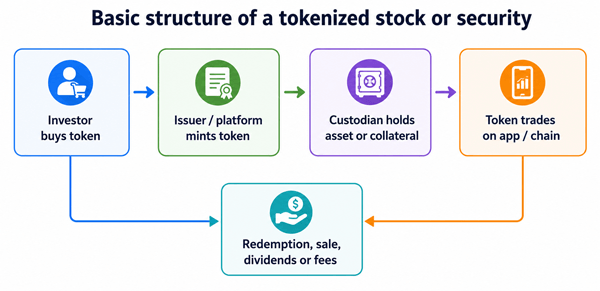
Diagram: A simplified tokenized security flow. The legal reality depends on the product documents, issuer, custodian, and jurisdiction.
2.1 The underlying asset
The underlying asset is the real-world financial instrument linked to the token. It could be a public stock, ETF, bond, treasury bill, money market fund share, private-company exposure, or another security. The key question is whether the token is actually backed by the asset, merely tracks the asset, or represents a derivative contract linked to the asset price.
2.2 The issuer or tokenization platform
The issuer creates the token and defines what token holders legally receive. The issuer may be a regulated broker-dealer, a special purpose vehicle, a crypto platform, a fund manager, or a dedicated tokenization company. The issuer’s legal documents are more important than the marketing page because they explain rights, restrictions, fees, redemption rules, and risk factors.
2.3 Custody and collateral
Many tokenized securities claim that each token is backed by an underlying asset held by a custodian. For example, a platform may hold one share of a company for each token issued, or it may hold collateral designed to match the token’s value. Custody matters because investors need to know who holds the asset, whether it is segregated, whether it is bankruptcy-remote, and whether token holders have a direct claim if the issuer fails.
2.4 Blockchain issuance
The token is minted on a blockchain such as Ethereum, Solana, Base, Arbitrum, or another network. The smart contract records token balances and may include transfer restrictions, allowlists, freeze functions, redemption mechanisms, or compliance controls. Unlike a normal stock ledger, blockchain balances can be visible to users and applications, but that transparency does not automatically create legal ownership of the underlying security.
2.5 Trading and settlement
Tokenized securities may trade inside a broker app, on a centralized crypto exchange, on an approved alternative trading system, or in certain cases through DeFi protocols. Some products advertise extended trading hours, such as 24/5 weekday access. Settlement may be faster than traditional systems, but investors still need to check when cash withdrawals, redemptions, and corporate actions actually settle.
2.6 Corporate actions, dividends, and voting
Traditional shareholders may receive dividends, vote on company matters, participate in splits, and benefit from shareholder protections. Token holders may receive dividend-equivalent adjustments, reinvested dividends, no voting rights, or different treatment depending on the product. Beginners should never assume a stock token gives the same rights as an ordinary share.
3. Types of Tokenized Securities
Tokenized securities are not all the same. The table below explains common categories.
| Type | What it represents | Common use | Key caution |
|---|---|---|---|
| Tokenized public stocks | Economic exposure to listed company shares | Access to U.S. or global equities through crypto rails | May not provide shareholder voting rights or direct ownership |
| Tokenized ETFs | Exposure to an exchange-traded fund | Index exposure, sector exposure, treasury ETFs | Check fees, liquidity, and whether dividends are passed through |
| Tokenized bonds or treasuries | Exposure to debt securities or government bills | Onchain yield products and treasury-backed assets | Interest-rate, issuer, and custody risks remain |
| Tokenized funds | Fund shares or fund-like claims onchain | Money market funds, private credit, institutional products | Eligibility, redemption windows, and legal rights vary |
| Derivative stock tokens | Contract linked to a stock price | App-based fractional exposure and extended trading | You may own a derivative claim, not the stock |
| Private-company exposure tokens | Indirect exposure to private company shares or SPVs | Pre-IPO or private-market access | High risk of misunderstanding, approval limits, illiquidity, and legal restrictions |
4. Tokenized Stocks vs Traditional Stocks
| Feature | Traditional stock through a broker | Tokenized stock or security |
|---|---|---|
| Legal ownership | Usually a regulated brokerage claim to shares held through the securities system | May be direct security ownership, a derivative, a tracker certificate, or a contract claim |
| Trading hours | Generally exchange market hours, with some extended hours | May offer longer hours, often 24/5, depending on the platform |
| Settlement | Often T+1 in U.S. equities, depending on market rules | Blockchain transfers can be fast, but cash redemption and platform settlement may still take time |
| Dividends | Paid according to shareholder and broker arrangements | May be paid, reinvested, adjusted into token value, or unavailable |
| Voting rights | Often available through broker voting systems | Often unavailable unless explicitly stated |
| Custody | Broker/custodian under securities rules | Issuer, custodian, wallet, smart contract, and platform structure all matter |
| Regulation | Established securities market rules | Depends on jurisdiction and product structure; securities laws may still apply |
| Main risk | Market, broker, liquidity, and company risk | All traditional risks plus smart contract, issuer, custody, redemption, and regulatory risk |
5. Real-World Examples of Tokenized Stocks and Securities
Examples change quickly, and availability depends heavily on the user’s country. The following examples are useful for understanding the market, not recommendations.
5.1 Robinhood Europe Stock Tokens
Robinhood Europe offers stock tokens to eligible European users. Its public materials state that Stock Tokens are offered under MiFID II as derivatives, that the underlying assets are held with a U.S.-licensed institution, and that the tokens are priced by reference to the underlying securities. Robinhood also warns that Stock Tokens are derivative contracts and do not grant rights to the underlying securities. This is a good example of why investors must read product documents rather than assuming the token equals a normal share.
5.2 xStocks by Backed Finance and Kraken
Backed Assets (JE) Limited describes xStocks as tokenized tracker certificates that track publicly traded equities and ETFs. Backed says each xStock is fully collateralized 1:1 by the corresponding underlying asset and designed for transfer across multiple blockchains and integrations with wallets, exchanges, and protocols. Kraken markets xStocks as tokenized stocks and ETFs available 24/5 for eligible users, with access to many U.S. companies and ETFs.
5.3 Ondo Global Markets
Ondo Global Markets is another example of onchain access to tokenized public securities. Ondo describes the tokens as providing holders with economic exposure to underlying publicly traded assets, including dividend value after fees and expenses. Its public materials and ecosystem announcements emphasize non-U.S. access, 1:1 backing, and integration with wallets and chains. As always, the legal documents should control how investors understand rights and risks.
5.4 Tokenized U.S. Treasuries and funds
Tokenization is not limited to stocks. Tokenized treasury bills, money market funds, and fund-like products are among the more practical uses because they connect onchain users with short-duration yield-bearing assets. These products may appeal to crypto treasuries, institutions, and stablecoin users, but they still involve regulatory, custody, interest-rate, and redemption risks.
5.5 Private-company token exposure
Private-company stock tokens are especially sensitive. In 2025, OpenAI publicly warned that tokens marketed as exposure to OpenAI did not represent actual OpenAI equity and were not endorsed by the company. This example shows a major beginner risk: a token may give indirect economic exposure through a contract or vehicle, but that is not the same as owning private-company shares.
6. Benefits of Tokenized Stocks and Securities
Tokenized securities are attracting attention because they may improve access and market infrastructure. The benefits are real, but they depend on compliant design and reliable execution.
6.1 Fractional access
Tokenization can make it easier to buy small amounts of high-priced assets. Instead of buying a full share, a user may buy a fraction represented by a token or platform balance. This can help beginners build diversified exposure with smaller amounts, though diversification still requires careful risk management.
6.2 Longer trading windows
Some stock token platforms offer extended access such as 24/5 trading. This can be helpful for global users who live outside U.S. market hours. However, prices outside normal exchange hours may be less liquid, spreads may be wider, and platform pricing may differ from the underlying market.
6.3 Faster transfer and settlement potential
Blockchains can move tokens quickly between wallets and platforms. In theory, this can reduce settlement delays and operational friction. In practice, securities compliance, custody, cash settlement, redemption, and offchain asset movement can still create delays.
6.4 Programmability
Tokenized securities can interact with smart contracts. For example, approved tokens might be used as collateral, integrated into automated portfolio tools, or connected to onchain compliance systems. This is powerful, but it also introduces smart contract and DeFi risks.
6.5 Global market access
Tokenized securities can give eligible users exposure to markets that are difficult to access locally. For example, a non-U.S. user may find a platform offering exposure to U.S. stocks or ETFs. But access is not universal. Many platforms block restricted jurisdictions, including the United States for some products, and eligibility rules can change.
6.6 Transparency of token supply
Public blockchains can make token supply and transfers easier to verify. This can improve transparency compared with opaque internal ledgers. Still, onchain transparency does not prove that offchain assets are actually held, properly segregated, or legally claimable. Proof of reserves and independent audits matter.
7. Risks and Limitations
The biggest mistake beginners make is treating tokenized securities as if they are just normal stocks with a crypto wrapper. They are often more complex.
7.1 Ownership and legal-rights risk
You may not own the underlying share. You may own a token, a derivative contract, a tracker certificate, a note, or a claim against an issuer. That can affect voting rights, dividends, tax treatment, investor protection, and recovery if something goes wrong.
7.2 Counterparty and issuer risk
If the issuer, broker, custodian, or platform fails, token holders may face losses or delays. Even if assets are advertised as backed 1:1, investors should check whether the structure is bankruptcy-remote, whether assets are segregated, and whether token holders have enforceable claims.
7.3 Smart contract and blockchain risk
A bug, hack, bridge failure, admin-key misuse, or network outage can affect tokenized assets. Some tokens may be freezeable or upgradeable for compliance reasons. That can be necessary in regulated markets, but it also means the token may not behave like a fully permissionless crypto asset.
7.4 Liquidity and price-tracking risk
A token may trade at a premium or discount to the underlying asset, especially outside market hours or during volatility. Low liquidity can create wide spreads and poor execution. If redemption is limited, the market price may drift from the underlying value.
7.5 Regulatory risk
Tokenized securities remain securities when the underlying instrument is a security. U.S. SEC staff and commissioners have repeatedly emphasized that tokenization does not remove securities-law obligations. Rules differ by country, and a product available in one region may be illegal or unavailable in another.
7.6 Corporate-action risk
Stock splits, dividends, mergers, spin-offs, delistings, trading halts, and tender offers can be complicated for tokenized products. The platform may handle these differently from a traditional broker. Always check the corporate-action policy.
7.7 Tax risk
Tax treatment may differ from traditional shares, especially for derivatives, structured notes, crypto transfers, rewards, and DeFi use. Users may need records of purchases, sales, conversions, fees, dividends, and wallet transfers. Tax rules vary by country.
7.8 Misleading marketing risk
Terms like “own Apple onchain” or “buy private shares” can oversimplify the legal reality. The safer question is: what exactly is the token holder’s legal claim, against whom, and under which law?
8. How to Evaluate a Tokenized Stock or Security Before Buying
Use this checklist before considering any tokenized security.
- Read the legal product documents, not only the homepage. Look for terms such as derivative, note, tracker certificate, beneficial interest, fund share, claim, redemption, and underlying asset.
- Identify the issuer. Check whether the issuer is regulated, where it is incorporated, and whether it has a track record.
- Understand what you own. Ask whether you receive shareholder rights, dividend rights, voting rights, redemption rights, or only price exposure.
- Check backing and custody. Who holds the underlying asset? Is it held 1:1? Is it segregated? Is it bankruptcy-remote? Is there independent verification?
- Check transfer restrictions. Can you withdraw to a wallet? Can you transfer peer-to-peer? Are only approved wallets allowed? Can the token be frozen?
- Review fees and spreads. Look beyond “zero commission.” There may be FX fees, spreads, custody fees, redemption fees, management fees, gas fees, and slippage.
- Check market hours and liquidity. Longer trading access is useful only if liquidity and pricing are fair.
- Understand redemption. Can you redeem for cash, the underlying stock, or only sell back to the platform? What happens during market stress?
- Know your jurisdiction. Eligibility and investor protections depend on where you live.
- Start small if you are learning. Never risk money you cannot afford to lose, and avoid leverage until you fully understand the product.
9. Best Practices for Beginners
- Do not assume a tokenized stock gives you voting rights or direct share ownership.
- Prefer transparent products with clear legal documents, known custodians, and independent proof of backing.
- Avoid private-company tokens unless you understand the exact vehicle and the company has approved the structure where required.
- Compare the token price with the underlying market price before trading.
- Be careful during off-hours trading, when liquidity may be thinner and prices may diverge.
- Keep detailed records for taxes, especially if you move tokens between wallets or use them in DeFi.
- Avoid platforms that promise guaranteed returns or hide key documents.
- Do not use leverage or DeFi collateral loops with tokenized securities unless you understand liquidation, oracle, and smart-contract risks.
10. Common Mistakes and Misconceptions
10.1 Misconception 1: A stock token is always the same as a share
Not necessarily. It may be a derivative, tracker certificate, note, or other contractual claim. The legal wrapper matters.
10.2 Misconception 2: Blockchain removes the need for regulation
No. If the underlying asset is a security, securities laws may still apply. Tokenization changes the technology layer, not the economic reality of the asset.
10.3 Misconception 3: 1:1 backing removes all risk
Backing helps, but it does not eliminate custody risk, issuer risk, legal risk, redemption risk, or market risk.
10.4 Misconception 4: 24/5 trading always means better execution
Longer access can be convenient, but off-hours trading can have lower liquidity and wider spreads. Convenience is not the same as best price.
10.5 Misconception 5: DeFi integration makes tokenized securities safer
DeFi composability can add utility, but it can also add smart contract, oracle, liquidation, and bridge risk.
11. Who Might Use Tokenized Securities?
Different users may have different reasons for interest:
- Retail investors may want fractional exposure to global stocks or ETFs.
- Crypto-native users may want onchain exposure without leaving blockchain wallets.
- Institutions may want faster settlement, programmable compliance, or collateral mobility.
- Companies and funds may explore tokenization to improve transferability, cap-table management, or investor access.
- DeFi protocols may integrate approved tokenized assets as collateral or yield sources.
However, tokenized securities are not automatically suitable for everyone. Beginners who simply want long-term stock exposure may find a regulated traditional brokerage or ETF simpler, cheaper, and better protected.
12. Practical Scenario: Buying a Tokenized Stock
Imagine Sara lives in a country where a regulated platform offers tokenized exposure to U.S. stocks. She wants exposure to a large technology company but can only invest a small amount.
- Sara checks whether the product is available in her jurisdiction.
- She reads the product document and sees that the token is a derivative contract, not direct share ownership.
- She confirms whether dividends are paid, reinvested, or excluded.
- She checks fees, FX conversion, spreads, withdrawal rules, and whether the token can be transferred to her own wallet.
- She compares the token price to the underlying stock price during normal market hours.
- She starts with a small amount and keeps records for taxes.
This process is less exciting than simply clicking “buy,” but it is the difference between informed investing and misunderstanding the product.
13. Tokenized Securities and Regulation
Regulation is central to tokenized stocks and securities. The core rule of thumb is simple: if the underlying instrument is a security, tokenizing it usually does not make it stop being a security. Regulators generally focus on the economic substance, investor rights, disclosures, trading venue, custody, and who is offering the product.
In the United States, the SEC has stated that securities can be tokenized and that normal securities-law considerations still matter. FINRA also warns that crypto assets can be exceptionally risky and may lack the protections investors expect from traditional stocks and bonds. In Europe and other regions, tokenized securities may fall under frameworks for derivatives, securities, crypto-assets, market infrastructure, or investment products depending on design.
The practical point is this: do not judge safety by whether a product uses blockchain. Judge it by legal structure, regulation, custody, disclosures, liquidity, and enforceable investor rights.
14. Future of Tokenized Stocks and Securities
Tokenized securities are likely to keep growing because the idea addresses real problems: slow settlement, fragmented market access, limited collateral mobility, and inefficient back-office systems. Major financial institutions, crypto companies, exchanges, and regulators are studying or building tokenization infrastructure.
The most promising future may not be every stock trading freely on every blockchain with no controls. A more realistic path is regulated tokenized markets with identity checks, compliant wallets, transfer controls, audited reserves, reliable custodians, and clearer investor disclosures. The winners will likely be products that combine the efficiency of blockchain with the protections of traditional finance.
For beginners, the best attitude is balanced: tokenized securities are important, but they are not magic. They can improve access and efficiency, yet they can also create new layers of complexity and risk.
15. FAQs About Tokenized Stocks and Securities
15.1 Are tokenized stocks real stocks?
Sometimes they may represent direct security interests, but many popular products are derivatives, tracker certificates, notes, or contractual claims linked to stock prices. Always read the product documents.
15.2 Do tokenized stocks pay dividends?
Some products pay dividend equivalents, some reinvest dividend value into token price, and some may not provide full dividend benefits. The answer depends on the issuer and product terms.
15.3 Can I vote with tokenized stocks?
Often no. Many tokenized stock products provide price exposure without shareholder voting rights. Voting rights must be explicitly stated.
15.4 Are tokenized securities legal?
They can be legal when issued and traded under applicable securities, derivatives, and financial-market rules. Legality depends on jurisdiction, issuer registration, investor eligibility, disclosures, and trading venue.
15.5 Are tokenized stocks available in the United States?
Many widely discussed tokenized stock products are not available to U.S. retail users. U.S. access depends on securities-law compliance, broker-dealer rules, exchange or ATS rules, and product registration or exemptions.
15.6 What happens if the platform goes bankrupt?
It depends on the legal structure. Token holders may have a segregated claim, a contractual claim against the issuer, or a more complicated recovery path. This is why bankruptcy-remote structure, custody details, and legal documents are critical.
15.7 Can tokenized stocks be used in DeFi?
Some tokenized securities are designed for wallet and protocol integration, but DeFi use adds risks such as smart contract bugs, oracle failures, liquidation, regulatory restrictions, and liquidity shocks.
15.8 Are tokenized securities safer than crypto coins?
They may be linked to familiar assets such as stocks or treasuries, but they still carry market risk plus additional tokenization risks. They are not automatically safer.
15.9 What is the difference between tokenized stocks and synthetic stocks?
A tokenized stock usually claims some link to an underlying asset or legal structure. A synthetic stock may simply track price through derivatives or collateral mechanisms without direct share backing. The boundary can be blurry, so product documents matter.
15.10 Should beginners invest in tokenized stocks?
Beginners should first understand normal stocks, crypto wallets, custody, fees, and regulation. If they still want to experiment, they should use small amounts, avoid leverage, and choose transparent, regulated platforms.
16. Conclusion
Tokenized stocks and securities are an important bridge between traditional finance and crypto. They can make markets more accessible, programmable, and efficient. They may also bring faster settlement, fractional exposure, and new ways to use real-world assets onchain.
But the main lesson is caution: a tokenized stock is not automatically the same as a stock. The token may represent direct ownership, a derivative, a tracker certificate, a note, or another legal claim. The difference affects your rights, protections, taxes, and losses if something goes wrong.
Before buying any tokenized security, focus on the legal structure, issuer, custodian, backing, redemption rules, liquidity, fees, jurisdiction, and investor rights. Blockchain can improve financial infrastructure, but it does not replace due diligence.
Sources Consulted and Checked
These sources were consulted and checked while preparing this article to support accuracy and provide authoritative context.
- U.S. SEC - Statement on Tokenized Securities
- SEC Investor.gov - Crypto Asset Securities Investor Alert
- FINRA - Crypto Assets investor education
- Robinhood Europe - Stock Tokens
- Robinhood Europe - Stock Tokens FAQ
- Backed Finance - xStocks issuer information
- Kraken - Tokenized Stocks and ETFs on Kraken
- Ondo Finance - Global Markets
- Reuters - Tokenized securities are still securities
- Reuters - ESMA warning on tokenised stock misunderstanding
- Business Insider - OpenAI warning about tokenized stock exposure
- World Economic Forum - Asset Tokenization in Financial Markets 2025
- OECD - Tokenisation of assets and DLT in financial markets
Reader Advice
This article is provided for educational and informational purposes only. It does not constitute personalized legal, financial, investment, tax, or regulatory advice, and it is not a recommendation to buy, sell, or use any tokenized stock, security, platform, or related product. Tokenized securities can involve market, liquidity, issuer, custody, smart-contract, redemption, tax, and regulatory risks, including the possible loss of some or all invested funds. Rules, policies, laws, product terms, eligibility requirements, and statistics may change over time and can vary by country or region. Before making a decision, verify current information through official regulatory and product sources, carefully review the relevant legal documents, consider your circumstances and risk tolerance, and seek advice from a qualified professional where appropriate.