Real World Assets in Crypto: Complete Guide, Examples, Risks and Best Practices
Real world assets in crypto, often called RWAs, are one of the clearest examples of how blockchain technology can connect with traditional finance. Instead of using crypto only for native digital assets such as Bitcoin, Ethereum or governance tokens, RWA projects use blockchains to represent claims on assets that already exist outside the blockchain world.
These assets may include U.S. Treasury bills, money market funds, real estate, commodities, invoices, private credit, carbon credits, bonds, stocks, art, insurance products or other financial claims. The main idea is simple: an off-chain asset is linked to an on-chain token, so ownership, transfer, settlement or access can be handled through blockchain-based systems.
This does not mean every tokenized asset is safe, liquid, regulated or suitable for everyone. A token is only as strong as the legal rights, asset backing, custody, disclosure and redemption process behind it. This guide explains RWAs from the ground up so beginners can understand the opportunity without ignoring the risks.
1. What Are Real World Assets in Crypto?
Real world assets in crypto are tokens that represent rights, ownership, economic exposure or claims connected to assets outside the blockchain. In plain English, an RWA token is a digital record that points to something real or traditional, such as a bond, property, fund share, invoice or commodity.
A useful definition of asset tokenization is the process of representing ownership rights in real-world assets as digital tokens on a blockchain. In practice, the token may represent direct ownership, a fund share, a debt claim, a receipt, a membership interest, or a contractual right to redeem an asset. These structures matter because two tokens can look similar in a wallet but provide very different legal rights.
| Term | Simple Meaning | Example |
|---|---|---|
| RWA | A blockchain token connected to an off-chain asset or claim | A token representing a share in a Treasury fund |
| Tokenization | Turning asset rights or claims into blockchain tokens | Issuing digital tokens backed by invoices or bonds |
| Issuer | The company or entity that creates and manages the token | A fund manager, fintech platform or special purpose vehicle |
| Custodian | The party that holds or safeguards the underlying asset | A regulated bank, broker, trustee or vault operator |
| Redemption | The process of exchanging the token for cash or the underlying asset | Redeeming tokenized fund shares for U.S. dollars |
2. Why RWAs Matter in Crypto
RWAs matter because they may bring more familiar assets into blockchain-based markets. Crypto has historically been dominated by native digital assets whose value depends on network demand, speculation, utility and market cycles. RWAs introduce assets that may be linked to yield, cash flow, collateral, property, invoices, commodities or regulated securities.
For institutions, tokenization may improve settlement speed, transparency, operational efficiency and collateral mobility. For crypto users, RWAs may provide exposure to assets that behave differently from volatile crypto tokens. For issuers, tokenization can create new distribution channels and more programmable asset administration.
However, RWAs also import old-world risks into crypto: legal disputes, custody failures, bad disclosures, poor governance, regulatory limits, valuation uncertainty and counterparty risk. Blockchain can improve record-keeping and transfer mechanics, but it cannot magically fix weak asset quality or weak legal design.
3. How Real World Asset Tokenization Works
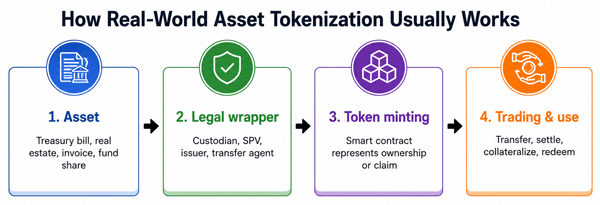
3.1 Choose the asset
The issuer decides what will be tokenized. This might be a financial asset such as a Treasury bill, a money market fund share, a corporate bond or a loan portfolio. It might also be a physical asset such as real estate, gold or artwork. The asset must be identifiable, valued and legally transferable or linked to a claim.
3.2 Create the legal structure
The most important part often happens off-chain. The issuer may use a fund, trust, special purpose vehicle, transfer agent, custody agreement or contractual framework. This structure explains what token holders actually own, what they can redeem, what happens if the issuer fails and which laws apply.
3.3 Custody or verify the underlying asset
For a tokenized Treasury product, the issuer or fund must hold the relevant securities or cash equivalents. For gold, there may be vault custody. For real estate, there may be property deeds, legal entities and local registration. For private credit, there may be loan agreements and servicing records.
3.4 Issue tokens through a smart contract
A smart contract creates the token and controls basic rules such as transfers, balances, minting, burning and compliance restrictions. Many RWA tokens are not fully permissionless. They may require know-your-customer checks, whitelisted wallets or transfer restrictions because the underlying asset may be a regulated security.
3.5 Manage transfers, income and redemptions
After issuance, token holders may transfer the token if allowed, use it as collateral, receive income distributions or redeem it according to product rules. For example, a tokenized Treasury fund may maintain a stable net asset value and distribute yield, while a tokenized real estate product may distribute rental income when available.
4. Common Types of Real World Assets in Crypto
| RWA Category | What It Represents | Beginner Example | Key Risk |
|---|---|---|---|
| Tokenized Treasuries and money market funds | Claims on short-term government debt, cash or fund shares | A tokenized fund holding U.S. Treasury bills | Issuer, interest rate and redemption risk |
| Tokenized private credit | Loans or debt claims brought on-chain | A pool of business loans funded by token buyers | Borrower default and weak underwriting |
| Tokenized real estate | Property ownership, fund shares or income rights | A token linked to rental income from a building | Legal title, valuation and liquidity risk |
| Tokenized commodities | Claims on physical commodities or commodity exposure | Gold-backed tokens or warehouse receipts | Custody, audit and redemption risk |
| Tokenized stocks and bonds | Traditional securities issued or represented on-chain | Tokenized shares or corporate bonds | Securities law and transfer restrictions |
| Tokenized invoices and receivables | Rights to future payments | A small business invoice financed by token holders | Payment delay and fraud risk |
| Carbon credits and environmental assets | Credits or certificates linked to environmental claims | Tokenized carbon offsets | Verification and double-counting risk |
5. Real-World Examples of RWAs in Crypto
5.1 BlackRock BUIDL
BlackRock's USD Institutional Digital Liquidity Fund, known as BUIDL, is a major institutional example of tokenized finance. It was launched with Securitize as the tokenization provider and is designed for qualified investors seeking exposure to a tokenized fund structure focused on U.S. dollar liquidity and short-term assets. It shows how large asset managers are experimenting with public blockchain infrastructure for regulated financial products.
5.2 Franklin Templeton OnChain U.S. Government Money Fund
Franklin Templeton's on-chain government money fund is another early example of a regulated fund using blockchain-based recordkeeping. Products like this are important because they are not just crypto experiments; they connect regulated fund administration with tokenized ownership records.
5.3 Tokenized Treasury products
Several platforms have offered tokenized access to Treasury bills or Treasury-backed yield products. These products became popular because they connected on-chain users with relatively familiar yield-bearing instruments. The exact rights, jurisdictions, investor eligibility and redemption rules vary by issuer.
5.4 Gold-backed and commodity-backed tokens
Gold-backed tokens are among the easiest RWA examples for beginners to understand: the token is marketed as representing a claim on physical gold held by a custodian. The practical questions are whether the gold is really held, whether audits are reliable, whether redemption is possible and what happens if the issuer or custodian fails.
6. RWA Tokens vs Stablecoins vs NFTs
| Feature | RWA Tokens | Stablecoins | NFTs |
|---|---|---|---|
| Main purpose | Represent rights or claims linked to real-world assets | Maintain price stability, usually against a fiat currency | Represent unique digital or asset-linked items |
| Typical backing | Treasuries, loans, funds, real estate, commodities or receivables | Cash, Treasuries, bank deposits or crypto collateral | Artwork, collectibles, membership, property rights or metadata |
| Legal complexity | Often high, especially for securities or debt | High, especially for reserves and payments regulation | Varies widely by use case |
| Liquidity | Can be limited and permissioned | Usually higher for major stablecoins | Varies by collection or asset |
| Main beginner mistake | Assuming the token equals direct ownership | Assuming all stablecoins are equally safe | Assuming metadata equals legal ownership |
7. Benefits of Real World Assets in Crypto
7.1 Better access to traditional assets
Tokenization may make certain assets easier to access for eligible investors. Instead of relying only on traditional brokerage, banking or private market channels, users may interact with tokenized versions through approved wallets and platforms.
7.2 Faster settlement and operational efficiency
Traditional financial markets often depend on separate systems for trading, clearing, settlement, reconciliation and recordkeeping. Tokenization can combine some of these steps into a shared digital record. This may reduce settlement delays and manual reconciliation, especially when used by regulated institutions.
7.3 Fractional ownership
Some assets are expensive or hard to divide, such as real estate, private funds or fine art. Tokenization can divide economic exposure into smaller units. This does not automatically make the product suitable for everyone, but it can reduce minimum investment barriers in well-designed structures.
7.4 Programmability
Smart contracts can automate parts of the asset lifecycle, including transfers, compliance checks, income distribution, collateral management and redemption workflows. This is one of the biggest differences between a tokenized asset and a traditional database entry.
7.5 Improved transparency
On-chain records can make token supply, transfers and wallet balances easier to verify. But transparency is not complete unless off-chain reserves, legal documents, audits and valuations are also reliable.
8. Risks and Limitations of RWAs
The biggest mistake beginners make is thinking that 'backed by real assets' automatically means safe. RWAs can be useful, but they combine blockchain risks with traditional finance risks.
| Risk | What It Means | Practical Question to Ask |
|---|---|---|
| Legal enforceability | The token may not give the rights you assume it gives | What exactly do token holders own or claim? |
| Issuer risk | The company issuing the token may fail, mismanage assets or change terms | Who is the issuer and is it regulated or audited? |
| Custody risk | The underlying asset may be lost, frozen, pledged or poorly safeguarded | Who holds the asset and under what agreement? |
| Redemption risk | You may not be able to redeem quickly, cheaply or at all | Can I redeem, when, for what, and with what fees? |
| Liquidity risk | There may be few buyers or transfer restrictions | Is there real secondary-market demand? |
| Smart contract risk | Code bugs or admin-key abuse can cause losses | Has the contract been audited and who controls upgrades? |
| Valuation risk | The token price may not reflect the real asset value | How is NAV or price calculated and updated? |
| Regulatory risk | Securities, commodities or payment rules may restrict access | Is this product legal for my location and investor status? |
| Oracle risk | Off-chain data may be wrong or manipulated | How does the protocol verify prices and asset status? |
9. How to Evaluate an RWA Crypto Project
Before buying, holding or using an RWA token, evaluate it like both a crypto product and a traditional financial product. A nice website, high yield or famous buzzword is not enough.
9.1 Due diligence checklist
- Identify the underlying asset. Is it cash, Treasuries, real estate, debt, invoices, commodities, equities or something else?
- Read the legal documents. Look for terms such as issuer, beneficial owner, redemption, transfer restrictions, jurisdiction and insolvency treatment.
- Check who holds the asset. Prefer clear custody arrangements, reputable service providers and independent verification.
- Review audits and attestations. Proof-of-reserve claims should be specific, recent and performed by credible parties.
- Understand redemption. Know the minimum amount, fees, timing, KYC requirements and whether redemption can be paused.
- Study smart contract controls. Check whether contracts are upgradeable, who holds admin keys and whether there are pause or blacklist functions.
- Evaluate yield sources. If yield is high, ask where it comes from and what risk is being taken.
- Check liquidity. A token may be technically transferable but practically hard to sell.
- Confirm regulatory eligibility. Many RWA products are restricted to qualified, accredited or region-specific investors.
- Avoid concentration. Do not treat one tokenized product as a risk-free savings account.
10. Best Practices for Beginners
RWAs are not a shortcut around financial due diligence. The safest approach is to start slowly, understand the structure and avoid products you cannot explain.
- Prefer simple structures before complex ones. Tokenized Treasuries or money market fund shares are easier to understand than opaque private credit pools.
- Do not chase yield without understanding risk. Higher yield usually means credit, liquidity, duration, leverage or counterparty risk.
- Separate token price from asset rights. A token balance in your wallet does not automatically mean direct ownership of the underlying asset.
- Use reputable wallets and platforms. Smart contract safety is useless if you lose private keys or sign malicious approvals.
- Keep records. Save offering documents, terms, transaction IDs and redemption instructions.
- Watch for lockups and whitelist rules. Some RWA tokens cannot be freely transferred to any wallet.
- Diversify carefully. Diversification across weak issuers is not true safety.
- Understand taxes. Income, capital gains, interest, dividends and redemptions may have tax consequences.
- Avoid products with vague backing. “Backed by real assets” is not enough; the asset must be identified and verifiable.
- Treat unverified RWA claims as marketing until proven otherwise.
11. Common Mistakes and Misconceptions
| Misconception | Reality |
|---|---|
| RWA tokens are always safer than crypto tokens | Some are safer, but others carry serious issuer, legal, credit and liquidity risks. |
| Tokenized means decentralized | Many RWA products are permissioned, regulated and controlled by centralized issuers. |
| A blockchain token proves the real asset exists | The blockchain proves token records, not necessarily off-chain asset quality or custody. |
| High yield means better product | High yield often means higher risk, weaker collateral or less liquidity. |
| If I hold the token, I own the asset directly | You may own a fund share, claim, receipt or contractual right instead of direct title. |
12. The Role of Oracles, Proof of Reserves and Audits
RWAs need reliable bridges between off-chain facts and on-chain records. Oracles can provide asset prices, interest rates, net asset values, collateral status or external data. Proof-of-reserve systems may help show whether issued tokens are matched by assets. Audits and attestations can provide additional confidence.
Still, these tools have limits. An oracle can report a price, but it cannot guarantee a borrower will repay a loan. A proof-of-reserve report can show assets at a point in time, but it may not reveal all liabilities or legal claims. An audit can improve trust, but it is not insurance against fraud, insolvency or market loss.
13. Regulatory and Legal Considerations
Many RWAs are legally similar to securities, funds, debt instruments, commodities interests or payment products. This means they may be subject to securities laws, investor eligibility rules, transfer restrictions, disclosures, custody rules and anti-money-laundering checks.
In the United States, SEC staff has explained that a tokenized security is still a security when a traditional security is issued or represented in crypto-asset format. Similar principles exist in many jurisdictions: changing the technology does not necessarily change the legal character of the asset.
For beginners, the practical lesson is simple: check whether the product is available in your jurisdiction, whether you meet eligibility requirements and what protections apply. Never assume that a token is legal or compliant just because it is visible on-chain.
14. Future of Real World Assets in Crypto
The RWA sector is likely to keep growing because it appeals to both traditional finance and crypto-native markets. Institutions are interested in tokenized funds, collateral mobility, settlement efficiency and programmable compliance. Crypto users are interested in yield-bearing assets, on-chain collateral and more mature financial products.
The strongest future use cases are likely to be those where tokenization solves a real problem: slow settlement, fragmented records, high minimums, inefficient collateral movement or poor transparency. The weakest use cases will be those that add a token only for marketing while leaving legal rights, liquidity and operations unclear.
15. Practical Example: Evaluating a Tokenized Treasury Product
Imagine you are considering a token that claims to provide exposure to short-term U.S. Treasury bills. A careful beginner would not stop at the phrase 'Treasury-backed.' Instead, they would ask:
- Is the token a fund share, debt claim, receipt, stablecoin-like product or synthetic exposure?
- Who is the issuer and where is it regulated?
- Are the Treasuries held directly, through a fund, through ETFs or through another structure?
- Who is the custodian?
- How often is the asset value updated?
- Can retail users buy it, or only qualified investors?
- Can it be redeemed for cash? What are the fees and timing?
- What happens if the issuer, custodian or tokenization platform fails?
- Is the token transferable to any wallet, or only approved wallets?
- Has the smart contract been audited and can it be paused?
This process may feel slower than simply buying a token, but it is exactly the difference between informed investing and trusting a label.
16. FAQs About Real World Assets in Crypto
16.1 What does RWA mean in crypto?
RWA stands for real world asset. In crypto, it usually means a blockchain token connected to an asset, claim or right that exists outside the blockchain, such as Treasuries, real estate, commodities, loans or fund shares.
16.2 Are RWAs the same as stablecoins?
No. Stablecoins are designed to maintain a stable value, usually against a fiat currency. RWA tokens can represent many different assets, including funds, bonds, loans, real estate, commodities and invoices. Some stablecoins use real-world reserves, but not all RWAs are stablecoins.
16.3 Are real world assets in crypto safe?
Some RWA products may be lower volatility than many crypto tokens, but they are not automatically safe. Key risks include issuer failure, legal uncertainty, custody problems, redemption limits, smart contract bugs, poor liquidity and regulatory restrictions.
16.4 Can I own real estate through an RWA token?
Possibly, but the token usually represents shares, membership interests or economic rights in a legal structure rather than direct property title. You must read the legal documents to understand what you actually own.
16.5 Why do institutions care about tokenization?
Institutions are interested in tokenization because it may improve settlement, transparency, collateral use, recordkeeping and operational efficiency. It may also create new ways to distribute regulated products to eligible investors.
16.6 What is the biggest risk with RWA tokens?
The biggest risk is often the gap between the on-chain token and the off-chain asset. If the legal structure, custody, audits or redemption rights are weak, the token may not protect holders even if the blockchain works perfectly.
16.7 Do RWA tokens need oracles?
Many do. Oracles can provide off-chain information such as prices, interest rates, net asset values or collateral status. However, oracles do not remove all risks; they only help bring external data on-chain.
16.8 Can RWA tokens be used as collateral in DeFi?
Yes, some platforms explore using tokenized Treasuries, funds or credit products as collateral. This can improve capital efficiency, but it also adds risks related to liquidity, valuation, legal enforceability and liquidation mechanics.
16.9 How do I know if an RWA token is really backed?
Look for clear legal documents, reputable custodians, independent audits or attestations, transparent supply data, redemption terms and credible issuer information. Avoid projects that make vague backing claims without verifiable details.
16.10 Are tokenized securities still securities?
In many jurisdictions, yes. If the underlying product is a security, tokenizing it usually does not remove securities-law obligations. This can affect who can buy it, how it can be transferred and what disclosures are required.
17. Conclusion
Real world assets in crypto are an important bridge between blockchain systems and traditional finance. They can make assets more programmable, easier to transfer, more transparent and potentially more accessible. Tokenized Treasuries, money market funds, commodities, private credit and real estate all show how broad the RWA category can become.
But RWAs are not magic. The token is only one part of the system. The real value depends on the asset, the issuer, the legal structure, custody, audits, redemption rights, liquidity and compliance. Beginners should focus less on hype and more on practical questions: What backs this token? Who controls it? What rights do I have? How do I redeem? What can go wrong?
The best RWA projects will combine strong legal foundations, reliable asset custody, transparent reporting, secure smart contracts and real user demand. The weakest ones will use tokenization as a marketing label. Learning the difference is the key to using RWAs wisely.
Sources Consulted and Checked
These sources were consulted and checked while preparing this article to support accuracy and clarity.
- Chainlink Education: Asset Tokenization - definition and explanation of tokenizing real-world asset rights.
- SEC Division of Corporation Finance statement on tokenized securities, January 2026 - guidance that tokenized securities remain securities when traditional securities are represented in crypto-asset format.
- BIS Committee on Payments and Market Infrastructures: Tokenisation in the context of money and other assets - analysis of tokenization opportunities and challenges.
- Financial Stability Board: The Financial Stability Implications of Tokenisation - discussion of financial stability risks and implications.
- Securitize: BlackRock BUIDL fund information and launch materials - example of an institutional tokenized fund.
- World Economic Forum: Asset Tokenization in Financial Markets 2025 - discussion of shared records, programmable transfers and settlement efficiency.
Reader Advice
This article is provided for educational and informational purposes only. It is not personalized legal, financial, investment, tax, or regulatory advice, and it should not be treated as a recommendation to buy, sell, hold, or use any crypto asset or tokenized product. Real world asset products may involve market, liquidity, issuer, custody, counterparty, smart contract, redemption, fraud, tax, and regulatory risks, including the possible loss of funds. Rules, policies, laws, product terms, eligibility requirements, and statistics can change over time and may vary by country or region. Readers should verify important information through current official sources, review the relevant legal documents, and consider advice from a suitably qualified professional before making decisions.