SocialFi in Crypto Explained: Meaning, How It Works, Examples, Benefits and Risks
SocialFi is one of the most interesting ideas in Web3 because it tries to solve a problem almost every internet user understands: social media platforms have huge power over profiles, followers, content visibility and monetization.
In traditional social media, a creator may spend years building an audience, but the platform usually controls the account, the algorithm, the data and the main revenue channels. If the account is banned, hacked, demonetized or simply ignored by the algorithm, the creator can lose reach overnight.
SocialFi, short for social finance, uses crypto networks, wallets, tokens, NFTs and decentralized identity to make social media more user-owned and creator-focused. The basic idea is simple: your social identity, content relationships and monetization tools should not depend entirely on one company.
That does not mean SocialFi is automatically better than normal social media. Many SocialFi apps are still early, risky and difficult for beginners. Some have weak user experience, speculative token models or unsustainable rewards. But the category is important because it explores a new way to combine online communities, creator monetization and digital ownership.
1. What Is SocialFi in Crypto?
SocialFi is the combination of social media and decentralized finance. It refers to crypto-powered social platforms, protocols and apps where users can own parts of their digital identity, monetize content directly, participate in communities and sometimes govern the platform through tokens.
A SocialFi platform may look like a social network, creator platform, community app, messaging app or content marketplace. The difference is that some important parts of the experience are connected to blockchain infrastructure.
| Traditional social media | SocialFi / decentralized social media |
|---|---|
| The platform controls most user data, profiles and monetization systems. | Users may control wallet-based identity, social graph, tokens or content assets. |
| Creators usually depend on ads, subscriptions, brand deals or platform payouts. | Creators can use tips, tokens, NFTs, paid communities, on-chain memberships or social marketplaces. |
| Followers and reputation are usually locked inside one app. | Social graphs may be portable across apps if the protocol supports interoperability. |
| Rules are controlled by the company and can change suddenly. | Rules may be partly transparent, open-source or governed by communities, although this varies widely. |
| Payments usually depend on banks, card networks or platform payout systems. | Payments can happen through crypto wallets, tokens or stablecoins, depending on the app. |
1.1 A Simple SocialFi Example
Imagine a music creator named Sara. On a normal social platform, Sara posts videos, gains followers and earns money through ads or sponsorships. If the platform changes its algorithm, Sara may lose income.
On a SocialFi platform, Sara might connect a crypto wallet, create a portable profile, issue limited supporter badges as NFTs, receive token tips from fans and allow badge holders to access private posts or livestreams. Her audience relationship is not just a list inside one company database; part of it may be represented by wallet-based memberships, tokens or on-chain records.
This is the promise of SocialFi. The risk is that the same tools can also encourage speculation, spam, fake engagement and confusing financial behavior if the design is poor.
2. Why SocialFi Matters
SocialFi matters because social media is already a major part of the internet economy. People use social networks to build careers, communities, brands, friendships and political movements. Yet most users do not own the infrastructure they depend on.
SocialFi tries to improve five areas:
- Ownership: users may own their digital identity, social graph, community access passes or creator assets.
- Monetization: creators may earn directly from fans instead of depending only on ads or platform programs.
- Portability: profiles, reputation and relationships may move between compatible apps.
- Community governance: token holders or members may vote on certain rules, features or treasury decisions.
- Open development: developers may build new apps on top of shared social protocols rather than starting from zero.
3. How SocialFi Works
SocialFi can feel complicated because it combines several crypto ideas. The easiest way to understand it is to break the system into layers.
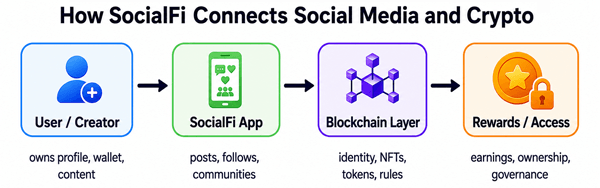
| Layer | What it does | Beginner example |
|---|---|---|
| Wallet and identity | Connects a user to the app and may act as a login, ownership record and payment tool. | You sign in with a wallet instead of only an email and password. |
| Social graph | Stores relationships such as follows, memberships, reputation or creator-fan links. | Your followers can be recognized across multiple apps built on the same protocol. |
| Content layer | Handles posts, comments, images, videos, links or metadata. Some content is stored on-chain; much is stored off-chain for cost and speed. | A post may point to decentralized storage while the ownership or interaction record is on-chain. |
| Token layer | Adds tokens, NFTs, rewards, access passes, tipping or governance rights. | Fans buy a creator pass to join a private community. |
| Application layer | Provides the user interface, feed, moderation tools, discovery and community features. | A mobile app or website makes the protocol usable for normal people. |
3.1 Wallet-Based Login and Digital Identity
Many SocialFi apps use crypto wallets for sign-in. A wallet can prove that a user controls a certain address, owns certain NFTs, or holds a membership token. This can reduce dependence on a platform-controlled username, but it also creates new responsibility. If a user loses access to the wallet, recovery may be difficult unless the app offers safer account recovery features.
3.2 Portable Social Graphs
A social graph is the map of who follows whom, which communities a person belongs to, and how accounts interact. Traditional platforms keep this graph inside their own databases. SocialFi protocols try to make parts of this graph portable, so another app can recognize the same identity or relationships.
3.3 Tokenized Access and Creator Monetization
SocialFi often uses tokens or NFTs to represent access, support or ownership. A creator could sell limited community passes, offer token-gated content, accept tips, or share rewards with active members. This can be useful, but it also turns social interactions into financial actions, which can attract speculation and scams.
3.4 Decentralized Storage and Content Ownership
Not every SocialFi post is stored directly on a blockchain because that can be slow and expensive. Many apps store content off-chain or on decentralized storage networks, while recording ownership, identity or transaction data on-chain. Beginners should understand that “on-chain” does not always mean every word, image or video is permanently stored on a blockchain.
3.5 Governance and Community Decisions
Some SocialFi projects use governance tokens or DAO-style voting. This may allow users to influence rules, product direction, treasury spending or community incentives. In practice, governance quality depends on participation, token distribution and whether the team actually respects community votes.
4. Common Types of SocialFi Platforms
| Type | What it means | How users may benefit | Main risk |
|---|---|---|---|
| Decentralized social networks | Social apps where identity or social graph is controlled through a protocol rather than only one company. | More control over identity and relationships. | Harder onboarding, moderation challenges and limited mainstream adoption. |
| Creator token platforms | Creators or communities use tokens, NFTs or access passes for monetization. | Direct fan support and new revenue models. | Speculation can overshadow real community value. |
| Token-gated communities | Access is based on holding a token, NFT or membership credential. | Clear membership, exclusive content and community ownership. | Can become pay-to-enter groups with weak value. |
| Social trading and reputation apps | Social activity, predictions, influence or reputation may be linked to on-chain assets. | New ways to reward expertise or participation. | Incentives may encourage manipulation or risky financial behavior. |
| Content marketplaces | Posts, media, knowledge or creator assets can be sold, collected or licensed. | Creators can monetize directly. | Copyright, quality and buyer protection issues. |
5. Real-World SocialFi and Decentralized Social Examples
The SocialFi category changes quickly, so examples should be treated as learning references, not investment recommendations. Some projects focus more on social protocols, some on creator monetization, and some on tokenized communities.
| Project / category | What it is known for | Beginner takeaway |
|---|---|---|
| Farcaster | A decentralized social network and protocol where users can own identity and developers can build social apps and mini-app experiences. | Shows how decentralized social apps can feel more like normal social media while still using Web3 infrastructure. |
| Lens | A decentralized social layer/social graph designed for apps that use user-owned profiles and social connections. | Useful example of portable social identity and app composability. |
| Cyber / CyberConnect | A Web3 social and identity ecosystem focused on social graph, profiles and community apps. | Shows how identity and social relationships can become shared infrastructure. |
| DeSo | A blockchain built for decentralized social applications and creator monetization. | Shows a more blockchain-native approach to social media infrastructure. |
| Friend.tech-style apps | Apps that experimented with tokenized access to people, communities or chats. | Important lesson: strong speculation can create hype quickly, but sustainability is difficult. |
| Zora and creator-focused platforms | On-chain creator tools, collectibles and social distribution around media and communities. | Shows how content, collecting and social discovery can overlap. |
6. SocialFi vs DeFi vs NFTs vs Web2 Social Media
| Category | Main purpose | What users do | Where SocialFi overlaps |
|---|---|---|---|
| Web2 social media | Communication, discovery and content distribution. | Post, follow, like, comment, share and message. | SocialFi borrows the social experience but adds user ownership and crypto tools. |
| DeFi | Financial services without traditional intermediaries. | Swap, lend, borrow, stake or provide liquidity. | SocialFi may use tokens, rewards, wallets and on-chain payments. |
| NFTs | Digital ownership records for unique assets or access rights. | Collect, trade, mint or use token-gated access. | SocialFi may use NFTs for profiles, badges, memberships or creator content. |
| DAOs | Community coordination and governance. | Vote, manage treasuries or coordinate work. | SocialFi communities may use DAO-style governance. |
7. Benefits of SocialFi
7.1 Better creator monetization
Creators may earn directly through tips, subscriptions, token-gated content, NFTs, community passes or revenue-sharing models. This can reduce dependence on advertising and platform-controlled payout rules.
7.2 User ownership of identity and relationships
A wallet-based profile or protocol-level social graph may make identity more portable. This can reduce the risk of losing everything when one app changes its rules.
7.3 More open innovation
Developers can build new apps on shared protocols instead of recreating every social network from scratch. This can lead to more experiments in feeds, communities, creator tools and reputation systems.
7.4 Community participation
Tokens and governance systems can give users a role in decisions, incentives and community direction. This works best when voting power is not too concentrated.
7.5 Global payments
Crypto payments can make it easier for creators and fans in different countries to transact without relying only on banks or card networks.
8. Risks and Limitations of SocialFi
8.1 Speculation can damage the social experience
When every follow, message, group or creator relationship becomes a tradable asset, people may start optimizing for short-term profit instead of genuine community. This can create pump-and-dump behavior, fake hype and disappointment.
8.2 Smart contract and wallet risks
SocialFi apps may use smart contracts, bridges, tokens and wallets. Bugs, malicious links, fake token approvals and phishing can lead to financial loss.
8.3 Privacy concerns
Blockchain data can be public and difficult to erase. Users may accidentally connect social activity with financial activity, wallet balances or transaction history.
8.4 Moderation is difficult
Decentralization does not remove the need for moderation. Spam, harassment, illegal content, impersonation and misinformation still need practical solutions.
8.5 User experience is still early
Many SocialFi products require wallets, gas fees, signatures, networks and token approvals. This can confuse beginners who are used to simple email or phone login.
8.6 Regulatory uncertainty
Tokens connected to creator earnings, profit sharing, governance or access may raise legal questions depending on jurisdiction and design.
8.7 Unsustainable token rewards
Some apps attract users by paying rewards for posting or engagement. If rewards are not backed by real demand, the token can fall sharply and users may leave.
9. Practical SocialFi Use Cases
| Use case | How it works | Practical example |
|---|---|---|
| Creator fan clubs | Fans hold a token or NFT that unlocks private posts, livestreams or group chats. | A writer gives members early access to research notes and monthly Q&A sessions. |
| Portable creator profiles | A profile and follower graph can be used across compatible apps. | A creator moves from one SocialFi app to another without rebuilding from zero. |
| Community rewards | Members earn tokens or badges for useful participation. | A coding community rewards helpful answers, tutorials and moderation work. |
| On-chain reputation | Reputation is linked to contributions, credentials or social history. | A freelance designer builds a public proof of community work and client feedback. |
| Token-gated education | Courses or study groups are accessed through wallet-based membership. | A blockchain course issues NFT passes for learners and alumni. |
| Social commerce | Creators sell digital goods, collectibles or access directly to followers. | An artist releases limited digital posters to supporters. |
10. How Beginners Can Evaluate a SocialFi Project
Before using a SocialFi app, treat it like both a social platform and a crypto product. A good-looking app can still have risky token mechanics, weak security or poor community incentives.
- What problem does it solve besides “earn tokens”?
- Can users enjoy the product without constant speculation?
- Who controls the protocol, app, treasury and moderation rules?
- Is the social graph, identity or content actually portable?
- Are fees, token rewards and withdrawal rules clear?
- Has the smart contract been audited or battle-tested?
- Is there real creator or community activity, or only airdrop farming?
- What happens if the token price falls?
- Can users recover accounts safely if they lose a device?
- Does the app explain privacy trade-offs clearly?
11. Best Practices for Using SocialFi Safely
11.1 Protect your wallet first
- Use a separate wallet for testing new SocialFi apps.
- Do not connect your main investment wallet to unknown apps.
- Review token approvals and revoke permissions you no longer need.
- Be careful with links shared in chats, feeds and private messages.
11.2 Start small
- Do not buy expensive access tokens or NFTs just because a creator or influencer is trending.
- Test the app with a small amount before committing more funds.
- Understand gas fees, withdrawal limits and platform fees.
11.3 Check the community quality
- Look for real conversations, useful content and active moderation.
- Be cautious if most posts are about token price, airdrops or referral farming.
- Avoid communities that pressure you to buy quickly.
11.4 Separate social identity and financial privacy
- Think carefully before linking your public identity to a wallet with visible assets.
- Consider using different wallets for public social activity and private holdings.
- Remember that public blockchain history can be analyzed later.
11.5 Understand token incentives
- Ask where rewards come from.
- Check whether token emissions are too high.
- Avoid assuming that early user rewards will last forever.
12. Common Mistakes and Misconceptions
| Mistake or misconception | Reality |
|---|---|
| “SocialFi means users always own everything.” | Ownership depends on design. Some apps are only partly decentralized. |
| “If a creator has a token, it must be valuable.” | A token is only useful if it has real demand, clear utility and sustainable economics. |
| “On-chain content cannot be removed.” | Some data may be permanent, but many apps store content off-chain or use moderation layers. |
| “Decentralized means no rules.” | Communities still need moderation, legal compliance and anti-spam systems. |
| “More rewards mean a better platform.” | High rewards can attract low-quality activity and disappear when incentives drop. |
| “SocialFi is only for influencers.” | It can also serve communities, educators, developers, artists, researchers and niche groups. |
13. What Makes a Good SocialFi Platform?
A strong SocialFi platform should be useful even when token prices are not exciting. The best projects usually focus on real community needs first and financial incentives second.
- Simple onboarding with clear wallet and recovery options.
- A social experience people actually want to use.
- Transparent fees, rewards and token rules.
- Useful creator tools such as memberships, analytics, payments and moderation.
- Strong anti-spam and anti-scam protection.
- Clear privacy explanations.
- Evidence of real users, developers and creators, not only airdrop hunters.
- Open documentation and a credible security approach.
14. The Future of SocialFi
SocialFi is still early. The future will likely depend less on slogans and more on whether apps can offer a better experience than traditional social media. For mainstream users, the winning products may hide much of the crypto complexity while still giving users more ownership, portability and monetization options.
Several trends could shape the category:
- Wallets becoming easier to use through account abstraction and social recovery.
- More creator tools that use stablecoins instead of highly volatile reward tokens.
- Portable social graphs that let users move between apps more easily.
- Better moderation systems that combine community rules, app-level controls and protocol-level neutrality.
- Token models that reward long-term contribution rather than short-term farming.
- More integration between SocialFi, gaming, NFTs, education, live streaming and online communities.
15. Is SocialFi a Good Idea for Beginners?
SocialFi can be worth exploring if you are curious about Web3 communities, creator monetization or decentralized identity. However, beginners should not treat SocialFi as a guaranteed way to earn money. The safest approach is to use it first as a learning experience, not as an investment strategy.
A beginner-friendly approach is:
- Choose one reputable app or protocol to study.
- Create a separate wallet with a small amount of funds.
- Learn how posting, following, tipping, collecting or memberships work.
- Avoid buying expensive tokens or access passes until you understand the risks.
- Track whether the platform provides real value beyond rewards.
16. FAQs About SocialFi in Crypto
16.1 What does SocialFi mean?
SocialFi means social finance. It refers to crypto-powered social platforms and protocols that combine social media features with wallets, tokens, NFTs, decentralized identity, creator monetization and community ownership.
16.2 Is SocialFi the same as decentralized social media?
They overlap, but they are not always the same. Decentralized social media focuses on user-owned identity, social graphs and censorship resistance. SocialFi adds financial features such as tokens, rewards, tips, memberships and creator monetization.
16.3 Can you make money with SocialFi?
Some users may earn through tips, rewards, content sales, NFTs, memberships or community tokens. However, earnings are not guaranteed. Many reward systems are temporary, and token prices can fall quickly.
16.4 Is SocialFi safe?
SocialFi has the same risks as crypto plus the risks of social platforms. Users must watch out for phishing, fake accounts, malicious links, smart contract bugs, token speculation, privacy leaks and scams.
16.5 Do I need a crypto wallet to use SocialFi?
Most SocialFi apps require a wallet, but some newer apps try to make onboarding easier with email login, embedded wallets or account recovery features.
16.6 Why would creators use SocialFi?
Creators may use SocialFi to earn directly from fans, sell memberships, issue collectibles, build portable communities and reduce dependence on one platform’s algorithm or payout rules.
16.7 What is a social graph in SocialFi?
A social graph is the network of relationships between users, such as followers, friends, communities and interactions. In SocialFi, parts of this graph may be portable across compatible apps.
16.8 What is token-gated content?
Token-gated content is content that only users with a specific token, NFT or membership credential can access. It is often used for private communities, premium posts, courses or events.
16.9 What are the biggest problems with SocialFi?
The biggest problems include poor user experience, weak moderation, privacy risks, speculative token models, fake engagement, regulatory uncertainty and limited mainstream adoption.
16.10 Should beginners invest in SocialFi tokens?
Beginners should be very careful. Understanding the app, token utility, supply schedule, risks, liquidity and legal issues is essential. Using a SocialFi app and investing in its token are two different decisions.
17. Final Thoughts
SocialFi is an attempt to redesign online social networks around user ownership, direct creator monetization and open social infrastructure. It can give creators and communities new tools, but it also introduces financial, technical and privacy risks that normal social media users may not expect.
The healthiest way to understand SocialFi is to look beyond hype. Ask whether the platform creates real social value, whether users can control their identity safely, whether monetization is sustainable and whether the community remains useful when token prices are quiet. If the answer is yes, SocialFi may become an important part of the next generation of online communities. If the answer is no, it may become just another short-lived crypto trend.
Sources Consulted and Checked
These sources were consulted and checked while preparing this article to support accuracy and clarity.
- Farcaster official website and app listings: decentralized social network where users own identity.
- Lens official website: social layer and on-chain social products.
- CoinGecko SocialFi category: market category definition and current SocialFi token listings.
- CoinMarketCap Social Token category: market listings for social tokens.
- Coinbase Learn: explanation of Farcaster as a decentralized social media protocol.
- Kraken SocialFi category: current market examples and category data.
Reader Advice
This article is for educational and informational purposes only and is not personalized financial, investment, legal, tax, security, or other professional advice, or a recommendation to use or invest in any SocialFi platform, token, NFT, wallet, or service. A project mentioned here is not necessarily safe, profitable, or suitable for every reader. SocialFi and crypto can involve significant risks, including volatility, loss of funds, scams, phishing, smart-contract failures, privacy exposure, changing platform features, and uncertain regulation. Project activity, fees, token details, market data, statistics, rules, policies, and laws can change over time and may vary by country or region. Please verify current information through official project documentation, relevant regulators, and reliable market-data sources before acting. Consider your circumstances and risk tolerance, use strong wallet-security practices, and consult a qualified professional when appropriate.