Decentralized Identity in Blockchain: Complete Guide, Examples, Risks and Best Practices
Decentralized identity is a new way to prove who you are, what you are allowed to do, or what facts are true about you online without depending on one giant company to store and control all of your identity data. It is often discussed with blockchain because blockchains can provide public, tamper-resistant registries for identifiers, keys, credential schemas, and revocation information. However, decentralized identity is not simply “putting your passport on a blockchain.” In a good design, personal data usually stays off-chain and under the control of the user or the organization that owns it.
This guide explains decentralized identity from a beginner’s perspective. You will learn what it means, how it works, where blockchain fits, what verifiable credentials are, real-world examples, benefits, risks, implementation mistakes, and best practices for individuals, developers, businesses, and crypto projects.
1. What Is Decentralized Identity in Blockchain?
Decentralized identity is a digital identity model where users, organizations, devices, or software agents can control identifiers and prove claims without relying entirely on one central identity provider. Instead of logging in everywhere through one company account, a person can hold digital credentials in a wallet and present only the needed proof to a verifier.
In blockchain-based decentralized identity, a blockchain may act as a verifiable data registry. It can help others discover public keys, verify that an identifier exists, check credential status, or confirm that a credential schema has not been changed. The important point is that the blockchain is normally used for verification infrastructure, not for storing private identity documents.
A simple example is a university issuing a digital diploma to a graduate. The graduate stores it in a wallet. When applying for a job, the graduate can share a cryptographic proof that the diploma was issued by the university and has not expired or been revoked. The employer can verify the proof without calling the university or storing a scan of the diploma.
2. Why Traditional Digital Identity Has Problems
Most people already use digital identity every day. Email accounts, social logins, bank logins, phone numbers, passports, national IDs, school records, work badges, and crypto wallet addresses are all forms of identity. The problem is that today’s identity systems are often fragmented, repetitive, and risky.
- Users must create accounts again and again for different services.
- Companies collect more personal data than they truly need.
- Large databases become attractive targets for hackers.
- People have limited control over how their identity data is shared, reused, or deleted.
- Cross-border verification can be slow, expensive, and dependent on manual checks.
Decentralized identity tries to reduce these problems by making credentials portable, cryptographically verifiable, and easier to share selectively.
3. Key Concepts You Need to Know
3.1 Decentralized identifiers (DIDs)
A decentralized identifier, or DID, is a special type of identifier that can be controlled by the subject of the identity, such as a person, company, device, or software agent. A DID can be resolved to a DID document. That document usually contains public keys, service endpoints, and other technical information needed to verify signatures or communicate securely.
A DID might look something like this: did:example:123456789abcdefghi. The part after “did:” shows the DID method, which defines how the identifier is created, updated, resolved, and deactivated. Some DID methods use blockchains. Others use web domains, peer-to-peer systems, or other registries.
3.2 Verifiable credentials
A verifiable credential is a tamper-evident digital statement made by an issuer about a subject. It may say that a person is over 18, has a degree, holds a professional license, completed KYC, owns a membership, or has passed a security training course. The credential is digitally signed so others can verify who issued it and whether it has changed.
3.3 Verifiable presentations
A verifiable presentation is what the holder shares with a verifier. It can include one or more credentials or a privacy-preserving proof derived from those credentials. For example, instead of sharing a full date of birth, a person may present proof that they are over 18.
3.4 Issuer, holder, and verifier
Most decentralized identity systems use three main roles. The issuer creates the credential. The holder receives and stores it. The verifier checks it. In many cases, the same organization can play different roles in different contexts. A bank may issue a KYC credential to a customer, verify a business credential from a supplier, and hold its own corporate credentials.
3.5 Digital identity wallet
A digital identity wallet is an app or secure software environment where users store identifiers, keys, and credentials. It may be a mobile wallet, browser wallet, enterprise wallet, cloud wallet, or hardware-backed wallet. A good wallet helps users understand what they are sharing, with whom, and why.
3.6 Selective disclosure and zero-knowledge proofs
Selective disclosure means sharing only the specific information needed for a transaction. Zero-knowledge proofs go further by allowing someone to prove that a statement is true without revealing the underlying data. For beginners, the key idea is simple: you should not need to reveal your full identity when a service only needs one fact.
4. How Decentralized Identity Works Step by Step
The workflow is easier to understand if you imagine a digital version of a physical document, but with stronger cryptographic verification.
- An issuer verifies a fact. For example, a university confirms that Alice graduated.
- The issuer creates a verifiable credential. The credential includes claims, metadata, an expiry date, and a digital signature.
- The holder stores the credential. Alice receives it in her identity wallet.
- A verifier requests proof. A job platform asks Alice to prove she has the required degree.
- The holder approves sharing. Alice reviews the request and shares the diploma credential or a limited proof.
- The verifier checks the proof. The platform verifies the signature, issuer DID, credential status, expiry date, and data format.
- The verifier makes a decision. If the proof is valid, the platform can accept the claim without storing unnecessary personal data.
5. Diagram: The Basic Decentralized Identity Flow
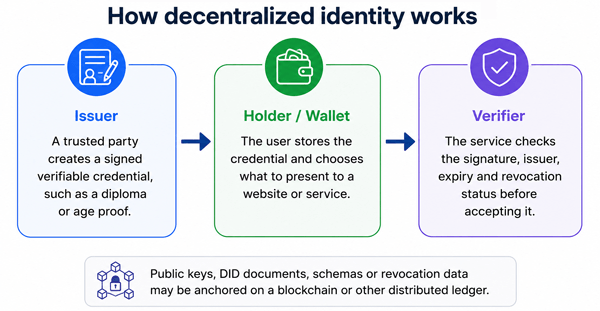
Figure: A simple issuer-holder-verifier flow for decentralized identity.
6. Where Blockchain Fits in Decentralized Identity
Blockchain is useful in decentralized identity because it can act as a shared source of truth that many parties can verify independently. However, it should be used carefully. A blockchain is usually not the right place for names, addresses, passport numbers, medical records, or other sensitive personal data because blockchains are hard to change or erase.
Common blockchain roles include anchoring DID documents or public keys, publishing credential schemas, managing issuer registries, recording revocation registries, timestamping credential-related events, and supporting smart contracts that verify proofs. Some systems use public blockchains, some use permissioned ledgers, and some use non-blockchain registries depending on privacy, governance, cost, and compliance needs.
7. Decentralized Identity vs Traditional Identity vs Federated Login
| Model | How it works | Main advantage | Main weakness |
|---|---|---|---|
| Traditional account | Each website creates and stores its own user account and identity data. | Simple for one service to manage. | Data is duplicated across many databases. |
| Federated login | A central provider such as a social or enterprise login helps users sign in to many services. | Convenient and familiar. | Creates dependency on a central provider and can increase tracking. |
| Decentralized identity | Users hold credentials and present cryptographic proofs to verifiers. | Portable, privacy-focused, and verifiable across organizations. | Still maturing; user experience and governance can be difficult. |
8. Practical Examples of Decentralized Identity
8.1 Age verification without revealing a birth date
A user wants to access an age-restricted service. Instead of uploading a passport or entering a full date of birth, the user presents a credential proving they are over the required age. The service verifies the credential and stores only the result, not the full document.
8.2 Education and professional credentials
Universities, training providers, and licensing bodies can issue credentials for degrees, certificates, licenses, and skills. Employers can verify them quickly without manual calls, forged PDFs, or long background checks.
8.3 Reusable KYC for crypto and financial services
A regulated provider can verify a customer once and issue a reusable credential showing that KYC checks were completed. Another approved service can verify the credential instead of collecting the same documents again. This can reduce onboarding friction, but it must be designed carefully to meet legal, privacy, and anti-money-laundering requirements.
8.4 DAO and Web3 reputation
A decentralized autonomous organization can use credentials to prove membership, contribution history, voting eligibility, event attendance, or role-based permissions. This can help communities reduce spam and sybil attacks without forcing every participant to publish their real-world identity.
8.5 Supply chain and business identity
Companies can issue and verify credentials for suppliers, products, certifications, audits, and compliance status. For example, a buyer might verify that a supplier is certified, insured, or authorized to distribute certain products.
8.6 Internet of Things and machine identity
Decentralized identity is not only for humans. Devices, APIs, vehicles, robots, and software agents may need verifiable identities too. A smart device can prove its manufacturer, firmware version, or authorization status before connecting to a network.
9. Real-World Projects and Ecosystem Examples
The decentralized identity ecosystem includes standards bodies, governments, enterprise identity providers, wallet developers, blockchain networks, and open-source tooling. Examples include W3C Decentralized Identifiers, W3C Verifiable Credentials, the European Digital Identity Wallet framework, Microsoft Entra Verified ID, Hyperledger Indy/Aries-related ecosystems, Polygon ID-style proof systems, SpruceID tooling, Dock, walt.id, and other credential platforms. The exact technology choices differ, but the common pattern is issuer, holder, verifier, wallet, credential format, and trust registry.
A beginner should not treat every project using the phrase “decentralized identity” as equally decentralized or equally mature. Some products are enterprise-managed, some are blockchain-native, some are open standards-based, and some are mostly marketing. Always look at standards support, privacy model, interoperability, recovery options, and governance.
10. Benefits of Decentralized Identity
10.1 Better privacy and data minimization
The strongest benefit is that users can share less data. A verifier may only need proof that a claim is true, not a copy of the full document. This can reduce unnecessary data collection and lower the damage caused by data breaches.
10.2 Portable identity credentials
Credentials can move with the user instead of being trapped inside one company’s database. A student, worker, customer, or business can reuse credentials across compatible services.
10.3 Faster verification
Cryptographic verification can be faster than manual document checks. Employers, banks, exchanges, schools, and marketplaces may reduce onboarding delays when trusted issuers and interoperable standards are in place.
10.4 Reduced fraud
Digitally signed credentials are harder to forge than screenshots, PDFs, and paper copies. Revocation checks can also help verifiers avoid accepting expired or withdrawn credentials.
10.5 Better user consent
A well-designed wallet can show users what information is requested before they share it. This does not automatically solve privacy, but it can make consent more visible and practical.
11. Risks and Limitations
| Risk | What can go wrong | Practical mitigation |
|---|---|---|
| Private key loss | A user may lose access to identifiers or credentials. | Use recovery methods such as social recovery, hardware backup, custodial options where appropriate, and clear user education. |
| Bad issuer trust | A verifier may accept credentials from untrustworthy issuers. | Use issuer governance, trust registries, accreditation, audits, and explicit acceptance policies. |
| Privacy leakage | On-chain identifiers or repeated presentations can enable tracking. | Keep personal data off-chain, rotate identifiers, use pairwise DIDs, selective disclosure, and privacy-preserving proofs. |
| Poor user experience | Users may not understand wallet prompts or credential requests. | Use plain-language consent screens, minimal steps, fallback support, and strong onboarding. |
| Regulatory mismatch | A system may conflict with data protection, KYC, eID, or record-retention rules. | Involve legal, compliance, privacy, and security experts early. |
| Interoperability gaps | Wallets, issuers, and verifiers may not work together. | Prefer mature open standards and test across multiple wallets and verifiers. |
| Revocation problems | Verifiers may not know a credential was revoked. | Use privacy-aware credential status checks and define clear revocation procedures. |
12. Common Misconceptions
12.1 Misconception 1: Decentralized identity means everything is anonymous
Decentralized identity can support privacy, but it does not always mean anonymity. A credential from a government, bank, or employer may strongly identify a person. The privacy benefit comes from user control, selective disclosure, and reduced data sharing, not from pretending identity does not exist.
12.2 Misconception 2: All identity data goes on-chain
This is one of the most dangerous misunderstandings. Sensitive personal data should usually stay off-chain. Blockchains are difficult to erase and can be visible to many parties. A good design keeps private data in wallets or secure issuer systems and only uses the blockchain for verification-related information.
12.3 Misconception 3: A crypto wallet address is the same as identity
A wallet address can identify control of a key, but it does not automatically prove a real-world identity, age, license, citizenship, role, or qualification. Decentralized identity adds verifiable claims issued by trusted parties.
12.4 Misconception 4: Decentralized means no governance
Identity systems need governance. Verifiers must know which issuers they trust, how credentials are revoked, how fraud is handled, and what rules apply. Without governance, cryptographic proofs may be technically valid but socially meaningless.
13. Best Practices for Individuals
- Do not store your seed phrase, wallet backup, or recovery codes in plain text on your phone, email, or cloud drive.
- Read wallet prompts carefully before sharing credentials.
- Share the minimum proof needed. If a service only needs age verification, avoid sharing full ID details.
- Use trusted wallets and keep them updated.
- Understand account recovery before relying on an identity wallet for important credentials.
- Be cautious of fake credential requests, phishing links, and fake verification QR codes.
14. Best Practices for Businesses and Developers
14.1 Start with a real problem, not the technology
Use decentralized identity where it improves verification, privacy, portability, or trust. Do not use it just because it sounds innovative. Good use cases include reusable onboarding, professional credentials, access control, compliance proofs, membership, supply chain verification, and cross-organization trust.
14.2 Keep personal data off-chain
Never place names, addresses, phone numbers, passports, medical data, or biometric templates directly on a public blockchain. Even hashed personal data can be risky if it can later be linked or brute-forced.
14.3 Use open standards where possible
Prefer standards-based approaches such as W3C DIDs and W3C Verifiable Credentials when they fit your requirements. Standards improve portability and reduce vendor lock-in.
14.4 Design for revocation and expiry
Credentials should not live forever by default. Define when they expire, how they are revoked, who can revoke them, and how verifiers check status without creating unnecessary tracking.
14.5 Make trust rules explicit
A verifier should not accept every credential just because it is signed. Define trusted issuers, acceptable credential types, schema versions, assurance levels, and compliance requirements.
14.6 Build privacy into the architecture
Use pairwise identifiers, selective disclosure, zero-knowledge proofs where appropriate, data minimization, short retention periods, and clear user consent. Privacy should not be an afterthought added after launch.
14.7 Plan recovery and support
Identity is high stakes. Users will lose phones, forget passwords, change jobs, and make mistakes. Provide secure recovery flows, credential reissuance procedures, and human support for important credentials.
14.8 Test interoperability
Test with multiple wallets, issuers, verifiers, browsers, devices, and edge cases. Check what happens when credentials expire, issuers rotate keys, wallets are restored, and networks are unavailable.
15. Implementation Checklist
| Question | Why it matters |
|---|---|
| What exact claim needs to be proven? | Prevents over-collecting data. |
| Who is the issuer, and why should they be trusted? | Defines the trust model. |
| What credential format and standard will be used? | Improves interoperability. |
| Where are keys stored and backed up? | Reduces account loss risk. |
| What data, if any, is written on-chain? | Protects privacy and supports compliance. |
| How does revocation work? | Avoids accepting invalid credentials. |
| What does the user consent screen show? | Makes sharing understandable. |
| How will the system handle lost devices? | Protects users from permanent lockout. |
| What laws and regulations apply? | Avoids legal and compliance failures. |
| How will you measure success? | Keeps the project focused on real value. |
16. Decentralized Identity in Crypto and Web3
In crypto, decentralized identity can help solve several practical problems. It can support sybil resistance in airdrops, proof of personhood, DAO voting eligibility, reusable compliance credentials, wallet-based login, reputation systems, and access control for token-gated communities. However, Web3 identity must balance privacy and accountability. Publicly linking a real-world identity to a wallet can expose financial activity, relationships, and behavior.
A safer design often separates public wallet activity from private credentials. For example, a user may prove eligibility for an airdrop without revealing their passport number or linking all their wallets forever. Projects should be especially careful with on-chain identity badges that are permanent, public, and hard to remove.
17. Decentralized Identity and Regulation
Digital identity touches privacy law, financial regulation, consumer protection, cybersecurity, accessibility, and sector-specific rules. In Europe, the European Digital Identity framework is pushing toward digital wallets that can link national digital identities with other attributes such as driving licenses, diplomas, and bank accounts. Around the world, governments and private companies are also exploring digital credentials for education, finance, travel, healthcare, and public services.
Regulation can help adoption by creating trust frameworks and assurance levels. It can also create constraints. Businesses should not assume that using blockchain automatically makes identity compliant. Legal requirements around consent, data minimization, right to erasure, audit logs, record retention, KYC, and cross-border data transfer still matter.
18. When Decentralized Identity Is a Good Fit
Decentralized identity is most useful when multiple organizations need to verify trusted claims, users benefit from credential portability, privacy matters, and manual verification is costly. It is less useful when a simple local account is enough, the issuer and verifier are the same organization, the trust model is unclear, or users cannot realistically manage wallets and recovery.
| Good fit | Poor fit |
|---|---|
| Reusable KYC or onboarding across approved partners | A small website that only needs a username and password |
| University degrees and professional licenses | One-time low-risk newsletter signup |
| Cross-border business or government credentials | Systems with no trusted issuer or clear verifier |
| DAO eligibility and privacy-preserving reputation | Permanent public identity badges exposing sensitive data |
| Supply chain certifications | Projects that want to put personal data directly on-chain |
19. Future of Decentralized Identity
The future of decentralized identity will likely be shaped by standards, regulation, wallet usability, privacy-preserving cryptography, and real-world adoption. The biggest improvements may come from better user experience, safer recovery, stronger interoperability, and more practical credential ecosystems where issuers and verifiers already trust each other.
For most users, success will not feel like “using blockchain.” It will feel like faster onboarding, fewer document uploads, more control over data sharing, and less repetition. For businesses, success will mean lower fraud, lower data storage risk, and more reliable verification.
20. FAQs About Decentralized Identity in Blockchain
20.1 Is decentralized identity the same as self-sovereign identity?
They are closely related but not always identical. Self-sovereign identity usually emphasizes strong user control over identifiers and credentials. Decentralized identity is a broader term that may include user-controlled, organization-controlled, enterprise, government, and hybrid models.
20.2 Does decentralized identity require blockchain?
Not always. Some DID methods and verifiable credential systems use blockchains, while others use web domains, peer-to-peer methods, or trusted registries. Blockchain is useful when a shared, tamper-resistant registry is needed, but it is not mandatory for every identity use case.
20.3 Can decentralized identity replace passports and national IDs?
Not by itself. It can digitize, verify, or present credentials related to government identity, but legal identity depends on government rules and official trust frameworks. A digital credential can complement official ID systems rather than automatically replacing them.
20.4 Is decentralized identity safe?
It can be safer than traditional data-heavy identity systems when designed well. It can also be risky if private keys are lost, personal data is placed on-chain, users are tricked by phishing, or verifiers accept low-quality credentials. Safety depends on architecture, governance, wallet design, recovery, and user education.
20.5 What is the difference between a DID and a verifiable credential?
A DID is an identifier that can be used to find verification material such as public keys. A verifiable credential is a signed statement containing claims about a subject. In simple terms, the DID helps verify who signed something, while the credential contains what was claimed.
20.6 Can I delete a decentralized identity?
It depends on the system. A DID may be deactivated, credentials may be deleted from a wallet, and issuers may revoke credentials. But anything written to a public blockchain may remain visible permanently. This is why personal data should not be written on-chain.
20.7 How does decentralized identity prevent fraud?
It helps by using digital signatures, trusted issuers, tamper-evident credentials, expiry dates, and revocation checks. It does not eliminate fraud completely. Issuer quality, governance, device security, and user behavior still matter.
20.8 What is the biggest challenge for adoption?
The biggest challenge is not only technology. It is coordination. Issuers, wallets, verifiers, regulators, and users must agree on standards, trust rules, recovery methods, and user experience. Without a strong ecosystem, credentials are not very useful.
21. Final Thoughts
Decentralized identity in blockchain is a practical attempt to make digital identity more private, portable, verifiable, and user-controlled. It can reduce repeated document uploads, lower data breach risk, and make verification faster across organizations. But it is not magic, and it should not be used as an excuse to put personal information on-chain.
The best decentralized identity systems are boring in the right way: they solve a real verification problem, use open standards, keep sensitive data off-chain, give users clear control, support recovery, and define trust rules carefully. For beginners, the most important lesson is simple: decentralized identity is less about hiding who you are and more about proving only what is necessary, when it is necessary, in a safer and more privacy-respecting way.
Sources Consulted and Checked
The following sources were consulted and checked while preparing this article and reviewing its accuracy.
- W3C Decentralized Identifiers (DIDs) v1.0 and v1.1 specifications.
- W3C Verifiable Credentials Data Model 2.0, published as a W3C Recommendation in 2025.
- European Commission information on the European Digital Identity Regulation and EUDI Wallet.
- Microsoft Entra Verified ID documentation on decentralized identifiers, verifiable credentials, and architecture.
- W3C Verifiable Credentials overview and related implementation guidance.
Reader Advice
This article is provided for general educational and informational purposes. It is not personalized legal, regulatory, financial, cybersecurity, identity-verification, or investment advice, and it should not be treated as a recommendation to use any particular blockchain, wallet, credential platform, identity provider, or crypto project. Decentralized identity systems may involve privacy, key-loss, fraud, phishing, tracking, interoperability, compliance, and financial risks. Laws, regulations, technical standards, platform policies, project features, and statistics can change over time and may differ by country or region. Before making an important decision or implementing a system, verify current information through official sources, assess the security and privacy design, and seek appropriately qualified professional advice where necessary.