Decentralized Storage in Blockchain: Complete Guide, Examples, Risks and Best Practices
Decentralized storage in blockchain is a way to store files, app data, media, backups, website content, NFT metadata and other digital information across many independent computers instead of relying on one central company or server. The blockchain part usually helps coordinate payments, incentives, ownership records, storage contracts or cryptographic proofs that data is being stored.
The idea is simple: instead of asking one cloud provider to hold everything, a decentralized storage network spreads data across a distributed group of nodes. In many systems, files are identified by their content rather than by a traditional web address. This can make data easier to verify, harder to quietly change and less dependent on a single point of failure.
This does not mean every file is automatically private, permanent or impossible to lose. Decentralized storage can be powerful, but it must be used correctly. Encryption, pinning, redundancy, gateway choices, legal requirements and recovery planning all matter.
1. What Is Decentralized Storage in Blockchain?
Decentralized storage is a data storage model where files are stored across a network of independent participants. In blockchain-based storage systems, tokens, smart contracts or consensus rules may be used to reward storage providers, verify storage, pay for retrieval or record commitments.
A beginner-friendly way to understand it is this:
- Traditional cloud storage usually asks, “Which server has this file?”
- Decentralized storage often asks, “Which network participants have the content that matches this cryptographic fingerprint?”
- Blockchain-based storage adds economic incentives and verification so people are rewarded for providing storage or access.
2. Decentralized Storage vs Traditional Cloud Storage
| Feature | Traditional cloud storage | Decentralized blockchain storage |
|---|---|---|
| Control | Usually controlled by one company or platform account. | Distributed across many nodes, providers or peers. |
| Addressing | Often location-based: a URL points to a server or bucket. | Often content-based: a hash or CID points to the exact content. |
| Availability | Depends on the provider, account status, region and service uptime. | Depends on replication, incentives, pinning and active network participants. |
| Privacy | Provider may manage access controls; encryption depends on setup. | Privacy usually requires client-side encryption before upload. |
| Payments | Paid subscription or usage bill in fiat currency. | May involve tokens, storage contracts, prepaid fees or third-party gateways. |
| Best for | Mainstream business apps, simple file sharing, enterprise compliance. | Web3 apps, censorship-resistance, verifiable data, NFT metadata, archival use cases. |
3. How Decentralized Storage Works
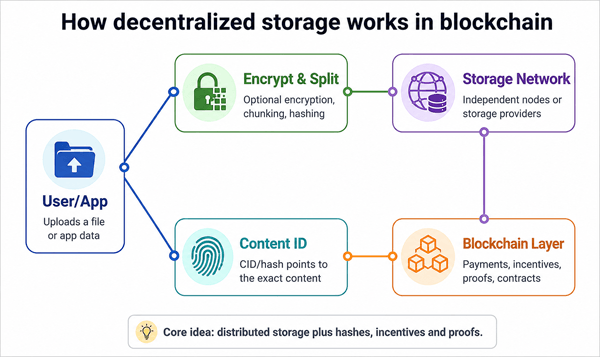
Diagram: A simplified flow showing how files can be encrypted, split, identified by a content hash, stored across a network and coordinated by a blockchain layer.
3.1 A user or app uploads data
A wallet, app, developer tool or storage gateway receives a file. The file might be a website, image, video, PDF, backup, dataset or NFT metadata file.
3.2 The data may be encrypted
For private files, encryption should happen before data leaves the user or application. This is important because public decentralized networks should not be treated as private by default.
3.3 The file is split and hashed
Many systems break files into smaller pieces and create cryptographic hashes. A hash acts like a fingerprint: if the file changes, the fingerprint changes.
3.4 A content identifier is created
IPFS uses content addressing and Content Identifiers, often called CIDs. A CID points to the content itself, not just a server location.
3.5 Nodes store or serve the content
Storage providers, hosts or peers keep copies of the data. The exact model depends on the network. Some use pinning, some use storage deals, some use long-term endowment-like incentives.
3.6 Blockchain incentives may verify storage
Networks such as Filecoin use proofs to help verify that storage providers are storing data over time. Other systems use different incentive and verification designs.
3.7 Users retrieve the file
The user, app or gateway requests the content by its identifier. If available nodes have the data, it can be retrieved and verified against the hash.
4. Important Terms Beginners Should Know
| Term | Simple meaning |
|---|---|
| Node | A computer participating in the network. It may store, route or serve data. |
| Peer-to-peer network | A network where computers can connect directly or semi-directly without relying only on one central server. |
| Content addressing | Identifying data by what it is, using a cryptographic hash, instead of only where it is hosted. |
| CID | A Content Identifier commonly associated with IPFS. It represents content-addressed data. |
| Pinning | Keeping data available on IPFS by ensuring one or more nodes continue to store it. |
| Storage provider / host | A participant that offers disk space to store data for others. |
| Proof of storage | A cryptographic method used by some networks to show that data is being stored as promised. |
| Gateway | A service that lets regular web browsers or apps access decentralized storage content. |
| Redundancy | Keeping multiple copies so data is less likely to become unavailable. |
5. Common Types of Decentralized Storage Systems
5.1 IPFS: content-addressed file sharing and retrieval
IPFS, short for InterPlanetary File System, is a set of open protocols for content-addressed, peer-to-peer data routing and transfer. It is widely used in Web3 because it lets apps refer to files by a CID. However, IPFS by itself does not guarantee that a file will remain online forever. Someone must continue to host or pin the content.
5.2 Filecoin: an incentivized storage marketplace
Filecoin is closely associated with IPFS but focuses on incentivized storage. Storage providers can earn rewards by storing data, and the network uses cryptographic proofs such as Proof of Replication and Proof of Spacetime to help verify storage commitments over time.
5.3 Arweave: permanent storage approach
Arweave is designed around permanent data storage and the “permaweb.” Users generally pay upfront, and the network’s economic design aims to support long-term storage. It is often used for permanent archives, static websites, NFT assets and public records that should remain accessible for a very long time.
5.4 Sia: decentralized cloud storage marketplace
Sia is a decentralized cloud storage network that connects renters and hosts. It is designed for distributed cloud storage, where data can be split, encrypted and stored across independent hosts using blockchain-based contracts.
| Network / approach | Best known for | Practical note |
|---|---|---|
| IPFS | Content addressing and peer-to-peer retrieval. | Great for CIDs and verifiable files, but availability requires pinning or hosting. |
| Filecoin | Incentivized storage deals and storage proofs. | Useful when you want a market-based storage layer with verification. |
| Arweave | Permanent storage and the permaweb. | Useful for public data intended to stay available long term. |
| Sia | Decentralized cloud storage marketplace. | Useful for encrypted distributed storage with host/renter economics. |
6. Real-World Examples and Use Cases
6.1 NFT metadata and media
A project can store NFT metadata JSON and image files on IPFS or Arweave instead of keeping them only on a private server. This reduces the risk that the NFT points to a broken or changed file later.
6.2 Decentralized websites and front ends
A Web3 app can host a static website on IPFS or Arweave so users can access the interface even if a centralized hosting account goes down.
6.3 DAO records and governance documents
A DAO can store proposals, votes, budgets and public reports on decentralized storage so members can verify historical documents.
6.4 Application data for dApps
Decentralized social apps, games and identity tools may use decentralized storage for user-generated content, profiles, attestations or media.
6.5 Archives and public-interest data
Researchers, journalists, libraries and public-good projects may use decentralized storage for datasets, public documents and censorship-resistant archives.
6.6 Backups and disaster recovery
Some users explore decentralized storage as a secondary backup layer. It should not be the only backup unless recovery, encryption and availability are carefully tested.
7. Benefits of Decentralized Storage
- Reduced reliance on one provider or server.
- Verifiable data integrity because content hashes reveal whether a file has changed.
- Better resilience when files are replicated across many nodes.
- Censorship-resistance for lawful public-interest content, depending on network design and access routes.
- Useful fit for Web3 apps, NFTs, DAOs and open-data projects.
- Potentially competitive pricing in some marketplace-based networks.
- Greater portability because content-addressed files can be fetched from different nodes or gateways.
8. Risks, Limitations and Trade-Offs
8.1 Data may disappear if nobody stores it
A CID is not a storage guarantee. If no node has the content, the CID cannot magically retrieve it. Use pinning, storage deals, replication and monitoring.
8.2 Public networks are not private by default
Never upload sensitive data unencrypted. If the data is public, assume it may be copied, indexed or retained by unknown parties.
8.3 Permanent storage can create legal and ethical problems
Permanent or hard-to-remove data is risky for personal data, copyrighted content, illegal content, leaked credentials or information that may need deletion later.
8.4 Gateway dependence can reintroduce centralization
Many users access decentralized storage through HTTP gateways. If one gateway blocks content, goes down or changes policies, users may need alternatives.
8.5 Retrieval speed can vary
Performance depends on where data is hosted, how many copies exist, network conditions and gateway quality.
8.6 Token prices and storage economics can change
Blockchain storage networks may involve tokens. Costs, incentives and provider behavior can change over time.
8.7 Compliance can be difficult
Businesses must think about privacy laws, data residency, retention policies, deletion rights, audits and vendor risk. Decentralized storage does not automatically solve compliance.
9. Best Practices for Using Decentralized Storage Safely
- Encrypt private or sensitive files before upload, and manage keys carefully.
- Use decentralized storage mainly for content that benefits from public verifiability, resilience or long-term access.
- Do not store secrets, seed phrases, API keys, private customer records or confidential business documents in public form.
- Use pinning services, storage deals or multiple hosts when availability matters.
- Keep local backups and at least one independent recovery path.
- Test retrieval, not just upload. A successful upload is not the same as a reliable recovery process.
- Document CIDs, transaction IDs, storage deal details and renewal dates.
- Use versioning: when a file changes, its content hash changes, so keep a clear map of versions.
- Monitor availability with automated checks if the content is business-critical.
- Review legal, privacy and copyright issues before storing permanent or hard-to-remove data.
10. Practical Decision Guide: When Should You Use It?
| Situation | Good fit? | Why |
|---|---|---|
| Public NFT metadata or media | Often yes | CIDs and permanent storage can reduce broken links and silent changes. |
| A static Web3 app front end | Often yes | Improves resilience and reduces dependence on one hosting provider. |
| Private customer records | Usually no, unless heavily controlled | Privacy, deletion and compliance risks are high. |
| Long-term public archive | Potentially yes | Permanent or replicated storage can be useful for public records. |
| Fast-changing app database | Usually not as primary storage | Traditional databases are often better for frequent updates, indexing and low-latency queries. |
| Secondary encrypted backup | Sometimes | Useful only if encryption, redundancy and recovery have been tested. |
11. Beginner Mistakes to Avoid
- Thinking “stored on IPFS” means “permanent forever.” IPFS availability depends on nodes keeping the content.
- Uploading unencrypted private files to a public network.
- Relying on a single gateway and calling the setup decentralized.
- Forgetting that edited files get new hashes or CIDs.
- Not keeping a backup of encryption keys.
- Assuming token incentives remove all operational risk.
- Using permanent storage for data that may need to be corrected, deleted or restricted later.
12. Decentralized Storage and NFTs
NFTs are one of the easiest ways to understand decentralized storage. An NFT usually lives on a blockchain, but the image, video or metadata often lives somewhere else. If the metadata is hosted only on a company server, the NFT may break if that server disappears or the project shuts down. Storing metadata and media on IPFS, Arweave or similar systems can improve durability and transparency.
A strong NFT storage setup usually includes:
- Immutable or clearly versioned metadata.
- Media stored using CIDs or permanent storage.
- Multiple pins, storage deals or archival copies.
- A public record of where the assets are stored.
- A plan for gateway access if one gateway fails.
13. Is Decentralized Storage the Same as Blockchain Storage?
Not exactly. Blockchains are usually expensive and inefficient for storing large files directly. They are better at storing small pieces of critical information, such as transaction records, hashes, ownership references, smart contract states or storage commitments. Decentralized storage networks handle the larger files, while the blockchain may record the proof, payment, pointer or agreement.
| Layer | What it usually stores | Example |
|---|---|---|
| Blockchain | Hashes, ownership, payments, smart contract rules, storage commitments. | An NFT contract stores a token URI pointing to metadata. |
| Decentralized storage | Files, metadata, images, websites, datasets, backups. | The NFT image and metadata JSON are stored on IPFS or Arweave. |
14. How to Evaluate a Decentralized Storage Provider or Network
- Availability: How is content kept online and for how long?
- Proofs: Does the network verify storage, and what do those proofs actually prove?
- Retrieval: How fast and reliable is access from your users’ locations?
- Redundancy: How many independent copies or hosts are used?
- Encryption: Is encryption client-side, and who controls the keys?
- Portability: Can you move data or retrieve it without being locked into one gateway?
- Cost model: Is pricing subscription-based, token-based, pay-once or contract-based?
- Compliance: Can your organization meet privacy, retention and deletion obligations?
- Developer experience: Are APIs, SDKs, documentation and monitoring tools mature enough?
- Reputation: Has the network or service shown long-term reliability?
15. Simple Workflow for a Safe First Test
- Choose a non-sensitive test file.
- Upload it through a reputable tool, gateway or storage service.
- Record the CID, transaction ID or storage reference.
- Open the content from two different networks, gateways or devices.
- Change the file slightly and notice that the content identifier changes.
- Set up pinning, storage deals or redundancy if you need ongoing availability.
- Delete your local copy only after you have tested recovery and saved key information securely.
16. Future of Decentralized Storage
Decentralized storage is likely to become more useful as Web3 apps, AI datasets, digital archives, DePIN networks, NFT infrastructure and decentralized identity systems mature. The most practical growth may come from hybrid models: decentralized storage for verifiable public data and traditional cloud databases for fast, private, frequently changing application data.
For most beginners and businesses, the winning approach is not “replace every cloud service with blockchain storage.” It is to use decentralized storage where its strengths matter: verifiability, resilience, portability, long-term access and reduced dependence on one provider.
17. FAQs About Decentralized Storage in Blockchain
17.1 What is decentralized storage in simple words?
It is a way to store data across many independent computers instead of one central server. Blockchain may be used to coordinate incentives, payments, proofs or ownership records.
17.2 Is IPFS a blockchain?
No. IPFS is not a blockchain. It is a peer-to-peer, content-addressed protocol for storing and retrieving data. It is often used with blockchains, but it is a separate technology.
17.3 Does IPFS store files forever?
Not by itself. A file on IPFS stays available only while at least one node has and serves it. Pinning, storage providers and redundancy are used to keep content available.
17.4 Is decentralized storage private?
Not automatically. Public decentralized networks should be treated as public unless files are encrypted before upload and keys are managed safely.
17.5 Can blockchain store large files directly?
Technically some chains can store data, but it is usually expensive and inefficient. A common design is to store large files off-chain and store hashes or references on-chain.
17.6 What is the difference between Filecoin and IPFS?
IPFS is mainly about content addressing and peer-to-peer data transfer. Filecoin adds an incentivized storage marketplace and proof mechanisms for storage providers.
17.7 What is Arweave used for?
Arweave is commonly used for permanent public storage, static websites, NFT assets, archives and other data intended to remain accessible for a long time.
17.8 What are the biggest risks?
The biggest risks include lost availability, poor key management, uploading private data publicly, compliance problems, gateway dependence and misunderstanding what a network actually guarantees.
17.9 Should businesses use decentralized storage?
Businesses can use it for public, verifiable or archival data, but they should be cautious with regulated, private or frequently changing data. Legal and security review is important.
17.10 What is the best decentralized storage network?
There is no single best choice for every use case. IPFS is common for content addressing, Filecoin for incentivized storage, Arweave for permanent public storage and Sia for decentralized cloud storage. The right choice depends on privacy, cost, availability and retention needs.
18. Conclusion
Decentralized storage in blockchain gives users and developers a new way to store and verify digital information without depending entirely on one central server. It is especially useful for Web3 apps, NFT metadata, decentralized websites, public archives and data that benefits from transparent verification.
The key lesson is balance. Decentralized storage is not magic cloud storage, and it is not automatically private, permanent or compliant. It works best when you understand the storage model, encrypt sensitive data, maintain redundancy, test retrieval and choose the right network for the job.
Sources Consulted and Checked
These sources were consulted and checked while preparing this article to support accuracy and clarity.
- IPFS documentation on content addressing and CIDs
- IPFS overview documentation
- Filecoin documentation on proofs
- Arweave official website
- Sia official website
Reader Advice
This article is for educational and informational purposes only and is not personalized legal, financial, security, investment or technical advice or a recommendation. Laws, policies, service terms, technical features, costs and statistics can change and vary by region, so verify important details through current official sources and obtain professional guidance where appropriate. Decentralized storage may involve privacy, data-loss, cybersecurity, compliance, permanence, token-price and availability risks; assess them carefully, protect encryption keys, keep independent backups and test recovery before relying on any solution.