Prediction Markets in Crypto
Complete Guide, Examples, Risks and Best Practices
Prediction markets in crypto are online markets where people trade on the outcome of future events. Instead of only asking, 'What do people think will happen?', a prediction market asks, 'What price are people willing to pay for a claim that pays if it happens?' That price can become a live crowd estimate of probability.
For example, a market may ask: 'Will Bitcoin close above $100,000 on December 31?' If a YES share trades at $0.62, the market is roughly saying there is a 62% implied chance, before considering fees, liquidity, and market distortions. If the event happens, YES shares usually redeem for $1. If it does not happen, YES shares become worthless and NO shares win.
Crypto makes prediction markets especially interesting because smart contracts can create outcome tokens, hold collateral, process trades, and settle winning positions transparently. But these markets are not risk-free. They can involve legal restrictions, oracle disputes, thin liquidity, market manipulation, poor question wording, and the same emotional mistakes that hurt traders in other markets.
1. What Are Prediction Markets in Crypto?
A crypto prediction market is a blockchain-based or crypto-enabled marketplace where users buy and sell positions tied to the outcome of a future event. The event can be about crypto prices, elections, sports, economic data, company news, weather, entertainment, technology launches, or almost any verifiable question allowed by the platform and law.
Most markets are built around a simple idea: if the event happens, one outcome token pays a fixed amount; if it does not happen, that token pays nothing. Because traders can buy and sell these tokens before the event is resolved, the market price constantly changes as new information appears.
| Term | Beginner-friendly meaning |
|---|---|
| Event contract | A tradeable contract linked to a real-world event, such as whether a team wins or a crypto price reaches a target. |
| Outcome token | A token representing one possible result, such as YES or NO. |
| Implied probability | A rough probability suggested by price. A $0.70 YES share suggests about 70%, before adjustments. |
| Liquidity | How easy it is to buy or sell without moving the price too much. |
| Oracle | A system or process that brings the final real-world result on-chain. |
| Resolution | The process of deciding which outcome won. |
| Settlement | The payout or redemption process after resolution. |
2. How Crypto Prediction Markets Work
Although platforms differ, most crypto prediction markets follow a similar lifecycle.
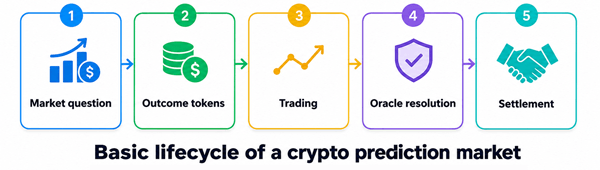
Basic lifecycle of a crypto prediction market
2.1 A Clear Market Question Is Created
A market begins with a specific question and clear resolution rules. A good question is measurable, time-bound, and linked to reliable sources. For example, 'Will ETH trade above $5,000 at 12:00 UTC on December 31, 2026, according to Coinbase?' is clearer than 'Will Ethereum perform well this year?'
Poor wording creates disputes. The market should define the data source, deadline, timezone, edge cases, and what happens if data is unavailable.
2.2 Outcome Shares Are Created
In a binary market, there are usually two outcomes: YES and NO. Some crypto systems create these as conditional tokens. A complete YES/NO pair may be backed by collateral, meaning the pair together represents the full payout amount. Polymarket documentation, for example, describes binary market outcome tokens where winning positions redeem at $1 and losing positions become worthless, with collateral locked in the contract.
2.3 Traders Buy and Sell Shares
Traders buy the outcome they believe is underpriced and sell the outcome they believe is overpriced. As news changes, prices move. If a court decision, election poll, team injury, exchange filing, or blockchain upgrade changes expectations, the market may reprice quickly.
A YES share at $0.20 can be read as roughly 20% implied probability. If you buy 100 YES shares at $0.20, you pay about $20 before fees. If YES wins, those shares redeem for $100, giving a gross profit of about $80. If YES loses, the position may go to zero.
2.4 Liquidity Comes From Order Books or AMMs
Some markets use order books, where buyers and sellers place bids and asks. Others use automated market makers, where smart contracts quote prices based on formulas and liquidity pools. Order books can be more efficient in active markets, while AMMs can make small markets tradeable even when there are not many direct buyers and sellers.
2.5 An Oracle Resolves the Outcome
Blockchains cannot automatically know who won an election, whether a law passed, or what a government report said. They need an oracle. Some markets use official data feeds for objective data. Others use optimistic oracles, where anyone can propose an answer and others can dispute it during a challenge window. Polymarket’s current documentation says it uses the UMA Optimistic Oracle for decentralized, permissionless resolution of many markets.
2.6 Winners Redeem and Losers Lose
After resolution, winning shares can be redeemed according to the market rules. Losing shares expire worthless. If a trader exits before resolution, their profit or loss depends on the market price at the time they sell.
3. Simple Example: A Bitcoin Price Market
| Step | Example |
|---|---|
| Question | Will Bitcoin close above $100,000 on December 31, 2026, according to a named exchange or index? |
| Starting price | YES trades at $0.40, suggesting about a 40% implied chance. |
| Your trade | You buy 50 YES shares for about $20 before fees. |
| Market moves | Good news pushes YES to $0.60. You can sell early for about $30 or keep holding. |
| Resolution | If BTC closes above the defined level, YES pays $1 per share. If not, YES pays $0. |
| Main lesson | The market price is not a guarantee. It is a live trading price shaped by information, liquidity, incentives, and emotion. |
4. Examples of Crypto Prediction Market Projects and Designs
| Example | What it is | Why it matters | Important caution |
|---|---|---|---|
| Polymarket | A popular crypto prediction market using outcome tokens and oracle-based resolution. | It helped bring prediction markets to mainstream crypto users with active markets across politics, crypto, sports, culture, and current events. | Access, legality, market categories, and available products vary by country and can change. |
| Augur | An early Ethereum-based decentralized prediction market and oracle project. | It showed how market creation, trading, reporting, and settlement could be handled through crypto incentives. | Earlier designs often faced user-experience, liquidity, gas-cost, and adoption challenges. |
| Gnosis Conditional Tokens | A framework for creating tokens that represent conditional outcomes. | It provides building blocks for more complex or combinatorial prediction markets. | Powerful infrastructure can be difficult for beginners and may require technical integrations. |
| UMA Optimistic Oracle | An oracle system used to verify real-world claims and resolve disputes. | It supports flexible market resolution where data may not come from a simple automated feed. | Optimistic designs depend on incentives, dispute processes, and clear market wording. |
| Kalshi-style event contracts | Regulated event-contract markets, not necessarily crypto-native. | They show how prediction markets overlap with financial regulation and mainstream trading. | Rules differ from crypto-native platforms and vary by jurisdiction. |
5. Common Types of Crypto Prediction Markets
| Market type | Example question | Beginner notes |
|---|---|---|
| Crypto price markets | Will ETH close above $5,000 by a specific date? | Easy to understand, but highly volatile and sensitive to market news. |
| Protocol and governance markets | Will a blockchain upgrade go live by a certain date? | Useful for tracking ecosystem expectations, but resolution must be precise. |
| Politics and elections | Will a named candidate win a specific election? | Often liquid and news-driven, but legally sensitive in many jurisdictions. |
| Sports and entertainment | Will a team win a championship? | Popular with users, but may be treated like gambling in some places. |
| Economic indicators | Will inflation be above a specific level in a government report? | Can be useful for macro watchers, but depends on data-source definitions. |
| Technology and business events | Will a company launch a product by a deadline? | Can be informative, but insider information and ambiguity can be issues. |
6. Why Prediction Markets Can Be Useful
Prediction markets are valuable because they turn disagreement into a price. People can talk endlessly about what they think will happen, but a market forces participants to attach a cost to their belief.
6.1 Market Prices Can Aggregate Information
A prediction market can combine information from analysts, fans, insiders, researchers, traders, journalists, and ordinary users. When participants have money at stake, they may be more careful than they are in social media arguments. This is why prediction markets are sometimes described as information markets.
6.2 They Can Update Faster Than Traditional Forecasts
Polls, reports, and expert forecasts often update slowly. Prediction markets can update minute by minute. During fast-moving events, this makes them useful as real-time sentiment indicators.
6.3 They Can Help With Hedging
Some users may use event markets to reduce exposure to a specific risk. For example, a crypto business heavily exposed to ETH may use a market related to an Ethereum upgrade delay, if such a market is legal and sufficiently liquid. This is not always practical, but it shows why event markets can be more than entertainment.
6.4 They Can Improve Research and Journalism
Journalists, researchers, and analysts can use prediction markets as one signal among many. A market price does not prove what will happen, but it can show how expectations change after new information.
7. What Prediction Market Prices Do Not Mean
A prediction market price is not a prophecy. It is not guaranteed probability. It is a traded price. Prices can be wrong for many reasons.
- A market with low liquidity can show misleading odds because a small trade can move the price.
- A market can be manipulated if someone is willing to lose money to influence public perception.
- Traders can overreact to rumors, fake news, social media trends, or incomplete data.
- The market question may be poorly worded, making resolution uncertain.
- Fees, spreads, and withdrawal costs can make a seemingly profitable trade unattractive.
8. Crypto Prediction Markets vs Traditional Prediction Markets
| Feature | Crypto prediction markets | Traditional/regulated event markets |
|---|---|---|
| Settlement | Often uses smart contracts and crypto collateral. | Settles through regulated market infrastructure. |
| Access | Can be global, but often restricted by jurisdiction and platform policy. | Usually limited to approved jurisdictions and regulated customers. |
| Transparency | Trades and collateral may be visible on-chain, depending on design. | Public market data may be available, but internal systems are not usually on-chain. |
| Oracle/resolution | Uses decentralized, optimistic, or platform-defined resolution systems. | Uses exchange rules, official sources, and regulatory oversight. |
| Risk profile | Adds smart-contract, wallet, bridge, and oracle risks. | Adds broker, exchange, regulatory, and platform risks. |
| User experience | Can involve wallets, stablecoins, gas fees, and self-custody. | Often resembles normal brokerage or exchange accounts. |
9. Major Risks of Prediction Markets in Crypto
9.1 Legal and Regulatory Risk
Prediction markets can sit between finance, gambling, derivatives, politics, and crypto regulation. The same market may be treated differently in different countries or even different states. In the United States, the CFTC has taken enforcement action against unregistered event-based binary options markets and continues to review frameworks for event contracts. This area is changing, so users should not assume that a platform is legal for them just because it is accessible online.
9.2 Oracle and Resolution Risk
If the final answer is unclear, delayed, disputed, or based on a source that becomes unavailable, the market may resolve in a way traders did not expect. This is especially important for subjective markets, vague wording, political edge cases, or events with multiple possible interpretations.
9.3 Smart Contract Risk
Crypto markets depend on smart contracts, wallets, bridges, and sometimes layer-2 networks. Bugs, exploits, admin-key problems, or contract design mistakes can cause losses even if your prediction is correct.
9.4 Liquidity and Slippage Risk
A market price is more meaningful when many traders participate and there is enough liquidity. In thin markets, the displayed price may not represent a realistic exit price. You may buy at one price but be forced to sell much lower if there are few buyers.
9.5 Manipulation and Misinformation Risk
A wealthy trader, campaign group, or coordinated community may push a market price to influence public narratives. Rumors, AI-generated fake content, spoofed announcements, and social-media campaigns can also distort prices.
9.6 Insider Information and Ethical Risk
Some markets involve events where insiders may know more than the public. This can make markets accurate but unfair. It can also create ethical and legal issues, especially around corporate actions, politics, sports injuries, regulatory decisions, and private data.
9.7 Stablecoin, Wallet, and Operational Risk
Many crypto prediction markets use stablecoins. Users still face risks such as wallet mistakes, phishing, sending funds on the wrong network, bridge failures, frozen assets, or stablecoin depegging.
10. Best Practices for Beginners
- Check whether the platform is legal and available in your jurisdiction before trading.
- Read the market rules before buying. Pay attention to deadline, timezone, data source, and edge cases.
- Start by observing markets before using real money. Watch how prices react to news.
- Use small position sizes. Treat prediction markets as high-risk trading, not guaranteed investing.
- Prefer liquid markets with clear rules and transparent resolution sources.
- Do not chase markets after viral social-media posts without checking the original source.
- Understand fees, bid-ask spread, deposit costs, withdrawal costs, and possible gas fees.
- Avoid markets where the outcome depends on vague wording, subjective judgment, or unknown decision makers.
- Keep wallet security strong: hardware wallets for larger funds, bookmarks for official sites, and no seed phrase sharing.
- Record your reasoning before entering a trade. This helps reduce emotional decisions and hindsight bias.
11. How to Evaluate a Crypto Prediction Market Platform
| Question to ask | Why it matters |
|---|---|
| Who can legally use it? | Access restrictions and regulatory rules may affect deposits, trading, and withdrawals. |
| How are markets resolved? | The oracle and dispute process determine whether winners are paid fairly. |
| Are market rules clear? | Ambiguous rules create disputes and unexpected outcomes. |
| How deep is liquidity? | More liquidity usually means better pricing and easier exits. |
| What collateral is used? | Stablecoin and custody risk affect your real exposure. |
| Are smart contracts audited? | Audits do not remove risk, but they can reduce obvious technical failures. |
| What fees apply? | Fees and spreads can turn a good prediction into a poor trade. |
| How does the platform handle disputes? | A good dispute system should be transparent, timely, and incentive-compatible. |
12. Common Misconceptions About Crypto Prediction Markets
12.1 Misconception 1: “The market price is the true probability.”
The price is an implied probability, not a fact. It may be distorted by liquidity, fees, manipulation, or emotional trading.
12.2 Misconception 2: “Prediction markets are always wiser than polls.”
Prediction markets can be powerful, but they are not always better. A highly liquid, well-designed market may be informative. A thin, poorly worded market may be worse than a good survey or expert model.
12.3 Misconception 3: “Decentralized means risk-free.”
Decentralization can reduce some platform risks, but it can add other risks: smart-contract bugs, oracle disputes, wallet mistakes, and complex governance.
12.4 Misconception 4: “If I am right, I will definitely profit.”
You also need the right entry price, enough liquidity, correct timing, and successful settlement. Being directionally right is not always enough.
13. A Practical Beginner Framework for Reading a Market
Before treating a prediction market as useful information, review it with this simple framework:
| Step | What to check | Example |
|---|---|---|
| Clarity | Is the question measurable and time-bound? | A market that names a specific date and source is better than a vague question. |
| Liquidity | Can a normal trade happen without moving the price sharply? | A market with only a few hundred dollars of volume may be noisy. |
| Source | What source decides the result? | Official election board, exchange index, government report, or oracle rules. |
| Incentives | Who may benefit from moving the price? | Campaigns, token communities, large holders, sports fans, or insiders. |
| Alternatives | Do polls, order books, news, or data agree? | If the market disagrees sharply, ask why before assuming it is wrong or right. |
| Exit plan | Will you hold to settlement or trade out early? | Early exits depend on liquidity and spread. |
14. Advanced Use Cases Beyond Simple Betting
14.1 Information Finance
Some crypto thinkers describe prediction markets as part of a wider category of information finance: using financial mechanisms to discover, price, and reward useful information. In this view, the market is not only a place to bet; it is a tool for producing public signals about uncertain events.
14.2 Decision Markets
A decision market asks what may happen under different choices. For example: 'If Protocol A adopts upgrade X, will fees fall by 30%?' These markets can help communities think through governance decisions, though they are harder to design well.
14.3 Risk Markets for Businesses
Businesses may eventually use event markets to hedge risks such as policy decisions, shipping delays, weather events, or protocol failures. This requires legal clarity, deep liquidity, and careful contract design.
15. Should Beginners Use Crypto Prediction Markets?
Beginners can learn a lot by watching prediction markets, but they should be cautious about trading them. The safest starting point is to use markets as information dashboards: observe prices, compare them with other sources, and study how they change after news.
Trading should come later, with small amounts and clear rules. If you do trade, assume you can lose the entire position. Do not use rent money, emergency savings, borrowed funds, or money needed for living expenses.
16. Beginner Checklist Before Trading
- I have checked whether the platform is allowed where I live.
- I understand the exact market question and resolution source.
- I know the maximum amount I can lose.
- I understand the fees, spread, and liquidity.
- I am not trading only because of hype, FOMO, or a social-media post.
- I have secured my wallet and verified the official platform URL.
- I have a plan for whether to exit early or hold to settlement.
17. FAQs About Prediction Markets in Crypto
17.1 Are crypto prediction markets the same as gambling?
They can look similar because users risk money on uncertain outcomes. However, some event contracts may be regulated as financial products, while others may be treated as gambling depending on jurisdiction, market type, and platform structure. The legal answer depends on where you live and what you are trading.
17.2 Why does a YES price of $0.65 mean about 65%?
If a winning YES share pays $1 and a losing YES share pays $0, then a $0.65 price suggests traders are willing to pay 65 cents for a possible $1 payout. That roughly maps to 65% implied probability before fees, spreads, risk premiums, and distortions.
17.3 Can prediction markets be wrong?
Yes. They can be wrong because traders have incomplete information, markets are illiquid, questions are unclear, news is fake, or participants are biased. A market is a useful signal, not a guaranteed forecast.
17.4 What is the role of an oracle?
An oracle brings the final real-world result to the blockchain or settlement system. Without an oracle, a smart contract cannot know whether the event happened.
17.5 What happens if a market is disputed?
It depends on the platform. Some systems have challenge windows, arbitration, token-holder votes, or official review processes. This is why reading resolution rules matters before trading.
17.6 Can I create my own prediction market?
Some decentralized systems allow market creation, but creating a good market is harder than writing a question. You need clear wording, valid collateral, legal awareness, liquidity, oracle design, and dispute rules.
17.7 Are prediction markets good for long-term investing?
They are usually event-driven trading instruments, not long-term investments. They may be useful for forecasting or hedging, but beginners should not treat them like savings products.
17.8 What is the biggest beginner mistake?
The biggest mistake is buying a market because the topic is exciting without reading the rules. A trader can predict the real-world event correctly but still lose because the market resolves based on a narrower definition.
17.9 Do crypto prediction markets require a wallet?
Many crypto-native platforms require a wallet and stablecoin funding, though some integrations and regulated event markets may use more familiar account structures. Always confirm platform requirements and risks.
17.10 What makes a high-quality market?
A high-quality market has clear wording, a reliable resolution source, enough liquidity, transparent fees, strong security, fair dispute rules, and no obvious legal or ethical red flags.
18. Final Thoughts
Prediction markets in crypto are one of the clearest examples of blockchains being used for more than simple token trading. They can turn uncertain future events into live, tradeable probabilities. When designed well, they can help users track expectations, discover information, hedge specific risks, and understand how crowds process news.
At the same time, they are complex and risky. A good prediction market needs clear rules, reliable resolution, strong liquidity, legal compliance, and careful users. Beginners should start by reading markets, not rushing to trade them. The best approach is to treat prediction-market prices as useful signals, compare them with other evidence, and only risk money you can afford to lose.
Sources Consulted and Checked
These sources were consulted and checked while preparing this document to support its accuracy and reliability.
- CFTC - Understanding Prediction Markets and Event Contracts
- CFTC - 2022 Polymarket enforcement order press release
- CFTC - June 2026 proposed rulemaking on prediction-market event contracts
- Polymarket Docs - Resolution
- Polymarket Docs - Conditional Token Framework overview
- UMA - Optimistic Oracle overview
- Gnosis Conditional Tokens documentation
- Augur whitepaper / decentralized oracle and prediction market design
- Vitalik Buterin - From prediction markets to info finance
- Reuters - Recent regulatory disputes involving prediction markets
Reader Advice
This article is provided for educational and informational purposes only and is not personalized legal, financial, investment, tax, or trading advice or a recommendation to use any platform or enter any market. Prediction markets and crypto assets involve substantial risks, including loss of funds, legal restrictions, market manipulation, liquidity problems, smart-contract failures, oracle or resolution disputes, wallet and stablecoin risks, and changing platform access. Rules, policies, laws, statistics, and market conditions change over time and vary by country, state, and region. Please verify current information through official sources, review the applicable market and platform rules, and consider qualified professional advice before making a decision. Never risk money you cannot afford to lose.