DePIN in Crypto Explained: Meaning, How It Works, Examples, Benefits and Risks
DePIN stands for decentralized physical infrastructure networks. It is one of the most practical ideas in crypto because it connects blockchain incentives with real-world infrastructure. Instead of using tokens only for trading or online apps, DePIN projects try to coordinate physical or digital resources such as wireless hotspots, storage drives, GPUs, sensors, mapping devices, energy equipment, or bandwidth.
The basic idea is simple: people or businesses contribute useful infrastructure, the network verifies that the contribution is real, and contributors may earn crypto rewards. Users can then pay to use the service. In theory, this creates an open marketplace where infrastructure can be built by many participants instead of one centralized company.
However, DePIN is not magic passive income. It combines crypto, hardware, real-world demand, local regulations, token economics, and operational costs. Some projects may build useful networks, while others may struggle with weak demand, poor token design, or unrealistic reward promises. This guide explains DePIN from the ground up so beginners can understand both the opportunity and the risks.
1. What Is DePIN in Crypto?
DePIN means Decentralized Physical Infrastructure Network. In crypto, it describes a network where independent participants provide real-world or machine-based resources and are coordinated through blockchain-based rewards, payments, rules, and verification systems.
A simple example is a decentralized wireless network. Instead of one telecom company building every tower or hotspot, many individuals install approved devices in useful locations. The network checks whether those devices provide coverage or data transfer, and rewards the operators according to the rules of the protocol.
1.1 DePIN meaning in plain English
DePIN is a way to use crypto incentives to help build and operate infrastructure. The infrastructure may be physical, like wireless hotspots and sensors, or digital but resource-based, like storage, computing power, bandwidth, and GPU rendering.
1.2 A simple analogy
Think of DePIN like a community-owned version of infrastructure platforms. Airbnb coordinates spare rooms, Uber coordinates cars and drivers, and cloud companies coordinate servers. DePIN tries to coordinate spare or purpose-built infrastructure using blockchain rules and token incentives instead of relying completely on one central company.
2. Why DePIN Matters
Infrastructure is expensive to build. Telecom networks, cloud storage, mapping systems, GPU clusters, weather sensors, and energy systems usually require large upfront investment. DePIN projects try to reduce this barrier by crowdsourcing supply from many participants.
This can matter because many resources already exist but are underused. A person may have spare hard drive space. A gaming computer may have idle GPU power. A driver may be able to collect road data. A business may have roof space for a wireless hotspot. DePIN turns these scattered resources into a coordinated network.
The key question is whether the network provides a service that real customers need. Token rewards can attract early contributors, but long-term sustainability depends on real usage, reliable quality, and sensible economics.
3. How DePIN Works Step by Step
- A contributor joins the network. This could be a person, small business, data center, developer, or hardware operator.
- The contributor provides a resource. Examples include storage space, wireless coverage, computing power, GPU rendering, bandwidth, location data, weather data, or energy data.
- The network verifies the contribution. Verification may use cryptographic proofs, device checks, location proofs, uptime records, bandwidth tests, customer usage data, or other methods.
- The contributor earns rewards. Rewards may come from newly issued tokens, customer fees, or a mix of both.
- Users pay for the service. Customers may pay for storage, compute, wireless access, mapping data, cloud services, or other infrastructure services.
- The protocol adjusts incentives. Many DePIN networks use reward rules to encourage useful locations, high uptime, quality service, or under-supplied areas.
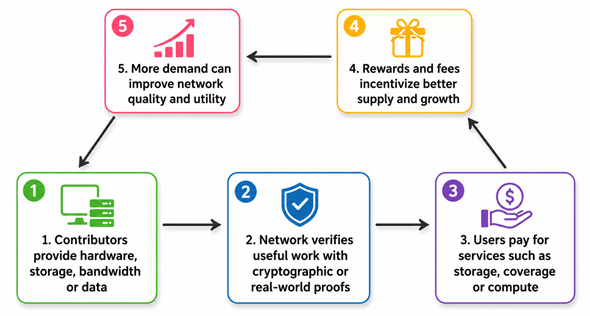
Figure: A simplified DePIN flywheel. Token rewards can help bootstrap supply, but lasting value depends on verified work and real customer demand.
4. Main Parts of a DePIN Network
| Part | What it does | Beginner example |
|---|---|---|
| Contributors | Provide infrastructure, hardware, data, or computing resources. | A hotspot owner, storage provider, GPU operator, or sensor installer. |
| Users or customers | Pay to use the network service. | A developer buying storage, a business using map data, or a customer using wireless coverage. |
| Blockchain layer | Records rewards, payments, rules, ownership, and sometimes governance. | Smart contracts distribute rewards and track network activity. |
| Verification system | Checks whether contributors are doing useful work. | Proof of storage, proof of coverage, uptime checks, bandwidth tests, or location validation. |
| Token or credit model | Coordinates incentives and payments. | Contributors earn tokens; users may pay with tokens, stablecoins, or network credits. |
| Hardware or software clients | Connect real-world resources to the network. | Hotspots, routers, storage nodes, GPU clients, mobile apps, dashcams, or sensors. |
5. Types of DePIN Projects
| Category | What is contributed | What users may buy | Example use cases |
|---|---|---|---|
| Wireless networks | Hotspots, routers, antennas, or mobile coverage devices. | Connectivity, IoT data transfer, mobile coverage, or data credits. | Internet of Things connectivity, community wireless, mobile network offload. |
| Storage networks | Hard drive or server storage capacity. | Decentralized file storage and retrieval. | Data backups, archives, app storage, public datasets. |
| Compute networks | CPU, GPU, or cloud computing resources. | Cloud compute, AI workloads, rendering, app hosting. | AI inference, rendering, scientific computing, developer workloads. |
| Mapping and sensor networks | Location data, road images, weather readings, environmental data. | Data products, maps, analytics, machine perception data. | Road mapping, weather intelligence, traffic insights, environmental monitoring. |
| Energy and mobility networks | Energy devices, EV charging data, batteries, vehicles, or machine data. | Energy coordination, charging access, grid data, mobility services. | Decentralized energy markets, EV charging discovery, machine networks. |
6. Real Examples of DePIN Projects
The DePIN sector includes many experiments. They are practical illustrations of how different DePIN models work.
| Project | Category | What it tries to do | Why it is often discussed |
|---|---|---|---|
| Filecoin | Decentralized storage | Creates a marketplace where storage providers offer capacity and clients pay to store data. | It is one of the best-known decentralized storage networks and uses proofs to verify storage commitments. |
| Helium | Wireless connectivity | Rewards operators who deploy wireless infrastructure such as hotspots and mobile network equipment. | It is a major example of a decentralized wireless model using community-deployed hardware. |
| Render Network | GPU rendering and compute | Connects people who need rendering or GPU work with providers of GPU capacity. | It shows how idle GPU resources can be coordinated for creative and compute workloads. |
| Akash Network | Decentralized cloud compute | Lets providers offer cloud compute capacity through a marketplace model. | It is often used as an example of decentralized cloud infrastructure. |
| Hivemapper | Mapping data | Uses contributors, often drivers with dashcams, to collect map and road imagery data. | It shows how DePIN can create real-world datasets through distributed contributors. |
| GEODNET | Geospatial data | Uses a network of satellite reference stations to provide location data services. | It is an example of DePIN applied to precision location and geospatial infrastructure. |
7. DePIN vs Traditional Infrastructure
| Feature | Traditional infrastructure | DePIN approach |
|---|---|---|
| Ownership | Usually owned by a company, government, or large operator. | Owned or operated by many independent participants. |
| Capital model | Large upfront investment from a central organization. | Crowdsourced supply encouraged by token rewards and market demand. |
| Expansion | Expansion depends on company budgets, permits, and central planning. | Expansion can happen wherever contributors find it profitable and useful. |
| Verification | Controlled internally by the operator. | Often uses open rules, on-chain records, and proof systems. |
| User trust | Users trust the company and its contracts. | Users trust the protocol design, verification system, contributors, and market liquidity. |
| Weakness | Can be expensive, centralized, and slow to expand. | Can suffer from weak demand, gaming, token volatility, and uneven service quality. |
8. Benefits of DePIN
8.1 Faster infrastructure growth
DePIN can make it easier for many small contributors to add capacity. Instead of waiting for one company to build everything, a network can grow through thousands or millions of independent devices.
8.2 Better use of idle resources
Many useful resources sit idle. DePIN can help monetize spare storage, bandwidth, GPU power, sensor data, or physical locations. This may improve efficiency if there is real demand.
8.3 Open participation
In many DePIN models, contributors can join without needing to become employees of a central company. This can make infrastructure markets more open, although practical requirements like hardware, location, capital, and technical skill still matter.
8.4 More resilient networks
A distributed network may avoid some single points of failure. If one provider fails, the network may still operate through other providers. This depends heavily on redundancy, quality controls, and network design.
8.5 New data and service markets
DePIN can create markets for data that is difficult for one company to collect alone, such as road imagery, environmental readings, radio coverage, or machine data.
9. Risks and Limitations of DePIN
9.1 Token rewards may not equal real demand
A DePIN project can look successful because many devices joined to earn tokens. But if few customers pay for the service, rewards may depend mostly on token issuance. That can be unsustainable.
9.2 Hardware costs can be higher than expected
Contributors may need to buy devices, pay electricity bills, maintain internet access, replace equipment, handle taxes, and manage repairs. The payback period can change if token prices fall or rewards decline.
9.3 Verification can be attacked or gamed
If rewards are valuable, some participants may try to fake location, spoof data, run low-quality nodes, or exploit reward rules. Strong verification is essential, but it is difficult when physical-world activity is involved.
9.4 Service quality may be uneven
A centralized company can enforce consistent hardware and support standards. DePIN networks often depend on many independent operators, so coverage, uptime, speed, accuracy, and reliability may vary.
9.5 Regulation can be complex
Wireless networks, mapping, energy, transportation, data collection, and financial tokens can all involve regulation. A project may face local rules about radio spectrum, privacy, securities laws, taxes, consumer protection, or data ownership.
9.6 Token price volatility
Rewards paid in crypto can rise or fall sharply. A contributor who calculates profits using today’s token price may lose money if the token drops, rewards are reduced, or demand does not grow.
10. How DePIN Tokens Are Used
Not every DePIN project uses tokens in the same way. A token may have one or more roles:
- Contributor rewards: paying people who provide useful infrastructure.
- Network payments: letting users pay for services directly or indirectly.
- Staking or collateral: requiring operators to stake tokens to discourage bad behavior.
- Governance: allowing token holders to vote on protocol rules or upgrades.
- Access or credits: converting tokens into non-transferable credits used for network services.
Beginners should be careful here. A token can be necessary for incentives, but the token itself is not proof that the project has real business value. The strongest DePIN projects should have a clear link between useful work, customer demand, and sustainable rewards.
11. How to Evaluate a DePIN Project
11.1 Useful checklist for beginners
- Identify the real service. What infrastructure or data does the network provide?
- Check real demand. Who pays for it, and why would they choose this network over a traditional provider?
- Understand the contributor economics. What hardware, electricity, internet, maintenance, and time are required?
- Study the reward model. Are rewards mostly from token emissions, real fees, or both?
- Review verification. How does the network prove that contributors are providing real, useful work?
- Look for customer traction. Are there paying customers, integrations, developer usage, or public demand metrics?
- Check decentralization. Is the network actually distributed, or does one foundation, company, or small group control key parts?
- Assess regulatory risk. Does the project touch telecom, energy, mapping, privacy, financial products, or protected data?
- Avoid profit assumptions. Do not assume hardware will pay for itself quickly just because old reward numbers looked attractive.
12. Common Mistakes and Misconceptions
| Misconception | Reality |
|---|---|
| DePIN is guaranteed passive income. | Rewards depend on demand, token price, hardware costs, competition, uptime, and protocol rules. |
| More devices always means more value. | Devices are valuable only if they are useful, well-located, reliable, and matched with demand. |
| A high token price means strong infrastructure. | Token markets can be speculative. Check usage, revenue, and service quality. |
| Decentralized means no regulation. | Physical infrastructure often faces real-world rules, permits, spectrum limits, privacy laws, and taxes. |
| Every DePIN project needs expensive hardware. | Some require special devices, while others use existing phones, computers, servers, vehicles, or software clients. |
13. DePIN for Users, Contributors, and Investors
13.1 For users
Ask whether the DePIN service is cheaper, more reliable, more open, or more useful than traditional alternatives. For example, decentralized storage may appeal to developers who want verifiable storage and open infrastructure. Wireless or mapping networks may appeal where centralized alternatives are expensive or incomplete.
13.2 For contributors
Calculate all costs before buying hardware. Include device cost, shipping, setup, electricity, internet, maintenance, downtime, taxes, and token volatility. Also check whether your location or resource type is actually valuable to the network.
13.3 For investors
Do not evaluate a DePIN token only by hype or market cap. Look for real usage, protocol revenue, customer retention, operator economics, strong verification, competitive advantages, and realistic token supply dynamics.
14. Practical Best Practices
- Start by understanding the service before studying the token.
- Do not buy hardware based only on social media reward screenshots.
- Check whether rewards are declining as more contributors join.
- Look for clear documentation explaining verification, rewards, slashing, and fees.
- Use conservative assumptions for token price, uptime, and customer demand.
- Avoid projects that cannot clearly explain who pays for the service.
- Consider privacy and legal issues before contributing location, mapping, wireless, or sensor data.
- Diversify your research sources and avoid treating promotional material as neutral analysis.
15. The Future of DePIN
DePIN is likely to remain an important crypto narrative because it connects blockchain incentives with real-world services. The strongest opportunities may appear where centralized infrastructure is expensive, underbuilt, fragmented, or slow to expand. AI demand for compute, growing data needs, machine networks, mapping, wireless connectivity, and edge infrastructure could all create room for DePIN experiments.
At the same time, many projects will fail or underperform. Building infrastructure is hard. A project must solve not only crypto problems but also hardware distribution, customer acquisition, quality control, regulation, pricing, support, and long-term economics. The winners will likely be networks that provide a service customers genuinely want, not just tokens contributors want to earn.
16. FAQs About DePIN in Crypto
16.1 What does DePIN stand for?
DePIN stands for decentralized physical infrastructure network. It refers to crypto networks that coordinate real-world or machine-based infrastructure through token incentives and verification systems.
16.2 Is DePIN the same as IoT?
No. IoT means Internet of Things, which refers to connected devices. DePIN may use IoT devices, but it also includes storage, computing, wireless, mapping, energy, and other infrastructure networks coordinated with crypto incentives.
16.3 Can beginners earn money from DePIN?
Possibly, but it is not guaranteed. Earnings depend on hardware cost, location, network demand, token price, reward rules, and operating expenses. Beginners should calculate risk carefully before buying equipment.
16.4 Are DePIN projects real businesses?
Some aim to provide real services such as storage, connectivity, compute, or data. But not every project has strong demand. The best test is whether customers pay for the service without relying only on token speculation.
16.5 What are the biggest DePIN risks?
Major risks include weak demand, token volatility, expensive hardware, poor verification, regulatory issues, uneven service quality, security problems, and unsustainable reward models.
16.6 What is the difference between DePIN and cloud computing?
Cloud computing is usually provided by centralized companies. DePIN compute networks try to create open marketplaces where independent providers contribute computing resources and earn rewards.
16.7 Is Filecoin a DePIN project?
Filecoin is commonly discussed as a DePIN example because it coordinates decentralized storage infrastructure and rewards storage providers for verifiable storage services.
16.8 Is Helium a DePIN project?
Helium is commonly discussed as a DePIN example because it uses community-deployed wireless infrastructure and crypto incentives to support network coverage and usage.
16.9 Do DePIN tokens always go up if the network grows?
No. Token price depends on supply, demand, emissions, market conditions, utility, investor sentiment, and broader crypto cycles. Network growth does not automatically guarantee token appreciation.
16.10 What should I check before joining a DePIN network?
Check the real service, customer demand, hardware cost, reward formula, location requirements, verification method, tax treatment, maintenance needs, and regulatory issues in your area.
17. Conclusion
DePIN in crypto is the idea of using blockchain incentives to build, coordinate, and operate infrastructure through many independent contributors. It can include storage, wireless networks, compute, mapping, sensors, energy, and machine data. The promise is powerful: more open participation, better use of idle resources, and infrastructure that can grow from the bottom up.
But DePIN should be evaluated carefully. A project needs real users, reliable verification, sustainable economics, and practical infrastructure quality. Token rewards can help bootstrap a network, but they cannot replace real demand. For beginners, the safest approach is to understand the service first, study the economics second, and treat investment or hardware decisions as high-risk until proven otherwise.
Sources Consulted and Checked
These sources were consulted and checked while preparing this article to support clarity and accuracy.
- Chainlink: Decentralized Physical Infrastructure (DePIN), 2026.
- Filecoin official website: decentralized storage network overview.
- Messari: State of DePIN 2024, published January 2025.
- Frontiers in Blockchain: Decentralized physical infrastructure networks tokenomics, 2026.
- Helium, Render Network, Akash Network, Hivemapper, and GEODNET project documentation and public materials.
Reader Advice
This article is provided for educational and informational purposes only. The project examples are practical illustrations, not personalized legal, financial, tax, technical, or investment advice or recommendations. Crypto assets, DePIN hardware, token rewards, operating costs, privacy obligations, and regulatory requirements can involve significant risks, including financial loss, equipment costs, service failure, security issues, and token-price volatility. Rules, policies, laws, project terms, and statistics may change over time and vary by region, so please verify current information through official project documentation, regulators, and other authoritative sources, and seek qualified professional advice when appropriate before making a decision.