AI Crypto Projects Explained: Meaning, How It Works, Examples, Benefits and Risks
AI crypto projects are blockchain projects that use artificial intelligence, support AI infrastructure, or create markets where people can pay for AI-related services with crypto tokens. Some focus on decentralized machine learning. Others provide GPU computing power, data marketplaces, AI agents, blockchain data indexing, or tools that help developers build AI-powered Web3 applications.
The idea is simple: AI needs models, data, computing power and users. Crypto networks can help coordinate these resources through open marketplaces, token incentives, smart contracts and transparent rules. In theory, this can make AI infrastructure more open and less dependent on a few large technology companies. In practice, the quality of AI crypto projects varies widely. Some are useful infrastructure projects. Others are mostly marketing, hype, or speculative tokens with limited real-world use.
This guide explains AI crypto projects from a beginner’s perspective. It covers what they mean, how they work, common categories, real examples, benefits, risks, mistakes to avoid and practical best practices before using or investing in them.
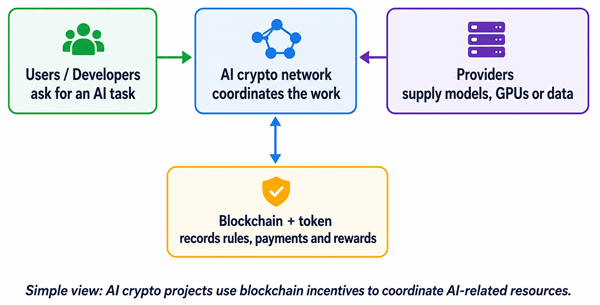
Figure 1: A simple beginner-friendly view of how AI crypto projects coordinate users, providers and token incentives.
1. What Are AI Crypto Projects?
AI crypto projects are blockchain-based projects connected to artificial intelligence. They may use AI inside a crypto product, provide infrastructure for AI systems, or use tokens to reward people who contribute useful AI resources such as models, data, compute power or predictions.
A normal AI company usually owns the platform, servers, data pipelines and pricing. An AI crypto project often tries to make at least one part of that system open, decentralized or community-owned. For example, a network may let GPU owners sell spare computing power to AI developers, or it may reward machine learning model operators when their models produce useful results.
Not every AI crypto project is truly decentralized, and not every AI crypto token has a strong reason to exist. The key question is whether the blockchain and token actually solve a real problem, or whether they are added mainly to attract attention.
| Term | Simple Meaning |
|---|---|
| AI | Software that can perform tasks that normally require human-like intelligence, such as prediction, language generation, image generation, classification or automation. |
| Crypto project | A blockchain-based network, app, protocol or token ecosystem. |
| AI crypto project | A crypto project that uses, supports, coordinates or monetizes AI-related resources. |
| Token | A digital asset used for payments, rewards, governance, staking or access inside a blockchain ecosystem. |
| Decentralized AI | AI systems or infrastructure that are not fully controlled by one central company, although the degree of decentralization can vary. |
2. How AI Crypto Projects Work
Different AI crypto projects work in different ways, but most follow a similar pattern: they connect people who need AI services with people or systems that provide AI resources. The blockchain records rules, payments, reputation, rewards or governance decisions.
- A user or developer needs an AI-related service: This might be model inference, GPU compute, data access, automated trading logic, image generation, blockchain analytics or an AI agent.
- The network matches demand with supply: A marketplace, protocol or app connects the user with model operators, GPU providers, data providers, validators or agents.
- Smart contracts handle rules and payments: Smart contracts can automate payments, staking, rewards, penalties or access rights.
- Tokens create incentives: Tokens may reward useful work, discourage bad behavior, give voting rights or act as the payment asset inside the network.
- Results are delivered to the user: The user receives an AI answer, compute job, indexed data, agent action, prediction, or another output.
- The system measures performance: Some networks use validators, reputation systems, benchmarks, staking or market demand to decide who gets rewarded.
3. Main Types of AI Crypto Projects
AI crypto is not one single category. It includes several different business models and technical designs. Understanding the category is important because the risks and value drivers are different.
| Category | What It Does | Beginner Example |
|---|---|---|
| Decentralized AI model networks | Reward people or teams for running, training or improving AI models. | A network pays model operators when their model gives useful answers. |
| Decentralized GPU and compute networks | Let users rent computing power from distributed providers. | An AI startup rents GPUs from a marketplace instead of a centralized cloud provider. |
| AI agents and automation | Use AI agents that can perform tasks, interact with apps, or automate workflows. | An agent books a service, searches data, or manages a workflow based on user instructions. |
| Data and indexing protocols | Organize, sell or make data available for AI models and Web3 apps. | A developer queries blockchain data without running their own indexer. |
| AI marketplaces | Create marketplaces for models, prompts, datasets, compute or AI services. | A user pays for access to a specialized model or dataset. |
| AI-powered crypto apps | Use AI to improve trading tools, risk analysis, security, gaming, wallets or analytics. | A wallet warns users about a suspicious transaction using AI-assisted risk scoring. |
4. Examples of AI Crypto Projects
| Project | Main Focus | How AI and Crypto Connect | Important Note |
|---|---|---|---|
| Bittensor (TAO) | Decentralized machine learning markets | Bittensor describes itself as a system of decentralized commodity markets, called subnets, coordinated under one token system. | Complex ecosystem; beginners should study subnets, incentives and actual usage before judging value. |
| Render Network (RENDER) | Distributed GPU rendering and compute | Render connects users needing GPU power with providers that contribute idle GPU resources. | Strong fit for rendering and compute, but users should compare cost, reliability and workflow support. |
| Artificial Superintelligence Alliance / Fetch.ai ecosystem (FET/ASI context) | AI agents, decentralized AI and related services | Fetch.ai, SingularityNET and Ocean Protocol announced a merger plan in 2024 to combine AI-focused ecosystems. | Token migrations and alliance changes can be confusing; always check official migration instructions. |
| Akash Network (AKT) | Decentralized cloud compute marketplace | Akash lets users buy and sell computing resources and has been used for GPU and AI workloads. | Compute supply, performance, availability and developer experience matter more than slogans. |
| The Graph (GRT) | Blockchain data indexing | The Graph organizes blockchain data and makes it easier for apps and AI tools to query Web3 information. | Not purely an AI project, but useful data infrastructure for AI-powered Web3 apps. |
| NEAR AI / NEAR ecosystem | User-owned and verifiable AI infrastructure | NEAR has positioned part of its ecosystem around user-owned AI, private inference and agent infrastructure. | Evaluate whether the specific AI product has users, privacy guarantees and developer adoption. |
5. Practical Real-World Scenarios
- A small AI startup needs GPUs: Instead of signing a long cloud contract, it may rent compute from a decentralized marketplace. This can be useful when pricing is competitive and the workload is flexible.
- A developer needs blockchain data for an AI assistant: The assistant may need token transfers, wallet history or DeFi activity. A data indexing protocol can make this information easier to query.
- A creator needs 3D rendering power: A rendering network can distribute rendering jobs across GPU providers, potentially reducing waiting time or cost.
- A team wants specialized AI models: A decentralized model network may let different model providers compete to produce useful outputs for a specific task.
- A user wants a Web3 AI agent: An AI agent may help search on-chain data, interact with apps, prepare transactions or automate routine crypto workflows. The user still needs to approve risky actions carefully.
6. Benefits of AI Crypto Projects
- Open access to AI infrastructure: Crypto networks can create open marketplaces where smaller teams access compute, models or data without relying only on big cloud platforms.
- Better incentives for contributors: Tokens can reward model operators, validators, GPU providers, data contributors or developers when they provide useful work.
- More transparent rules: Smart contracts and public networks can make reward rules, payments and governance easier to inspect, although not every project is equally transparent.
- New funding models: Token networks can help early ecosystems fund infrastructure and coordinate communities, but this also increases speculation risk.
- Composability with Web3 apps: AI services can connect with wallets, smart contracts, DAOs, DeFi apps, games and blockchain data.
- Reduced dependence on one provider: Decentralized infrastructure can reduce single-provider dependence, but only if the network has enough reliable suppliers.
7. Risks and Limitations of AI Crypto Projects
AI crypto is a high-risk area because it combines two fast-moving fields: artificial intelligence and crypto. Beginners should be especially careful with projects that make unrealistic promises, hide technical details or focus more on token price than product usage.
| Risk | What It Means | How to Reduce It |
|---|---|---|
| Hype risk | Some projects use AI language mainly for marketing. | Look for real users, working products, public documentation and measurable demand. |
| Token utility risk | The token may not be necessary for the product to work. | Ask why the token is needed for payments, rewards, staking, security or governance. |
| Technical complexity | AI networks can be difficult to evaluate. | Read beginner documentation, test the product if possible and compare with non-crypto alternatives. |
| Centralization risk | A project may claim decentralization while most control remains with one team or company. | Check token distribution, validator/provider diversity, governance and infrastructure dependence. |
| Security risk | Smart contracts, bridges, wallets and AI agents can be exploited. | Use hardware wallets for larger funds, avoid unknown approvals and prefer audited systems. |
| Data privacy risk | AI systems may process sensitive user data. | Avoid sharing private keys, seed phrases, identity documents or confidential business data. |
| Regulatory risk | Token rules, data rules and AI regulations may change. | Avoid assuming a token is safe just because it is popular. Follow local laws and platform rules. |
| Market risk | AI tokens can be extremely volatile. | Never invest money you cannot afford to lose and avoid leverage as a beginner. |
8. AI Crypto vs Traditional AI Platforms
| Feature | Traditional AI Platform | AI Crypto Project |
|---|---|---|
| Control | Usually controlled by one company or cloud provider. | May be community-governed or marketplace-based, depending on design. |
| Payments | Credit card, invoices or subscription pricing. | Tokens, stablecoins or crypto payments may be used. |
| Infrastructure | Centralized servers and cloud data centers. | May use distributed GPU providers, validators or decentralized storage. |
| Transparency | Limited visibility into internal systems. | Some rules may be visible on-chain, but off-chain AI systems can still be opaque. |
| Ease of use | Often easier for beginners and businesses. | Can be harder because users may need wallets, tokens and technical setup. |
| Risk profile | Platform lock-in, privacy concerns and pricing changes. | Smart contract risk, token volatility, scams and governance risk. |
9. How to Evaluate an AI Crypto Project
A useful AI crypto project should have more than a trendy name. Use the checklist below before spending time or money on one.
- Problem: What real problem does the project solve? Is it AI compute, model access, data, automation, security, or something else?
- Product: Can people use the product today, or is it only a roadmap?
- Users: Who actually uses it: developers, creators, enterprises, traders, researchers, or mostly token speculators?
- Token role: Does the token have a clear job, or is it unnecessary?
- Economics: Where does demand come from? Who pays? Who earns? Are rewards sustainable?
- Decentralization: How many independent providers, validators or contributors are active?
- Security: Are contracts audited? Are bridges involved? Is admin control clearly explained?
- Team and governance: Who builds it? How are decisions made? Are treasury and token allocations transparent?
- Documentation: Are docs clear enough for developers or users to understand the system?
- Competition: Can a normal cloud provider, AI API or database solve the same problem more easily?
10. Red Flags to Watch For
- Promises of guaranteed returns, fixed daily profits or “risk-free” AI trading.
- No working product, no public demo and no meaningful technical documentation.
- Anonymous team with no credible track record, especially when raising funds.
- Heavy focus on token price predictions instead of real usage.
- Fake partnerships, copied whitepapers or unverifiable claims.
- Unclear token supply, hidden unlocks or large insider allocations.
- Pressure to buy quickly before a “secret listing” or “limited AI presale.”
- Bots, fake social engagement or communities that ban basic questions.
- AI agents that ask for seed phrases, private keys or unrestricted wallet approvals.
11. Best Practices for Beginners
- Start with education, not buying: Learn the category first. Understand what compute, inference, agents, data indexing and token incentives mean before investing.
- Use small test amounts: When trying a new crypto app, start with a small amount you can afford to lose.
- Separate wallets: Use a separate wallet for testing new AI crypto apps. Keep long-term holdings in a safer wallet.
- Check official links: Use official websites and documentation. Scammers often create fake token migration pages and fake airdrops.
- Read token unlocks: Large unlocks can create selling pressure. Review supply, emissions and vesting schedules.
- Compare with non-crypto alternatives: If a centralized AI API is cheaper, faster and safer, the crypto project needs a strong reason to exist.
- Protect private data: Do not give AI agents your seed phrase, private keys, exchange login, identity documents or confidential company data.
- Avoid leverage: AI tokens can move sharply. Leverage can wipe out beginners quickly.
- Review permissions: Before approving transactions, check what the app can access. Revoke risky token approvals when no longer needed.
- Think in years, not headlines: Strong infrastructure takes time to build. Avoid chasing every AI narrative pump.
12. Common Misconceptions About AI Crypto
| Misconception | Reality |
|---|---|
| Every AI crypto token uses advanced AI. | Some do, but others only use AI branding. Always check the product. |
| Decentralized AI is automatically better. | Decentralization can help with access and incentives, but performance, security and user experience still matter. |
| A token is valuable because AI is popular. | Narratives can create attention, but long-term value depends on real demand and sustainable economics. |
| AI agents can safely control my wallet. | Agents can make mistakes or be attacked. Users should limit permissions and approve important actions manually. |
| More complex technology means better investment. | Complexity can hide weak economics. Simple questions about users, revenue and utility still matter. |
13. Should Beginners Invest in AI Crypto Projects?
Beginners should treat AI crypto projects as high-risk, speculative assets unless they fully understand the project, token design and market risks. The technology may be promising, but promising technology does not automatically make a good investment.
A safer beginner approach is to first learn the sector, test products without risking meaningful money, compare projects across categories and avoid tokens that depend only on hype. If you do invest, consider position sizing, diversification and a clear reason for buying beyond “AI is the future.”
14. Beginner Checklist Before Using or Buying an AI Crypto Token
- ☐ I can explain what the project does in one sentence.
- ☐ I know whether it is compute, model, data, agent, marketplace or analytics infrastructure.
- ☐ I understand why the token is needed.
- ☐ I have checked the official website, docs and token contract address.
- ☐ I know the main competitors, including non-crypto competitors.
- ☐ I have reviewed major risks, token unlocks and security history.
- ☐ I am not relying on guaranteed-profit claims, influencer hype or anonymous DMs.
- ☐ I am using a safe wallet setup and small test amounts.
- ☐ I can afford to lose the money I put at risk.
15. FAQs About AI Crypto Projects
15.1. What is an AI crypto project?
An AI crypto project is a blockchain-based project that uses artificial intelligence, provides AI infrastructure, or creates a token-based market for AI services such as compute, models, data or automation.
15.2. How do AI crypto projects make money?
Some charge for compute, model access, data queries, transaction fees or marketplace usage. Others rely on token incentives while they build demand. The business model should be clear before you trust the project.
15.3. Are AI crypto projects safe?
They can be useful, but they are not automatically safe. Risks include scams, token volatility, smart contract bugs, privacy issues, weak token design and misleading marketing.
15.4. What is the difference between AI tokens and normal crypto tokens?
AI tokens are connected to AI-related networks or products. The token may be used for payments, staking, rewards, governance or access. However, some tokens use AI branding without meaningful AI utility.
15.5. Can AI crypto replace big AI companies?
It may compete in specific areas such as open compute marketplaces, decentralized model incentives or user-owned data. But large AI companies still have major advantages in funding, talent, hardware and distribution.
15.6. What are examples of AI crypto use cases?
Examples include renting GPUs, rewarding machine learning models, indexing blockchain data for AI tools, running AI agents, creating data marketplaces and using AI to improve wallet security or analytics.
15.7. Is Bittensor an AI crypto project?
Yes. Bittensor is commonly discussed as an AI crypto project because it focuses on decentralized machine learning markets and subnets coordinated through a token system.
15.8. Is Render an AI crypto project?
Render is often included in AI crypto discussions because GPU compute is important for AI workloads, although its original focus is decentralized GPU rendering for creative work.
15.9. What is the biggest mistake beginners make?
The biggest mistake is buying because a token has “AI” in the name without checking product usage, token utility, security, competition and valuation.
15.10. Do I need crypto to use AI?
No. Most people can use AI without crypto. AI crypto is mainly relevant when blockchain incentives, token payments, decentralized infrastructure or Web3 integration add value.
16. Conclusion
AI crypto projects sit at the intersection of two powerful trends: artificial intelligence and blockchain networks. At their best, they can open access to compute, reward useful AI contributors, create transparent marketplaces and connect AI tools with Web3 applications. At their worst, they can be vague tokens built around buzzwords, unrealistic promises and speculation.
For beginners, the best approach is practical and skeptical. Learn what problem the project solves, check whether the product works, understand why the token exists, compare it with traditional AI alternatives and protect your wallet and private data. AI crypto may become an important part of future digital infrastructure, but careful research matters more than hype.
Sources Consulted and Checked
These sources were consulted while preparing this document and checking its accuracy.
- Bittensor official site and documentation - describes Bittensor as internet-scale machine learning and explains subnets and token coordination.
- Render Network official site - describes decentralized GPU rendering and access to distributed GPU power.
- Fetch.ai official blog - announced the Artificial Superintelligence Alliance merger details involving Fetch.ai, SingularityNET and Ocean Protocol in 2024.
- Akash Network official site - describes an open network for buying and selling computing resources.
- The Graph official site - describes an indexing protocol for organizing and serving Web3 data through GraphQL.
- NEAR and NEAR AI official pages - describe user-owned AI, private inference and agent infrastructure.
- CoinMarketCap AI & Big Data category - useful for checking current market categories and rankings, but market data changes quickly.
Reader Advice
This article is provided for educational and informational purposes only and is not personalized financial, investment, legal, tax, technical, or professional advice or a recommendation to buy, sell, or use any token, platform, or service. AI and crypto projects can involve substantial risks, including price volatility, loss of funds, scams, smart-contract failures, privacy or security problems, changing project status, and regulatory uncertainty. Rules, policies, laws, statistics, token details, migration instructions, and market information may change over time and vary by region. Please verify current information through official sources, assess your own circumstances and risk tolerance, use appropriate security precautions, and seek qualified professional advice where necessary before making a decision.