Crypto Restaking Explained: Meaning, How It Works, Examples, Benefits and Risks
Crypto restaking is one of the most important ideas to appear in Ethereum and DeFi in recent years. At its simplest, restaking means using already-staked crypto, usually ETH or liquid staking tokens, to help secure additional blockchain services beyond the original network. In return, restakers may earn extra rewards. The trade-off is that they accept extra risks.
For beginners, restaking can sound confusing because it combines several ideas: proof-of-stake, validators, liquid staking tokens, operators, shared security, AVSs, smart contracts and slashing. This guide explains each part in plain English, with practical examples and honest warnings.
1. What Is Crypto Restaking?
Crypto restaking is the process of taking crypto that is already staked and using it again to provide security for another protocol, application or service. The most common discussion is Ethereum restaking, where ETH stakers or holders of liquid staking tokens can opt into extra security commitments through a restaking platform.
Ethereum.org describes restaking as using already-staked ETH to provide security for additional protocols and services beyond Ethereum's base layer. EigenLayer, one of the best-known restaking protocols, says restaking enables stakers to restake native ETH or liquid staking tokens to provide security for Autonomous Verifiable Services, often called AVSs.
In simple terms: Staking secures one network. Restaking tries to let the same economic security support more than one service.
| Term | Simple meaning |
|---|---|
| Staking | Locking or committing crypto to help secure a proof-of-stake network and earn rewards. |
| Restaking | Using already-staked assets again to secure additional services. |
| Native restaking | Restaking ETH directly from an Ethereum validator setup. |
| Liquid staking token (LST) | A token such as stETH or rETH that represents staked ETH. |
| Liquid restaking token (LRT) | A token that represents a restaked position and can often be used in DeFi. |
| Operator | The entity that runs infrastructure for AVSs using delegated restaked capital. |
| AVS | An Autonomous Verifiable Service that uses restaked security, such as data availability, oracle or validation services. |
| Slashing | A penalty where part of staked or restaked assets may be burned or redistributed for serious failures or misbehavior. |
2. Why Restaking Exists
New crypto networks and infrastructure services need security. Traditionally, each new project had to create its own token, convince validators to join, and build enough economic value to make attacks expensive. This is difficult and can lead to weak security, fragmented validator sets and high bootstrapping costs.
Restaking tries to solve this by letting new services borrow security from already-staked assets. Instead of every project building security from zero, restaking creates a marketplace where stakers, operators and services can connect.
- Stakers want additional rewards on top of normal staking rewards.
- Operators want to run infrastructure and earn fees or rewards.
- New services want access to stronger crypto-economic security.
- Users of those services want more reliable infrastructure.
3. How Crypto Restaking Works
The exact process depends on the restaking protocol, but the basic flow is similar across many systems.
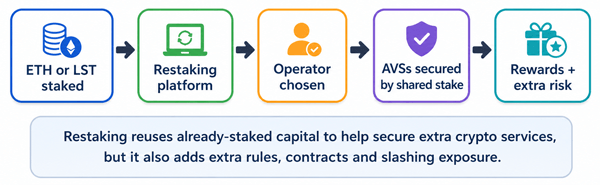
Diagram: A simplified crypto restaking flow from staked assets to AVS rewards and risks.
- A user stakes ETH or holds a liquid staking token. The asset is already connected to Ethereum staking or a staking provider.
- The user opts into a restaking platform. The platform adds an extra layer of smart contracts and rules.
- The user delegates to an operator. The operator runs software for one or more AVSs.
- The operator chooses or is assigned AVS work. Examples can include data availability, oracle services, cross-chain messaging or specialized validation.
- If the work is performed correctly, rewards may be paid to operators and restakers.
- If the operator violates commitments, goes offline, acts maliciously or fails AVS rules, the restaked position may face slashing or other penalties.
4. The Main Types of Restaking
4.1 Native Restaking
Native restaking is usually for users who run Ethereum validators directly. A standard Ethereum validator requires 32 ETH. In native restaking, the validator connects to a restaking system, often by setting withdrawal credentials or using a restaking contract structure. EigenLayer documentation notes that running native restaking infrastructure is advanced and involves validator key management, downtime penalties, slashing risk and possible loss of access if keys are lost or compromised.
- Best suited for advanced users, professional validators and institutions.
- Requires validator infrastructure knowledge.
- May provide more direct control than tokenized routes.
- Can expose the validator to extra protocol commitments.
4.2 Liquid Restaking
Liquid restaking is more accessible for many DeFi users. Instead of running a validator, a user deposits an LST, such as a token representing staked ETH, into a liquid restaking protocol. The user may receive a liquid restaking token, or LRT, that represents the restaked position.
For example, a user might stake ETH through a liquid staking protocol, receive an LST, then deposit that LST into a liquid restaking protocol and receive an LRT. That LRT may be usable in DeFi, but every added layer brings extra smart contract, liquidity and market risk.
4.3 Delegated Restaking
In delegated restaking, the user does not personally run AVS infrastructure. Instead, they delegate restaked assets to an operator. The operator is responsible for performing AVS tasks. The user must trust the operator's competence, security practices and risk choices.
| Type | Who it suits | Main advantage | Main risk |
|---|---|---|---|
| Native restaking | Validator operators and advanced users | More direct control over validator setup | Operational mistakes, validator slashing and complex setup |
| Liquid restaking | DeFi users who want tokenized exposure | Easier access and possible liquidity through LRTs | Smart contract risk, depeg risk and layered protocol exposure |
| Delegated restaking | Users who do not run infrastructure | Convenience and operator specialization | Operator failure, poor AVS selection or unclear slashing exposure |
5. Restaking vs Staking vs Liquid Staking
| Feature | Staking | Liquid staking | Restaking |
|---|---|---|---|
| Main goal | Secure a proof-of-stake network | Stake while keeping a liquid token | Use staked assets to secure extra services |
| Typical asset | ETH or another PoS asset | LST such as stETH or rETH | ETH, LSTs or restaked derivatives |
| Reward source | Base network staking rewards | Staking rewards minus provider fees | Base staking rewards plus possible AVS rewards |
| Liquidity | Often locked or less liquid | Usually liquid through an LST | May be liquid through an LRT, depending on protocol |
| Complexity | Medium | Medium to high | High |
| Risk layers | Validator and network risk | Validator plus smart contract and token liquidity risk | All previous risks plus AVS, operator and extra slashing risk |
6. Practical Example: A Simple Restaking Scenario
Imagine Sara owns ETH and wants to earn staking rewards. She has three broad options:
- She can stake ETH directly by running a validator, which requires technical knowledge and 32 ETH.
- She can use liquid staking and receive a liquid staking token that represents her staked ETH.
- She can restake her native ETH or LST through a restaking platform and delegate to an operator that supports AVSs.
If Sara restakes, she may earn extra rewards from AVSs. But she must also understand the operator's track record, which AVSs the operator supports, what slashing conditions apply, whether withdrawals have delays, and whether her token can lose value if the market becomes stressed.
7. Examples of Crypto Restaking Projects and Use Cases
The best-known example is EigenLayer, an Ethereum restaking protocol that connects restakers, operators and AVSs. The restaking idea has also inspired liquid restaking protocols and restaked-token markets across DeFi.
| Example category | What it does | Beginner takeaway |
|---|---|---|
| EigenLayer-style restaking | Lets ETH or LST holders opt into extra security services through operators and AVSs. | This is the core restaking model most people refer to. |
| Liquid restaking protocols | Issue LRTs that represent restaked positions. | Easier to access, but adds token and protocol complexity. |
| Data availability services | Help blockchains publish and verify transaction data. | Restaking can support infrastructure that other chains or rollups depend on. |
| Oracle or validation services | Provide verified data, computation or cross-chain information. | Restaked security can make dishonest behavior economically costly. |
| Shared security marketplaces | Match stakers and operators with services needing security. | Restaking turns security into a reusable market. |
8. Benefits of Crypto Restaking
8.1 Extra Reward Potential
The most obvious appeal is the possibility of earning additional rewards on top of normal staking rewards. These rewards may come from AVSs, protocol incentives, points programs or tokens. However, expected returns can change quickly and should never be treated as guaranteed income.
8.2 Better Capital Efficiency
Restaking tries to make staked assets more productive. Instead of using capital for only one security role, the same capital can support multiple services. This is similar to renting out the security value of staked assets to more than one customer.
8.3 Easier Security for New Protocols
New infrastructure projects may not need to create a large validator network from scratch. They can use restaked security to launch faster and focus on their service.
8.4 More Innovation in Crypto Infrastructure
Restaking can support data availability layers, oracle systems, sequencing services, bridges, specialized computation and other middleware. This could make it easier to build modular blockchain infrastructure.
9. Risks and Limitations of Crypto Restaking
Restaking is not simply 'free extra yield.' It adds new dependencies and new ways to lose money. Beginners should understand the following risks before participating.
| Risk | What it means | How to reduce it |
|---|---|---|
| Slashing risk | Assets may be penalized if the operator breaks Ethereum or AVS rules. | Use reputable operators, understand AVS rules, avoid overexposure. |
| Smart contract risk | Restaking and LRT contracts may contain bugs or be exploited. | Prefer audited protocols, limit position size, avoid unaudited systems. |
| Operator risk | An operator may go offline, misconfigure software or act maliciously. | Check operator history, diversification and supported AVSs. |
| AVS risk | Each AVS can have different reward and penalty rules. | Review which AVSs your operator supports and what can be slashed. |
| Liquidity risk | LRTs may trade below their expected value during stress. | Avoid relying on instant liquidity; watch withdrawal queues and market depth. |
| DeFi stacking risk | Using LRTs as collateral can create liquidation risk. | Avoid leverage, monitor collateral ratios and depeg scenarios. |
| Centralization risk | Too much stake delegated to a few operators can create systemic risk. | Support diversified operators and avoid blindly following the largest yield. |
| Regulatory and tax uncertainty | Rules around staking, rewards and protocol tokens vary by country. | Keep records and consult a qualified professional where needed. |
10. What Is Slashing in Restaking?
Slashing is one of the most important risks. In Ethereum staking, slashing means a validator loses part of its stake and is forced out of the validator set for serious rule violations. Ethereum.org explains that slashing penalties can grow when many validators are slashed around the same time, because correlation matters.
In restaking, slashing can also be tied to AVS commitments. EigenLayer documentation says AVSs can define penalties for broken commitments by operators, and slashed funds may be burned or redistributed. This means a restaker may face not only Ethereum staking risk, but also extra AVS-level risk.
A key beginner point: If your assets are delegated to an operator, your risk can depend on what that operator does after you delegate. You are not only choosing a protocol; you are also choosing an operator and the operator's AVS exposure.
11. How Restaking Rewards Work
Restaking rewards are not uniform. They depend on the platform, the asset, the operator, the AVSs, the reward tokens, and the market value of those tokens. EigenLayer documentation notes that AVSs can distribute rewards in ERC-20 tokens of their choosing, and reward calculations can depend on stake and submitted reward data.
In practice, a restaker may see different types of reward signals:
- Base staking rewards from ETH or another proof-of-stake asset.
- AVS rewards paid by services that use restaked security.
- Protocol incentives or points, which may or may not become valuable.
- DeFi yield from using LRTs elsewhere, which adds extra risk.
Be careful with advertised APRs. A high displayed yield may be temporary, based on incentives, paid in volatile tokens, or tied to extra risk. Always ask: where does the reward come from, who pays it, and what can go wrong?
12. Best Practices Before Restaking
- Start by understanding normal staking first. Restaking is an advanced layer, not a beginner shortcut.
- Use only money you can afford to expose to smart contract and market risk.
- Read the withdrawal rules, including delays, queues, cooldowns and unstaking steps.
- Research the operator, including uptime, security practices, reputation and AVS selection.
- Check which assets are accepted and what token you receive in return.
- Avoid leverage unless you fully understand liquidation and depeg risk.
- Do not chase the highest APR without checking the risk source.
- Diversify carefully, but do not spread funds across protocols you do not understand.
- Keep wallet hygiene strong: use official links, hardware wallets where appropriate, and beware of phishing.
- Track rewards, transactions and taxable events for your jurisdiction.
13. Common Mistakes Beginners Make
- Thinking restaking is the same as normal staking.
- Assuming extra rewards are guaranteed.
- Ignoring operator risk because the platform looks popular.
- Using LRTs as collateral without understanding liquidation risk.
- Not checking whether an asset can depeg from ETH.
- Confusing points with confirmed token rewards.
- Putting too much capital into a new or unaudited protocol.
- Not understanding withdrawal delays before depositing.
14. Who Might Consider Restaking?
Restaking may be suitable for users who already understand staking, are comfortable with DeFi risks, and can evaluate smart contracts, operators and liquidity conditions. It may be unsuitable for users who need simple, low-maintenance exposure or cannot tolerate the possibility of slashing, token depegs, delayed withdrawals or smart contract losses.
| User type | Restaking suitability |
|---|---|
| Complete beginner | Usually not ideal as a first crypto activity. Learn wallets, ETH, staking and DeFi basics first. |
| Long-term ETH holder | May be worth researching if the user understands added risk and does not need instant liquidity. |
| DeFi yield seeker | Potentially attractive, but dangerous if combined with leverage or complex loops. |
| Validator operator | Relevant, but requires serious infrastructure and risk management. |
| Institution or treasury | Requires legal, custody, operational, slashing and counterparty analysis. |
15. A Simple Due Diligence Checklist
- What asset am I depositing: ETH, LST, LRT or another token?
- What exactly do I receive back?
- Can the received token trade below the value of the underlying asset?
- Who is the operator and what AVSs are they supporting?
- What actions can cause slashing?
- Are rewards paid in ETH, stablecoins, protocol tokens or points?
- How long do withdrawals take?
- Has the protocol been audited, and by whom?
- Is there a bug bounty or insurance mechanism?
- What happens in a market panic or smart contract exploit?
16. Crypto Restaking FAQs
16.1 Is restaking safe?
Restaking is not risk-free. It can add slashing, smart contract, operator, AVS and liquidity risks on top of ordinary staking risks.
16.2 Can I lose money by restaking?
Yes. Losses can come from slashing, token depegs, smart contract bugs, failed operators, market volatility or liquidations if you use LRTs in DeFi.
16.3 Is restaking only for Ethereum?
Ethereum restaking is the most discussed version, especially through EigenLayer-style systems, but the general idea of shared security can appear in other ecosystems.
16.4 What is the difference between LST and LRT?
An LST represents a staked asset, such as staked ETH. An LRT represents a restaked position, often after an LST or ETH is deposited into a restaking protocol.
16.5 What are AVSs?
AVSs are Autonomous Verifiable Services that use restaked security. They can include infrastructure such as data availability, oracle, validation or cross-chain services.
16.6 Why do AVSs pay rewards?
They pay rewards because operators and restakers provide economic security and infrastructure services. The exact reward token and formula depend on the AVS and protocol rules.
16.7 Can restaking increase Ethereum risk?
Some researchers and ecosystem participants worry about centralization, correlated slashing and shared-risk chain reactions. This is why operator diversity and careful risk limits matter.
16.8 Should beginners use liquid restaking tokens?
Beginners should be cautious. LRTs can be convenient, but they add token, liquidity, smart contract and composability risks that are easy to underestimate.
16.9 Is a high restaking APR always better?
No. Higher yield usually means higher risk, temporary incentives, volatile rewards or less mature infrastructure. Compare risk-adjusted returns, not just headline APR.
16.10 What is the safest way to approach restaking?
There is no completely safe way. A more cautious approach is to learn staking first, use small position sizes, avoid leverage, choose reputable operators, and understand withdrawal and slashing rules before depositing.
17. Conclusion
Crypto restaking is a powerful but complex idea. It lets already-staked assets help secure additional services, which can create new rewards and make crypto infrastructure more capital-efficient. At the same time, it adds extra layers of risk: smart contracts, operators, AVSs, slashing rules, liquidity issues and market stress.
For beginners, the most important lesson is simple: restaking is not just staking with a bonus yield. It is a new set of security commitments. Before using it, understand what you are depositing, who controls the infrastructure, how rewards are created, what can be slashed, and how you can exit. A careful, risk-first approach is far better than chasing the highest advertised return.
Sources Consulted and Checked
These sources were consulted and checked while preparing this article to support accuracy and clarity.
- Ethereum.org - Benefits and use of restaking, including definitions, risks and restaking roles.
- Ethereum.org - Proof-of-stake rewards and penalties, including slashing and correlation penalties.
- EigenCloud / EigenLayer documentation - EigenLayer overview, native restaking, slashing, rewards, operators and AVS concepts.
- Chainlink education - Liquid restaking and liquid restaking tokens overview.
- Academic and ecosystem research on liquid staking, restaking and correlated risk, used for risk framing.
Reader Advice
This article is provided for general educational and informational purposes only. It does not constitute personalized financial, investment, legal, tax, or other professional advice or a recommendation to use any protocol, asset, operator, or strategy. Crypto restaking can involve significant risks, including smart contract failures, slashing, operator or AVS errors, token depegs, liquidity constraints, delayed withdrawals, market volatility, loss of funds, and changing tax or regulatory treatment. Rules, policies, laws, protocol terms, reward structures, and statistics can change over time and may vary by country or region. Before making a decision, verify current information through official sources, assess whether the risks are suitable for your circumstances, and seek advice from an appropriately qualified professional where necessary.