GameFi in Crypto Explained: Meaning, How It Works, Examples, Benefits and Risks
1. Introduction: Why GameFi Matters
GameFi is one of the most talked-about ideas in crypto because it connects two large worlds: video games and digital finance. In a normal game, players may spend hundreds of hours earning skins, weapons, cards, characters, land, or rankings. But those items usually stay inside the game company's closed system. GameFi tries to change that by using blockchain technology so some in-game items can be owned, transferred, traded, rented, or used in wider digital economies.
The idea sounds simple: play games and own digital assets. In practice, GameFi is more complicated. Some projects offer fun gameplay with optional crypto features. Others focus too much on token rewards and fail when new players stop coming in. A good GameFi article should therefore explain both sides: the exciting potential and the serious risks.
This guide is written for beginners. It explains what GameFi means, how it works, common examples, how players may earn rewards, how GameFi compares with traditional gaming, and what to check before spending money or time in a blockchain game.
2. What Is GameFi in Crypto?
GameFi is short for “game finance.” It refers to blockchain-based games that include digital ownership, crypto tokens, NFTs, marketplaces, and sometimes decentralized finance features. In many GameFi projects, players can earn or collect digital assets through gameplay, then trade or use those assets inside or outside the game ecosystem.
2.1 A simple definition:
GameFi is a type of blockchain gaming where players can own and sometimes earn crypto-based in-game assets such as tokens, NFTs, characters, cards, land, skins, or equipment.
GameFi is closely related to terms such as Web3 gaming, blockchain gaming, play-to-earn, play-and-earn, NFT games, metaverse gaming, and crypto gaming. These terms overlap, but they are not always exactly the same.
| Term | Meaning | Beginner note |
|---|---|---|
| GameFi | Gaming mixed with crypto-based financial features. | Broad umbrella term. |
| Blockchain gaming | Games that use a blockchain for assets, transactions, identity, or rewards. | Not every blockchain game is fully financialized. |
| Play-to-earn (P2E) | Games where earning crypto is a major attraction. | Often high-risk if rewards depend on constant new demand. |
| Play-and-earn | Games where gameplay comes first and earning is secondary. | More sustainable direction for many newer projects. |
| NFT game | A game that uses NFTs for items such as characters, cards, skins, or land. | NFT ownership does not guarantee profit. |
| Web3 gaming | Games using wallets, tokens, NFTs, decentralized identities, or player-owned economies. | A broader and more modern term. |
3. How GameFi Works
GameFi usually combines several building blocks. A project does not need to use all of them, but most blockchain games include at least a wallet, smart contracts, digital assets, a marketplace, and a reward or progression system.
3.1 Players connect a crypto wallet
A crypto wallet is used to sign transactions, hold tokens, and store NFTs. Some newer games hide the wallet experience behind email login or social login to make onboarding easier. This is useful for beginners, but players still need to understand who controls the wallet and how assets are secured.
3.2 The game creates digital assets
GameFi assets can include characters, trading cards, weapons, land, avatars, crafting materials, tickets, cosmetics, or governance tokens. Some assets are NFTs, meaning each item is unique or individually tracked. Other assets are fungible tokens, meaning each unit is interchangeable like a normal cryptocurrency.
3.3 Smart contracts manage ownership and transactions
Smart contracts are blockchain programs that can record ownership, handle transfers, distribute rewards, or run marketplaces. They reduce the need for a central middleman, but they also introduce smart contract risk. A bug, exploit, or poor design can cause real losses.
3.4 Players earn, buy, sell, rent, or upgrade assets
Depending on the game, players may earn rewards by completing quests, winning battles, collecting resources, crafting items, joining tournaments, staking tokens, selling NFTs, renting assets to other players, or participating in governance. However, rewards are never guaranteed, and token prices can rise or fall quickly.
3.5 The economy needs balance
A GameFi economy works only when the game has real demand, useful sinks, fair rewards, and enjoyable gameplay. If a game prints too many reward tokens and does not create enough reasons to use or spend them, the token price can collapse. This is why many projects are moving away from pure play-to-earn models toward fun-first play-and-earn models.
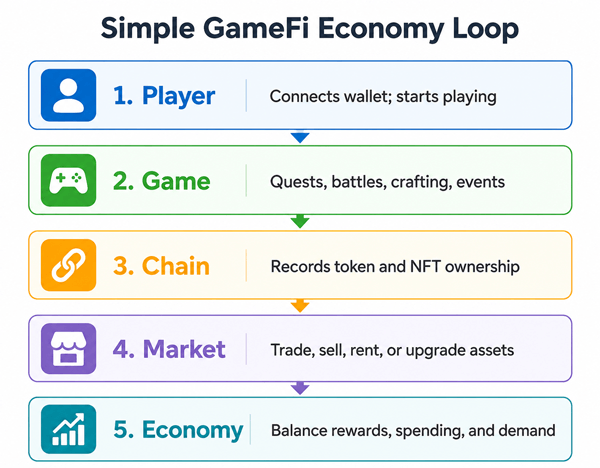
Diagram: Simple GameFi economy loop.
4. Common GameFi Assets and Tokens
| Asset type | Example use | Main risk |
|---|---|---|
| Governance token | Voting, staking, ecosystem incentives, premium features. | Price volatility and weak governance participation. |
| Reward token | Earned through gameplay, quests, battles, or achievements. | Inflation if too many tokens are created. |
| NFT characters | Playable heroes, creatures, avatars, or teams. | High entry cost, changing game rules, falling demand. |
| NFT items | Weapons, skins, cards, land, vehicles, or equipment. | Illiquid markets and uncertain long-term value. |
| In-game resources | Crafting materials, energy, fuel, or upgrades. | Can become worthless if the game loses players. |
| Land or virtual property | Building, renting, events, resource production. | Speculative pricing and low actual utility. |
5. GameFi Examples: Real-World Projects Beginners Should Know
Examples help show how GameFi can look in practice.
| Project | What it is | GameFi feature | Beginner takeaway |
|---|---|---|---|
| Axie Infinity | A blockchain game centered on collectible creatures called Axies. | Players can collect, battle, breed, and use tokenized assets. | It made play-to-earn famous, but also showed how fragile token economies can be. |
| Gods Unchained | A trading card game with blockchain-based card ownership. | Players can collect and trade digital cards. | A familiar genre where NFT ownership is easier to understand. |
| The Sandbox | A virtual world/metaverse platform with user-created experiences. | LAND and assets can be owned, created, and traded. | Shows GameFi mixed with creator economies and virtual land. |
| Illuvium | A blockchain-based fantasy game ecosystem focused on collectible creatures and auto-battler/RPG-style gameplay. | Uses NFTs and token economics around in-game assets. | Represents the push toward higher-quality Web3 gaming experiences. |
| Immutable ecosystem | A gaming-focused Web3 infrastructure and marketplace ecosystem. | Supports games, NFTs, wallets, and gaming asset trading. | Many GameFi projects now rely on specialized gaming infrastructure instead of general-purpose chains alone. |
6. Play-to-Earn vs Play-and-Earn
Early GameFi was often marketed as play-to-earn. The idea attracted attention because players could earn tokens from gameplay. But many early models were too dependent on constant growth. When new demand slowed, reward tokens lost value and players left.
The newer play-and-earn idea is more balanced. The game should be enjoyable even if rewards are small or token prices fall. Earning becomes an optional benefit, not the only reason to play.
| Feature | Play-to-earn | Play-and-earn |
|---|---|---|
| Main appeal | Earning tokens or NFTs. | Fun gameplay first, rewards second. |
| Player motivation | Often financial. | Entertainment, community, progression, ownership. |
| Sustainability | Can fail if rewards exceed real demand. | More likely to survive if the game is genuinely fun. |
| Entry barrier | May require buying NFTs or tokens. | May offer free-to-play or low-cost onboarding. |
| Best question to ask | Where does the yield come from? | Would people play this even without rewards? |
7. How Players May Earn in GameFi
GameFi rewards vary from one project to another. A beginner should understand that “earn” does not mean guaranteed income. It usually means the game has assets that may have market value if other players want them.
- Gameplay rewards: Tokens or items for quests, wins, achievements, ranking, or participation.
- NFT trading: Buying, selling, or crafting characters, cards, skins, land, or equipment.
- Tournaments: Prize pools for skilled players or teams.
- Asset renting: Lending valuable characters, land, or items to other players for a fee.
- Staking or governance: Locking tokens or voting in ecosystem decisions, where supported.
- Creator income: Building worlds, maps, items, or experiences that other players use or buy.
The practical question is not only “Can I earn?” but “Who is paying, why are they paying, and can that demand last?” If rewards mainly come from new users buying in, the model can become unstable.
8. Benefits of GameFi
GameFi can be useful when it improves the gaming experience rather than simply adding speculation. The strongest benefits are digital ownership, open markets, creator opportunities, and better portability of assets.
8.1 Real digital ownership
In traditional games, players usually have access to items inside an account, but they do not truly control those items outside the game. In GameFi, some assets can be held in a wallet and transferred according to blockchain rules. This gives players more control, although the asset still depends on the game remaining useful and active.
8.2 Open trading and marketplaces
GameFi assets can often be traded on marketplaces. This can make buying and selling more transparent than private peer-to-peer trades. It also allows players to exit an asset position if there is enough market demand.
8.3 New revenue models for players and creators
Players, streamers, guilds, modders, artists, and world builders may earn from assets, tournaments, rentals, or user-generated content. This can create a wider creator economy around games.
8.4 Community ownership and governance
Some GameFi projects use governance tokens so communities can vote on proposals or ecosystem decisions. This can give players a stronger voice, though many governance systems are still dominated by large token holders or inactive voters.
8.5 Interoperability potential
In theory, blockchain assets can be used across multiple games or apps. In practice, this is difficult because games have different engines, art styles, balance rules, and business incentives. Interoperability is a long-term possibility, not something beginners should assume.
9. Risks and Limitations of GameFi
GameFi is not just gaming. It also involves crypto markets, smart contracts, token economics, wallets, and sometimes financial speculation. Beginners should treat it with more caution than a normal video game purchase.
| Risk | What it means | How to reduce the risk |
|---|---|---|
| Token volatility | Game tokens can lose value quickly. | Do not rely on rewards as income; avoid spending money you cannot afford to lose. |
| Unsustainable rewards | A game may pay early users using demand from new users. | Check whether people play for fun, not only for yield. |
| Smart contract bugs | Code flaws can lead to hacks or lost assets. | Look for audits, bug bounties, and a strong security history. |
| Wallet scams | Fake links, phishing, malicious approvals, and fake airdrops can drain wallets. | Use official links, hardware wallets for valuable assets, and revoke risky approvals. |
| Low liquidity | You may not find buyers for NFTs or tokens. | Check actual trading volume, not just listed prices. |
| Game shutdown risk | If the developer abandons the game, assets may lose utility. | Research the team, funding, roadmap, updates, and community activity. |
| Regulatory and tax risk | Crypto rewards may have legal or tax consequences. | Keep records and consult local guidance where necessary. |
| Pay-to-win design | Wealthy players may gain unfair advantages. | Prefer games with balanced competitive design. |
10. GameFi vs Traditional Gaming
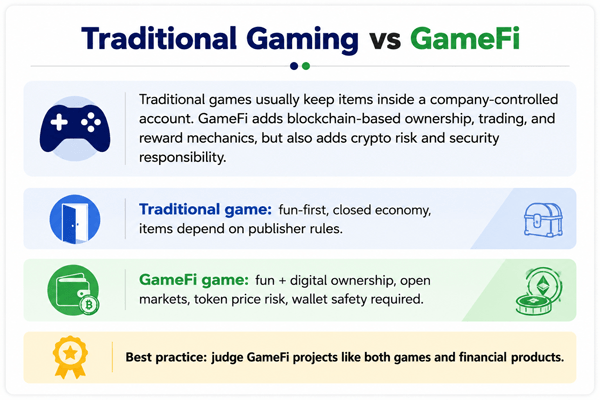
Traditional Gaming vs GameFi
| Area | Traditional gaming | GameFi |
|---|---|---|
| Ownership | Items are usually tied to a publisher-controlled account. | Some assets may be wallet-owned tokens or NFTs. |
| Trading | Often limited, restricted, or against terms of service. | Often supported through marketplaces. |
| Revenue for players | Mostly streaming, esports, coaching, or gray markets. | Gameplay rewards, asset trading, tournaments, rentals, or creator tools. |
| User experience | Simple login and payment experience. | May require wallets, gas fees, bridges, and security habits. |
| Risk level | Main risk is spending money/time on entertainment. | Adds financial, technical, and market risks. |
| Game balance | Controlled by developer. | Still controlled by developer in most cases, but token holders may have input. |
11. What Makes a Good GameFi Project?
A strong GameFi project should be evaluated like a game and like a digital economy. Many weak projects look attractive because they promise rewards, but they do not have enjoyable gameplay or sustainable demand.
- Fun gameplay: Would players stay if rewards were low?
- Clear asset utility: Do tokens and NFTs do something useful inside the game?
- Balanced economy: Are there enough token sinks, upgrades, fees, crafting systems, or reasons to spend?
- Low onboarding friction: Can beginners start without risking a large amount of money?
- Transparent team and roadmap: Are updates regular, specific, and realistic?
- Security practices: Are smart contracts audited? Are wallet permissions safe?
- Active community: Are real players discussing gameplay, not only token price?
- Healthy marketplace activity: Is there real volume, or are assets only listed with no buyers?
12. How to Research a GameFi Project Before Playing or Investing
- Play or watch the gameplay first. If the game is not enjoyable, the token may not have lasting demand.
- Read the whitepaper or documentation, especially the tokenomics, reward schedule, asset supply, and utility.
- Check whether the game is free-to-play, pay-to-start, or requires buying NFTs.
- Look at real player activity, not only social media hype.
- Check token supply, unlock schedules, inflation, staking rewards, and team allocations.
- Review marketplace volume and floor prices, but remember that listed prices are not the same as actual sales.
- Look for security audits, bug bounty programs, and past exploit history.
- Join the community and see whether people talk about gameplay, updates, and strategy or only price speculation.
- Start small. Treat your first purchase as tuition, not as an investment plan.
- Use a separate wallet for gaming so one mistake does not expose your main crypto holdings.
13. Common Beginner Mistakes in GameFi
- Buying expensive NFTs before understanding the game economy.
- Assuming token rewards are guaranteed income.
- Following influencers without checking tokenomics or gameplay.
- Ignoring gas fees, bridge fees, marketplace fees, and taxes.
- Using the same wallet for risky games and long-term holdings.
- Connecting wallets to fake websites or signing approvals without reading them.
- Confusing a high NFT floor price with real liquidity.
- Believing “limited supply” automatically creates value.
- Playing only for earnings instead of evaluating whether the game can attract real players.
14. Best Practices for Beginners
- Start with free or low-cost games: Learn the mechanics before buying assets.
- Use a separate gaming wallet: Keep your main holdings away from experimental dapps.
- Verify official links: Use project websites and official social channels, not random ads or DMs.
- Limit approvals: Avoid unlimited token approvals when possible and revoke old permissions.
- Track costs and rewards: Include purchase price, fees, time spent, and token price changes.
- Do not treat gameplay as salary: Rewards can fall quickly and may become illiquid.
- Prefer fun-first projects: A real game has a better chance than a token farm with graphics.
- Watch for economy changes: Developers can change rewards, breeding costs, crafting rules, or item utility.
15. The Future of GameFi
The future of GameFi is likely to be less about simple “earn money by clicking” games and more about invisible blockchain features inside better games. Many players do not want complicated wallets, high gas fees, or financial pressure. They want fun, ownership, fair markets, and safe user experiences.
Important trends include account abstraction, gasless transactions, mobile-friendly wallets, gaming-focused blockchains, better marketplaces, player identity systems, AI-assisted game creation, user-generated content, esports-style tournaments, and more careful token design. The strongest projects will probably be those where crypto improves the experience without making the whole game feel like a financial job.
16. Final Thoughts
GameFi in crypto is the combination of gaming, blockchain ownership, digital assets, and token-based economies. Its promise is powerful: players can own items, trade assets, join open economies, and possibly earn from their time and skill. But the risks are just as real. Token prices can crash, NFTs can become illiquid, smart contracts can be hacked, and weak games can disappear.
For beginners, the best approach is simple: judge the game first, then judge the economy. A GameFi project should be fun, secure, understandable, and economically realistic. If the only reason to play is the promise of profit, be careful. Sustainable GameFi needs real players, real entertainment value, and responsible economic design.
17. FAQs About GameFi in Crypto
17.1 What does GameFi mean in crypto?
GameFi means game finance. It describes blockchain games that use crypto tokens, NFTs, marketplaces, or financial incentives as part of the gaming experience.
17.2 Is GameFi the same as play-to-earn?
Not exactly. Play-to-earn is one type of GameFi where earning rewards is a major focus. GameFi is broader and can include play-and-earn, NFT ownership, creator economies, metaverse games, and blockchain-based trading.
17.3 Can you really make money with GameFi?
Some players may earn tokens, NFTs, tournament prizes, or trading profits, but earnings are not guaranteed. Token prices can fall, assets may be hard to sell, and time spent may not be worth the reward.
17.4 Do I need a crypto wallet to play GameFi games?
Often yes, although some newer games offer email or social login with embedded wallets. If real tokens or NFTs are involved, you should still learn wallet security basics.
17.5 Are GameFi NFTs valuable?
They can be valuable if they have real utility, demand, rarity, and active buyers. But many NFTs become illiquid or lose value when game interest declines.
17.6 What is the biggest risk in GameFi?
The biggest risk is assuming that game rewards are stable income. Other major risks include token inflation, weak gameplay, hacks, scams, regulatory uncertainty, and low liquidity.
17.7 What is a good GameFi project for beginners?
A beginner-friendly project should have low entry cost, clear instructions, active development, real gameplay, strong security practices, and a community focused on the game rather than only token price.
17.8 Is GameFi gambling?
Not all GameFi is gambling. However, some projects include speculative trading, random rewards, loot-box-like mechanics, or high-risk token incentives. Players should understand the rules and local regulations.
17.9 What is the difference between GameFi and metaverse gaming?
GameFi focuses on game economies and financial features. Metaverse gaming focuses on virtual worlds, avatars, land, and social experiences. Some projects combine both.
17.10 Should I invest in GameFi tokens?
GameFi tokens are highly speculative and may not be suitable for every person. Before committing money, assess the game, token utility, supply and unlocks, security, liquidity, local rules, and your ability to bear a complete loss; consider qualified professional advice when appropriate.
Sources Consulted and Checked
These sources were consulted and checked while preparing this document and supporting its accuracy.
- Binance Academy, “What Is GameFi and How Does It Work?” Updated May 28, 2026.
- CoinGecko, “Top Gaming (GameFi) Coins by Market Cap,” accessed June 24, 2026.
- DappRadar, “State of Blockchain Gaming Q3 2025,” published October 16, 2025.
- Axie Infinity official website, project description and gameplay overview.
- Gods Unchained official website, trading card game and card ownership overview.
- CoinTracker Learn, “What is GameFi? How it works, examples, and challenges.”
Reader Advice
This article is for educational and informational purposes only. It is not personalized financial, investment, legal, tax, regulatory, or security advice, and it does not recommend any GameFi project, token, NFT, platform, or transaction. GameFi changes quickly, while rules, laws, tax treatment, project features, player activity, token prices, market conditions, and statistics may change over time and vary by region. Verify current information through official sources and seek qualified professional advice when appropriate. Risks include price volatility, scams, wallet compromise, smart-contract failures, low liquidity, changing game economies, project shutdowns, and loss of money, time, or digital assets. Research carefully, use secure wallet practices, and never commit funds or time you cannot afford to lose.