How to Survive a Bear Market Without Panic Selling
1. Introduction: The Real Test Is Not the Market Drop - It Is Your Reaction
A bear market can feel personal. Your portfolio falls, financial news becomes dramatic, and every red day makes you wonder whether you should sell before things get worse. For a beginner, this is often the first moment when investing stops feeling like a simple app balance and starts feeling like a real emotional test.
The most important thing to understand is this: a bear market is not unusual, and panic selling is rarely a strategy. It is usually an emotional reaction to uncertainty. The goal is not to pretend losses do not hurt. The goal is to build a clear plan before fear takes over, so you know what to do, what not to do, and when to ask for help.
This guide explains what a bear market is, how it works, why people panic sell, and how beginners can survive one with practical steps. It is written in plain English, with examples, checklists, and tables you can use immediately.
1.1 Quick Answer: What Should You Do in a Bear Market?
| Situation | Better action | Why it helps |
|---|---|---|
| Your portfolio is down 20% or more | Pause, review your plan, and avoid same-day emotional decisions. | Selling after a large decline can lock in losses and make it harder to benefit from a recovery. |
| You need money within 1-3 years | Move required cash needs into safer short-term assets. | Money needed soon should not depend on stock market recovery timing. |
| You are investing for retirement or a 10+ year goal | Keep contributing if your emergency fund and income are stable. | Regular investing can buy more shares when prices are lower. |
| You cannot sleep because of losses | Recheck your risk level and consider speaking with a qualified financial advisor. | A portfolio you cannot emotionally hold is too aggressive, even if it looks good on paper. |
2. What Is a Bear Market?
A bear market is commonly described as a decline of 20% or more from a recent market high. It can happen in a broad stock index, a sector, a country market, or even a single asset class. For example, if a stock index falls from 5,000 to 4,000, that is a 20% drop.
A bear market is different from normal volatility. A 5% pullback may happen quickly and often. A 10% correction can feel uncomfortable but is still smaller than a bear market. A bear market usually brings deeper fear, negative headlines, falling investor confidence, and more pressure to sell.
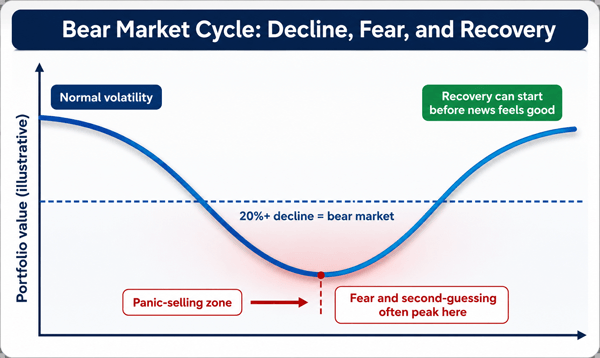
Figure 1. An illustrative bear market cycle showing why panic often peaks near the worst emotional point, not necessarily at the best investment decision point.
| Market move | Common name | What it feels like | Beginner mistake to avoid |
|---|---|---|---|
| Down 5%-9% | Pullback | Annoying but normal | Checking prices every hour |
| Down 10%-19% | Correction | Uncomfortable and headline-heavy | Assuming every correction becomes a crash |
| Down 20%+ | Bear market | Fearful, confusing, exhausting | Selling everything without a plan |
| Down 30%-50%+ | Severe bear market/crash | High stress and uncertainty | Abandoning long-term goals permanently |
2.1 How a Bear Market Works in Real Life
Bear markets usually start when expectations change. Investors may become worried about recession, inflation, interest rates, corporate profits, banking stress, war, valuations, or a major financial shock. Prices fall because buyers demand a larger discount before taking risk.
The hard part is that markets do not wait for perfect clarity. Stocks often fall before the economy looks terrible, and they can begin recovering before the news feels safe. This is why trying to sell now and buy back later is difficult: you must be right twice, first on when to exit and then on when to re-enter.
For beginners, the most practical lesson is simple: a bear market is not a single event. It is a process. It includes the fall, the emotional bottom, the false recoveries, the real recovery, and the long period when patient investors look back and realize that their behavior mattered as much as the market itself.
3. Why People Panic Sell
Panic selling happens when fear becomes stronger than the investment plan. It often starts with a reasonable thought: “I do not want to lose more money.” But it can turn into a harmful decision when the investor sells quality long-term assets only because prices are falling.
Many investors are not actually reacting to math. They are reacting to uncertainty, social pressure, scary news, and the pain of seeing losses in real time. Losses usually feel more intense than gains of the same size. That is why a portfolio falling from $10,000 to $8,000 can feel more powerful than the happiness of it rising from $8,000 to $10,000.
| Trigger | What you may feel | Calmer response |
|---|---|---|
| News says recession risk is rising | “This will never recover.” | Ask: has my time horizon changed, or only the headlines? |
| Friends are selling | “Maybe they know something.” | Ask: do they have my goals, income, risk tolerance, and tax situation? |
| Portfolio app shows a large loss | “I need to stop the bleeding.” | Ask: am I selling a bad investment or just reacting to price movement? |
| Cash feels safer | “I will get back in later.” | Ask: what exact rule will tell me when to buy back? |
4. The Bear Market Survival Plan for Beginners
4.1 Step 1: Separate Emergency Money from Investment Money
Before thinking about buying the dip, make sure your basic financial foundation is safe. Keep an emergency fund for job loss, medical needs, rent, family responsibilities, or business slowdowns. If you may need the money soon, it should not be exposed to stock market risk. A bear market becomes much less scary when your next six months of life do not depend on selling investments at a bad time.
4.2 Step 2: Write Down Your Time Horizon
Your response should depend on when you need the money. A 25-year-old investing for retirement has a very different situation from someone who needs a house deposit next year. Long-term money can usually tolerate volatility. Short-term money needs stability. Do not use one strategy for every goal.
4.3 Step 3: Check What You Actually Own
Many beginners think they are diversified because they own many stocks or funds. But if most of them are technology stocks, crypto-related assets, high-growth funds, or one country market, the portfolio may still be highly concentrated. During a bear market, concentration becomes obvious.
4.4 Step 4: Decide Before You Act
Use a 24-hour rule for major decisions. If you want to sell because you feel fear, wait one day, write the reason, and check whether it is based on your goals or on today’s headlines. This one habit can prevent the most expensive mistakes.
4.5 Step 5: Rebalance Instead of Panic Selling
Rebalancing means bringing your portfolio back to its target mix. If stocks fell and bonds or cash became a bigger percentage, rebalancing may involve buying some stocks at lower prices. This is disciplined, rule-based behavior, not emotional trading.
4.6 Step 6: Keep Investing Only If Your Foundation Is Strong
Dollar-cost averaging means investing a fixed amount regularly, such as monthly. In a bear market, the same amount buys more shares when prices are lower. This can help long-term investors, but it should not come before rent, emergency savings, debt control, and job stability.
5. Practical Examples
5.1 Example 1: The Beginner Who Sells at the Bottom
Sara invests $10,000 in a broad stock market index fund. A bear market hits and her balance falls to $7,500. She sells everything because she wants to protect what is left. Six months later, the market begins to recover, but she is too nervous to re-enter. By the time she feels safe, prices are much higher. Her real mistake was not feeling afraid. Her mistake was having no rule for selling and no rule for buying back.
5.2 Example 2: The Beginner Who Uses a Plan
Ali also invests $10,000 for a retirement goal more than 20 years away. Before the bear market, he already decided that this money is long-term. He keeps his emergency fund in cash, continues monthly contributions, and rebalances once per year. His portfolio still falls, and he still feels stress, but his decisions are guided by a written plan instead of fear.
6. Panic Selling vs. Disciplined Risk Management
| Question | Panic selling | Disciplined risk management |
|---|---|---|
| Main driver | Fear and urgency | Goals, time horizon, and rules |
| Timing | Usually after large losses | Planned before or during review periods |
| What gets sold | Often everything | Only assets that no longer fit the plan |
| Buying back | No clear rule | Re-entry or allocation rules are written in advance |
| Long-term effect | Can lock in losses and create regret | Can reduce risk while preserving the long-term strategy |
7. What Every Beginner Should Know Before the Next Bear Market
7.1 A Falling Price Is Not Automatically a Broken Investment
A broad index fund can fall because the whole market is fearful, not because every company inside it is permanently damaged. A single speculative stock is different. Beginners should learn the difference between market-wide volatility and permanent business risk.
7.2 Cash Feels Safe, but It Has Hidden Risks
Cash can protect short-term needs, but too much cash for too long can lose purchasing power to inflation and can miss market recoveries. The question is not “stocks or cash?” The better question is “how much cash do I need for safety, and how much can stay invested for long-term growth?”
7.3 Diversification Does Not Prevent Losses, but It Can Prevent Disaster
A diversified portfolio can still fall in a bear market. The purpose is not to avoid every loss. The purpose is to avoid depending on one company, one sector, one country, or one idea.
7.4 Low Fees Matter More During Difficult Periods
When returns are weak, high fees hurt more. Beginners should understand expense ratios, fund fees, advisory fees, and trading costs. Low-cost index funds and ETFs are common tools for long-term investors, but suitability depends on the person’s goals and risk tolerance.
7.5 A Financial Advisor Can Help, but Only If Incentives Are Clear
Some investors benefit from a qualified fiduciary advisor, especially when retirement planning, tax planning, estate planning, or large life decisions are involved. Always ask how the advisor is paid, what licenses they hold, and whether they are required to act in your best interest.
8. Bear Market Action Checklist
- Confirm your emergency fund is separate from your investment account.
- List each investment and write why you own it.
- Label each goal as short-term, medium-term, or long-term.
- Stop checking portfolio prices multiple times per day.
- Avoid borrowing money to invest unless you fully understand the risk.
- Do not sell simply because a headline says markets may fall further.
- Rebalance using written rules, not emotions.
- Continue retirement contributions only if your income and cash reserve are stable.
- Review tax consequences before selling in taxable accounts.
- Consider professional advice if you are near retirement, heavily concentrated, or emotionally overwhelmed.
9. Simple Portfolio Defense Tools
| Tool | Best for | Benefit | Main caution |
|---|---|---|---|
| Emergency fund | Everyone | Prevents forced selling | Too little cash creates stress; too much cash may drag growth |
| Diversification | Long-term investors | Reduces dependence on one asset | Does not eliminate losses |
| Dollar-cost averaging | Regular income earners | Creates a habit and buys more when prices are lower | Does not guarantee profit |
| Rebalancing | Goal-based portfolios | Turns a plan into action | Can feel uncomfortable because it may require buying what recently fell |
| Target-date or balanced funds | Hands-off beginners | Built-in allocation and rebalancing | Still carries market risk and may not fit every person |
| Qualified financial advisor | Complex situations | Adds planning, tax, and behavioral support | Fees and conflicts must be understood |
10. Common Bear Market Mistakes to Avoid
10.1 Mistake 1: Selling Because the Market Is Down
A lower price alone is not a complete reason to sell. A better reason is that the investment no longer fits your goals, your risk tolerance, or your financial situation.
10.2 Mistake 2: Waiting for the Perfect Bottom
Nobody rings a bell at the bottom. If your plan is to invest for decades, waiting for a perfect entry can become another form of fear.
10.3 Mistake 3: Going All In Too Fast
Buying lower prices can be smart, but using all your cash at once can create regret if the market falls further. A staged approach may be easier to follow emotionally.
10.4 Mistake 4: Confusing Entertainment with Research
Market predictions, social media charts, and dramatic videos can feel useful but often increase anxiety. Good research connects the investment to valuation, quality, risk, fees, and your goal.
10.5 Mistake 5: Ignoring Taxes and Account Type
Selling in a taxable account may create tax consequences. Selling in a retirement account may affect long-term compounding. Decisions should consider account type, not only market direction.
11. FAQs
11.1 Should I Stop Investing During a Bear Market?
Not automatically. If your emergency fund is solid, your income is stable, and your goal is long-term, continuing regular contributions can be reasonable. If you need cash soon or your job is at risk, strengthening liquidity may be more important.
11.2 Is a Bear Market a Good Time to Buy?
It can be, but only with a plan. Lower prices may improve future return potential for quality assets, but prices can fall further. Beginners should avoid emotional “all in” decisions and use a disciplined schedule or rebalancing rule.
11.3 What If This Time Is Different?
Every bear market has different causes, but investor behavior often repeats: fear rises, selling pressure increases, and many people abandon their plans. The right question is not whether the situation is different. The right question is whether your plan is strong enough for uncertainty.
11.4 Should I Move Everything to Bonds or Cash?
Only if your goals, time horizon, or risk capacity truly changed. Moving everything after a decline may reduce future volatility but can also make it hard to recover. A more balanced adjustment is usually better than an emotional all-or-nothing move.
11.5 How Do I Know If My Portfolio Is Too Risky?
If normal market losses make you want to sell everything, your portfolio may be too aggressive. Risk tolerance is not what you say during a bull market; it is what you can actually hold during a bear market.
12. Conclusion: The Best Bear Market Strategy Is Prepared Calm
You do not survive a bear market by predicting every move. You survive it by building a plan that is stronger than your fear. That plan starts with emergency cash, realistic risk, diversification, low costs, a long-term mindset, and rules for rebalancing or continuing contributions.
Panic selling feels protective in the moment, but it can turn a temporary decline into a permanent loss. A calm investor does not ignore risk. A calm investor manages risk with structure. The next bear market will test prices, headlines, and patience. Your advantage is having a plan before the fear arrives.
13. Sources Consulted and Checked
The following sources were consulted while preparing this article and checking its general accuracy:
- Investor.gov - U.S. Securities and Exchange Commission investor education resources
- FINRA investor education resources
- Morgan Stanley - investor education on common mistakes in volatile markets
- J.P. Morgan Asset Management - Guide to the Markets
- Vanguard investor principles on goals, balance, costs, and discipline
- NIH/PubMed Central research on overconfidence, financial literacy, and panic selling
14. Reader Advice
This article is provided solely for educational and informational purposes. It is not personal financial, investment, tax, legal, accounting, or retirement-planning advice, and it does not recommend any particular security, fund, strategy, or course of action. Investing involves risk, including the possible loss of principal, and past performance does not guarantee future results.
Before making any financial decision, consider your own goals, time horizon, income stability, liquidity needs, risk tolerance, tax position, and other personal circumstances. Rules, regulations, tax treatment, market conditions, product features, fees, and professional standards may change over time and may differ by country, state, account type, institution, and individual situation. Readers should verify important facts, figures, legal requirements, and current guidance through official regulators, tax authorities, financial institutions, and other authoritative sources.
Consider consulting an appropriately qualified and, where applicable, licensed financial advisor, tax professional, or legal professional before making major decisions. No outcome, return, protection from loss, or market recovery is guaranteed.