How Interest Rates Affect Stocks and the Economy
1. Quick answer: why interest rates matter
Interest rates are the price of money. When money becomes more expensive to borrow, people usually borrow less, companies invest more carefully, and investors become pickier about what they are willing to pay for stocks. When money becomes cheaper, borrowing becomes easier, spending can rise, and stock prices often get support - but only if the economy is not already in serious trouble.
For beginners, the key point is simple: interest rates do not move stocks in a straight line every day, but they strongly influence the environment in which stocks, bonds, housing, banks, consumers, and businesses operate. A rate hike can pressure expensive growth stocks, weak balance sheets, and highly indebted consumers. A rate cut can help borrowers and some stocks, but it may also signal that the economy is slowing.
2. What is an interest rate?
An interest rate is the cost of borrowing money or the reward for lending or saving money. If you borrow $1,000 at 10% annual interest, the lender expects to be paid for letting you use that money. If you deposit money in a savings account, the bank may pay you interest because it can use those deposits to make loans or buy safe assets.
In real life, there are many interest rates: credit card APRs, mortgage rates, auto loan rates, business loan rates, Treasury yields, corporate bond yields, savings account APYs, and central bank policy rates. They do not all move by the exact same amount at the exact same time, but they are connected. The Federal Reserve explains that interest rates influence borrowing costs and spending decisions for households and businesses. Lower rates often encourage borrowing for homes, cars, improvements, and business expansion, while higher rates can restrain borrowing and help prevent economic excesses.
3. The simple chain: from central bank rate to your wallet
Central banks, such as the Federal Reserve in the United States, set monetary policy to influence short-term interest rates and broader financial conditions. The Fed describes its goal as moving the economy toward maximum employment and stable prices. In plain English, it tries to keep jobs healthy without letting inflation get out of control.
The central bank does not directly set every mortgage rate, credit card rate, or stock price. Instead, its policy rate works like a steering wheel. When policy rates go up, banks and bond investors usually demand higher returns. Loans become more expensive. Savings and money market yields may become more attractive. Companies face higher costs. Investors compare stocks against safer assets and may demand better stock returns before buying.
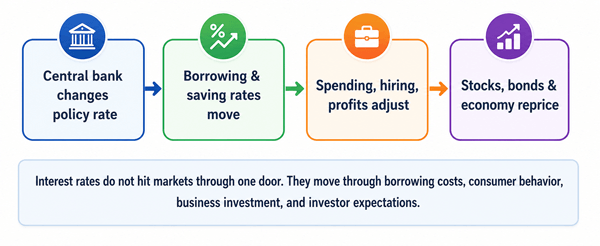
Figure 1: Interest rates move through the economy in stages, not instantly.
| Rate type | What it means | Why beginners should care |
|---|---|---|
| Policy rate / federal funds rate | A short-term rate targeted by the central bank. | It influences borrowing costs, savings yields, bond yields, and investor expectations. |
| Mortgage rate | The rate paid on a home loan. | Higher mortgage rates reduce affordability and can cool housing activity. |
| Credit card APR | The annualized borrowing cost on unpaid card balances. | High APR debt can become a serious wealth destroyer when rates rise. |
| Treasury yield | The return investors demand to lend to the government. | Often used as a benchmark for loans, bonds, and stock valuation. |
| Corporate bond yield | The return demanded to lend to a company. | Higher yields can raise company financing costs and expose weak balance sheets. |
| Savings APY | The annual percentage yield on savings or cash-like products. | Higher rates can make cash more useful, but inflation still matters. |
4. How higher interest rates affect the economy
Higher rates are designed to cool demand. That can be useful when inflation is too high, because inflation often comes from too much demand chasing limited supply. Higher rates make mortgages, car loans, credit cards, student loans, and business loans more expensive. Families may delay large purchases. Companies may delay hiring, expansion, inventory building, or acquisitions. Over time, slower demand can reduce inflation pressure.
But there is a trade-off. If rates stay too high for too long, economic growth can weaken. Businesses may cut costs. Unemployment can rise. Loan defaults may increase. Asset prices may fall. This is why rate policy is watched so closely by investors, homeowners, banks, and business owners.
5. How lower interest rates affect the economy
Lower rates are designed to stimulate activity. They can make monthly payments cheaper, encourage refinancing, support home buying, and make it easier for companies to finance growth. Lower rates can also push investors away from low-yielding cash and bonds and toward stocks, real estate, and other risk assets.
Still, lower rates are not always bullish. Sometimes central banks cut rates because the economy is already weakening. In that case, the positive effect of cheaper money may be offset by falling profits, layoffs, tighter credit, or recession fears. Beginners should always ask: are rates falling because inflation is cooling in a healthy economy, or because the economy is under stress?
6. How interest rates affect stocks
Stocks are affected through at least five channels: valuation, profits, debt costs, investor alternatives, and market psychology. The most important concept for beginners is valuation. A stock price is partly based on what investors think a company’s future cash flows are worth today. When required returns rise, the present value of future cash flows falls. That is why high-growth companies, which often promise more profits far in the future, can be sensitive to rising rates.
Rates also affect earnings. A company with floating-rate debt may pay more interest when rates rise, leaving less money for shareholders. A retailer may sell less if consumers are squeezed by higher loan payments. A homebuilder may face weaker demand when mortgage rates rise. On the other hand, some banks can benefit from higher interest income if they manage deposit costs and credit risk well.
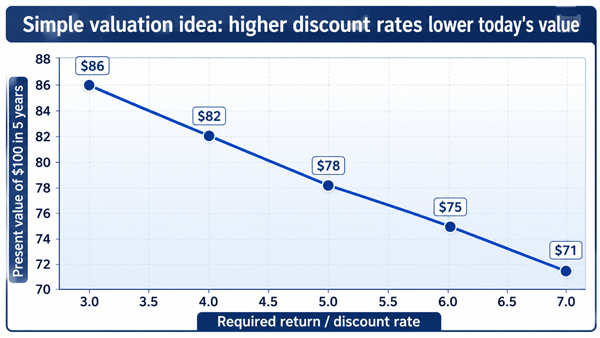
Figure 2: A simplified discount-rate example. The higher the required return, the lower the present value of the same future cash flow.
| Market area | Usually helped by lower rates | Usually pressured by higher rates | Beginner takeaway |
|---|---|---|---|
| Growth stocks | Future profits become more valuable when discount rates fall. | Valuations can compress when required returns rise. | Do not buy only because a stock is “innovative”; check valuation and cash flow. |
| Dividend stocks | Income stocks can look attractive when bond yields are low. | If bond yields rise, investors may demand higher dividend yields. | A high dividend is not enough if the business is weak. |
| Banks | Loan demand may improve when rates are moderate. | Credit losses can rise if rates hurt borrowers. | Bank stocks depend on both interest margins and loan quality. |
| Real estate / REITs | Cheaper financing can support property values. | Higher debt costs and cap rates can pressure values. | Rate sensitivity is high; balance sheet quality matters. |
| Consumer discretionary | Consumers may spend more when financing is cheaper. | Spending can slow when debt payments rise. | Watch employment, wages, credit card stress, and confidence. |
| Utilities | Stable dividends can attract income investors. | They may compete with higher bond yields and carry large debt. | Often defensive, but not risk-free in rising-rate periods. |
7. How interest rates affect bonds and why stock investors should care
Bond prices and interest rates usually move in opposite directions. Investor.gov explains that when interest rates rise, newly issued bonds become more appealing because they offer higher interest, so older bonds with lower coupons may need to sell at a discount. This matters for stock investors because bond yields are the competition. If a safe Treasury offers a higher return, investors may be less willing to pay a rich price for a risky stock.
A simple comparison helps. If safe cash pays close to nothing, a 4% dividend yield may look attractive. If safe cash pays 5%, that same dividend stock must offer either better growth, better quality, or a cheaper price to compete. This is one reason higher rates can lower stock market price-to-earnings multiples.
8. Inflation, interest rates, and the stock market
Inflation means prices are rising. Central banks often raise rates when inflation is too high because higher rates reduce demand. The Bureau of Labor Statistics describes the Consumer Price Index as a measure of the average change over time in prices paid by urban consumers for a basket of goods and services. Investors watch CPI because inflation can influence central bank policy, bond yields, company costs, wages, and consumer purchasing power.
Moderate inflation can be manageable if companies can raise prices without losing customers. High inflation is harder. It can squeeze consumers, increase input costs, create uncertainty, and force central banks to tighten policy. That combination often creates a more difficult environment for stocks, especially expensive stocks with profits far in the future.
9. A real-world example beginners can understand: 2022
In 2022, inflation was elevated and the Federal Open Market Committee raised the federal funds rate target range sharply. The St. Louis Fed notes that the target range moved from 0%-0.25% to 4.25%-4.5% during 2022. The official FOMC statement in December 2022 said inflation remained elevated and the Committee raised the target range to 4.25%-4.5% to support its goals of maximum employment and 2% inflation over the longer run.
What did investors experience? Many high-growth stocks fell heavily because valuations adjusted to higher discount rates. Bond prices also fell as yields rose. Mortgage rates increased, hurting affordability. Savers, however, started seeing better yields in savings accounts, Treasury bills, CDs, and money market funds. This is a useful lesson: the same rate change can hurt one part of your financial life and help another.
10. Common beginner mistakes when reading rate news
- Assuming every rate cut is good for stocks. A cut can be good if inflation is cooling and growth is stable, but it can be bad if the cut happens because unemployment is rising and profits are about to fall.
- Ignoring debt. Two companies may look similar, but the one with more floating-rate debt can suffer more when rates rise.
- Chasing yield without checking risk. A high-yield bond or high-dividend stock may be cheap for a reason.
- Thinking the Fed controls everything. Long-term rates are also affected by inflation expectations, government borrowing, global demand for bonds, growth expectations, and investor risk appetite.
- Making all-or-nothing portfolio changes. Rate cycles are uncertain. A diversified, rules-based plan usually works better than emotional predictions.
| Question to ask | Why it matters | Practical example |
|---|---|---|
| Are rates rising because growth is strong or because inflation is too high? | Strong growth and high inflation can have different effects on earnings and valuations. | A company may sell more in a strong economy but still face margin pressure from wage and input costs. |
| Does the company have heavy debt? | Higher interest expense can reduce profits. | A highly leveraged real estate company may suffer more than a cash-rich software company. |
| Are profits today or far in the future? | Long-duration growth stocks are usually more rate-sensitive. | A profitable consumer staples firm may be less sensitive than a speculative company with no earnings. |
| What is the alternative yield? | Stocks compete with cash, CDs, Treasury bills, and bonds. | If cash yields rise, investors demand better prices before buying risky assets. |
| Is the rate move already priced in? | Markets often move before official announcements. | Stocks may rally after a hike if investors expected an even harsher decision. |
11. How beginners can use interest-rate information
You do not need to predict every central bank decision. A better goal is to understand the environment and avoid obvious mistakes. Start with your personal finances. If you have high-interest debt, rising rates make it more urgent to reduce that burden. If you have emergency savings, higher rates may let you earn more on safe cash. If you invest, rates can help you understand why valuations, dividends, bonds, and sectors are moving.
For stocks, use rates as a filter, not a crystal ball. In rising-rate environments, focus harder on companies with strong balance sheets, real profits, pricing power, and reasonable valuations. In falling-rate environments, do not blindly chase risky growth; first check whether earnings estimates are improving or deteriorating.
12. A practical investor checklist
Before buying a stock during a rate-sensitive market, ask: Does the company rely on cheap financing? Can it pass higher costs to customers? Does it generate free cash flow? How much debt matures soon? Is the valuation reasonable compared with safer yields? What happens if revenue slows for one year? These questions turn rate news into practical analysis.
For personal finance, ask: Should I refinance, pay down variable-rate debt, shop for a better savings rate, ladder CDs or Treasury bills, or rebalance my portfolio? Good rate decisions are not just about Wall Street; they affect your monthly budget, housing choices, and emergency fund.
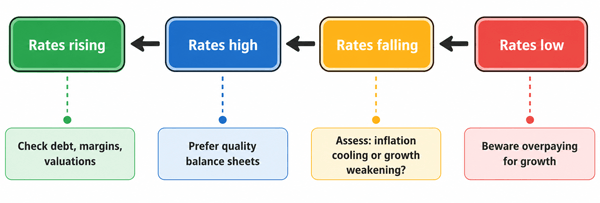
Figure 3: Use rate cycles as a checklist for risk management, not as a prediction machine.
| Scenario | What it may mean | Actionable beginner response |
|---|---|---|
| Rates rising quickly | Central bank is likely fighting inflation or financial excess. | Review debt-heavy stocks, avoid overpaying for distant profits, strengthen emergency cash. |
| Rates staying high | Borrowing remains expensive and weaker companies may feel pressure. | Prefer quality companies, manageable debt, and realistic earnings assumptions. |
| Rates falling slowly | Inflation may be easing or policy may be normalizing. | Look for companies whose earnings can improve, not just stocks that benefit from hype. |
| Rates falling aggressively | Economy may be weakening or financial stress may be rising. | Be careful with cyclical stocks, watch unemployment, credit spreads, and earnings revisions. |
| Yield curve inverted | Short-term rates are above long-term rates, often a caution signal. | Do not panic, but avoid excessive leverage and check recession-sensitive holdings. |
13. Frequently Asked Questions About Interest Rates and Stocks
13.1 Do interest rates always make stocks go down?
No. Higher rates often pressure stocks, especially expensive growth stocks, but stock prices also depend on earnings, inflation, expectations, investor sentiment, and whether the rate move was already priced in.
13.2 Which stocks benefit from higher interest rates?
Some banks, insurance companies, and cash-rich companies may benefit in certain higher-rate environments. But benefits are not automatic because credit losses, deposit costs, and weaker economic growth can offset higher interest income.
13.3 Are rate cuts always good for the stock market?
No. Rate cuts can support valuations, but aggressive cuts may signal recession risk. Investors should ask why rates are being cut.
13.4 How do interest rates affect mortgage rates?
Mortgage rates are influenced by central bank policy, Treasury yields, inflation expectations, lender spreads, and housing-market conditions. They often move in the same broad direction as long-term bond yields, not mechanically point-for-point with the policy rate.
13.5 How do interest rates affect inflation?
Higher rates can reduce demand by making borrowing more expensive, which may help cool inflation. Lower rates can increase demand, which may support growth but can also add inflation pressure if supply is limited.
13.6 What should beginners watch before investing?
Watch inflation trends, central bank statements, bond yields, earnings growth, debt levels, valuation, and your own time horizon. Do not make investment decisions from one headline.
Sources Consulted and Checked
The following authoritative sources were consulted and checked while preparing this article and reviewing its accuracy:
- Federal Reserve, “Why do interest rates matter?” - https://www.federalreserve.gov/faqs/why-do-interest-rates-matter.htm
- Federal Reserve, The Fed Explained: Monetary Policy - https://www.federalreserve.gov/aboutthefed/fedexplained/monetary-policy.htm
- Investor.gov, “Bonds - FAQs” - https://www.investor.gov/introduction-investing/investing-basics/investment-products/bonds-or-fixed-income-products/bonds
- SEC Investor Bulletin, “When Interest Rates Go Up, Prices of Fixed-rate Bonds Fall” - https://www.sec.gov/files/ib_interestraterisk.pdf
- Bureau of Labor Statistics, Consumer Price Index - https://www.bls.gov/cpi/
- Federal Reserve Bank of St. Louis, “The Many Interest Rates in 2022” - https://www.stlouisfed.org/on-the-economy/2023/jan/many-interest-rates-2022
- Federal Reserve, FOMC statement, December 14, 2022 - https://www.federalreserve.gov/newsevents/pressreleases/monetary20221214a.htm
- International Monetary Fund, “Monetary Policy: Stabilizing Prices and Output” - https://www.imf.org/en/publications/fandd/issues/series/back-to-basics/monetary-policy
Reader Advice
This article is provided solely for educational and informational purposes. It does not constitute personal investment, financial, tax, accounting, or legal advice, and it should not be treated as a recommendation to buy, sell, or hold any security or financial product. Interest rates and their effects can differ according to a reader’s country, income, debt, financial goals, time horizon, and risk tolerance.
Economic conditions, market prices, laws, regulations, tax rules, central-bank policies, and product terms may change over time. Before making an important financial decision, readers should verify current facts, figures, rates, and requirements through official or otherwise authoritative sources and, where appropriate, seek advice from a suitably qualified professional. Past market behavior does not guarantee future results, and all investing involves risk, including possible loss of principal.