Should You Sell Stocks During a Recession? A Long-Term Investor's Guide
Quick answer
Most long-term investors should not sell stocks simply because a recession is happening or expected. The better move is usually to check your cash needs, rebalance to your target asset allocation, keep costs low, and stay disciplined. Selling may make sense when your time horizon, emergency fund, risk level, debt, or investment thesis has changed - not because the headlines are scary.
1. Introduction: The Real Question Is Not “Will Stocks Fall?”
When a recession appears in the news, many beginner investors ask the same question: should I sell my stocks now and buy back later when things look safe? It sounds logical. If the economy is slowing, companies may earn less, unemployment may rise, and stock prices may drop. So why not step aside?
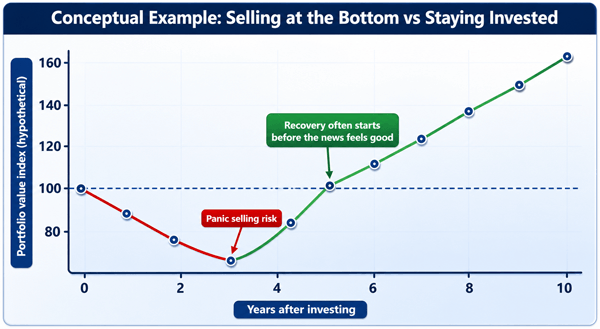
The problem is that investing is rarely that clean. The stock market often moves before the economy does. It can fall before a recession is officially announced, recover while the economic news still sounds terrible, and punish investors who wait for perfect clarity. A recession is painful in real life, but for a long-term investor, the decision to sell should be based on your plan - not on fear alone.
This guide explains what a recession is, how stocks often behave around recessions, why panic selling can be costly, when selling can be reasonable, and how to build a practical recession plan even if you are completely new to investing.
2. What Is a Recession in Simple Words?
A recession is a broad slowdown in economic activity. In the United States, the National Bureau of Economic Research describes it as a significant decline in economic activity that is spread across the economy and lasts more than a few months. It is normally visible in measures such as real GDP, real income, employment, industrial production, and wholesale-retail sales.
In everyday language, a recession means people and businesses spend more carefully, companies may cut costs, job losses can rise, credit may become tighter, and confidence usually weakens. It does not mean every company fails or every stock must go down. Some businesses struggle badly, some remain stable, and a few may even grow.
| Term | Simple meaning | Why it matters for investors |
|---|---|---|
| Recession | The economy contracts broadly for more than a short moment. | Earnings and confidence may weaken, creating market volatility. |
| Bear market | A major market decline, often defined as a drop of 20% or more. | Can happen with or without a recession. |
| Market correction | A decline of about 10% from a recent high. | Common and not always tied to the economy. |
| Recovery | The period after the economy or market bottoms. | Often begins before the news feels positive. |
3. How the Stock Market Usually Works During a Recession
Stocks represent ownership in businesses. When investors expect lower profits, tighter credit, or weaker consumer demand, they may price stocks lower. But stock prices are not a live report card of today’s economy; they are a forward-looking estimate of future cash flows, risk, and investor confidence.
That is why the market can fall before a recession is obvious and rise before the recession is officially over. By the time a recession is confirmed, much of the bad news may already be reflected in prices. This is one reason timing the market is so difficult.
Fidelity notes that recessions are not all alike, and since 1950, 5 of 11 U.S. recessions produced positive total returns for the S&P 500. That does not mean recessions are harmless. It means the relationship between recession headlines and stock returns is less direct than many beginners assume.
4. Should You Sell Stocks During a Recession?
For most long-term investors, the answer is: do not sell just because there is a recession. A recession is a reason to review your plan, not automatically abandon it.
Selling can feel like control. In reality, it creates two hard decisions instead of one: when to sell and when to buy back. Many people manage the first decision emotionally and fail at the second. They sell after a painful drop, then wait for the economy to feel safe. By the time it feels safe, prices may already be much higher.
A better question is: do I still own the right investments for my goals, time horizon, and risk tolerance? If yes, staying invested, continuing regular contributions, and rebalancing can be more rational than trying to predict the exact bottom.
4.1 When Selling May Be a Mistake
| Reason people sell | Why it feels smart | Why it can hurt long-term returns |
|---|---|---|
| “The news says a recession is coming.” | You want to avoid losses. | Markets often price in bad news early. You may sell after the decline has already happened. |
| “My portfolio is down and I cannot watch it.” | You want emotional relief. | Emotional relief today can become permanent wealth damage if you miss the recovery. |
| “I will buy back when things improve.” | It sounds disciplined. | The market may recover before the economy looks healthy. |
| “Everyone online is bearish.” | Social proof feels comforting. | Crowd emotion is not the same as a personal financial plan. |
4.2 When Selling Can Make Sense
Selling is not always wrong. The mistake is selling for the wrong reason. Here are practical situations where reducing stocks may be reasonable:
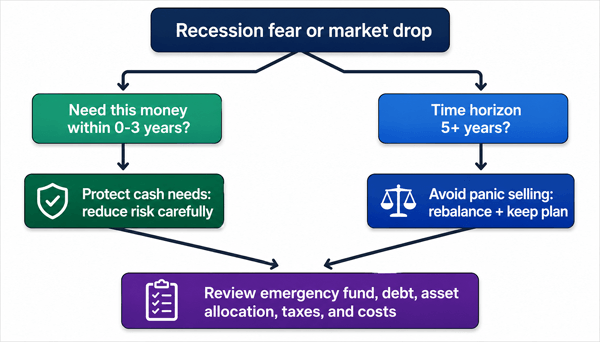
- You need the money soon. Money needed in the next 0-3 years usually should not depend heavily on stocks.
- Your emergency fund is weak. If you may need cash for rent, medical bills, job loss, or business expenses, raising liquidity can be sensible.
- Your portfolio is too aggressive. If a downturn reveals that you cannot tolerate your stock allocation, rebalance thoughtfully rather than panic selling everything.
- A company-specific thesis broke. If an individual stock has deteriorating debt, shrinking competitive advantage, poor cash flow, or management problems, selling may be investment discipline, not fear.
- You are taking tax-aware action. Tax-loss harvesting may make sense in taxable accounts if done carefully and within wash-sale rules.
- You are near or in retirement. You may need a more defensive withdrawal plan, cash bucket, or bond allocation to reduce sequence-of-returns risk.
5. A Practical Decision Framework
| Question to ask | If your answer is YES | If your answer is NO |
|---|---|---|
| Do I need this money within 3 years? | Consider moving that portion to cash, CDs, Treasury bills, short-term bonds, or a safer vehicle. | You may have time to ride out volatility. |
| Do I have 3-6+ months of emergency savings? | Good. Avoid using your portfolio as your emergency fund. | Build cash before adding more stock risk. |
| Is my portfolio diversified? | Stay close to your target allocation and rebalance. | Reduce concentration in single stocks, sectors, or risky assets. |
| Am I selling because my plan changed? | Selling may be justified. Document the reason. | Do not sell only because prices are down. |
| Would I buy this investment today? | Holding may make sense. | Review fundamentals, costs, and alternatives. |
6. Example: Two Investors During the Same Recession
Imagine two investors, Aisha and Daniel. Both invested $50,000 in a diversified stock fund before a recession. The market falls 30%, and their account value drops to $35,000.
| Investor | Action | What happens next | Lesson |
|---|---|---|---|
| Aisha | Sells the entire stock fund at $35,000 and waits for “better news.” | The market begins recovering while the economy still feels weak. She hesitates to buy back and misses part of the rebound. | Avoid turning temporary volatility into a permanent loss. |
| Daniel | Keeps his long-term allocation, continues monthly investing, and rebalances once. | His new contributions buy shares at lower prices. He still experiences stress, but his plan remains intact. | A written plan helps reduce emotional decisions. |
This example is simplified, but it reflects a common real-world experience: the hardest part is not understanding the math. The hardest part is staying disciplined when your account balance and the news both look ugly.
7. What Beginner Investors Should Know Before a Recession
7.1 Your time horizon decides how much stock risk is reasonable
If you are investing for retirement 20 or 30 years away, recessions are unpleasant but expected. If you are saving for a house down payment next year, a stock-heavy portfolio may be too risky. Time horizon is one of the biggest differences between smart patience and reckless risk-taking.
7.2 Diversification does not prevent losses, but it can prevent disaster
Diversification means spreading money across asset classes, sectors, companies, and sometimes countries. The SEC’s Investor.gov explains asset allocation as dividing a portfolio among categories such as stocks, bonds, and cash. FINRA describes diversification and rebalancing as tools for managing investment risk. The goal is not to avoid every decline; it is to avoid one bad bet destroying your future.
7.3 Cash is not weakness
A strong emergency fund helps you avoid selling stocks at the worst possible time. Many investors do not panic because they lack intelligence; they panic because they need cash. Liquidity gives you patience.
7.4 Rebalancing is different from market timing
Market timing says, “I know what the market will do next.” Rebalancing says, “My portfolio drifted away from my plan, so I will bring it back.” Rebalancing is rules-based. Panic selling is emotion-based.
7.5 Costs matter more when returns are uncertain
Expense ratios, advisory fees, trading costs, taxes, and high-interest debt all reduce your net return. Vanguard’s investing principles emphasize goals, balance, low costs, and discipline. Those boring basics become more valuable during recessions.
8. Best Long-Term Investor Actions During a Recession
| Action | Why it helps | Beginner-friendly way to do it |
|---|---|---|
| Review your financial plan | Prevents fear-based decisions. | Write your goal, time horizon, monthly contribution, and target allocation on one page. |
| Build or protect emergency cash | Reduces forced selling. | Hold essential expenses in a high-yield savings account, money market fund, or other liquid account appropriate to your country and risk needs. |
| Keep investing regularly | Uses lower prices to your advantage. | Automate monthly contributions into diversified funds if your income is stable. |
| Rebalance | Controls risk without guessing the bottom. | If stocks fell below target, buy enough to return to target; if stocks still dominate, trim carefully. |
| Focus on quality | Weak businesses may not recover. | Favor diversified funds or companies with strong balance sheets, durable demand, and manageable debt. |
| Avoid leverage | Debt magnifies mistakes. | Do not use margin or risky options to “make losses back.” |
| Tax-loss harvest carefully | Can improve after-tax outcomes. | Sell a losing taxable investment and buy a similar, not substantially identical, replacement while respecting wash-sale rules. |
9. What to Buy During a Recession? A Careful View
This article is not telling you what to buy. However, beginners often ask where long-term investors look during downturns. The answer depends on goals and risk tolerance, but the broad categories below are common.
| Investment type | Potential role | Main risk |
|---|---|---|
| Broad stock index funds or ETFs | Simple diversification across many companies. | Still falls with the market; not guaranteed. |
| Dividend-paying companies or funds | May provide income and mature-business exposure. | Dividends can be cut; high yield can signal trouble. |
| Investment-grade bonds | Can reduce portfolio volatility and provide income. | Interest-rate risk, inflation risk, credit risk. |
| Treasury bills / short-term government securities | Useful for near-term cash needs. | Lower long-term growth potential. |
| Target-date funds | One-fund asset allocation and automatic glide path. | May not match your exact risk tolerance or tax needs. |
| High-yield savings / money market funds | Emergency fund and short-term goals. | Cash may lag inflation over long periods. |
Honest investing note
A recession can create opportunity, but not every cheap-looking stock is a bargain. Some stocks fall because the market is emotional. Others fall because the business is permanently weaker. Beginners usually reduce avoidable mistakes by using diversified, low-cost funds before trying to pick individual recession winners.
10. Retirement Investors: Why Selling Can Be Extra Risky
If you invest through a 401(k), IRA, pension plan, or other retirement account, selling during a recession can interrupt compounding. Retirement investors also face different tax rules and penalties depending on account type and country. In many cases, changing future contributions or rebalancing is less damaging than liquidating the account.
For retirees, the issue is more nuanced. Selling some stocks may be appropriate if withdrawals are coming soon, but the goal is usually to create a sustainable withdrawal plan, not to exit the market entirely. Many retirees use a cash bucket for near-term spending, bonds for stability, and stocks for long-term growth. This can help reduce the need to sell stocks during deep declines.
11. Common Mistakes People Make During Recessions
- Checking the portfolio too often. Daily checking makes normal volatility feel like personal failure.
- Confusing economic news with investment instructions. Bad news is not automatically a sell signal.
- Selling diversified funds but keeping speculative single stocks. This often increases risk instead of reducing it.
- Stopping retirement contributions without a cash-flow reason. Lower prices can improve long-term expected returns for regular investors, though nothing is guaranteed.
- Trying to recover losses quickly. Margin, options, leveraged ETFs, and concentrated bets can turn a manageable decline into a financial emergency.
- Ignoring taxes. Selling in a taxable account may create tax consequences or disrupt a tax-loss harvesting strategy.
- Following influencers instead of a written plan. Entertainment is not financial planning.
12. A Simple Recession Portfolio Checklist
- Emergency fund: Do I have enough safe, liquid money for job loss or surprise expenses?
- Debt: Am I carrying high-interest debt that weakens my financial flexibility?
- Time horizon: Which money is for the next 0-3 years, 3-10 years, and 10+ years?
- Allocation: What percentage is in stocks, bonds, cash, real estate, and other assets?
- Diversification: Am I overexposed to one company, employer stock, sector, country, or theme?
- Costs: Are my expense ratios, advisory fees, and trading costs reasonable?
- Taxes: Would selling create taxable gains, losses, or wash-sale issues?
- Behavior: Can I realistically hold this portfolio through a 30%-50% decline?
- Rules: What exactly would make me buy, rebalance, sell, or do nothing?
13. Beginner-Friendly Recession Investing Plan
Here is a practical plan a beginner can use without trying to predict the economy:
13.1 Separate short-term and long-term money
Do not invest rent money, tax money, tuition money, or next year’s down payment in stocks. Stocks are for long-term goals.
13.2 Choose a target allocation
Example: 80/20 stocks/bonds for an aggressive young investor, 60/40 for moderate risk, or a more conservative mix for near-term needs. These are examples, not recommendations.
13.3 Use diversified building blocks
Broad index funds, target-date funds, and balanced funds can reduce single-company risk.
13.4 Automate contributions
Regular investing removes some emotion and can buy more shares when prices are lower.
13.5 Rebalance on a schedule
Once or twice a year, or when your allocation drifts by a set percentage, rebalance back to plan.
13.6 Create selling rules before panic arrives
Examples: sell if a goal becomes short-term, if an individual stock thesis breaks, if debt risk is too high, or if rebalancing requires it.
13.7 Review, but do not obsess
A quarterly review is enough for many long-term investors. Daily market watching usually increases anxiety without improving decisions.
14. Frequently Asked Questions
14.1 Is cash better than stocks during a recession?
Cash is better for short-term needs and emergency savings. Stocks may be better for long-term growth, but they can fall sharply. The question is not cash or stocks; it is which money belongs in cash and which money has enough time to stay invested.
14.2 Should I stop investing during a recession?
If your income is stable and emergency fund is strong, continuing regular investing can be reasonable. If your job is at risk or cash is tight, building liquidity may come first.
14.3 Should I sell individual stocks and buy index funds?
That can make sense if you are too concentrated or no longer understand the businesses you own. Do it thoughtfully, considering taxes and transaction costs.
14.4 What if the market drops another 30% after I hold?
That is possible. Long-term investing requires accepting uncertainty. The answer is not to pretend losses cannot happen; it is to size your stock exposure so you can survive them.
14.5 How do I know when the recession is over?
Official recession dating is often announced after the fact. Waiting for confirmation can mean missing market recovery. Investors should focus more on their plan than on perfect economic timing.
14.6 Do I need a financial advisor?
A good fiduciary financial advisor can help with retirement planning, tax strategy, asset allocation, behavioral coaching, and withdrawal planning. But avoid anyone promising recession-proof returns or guaranteed market timing.
15. Bottom Line: Recessions Test Your Plan
A recession is not a command to sell stocks. It is a stress test. If your portfolio was built for your goals, time horizon, and risk tolerance, the best action may be to stay invested, keep contributing, and rebalance. If the downturn reveals that you lack cash, hold too much risk, own weak investments, or need money soon, selling some stocks may be sensible - but the reason should be your financial reality, not panic.
The long-term investor’s advantage is not predicting every recession. It is preparing before fear arrives, making fewer emotional decisions, and allowing time, diversification, low costs, and discipline to do their work.
Sources Consulted and Checked
These authoritative sources were consulted and checked while preparing this article to support accuracy, balance, and clarity.
- National Bureau of Economic Research (NBER): Business Cycle Dating and recession definition: https://www.nber.org/research/business-cycle-dating
- SEC Investor.gov: Beginner guide to asset allocation, diversification, and rebalancing: https://www.investor.gov/additional-resources/general-resources/publications-research/info-sheets/beginners-guide-asset
- FINRA: Asset allocation, diversification, and rebalancing basics: https://www.finra.org/investors/investing/investing-basics/asset-allocation-diversification
- Fidelity: Recession investing context and historical note that 5 of 11 recessions since 1950 had positive S&P 500 total returns: https://www.fidelity.com/learning-center/wealth-management-insights/3-things-to-know-about-recessions
- Charles Schwab: Recession preparation and staying invested principles: https://www.schwab.com/learn/story/5-tips-weathering-recession
- Vanguard: Principles for investing success: goals, balance, cost, discipline: https://corporate.vanguard.com/content/corporatesite/us/en/corp/about-our-funds/how-we-invest/principles-for-investing-success.html
- J.P. Morgan Asset Management: Guide to the Markets and staying invested / market timing materials: https://am.jpmorgan.com/us/en/asset-management/institutional/insights/market-insights/guide-to-the-markets/
Reader Advice
This article is provided solely for educational and general informational purposes. It does not constitute personalized investment, financial, tax, accounting, or legal advice, and it should not be treated as a recommendation to buy, sell, or hold any security or financial product.
Investment decisions should be based on your own objectives, time horizon, financial circumstances, risk tolerance, tax position, and applicable laws. Consider consulting a qualified fiduciary financial professional, tax adviser, or legal adviser before making a material decision.
Economic conditions, market data, tax rules, investment regulations, product terms, and official guidance can change. Readers should verify current facts, figures, eligibility requirements, and rules through relevant official or primary sources before acting. All investments involve risk, including possible loss of principal, and past performance does not guarantee future results.