What Happens During a Stock Market Crash? History and Recovery
1. Quick answer
A stock market crash is a sudden, sharp fall in stock prices across a major market. It usually happens when fear spreads faster than facts: investors sell, prices drop, news gets worse, margin calls force more selling, and confidence breaks. A crash can hurt retirement accounts, brokerage portfolios, business funding, and everyday consumer confidence. But history also shows that crashes do not all end the same way. Some recover quickly, like the 2020 COVID crash. Others take years, like the 2000 dot-com bust or the 2008 financial crisis.
The most important beginner lesson is simple: a crash is not only a price event; it is a behavior test. People who panic sell often turn a temporary decline into a permanent loss. People who prepare with cash reserves, diversification, realistic risk, and a written investment plan are usually in a stronger position to survive the fall and participate in recovery.
2. What is a stock market crash?
A stock market crash is a fast and dramatic drop in stock prices. There is no single official percentage that defines every crash, but investors usually use the word when the decline is sudden, broad, emotional, and disruptive. A market correction is commonly a fall of about 10% from a recent high. A bear market is commonly a fall of 20% or more. A crash can happen inside either one, but it feels more violent because the selling is compressed into days or weeks.
Imagine a store where everyone believes prices will be higher next month. Buyers keep coming. Then one day a rumor spreads that the store may close. Everyone rushes to sell their gift cards at once. The gift cards may still have value, but buyers demand a discount because they are scared. The stock market works in a similar emotional way during a crash: the value of businesses may not disappear overnight, but the price people are willing to pay can drop very quickly.
| Term | Simple meaning | Typical size | Beginner takeaway |
|---|---|---|---|
| Pullback | A small decline after prices rose | Often 5%-10% | Normal market breathing. Do not overreact to every red week. |
| Correction | A meaningful decline from a recent high | Around 10% or more | Common and uncomfortable, but not automatically a crisis. |
| Bear market | A deeper market decline | 20% or more | Requires patience, risk control, and a plan. |
| Crash | A sudden, sharp drop driven by fear | No single fixed number | Speed and panic matter as much as percentage. |
| Recession | A broad economic slowdown | Economic, not just market-based | Stocks may fall before, during, or even without a recession. |
3. What actually happens during a stock market crash?
A crash looks chaotic from the outside, but it usually follows a pattern. First, investors become worried about something serious: a recession, banking stress, war, inflation, interest rates, a pandemic, a debt bubble, or a technology bubble. Then selling begins. As prices fall, more investors check their accounts and feel pressure to sell. Some investors are forced to sell because they borrowed money to invest. Financial news becomes louder. Fear spreads. Prices fall further.
This is why crashes often feel faster than recoveries. Fear creates urgency. Recovery requires evidence: better earnings, lower uncertainty, policy support, improved credit conditions, lower inflation, or simply enough time for investors to regain confidence.
3.1 The crash chain reaction
- A trigger appears: bad earnings, rate shock, financial stress, geopolitical shock, fraud, or economic slowdown.
- Large investors reduce risk first, often selling liquid assets such as major stocks and ETFs.
- Prices fall, and stop-loss orders or algorithmic trading can add short-term selling pressure.
- Leveraged investors face margin calls and may be forced to sell even if they want to hold.
- News headlines amplify fear, causing retail investors to check accounts more often and act emotionally.
- Valuations reset. Eventually, long-term buyers return when prices look attractive compared with future earnings.
Figure 1 is an illustration, not a prediction. It shows how a crash can feel like a straight line down, while recovery often happens in uneven steps with rallies, setbacks, and long periods of doubt.
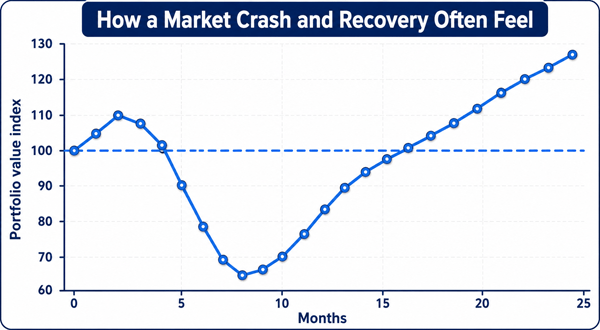
Figure 1: Illustrative crash-and-recovery cycle. Real markets are more volatile and never move this smoothly.
4. Why do stock markets crash?
Markets usually crash when expectations become too optimistic and then reality changes quickly. The trigger can be different each time, but the deeper cause is often the same: investors paid prices based on a best-case future, then suddenly had to reprice for risk.
| Cause | How it leads to a crash | Real-world example |
|---|---|---|
| Speculative bubble | Prices rise because people expect someone else to pay more later, not because fundamentals justify it. | Dot-com stocks in 2000. Many internet companies had little profit but very high valuations. |
| Excess debt and leverage | Borrowed money magnifies losses. Falling prices force selling. | 1929 margin speculation and 2008 mortgage-linked leverage. |
| Banking or credit stress | When lenders pull back, businesses and consumers struggle to borrow. | Global Financial Crisis of 2007-2009. |
| Economic shock | A sudden event changes earnings expectations and daily life. | COVID-19 crash in 2020. |
| Interest-rate shock | Higher rates can lower stock valuations and increase borrowing costs. | Inflation and rate fears contributed to the 2022 bear market. |
| Loss of confidence | Investors sell because they no longer trust prices, institutions, or future growth. | The 1929 crash shattered confidence and deepened economic weakness. |
5. What changes for everyday investors?
For beginners, the most painful part of a crash is not the market chart. It is the emotional experience of watching money fall in an account that was supposed to help with retirement, a house deposit, education, or future security. A $10,000 portfolio down 30% becomes $7,000. To get back from $7,000 to $10,000, it needs to rise about 43%, not 30%. This math surprises many new investors.
| If your portfolio falls... | Portfolio value from $10,000 | Gain needed to recover |
|---|---|---|
| 10% | $9,000 | 11.1% |
| 20% | $8,000 | 25.0% |
| 30% | $7,000 | 42.9% |
| 40% | $6,000 | 66.7% |
| 50% | $5,000 | 100.0% |
This is why risk management matters before a crash. A beginner should not build a portfolio that only feels good in a bull market. The real test is whether you can hold it when it is down 20%, 30%, or more.
6. History of major stock market crashes and recoveries
History does not repeat perfectly, but it gives investors perspective. Every major crash had its own cause, mood, and recovery path. The lesson is not that stocks always recover quickly. The lesson is that recovery depends on valuation, earnings, policy response, financial-system health, and investor behavior.
| Period | What happened | Approximate U.S. market decline | Recovery lesson |
|---|---|---|---|
| 1929-1932 Great Depression | Speculation, leverage, banking failures, and economic collapse created the most severe U.S. market crash. The Dow eventually fell close to 89% from its peak. | About -89% for the Dow | Some crashes can take many years. Avoid leverage and never assume quick recovery. |
| 1987 Black Monday | A sudden one-day collapse hit global markets. Program trading and portfolio insurance worsened selling pressure. | Dow fell 22.6% in one day | A terrifying crash can recover faster if the economy and banking system remain intact. |
| 2000-2002 Dot-com bust | Overvalued technology and internet stocks collapsed after a speculative boom. | S&P 500 about -49%; Nasdaq much worse | Great stories are not enough. Valuation and profits matter. |
| 2007-2009 Global Financial Crisis | Housing debt, mortgage securities, bank stress, and credit freezing caused a deep bear market. | S&P 500 about -57% | Financial-system crashes are especially dangerous and can require major policy response. |
| 2020 COVID crash | A global pandemic shut down economic activity. Markets fell fast, then recovered quickly after large policy support. | S&P 500 about -34% | Event-driven crashes can rebound quickly, but only hindsight makes them look easy. |
| 2022 inflation/rate bear market | High inflation and rising interest rates pressured valuations, especially growth stocks. | S&P 500 about -25% intrayear peak-to-trough | Rates matter. A good company can still be a bad investment if bought at too high a price. |
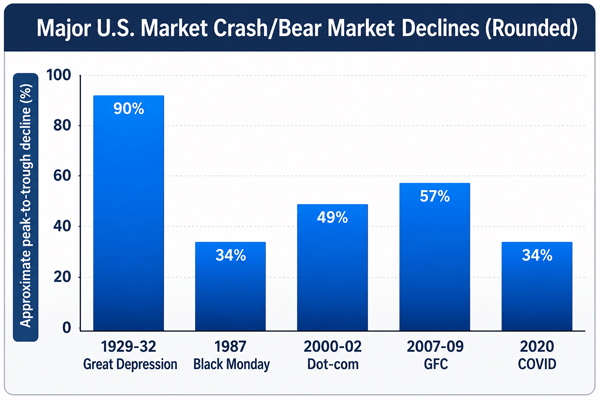
Figure 2: Rounded examples of major U.S. market declines. Different indexes and measurement dates produce slightly different figures.
7. How long does stock market recovery take?
Recovery means different things. A trader may mean the market bounces 10% from the bottom. A long-term investor usually means prices return to the previous high. A retirement investor cares about something more practical: whether their full portfolio, including contributions and dividends, is back on track for their goal.
Historically, some bear markets have recovered in months, while others have taken years. The 2020 crash recovered unusually fast. The 1929 crash and the dot-com bust were much slower for many investors. The deeper the crash, the more important it becomes to own a diversified portfolio, keep cash for near-term needs, and avoid forced selling.
| Type of recovery | What it means | Why beginners should care |
|---|---|---|
| Price recovery | Index returns to its old high. | Good for headlines, but ignores dividends and personal contributions. |
| Portfolio recovery | Your account value returns to its prior level. | Depends on your allocation, deposits, withdrawals, and behavior. |
| Financial-plan recovery | You are still on track for your goal. | This is the most important measure for retirement and long-term investing. |
| Emotional recovery | You regain confidence and stop checking prices constantly. | Often takes longer than the market recovery. |
8. What should beginners do before a crash?
The best crash strategy is built before the crash. Once fear is high, decision quality usually falls. Beginners should focus on the basics that prevent panic and forced selling.
- Build an emergency fund before aggressive investing. If you may need cash in the next few months, it should not be fully exposed to stocks.
- Separate short-term and long-term money. Money needed in one to three years should generally be more conservative than retirement money needed decades from now.
- Choose an asset allocation you can actually hold. A 100% stock portfolio may look attractive in a bull market but feel unbearable in a crash.
- Diversify across asset classes, sectors, and geographies. Diversification does not prevent loss, but it can reduce dependence on one company, sector, or theme.
- Avoid margin debt. Borrowing to invest can turn a normal downturn into a forced sale.
- Write a crash plan. Decide in advance when you will rebalance, continue contributions, or review your portfolio.
8.1 Simple beginner allocation examples
| Investor situation | Possible risk level | Example mix | Reasoning |
|---|---|---|---|
| Needs money within 12 months | Low | Mostly cash or short-term high-quality instruments | A crash at the wrong time can ruin a near-term goal. |
| Saving for a home in 3-5 years | Low to moderate | Cash, short-term bonds, limited equities | Growth matters, but capital preservation matters more. |
| Retirement in 20+ years | Moderate to high | Diversified stock funds plus bonds/cash buffer | Longer time horizon can absorb more volatility. |
| Retired and withdrawing money | Moderate | Balanced mix with cash reserve and income assets | Withdrawals during crashes can permanently damage a portfolio. |
9. What should beginners do during a stock market crash?
During a crash, the goal is not to be a hero. The goal is to avoid irreversible mistakes. A good decision during panic is usually boring: pause, check your plan, confirm your cash needs, rebalance only if planned, and avoid emotional all-or-nothing moves.
9.1 A practical crash checklist
- Do not sell just because prices are red. Ask: has my goal changed, or only the market price?
- Check your emergency fund. If you have enough cash for near-term needs, you are less likely to panic sell.
- Review your allocation. If stocks became too large before the crash, rebalance carefully. If stocks fell below target, buying may be part of your plan.
- Continue automatic contributions if your income is stable. Buying regularly during declines can lower average purchase prices, though it does not guarantee profit.
- Avoid trying to call the exact bottom. Most investors fail because bottoms are only obvious later.
- Be careful with individual stocks. A broad index can recover while some companies never return to old highs.
- Do not take high-risk loans or use margin to buy the dip. A cheap market can become cheaper.
9.2 Dollar-cost averaging example
Suppose a beginner invests $300 every month into a diversified stock index fund. If the fund price falls from $100 to $60, that same $300 buys more shares at lower prices. When prices later recover, those cheaper shares help the portfolio. This is called dollar-cost averaging. It is useful because it removes the pressure to predict the perfect buying day. But it does not remove risk, and it works best when the investor has stable income, a long time horizon, and a diversified investment.
| Month | Fund price | Monthly investment | Shares bought |
|---|---|---|---|
| 1 | $100 | $300 | 3.00 |
| 2 | $80 | $300 | 3.75 |
| 3 | $60 | $300 | 5.00 |
| 4 | $75 | $300 | 4.00 |
| 5 | $90 | $300 | 3.33 |
In this example, the investor buys 19.08 shares for $1,500, with an average cost of about $78.62 per share. The strategy feels uncomfortable during the decline, but it can be powerful when used with patience and a suitable investment.
10. What should beginners do after a crash?
After a crash, many investors make the opposite mistake: they become too confident because the market has recovered, or too scared because they remember the pain. The right response is to learn from the crash and improve the process.
- Review what caused your stress. Was the portfolio too risky, or were you checking it too often?
- Rebuild your cash reserve if you used it.
- Rebalance back to your target allocation instead of chasing the hottest recovery sector.
- Increase contributions gradually if your income is stable and your plan allows it.
- Document what worked and what failed. Your future self will forget how the crash felt.
- Check fees, taxes, and account structure. High-fee products and tax-inefficient trading can reduce recovery.
11. Mistakes that hurt beginners during market crashes
| Mistake | Why it hurts | Better choice |
|---|---|---|
| Panic selling everything | Locks in losses and may miss the rebound. | Use a written plan and sell only if your goal or risk needs changed. |
| Waiting for perfect certainty | Markets often recover before news feels good. | Invest in steps rather than needing one perfect moment. |
| Buying only hype stocks | Some fallen stocks are cheap for a reason. | Use diversified funds as a core holding. |
| Using margin to buy the dip | Forced selling can happen if prices fall further. | Use only cash you can afford to invest long term. |
| Ignoring taxes and fees | Frequent trading can reduce net returns. | Consider low-cost funds and tax-aware decisions. |
| Copying influencers | Their risk, income, and incentives may be different from yours. | Use credible sources and, when needed, a licensed financial advisor. |
12. How to “use” a market crash without gambling
A crash can create opportunity, but only for investors who stay disciplined. The goal is not to predict the bottom. The goal is to use lower prices in a controlled way without putting your financial life at risk.
12.1 Practical crash strategy for beginners
- Keep your emergency fund separate.
- Set a target allocation, such as 70% stocks and 30% bonds/cash, based on your age, income stability, goals, and risk tolerance.
- Invest a fixed amount monthly through a diversified fund.
- If the market falls 20% or more, consider rebalancing back to your target allocation instead of making emotional bets.
- Keep a watchlist of high-quality assets before the crash, not during panic.
- Review once a month or quarter, not every hour.
Example: A beginner with $10,000 and a long time horizon might avoid investing it all in one day during a crash. Instead, they might invest $2,000 now, then $2,000 each month for five months, while keeping emergency savings untouched. This approach is not guaranteed to beat lump-sum investing, but it can reduce regret and make the plan easier to follow emotionally.
13. How crashes affect different people differently
| Person | Main risk during a crash | Best focus |
|---|---|---|
| Young investor with stable job | Panic selling too early | Keep contributing and learn volatility discipline. |
| Parent saving for school fees | Money needed soon may fall at the wrong time | Separate short-term education money from risky assets. |
| Retiree withdrawing income | Selling depressed assets to fund expenses | Keep cash/bond reserve and manage withdrawals carefully. |
| Business owner | Income and portfolio may fall together | Maintain liquidity and avoid overconcentration in one sector. |
| Trader | Leverage and speed can wipe out capital | Use strict risk limits and understand that trading is not investing. |
14. Beginner-friendly facts that make crashes easier to understand
- A 50% loss requires a 100% gain to break even.
- A market can rise while the economy still feels weak because stocks price future expectations.
- The best recovery days often occur near the worst days, which makes market timing difficult.
- Not every crash is caused by a recession, and not every recession creates the same market decline.
- Diversification reduces single-risk exposure, but it does not make a portfolio loss-proof.
- Cash is not “lazy” if it protects short-term goals and prevents panic selling.
- A low price alone does not mean a stock is a bargain. Quality, debt, earnings, and valuation matter.
15. FAQs
15.1 Is a stock market crash good or bad?
It is bad for investors who need to sell, use leverage, or hold weak assets. It can be useful for patient long-term investors with cash, diversification, and a plan. The same crash can be a disaster for one person and an opportunity for another.
15.2 Should I sell before a stock market crash?
Only if your portfolio no longer matches your goals or risk tolerance. Selling because you predict a crash is market timing, and most investors are not consistently good at it. A better approach is to keep a portfolio that can survive a crash before it happens.
15.3 Should I buy during a crash?
Buying during a crash can work if you use money you do not need soon, invest in diversified or high-quality assets, and avoid leverage. Buying randomly because something is down 50% is not a strategy.
15.4 How long does recovery take?
It can take months or years. Recovery depends on the crash cause, valuations, earnings, interest rates, policy support, and financial-system health. Plan for uncertainty rather than assuming a quick rebound.
15.5 Can the stock market go to zero?
A broad national or global index going to zero would imply an extreme collapse of the business system. Individual stocks can go to zero, which is why diversification matters.
15.6 What is the safest investment during a crash?
Safety depends on the goal. Cash and high-quality short-term instruments are usually better for near-term needs. Long-term growth money may still include diversified stocks, but only at a risk level the investor can hold.
15.7 Are market crashes predictable?
Warning signs such as high valuations, excess debt, weak earnings, or rising rates can exist, but the timing is extremely hard. Being prepared is more reliable than trying to predict the exact crash date.
16. Final takeaway
A stock market crash is a sharp fall in prices, but for beginners it is also a test of preparation, patience, and behavior. The market can fall quickly because fear moves quickly. Recovery usually takes more time because trust must be rebuilt. The investor who understands this is less likely to panic and more likely to act with discipline.
The best crash plan is honest and simple: keep emergency cash, avoid leverage, diversify, invest according to your time horizon, continue sensible contributions, rebalance when appropriate, and do not confuse social-media excitement with investment advice. Crashes are painful, but they are also part of long-term investing. You do not need to predict them perfectly. You need a portfolio and a mindset that can survive them.
Sources Consulted and Checked
The following sources were consulted and checked while preparing this article to support factual accuracy and provide reliable background information.
- Federal Reserve History, “Stock Market Crash of 1929” - notes that the Dow Jones Industrial Average declined nearly 13% on Black Monday, October 28, 1929, and describes policy disagreement at the Fed.
- Encyclopaedia Britannica, “Stock market crash of 1929” - summarizes causes and economic impact of the 1929 crash, updated May 4, 2026.
- Investor.gov / SEC, “Asset Allocation and Diversification” - explains asset allocation as dividing investments among stocks, bonds, and cash based on time horizon and risk tolerance.
- Investor.gov / SEC, “Don’t Panic, Plan It!” - emphasizes having a long-term plan, risk tolerance, diversification, and avoiding panic during volatility.
- FINRA, “Asset Allocation and Diversification” - explains how asset allocation and diversification help guide investment decisions.
- Morningstar, “Stock Market Crashes: A Look at 150 Years of Bear Markets” - provides historical perspective on bear markets and recoveries.
- MFS, “Market Declines: A History of Recoveries” - cites daily S&P 500 data through December 31, 2025 and defines bear markets by peak-to-trough decline of at least 20%.
- Hartford Funds, “10 Things You Should Know About Bear Markets” - notes bear markets are normal and summarizes average historical bear-market duration using S&P 500 history.
- Vanguard, “How to navigate market turbulence” - discusses risks of switching to cash during turmoil and the importance of staying invested according to plan.
- Thrivent, “What is dollar cost averaging?” - defines dollar-cost averaging as regular fixed investments over time rather than trying to time the market.
Reader Advice
This article is provided solely for educational and informational purposes and does not constitute personal financial, investment, tax, or legal advice. Investment decisions should be based on your own objectives, financial circumstances, time horizon, and tolerance for risk. Before acting, consider consulting an appropriately qualified and licensed financial professional. Market conditions, laws, regulations, tax rules, product features, historical figures, and institutional policies may change over time and can vary by country or jurisdiction.
Readers should independently verify important facts, figures, and current requirements through official or otherwise authoritative sources. Past market performance does not guarantee future results, and all investments involve risk, including possible loss of principal.