How to Invest in U.S. Stocks from Pakistan: Best Brokers and Step-by-Step Guide
1. Quick answer
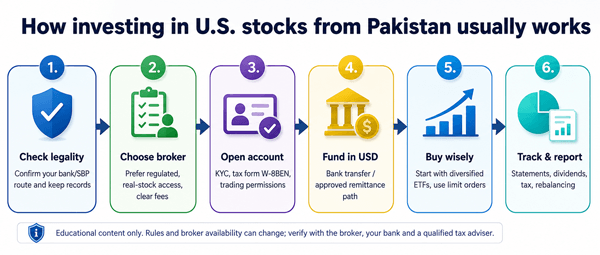
Pakistani residents can potentially invest in U.S. stocks by opening an account with an international broker that accepts Pakistan-based clients, completing identity checks and U.S. tax documentation, funding the account through an allowed banking/remittance route, and buying listed U.S. stocks or ETFs. The practical difficulty is not clicking the buy button. The difficult parts are choosing a safe broker, funding the account legally, understanding USD currency risk, avoiding risky products and keeping tax records.
For most beginners, the cleanest starting point is not day trading Tesla or Nvidia. A safer educational starting point is learning how broad-market ETFs work, using small amounts, avoiding leverage, and treating U.S. investing as a long-term portfolio decision rather than a quick-profit scheme.
2. Can Pakistanis invest in U.S. stocks?
Yes, but with important conditions. A Pakistan resident should not assume that every international app, YouTube method or fintech workaround is allowed. Pakistan has foreign-exchange controls, and movement of securities or foreign currency can require proper banking channels and permissions. The State Bank of Pakistan foreign-exchange manual states that taking or sending securities outside Pakistan generally requires general or special permission, and persons who want to send foreign securities to banks, brokers or agents abroad should apply through an Authorized Dealer bank. This is why this article takes a compliance-first approach: use regulated brokers, use documented bank routes and keep records.
In simple words: opening an online brokerage account is one part of the process; moving money from Pakistan to that broker is the part that must be handled carefully. Before funding an account, contact your bank, explain that you want to invest abroad through a regulated brokerage account, ask what documentation is required, and keep written evidence of the bank’s response.
3. How U.S. stock investing works in plain English
When you buy a U.S. stock, you are buying a small ownership share in a company listed on a U.S. exchange such as the New York Stock Exchange or Nasdaq. When you buy an ETF, you are usually buying one fund that holds many stocks. For example, an S&P 500 ETF gives exposure to around 500 large U.S. companies through one ticker. That is why ETFs are popular among beginners: they reduce single-company risk and make diversification easier.
A broker is the middleman that gives you market access. You deposit money with the broker, search a ticker such as AAPL, MSFT, VOO or VTI, place an order, and the broker executes it on the exchange or through its execution network. Your holdings appear inside your brokerage account, and the broker provides statements showing cash, securities, trades, fees and dividends.
| Term | Meaning for a beginner | Why it matters |
|---|---|---|
| Stock | A share in one company such as Apple or Microsoft. | Higher company-specific risk; returns depend heavily on that business. |
| ETF | A fund traded like a stock that may hold hundreds or thousands of securities. | Often better for beginners because one purchase can diversify your money. |
| Ticker | Short code used to search a stock or ETF, such as AAPL or VOO. | Always verify the exact ticker before buying. Similar tickers can be different products. |
| Fractional share | Buying part of one share instead of a full share. | Useful if one share is expensive and you want to invest small amounts. |
| Dividend | Cash paid by some companies or ETFs to shareholders. | U.S. withholding tax may apply before you receive it. |
| Capital gain/loss | Profit or loss when you sell for more or less than your purchase price. | You need records for tax reporting and performance tracking. |
| USD/PKR risk | Your investment is in U.S. dollars, while your expenses may be in rupees. | Even if the stock price is flat, currency movements can change your rupee return. |
4. Best brokers for Pakistan residents to buy U.S. stocks
Broker availability changes often, and onboarding may depend on your nationality, residency, sanctions screening, documents, funding route and account type. The comparison below is written for a Pakistan-based beginner who wants real U.S. stocks or ETFs, not high-leverage CFDs. Always confirm directly on the broker website before applying.
| Broker / platform | Best for | Pakistan availability notes | Key strengths | Main cautions |
|---|---|---|---|---|
| Interactive Brokers (IBKR) | Most serious long-term investors, ETF buyers and people who want broad market access. | Interactive Brokers lists Pakistan in its available countries list. | Large global broker, U.S. stocks and ETFs, fractional shares, strong reporting, low commissions on IBKR Pro, no account minimum advertised on main pricing pages. | Interface can feel technical for beginners; funding from Pakistan may be the real bottleneck; market data subscriptions can confuse new users. |
| CapTrader | Investors who want an introducing broker built around IBKR infrastructure. | BrokerChooser ranks it among available choices for Pakistan, but direct verification is required. | Access to many markets and generally competitive fees. | May have different support, fee and onboarding rules from direct IBKR. Check custody, protections and costs. |
| Zacks Trade | Investors who want U.S.-focused research/support and are comfortable with a less beginner-style platform. | Listed by BrokerChooser as an option for Pakistan; verify directly. | U.S. stocks/ETFs, research-oriented positioning. | Minimums and commissions may be less attractive for tiny accounts; check account approval and funding carefully. |
| Saxo Bank / Saxo Markets | Higher-balance investors who value a polished platform and multi-asset access. | Availability and entity depend on region; Pakistan residents must verify with Saxo directly. | Strong platform, research, global markets. | Can be more expensive for small accounts; custody/platform fees may apply depending on entity. |
| CFD/forex apps advertising U.S. stocks | Generally not recommended for beginners seeking long-term ownership. | Some accept Pakistan clients, but many offer CFDs, not real shares. | Easy signup and card-style funding in some cases. | High risk: leverage, spreads, overnight fees, liquidation risk, unclear protections. Beginners often misunderstand CFDs as real stock ownership. |
Practical verdict: For most Pakistan-based beginners who want actual U.S. stocks and ETFs, Interactive Brokers is usually the first broker to investigate because it publicly lists Pakistan as an eligible country and offers broad U.S. market access. However, “best broker” does not mean “best for everyone.” The best choice is the one you can fund legally, understand clearly and use without taking unnecessary risk.
5. How to choose a broker: a beginner checklist
- Confirm the broker accepts residents of Pakistan today, not last year.
- Prefer real stocks and ETFs over CFDs if your goal is long-term investing.
- Check regulation, investor protection, account entity, custody and whether the broker is an SIPC member for U.S. securities accounts.
- Check all costs: trading commission, FX conversion, withdrawal fee, inactivity fee, custody fee, market data fee and bank wire charges.
- Check minimum deposit, fractional shares, ETF availability and whether you can download annual statements.
- Check whether the platform supports two-factor authentication and withdrawal security.
- Contact customer support before depositing. A good broker should clearly explain documents, tax forms and funding instructions.
6. Broker safety: what SIPC does and does not protect
Many beginners hear “insured brokerage account” and assume their stocks cannot go down. That is wrong. SIPC protection is mainly about a broker failure, not market losses. SIPC states that if a securities broker fails, protection covers securities and cash in a brokerage account up to $500,000, including up to $250,000 for cash. It does not protect you from a bad investment, a stock crash, currency losses or your own trading decisions.
| Risk | Covered by SIPC? | What to do |
|---|---|---|
| Broker fails and customer securities are missing | Potentially, within limits and rules. | Use regulated/SIPC-member brokers where applicable and keep statements. |
| Apple stock falls 40% | No. | Diversify and avoid putting all money in one company. |
| PKR strengthens after you buy USD assets | No. | Understand currency risk before investing. |
| You send money to a fake broker or scammer | No. | Verify URLs, regulation, bank account names and never trust WhatsApp “account managers.” |
| You lose money in leveraged CFD trading | No. | Avoid leverage, CFDs and margin as a beginner. |
7. Step-by-step: how to invest in U.S. stocks from Pakistan
7.1 Decide why you are investing
Before opening any app, write down your goal. Are you investing for education, long-term wealth, dollar exposure, retirement-style savings or learning? If your goal is “make fast money,” pause. U.S. markets are liquid and accessible, but they are not easy money. A realistic beginner goal is: invest small amounts regularly in diversified assets for many years.
7.2 Check your legal and banking route
Speak to an Authorized Dealer bank in Pakistan before sending funds abroad. Ask what documents they need, whether SBP permission or a specific remittance category applies, what limits exist, and whether they can send funds directly to your brokerage account. Keep emails, forms, receipts and SWIFT messages. Avoid informal money changers, third-party transfers and “friends abroad” funding unless professionally advised and documented.
7.3 Choose a regulated broker
Shortlist brokers that accept Pakistan residents and allow real U.S. stocks/ETFs. For many readers, IBKR will be the most practical starting point to research. Do not choose a broker only because a TikTok creator says deposits are easy. Easy deposit plus weak regulation is a dangerous combination.
7.4 Prepare documents
You will usually need a passport or national identity document, proof of address, tax residency details, phone/email verification, employment or source-of-funds information and sometimes bank statements. Use your real information. Do not fake residency, use a VPN location, borrow someone else’s address or hide source of funds. That can lead to account closure and compliance problems.
7.5 Complete W-8BEN tax form
Non-U.S. individuals are commonly asked to complete IRS Form W-8BEN through the broker. This tells the broker that you are a foreign beneficial owner. The IRS instructions warn that failure to provide Form W-8BEN when requested may lead to the 30% foreign-person withholding rate. For Pakistani individual investors, treaty benefits are a tax-adviser question; do not assume a reduced rate unless the broker’s tax form process and treaty rules clearly support it.
7.6 Fund the account
Use the broker’s official deposit instructions. The bank account name should match the regulated broker or its custodian, not an individual. Send a small test amount first if allowed. Compare costs: Pakistani bank wire fee, correspondent bank charges, exchange rate spread and broker deposit/withdrawal fees. Do not invest emergency money.
7.7 Convert or hold USD correctly
Some brokers let you deposit USD directly; others may receive another currency and convert. Understand the FX rate and commission before converting. With IBKR, spot currency costs can be low, but the interface is not always beginner-friendly. A small FX mistake can create an unintended currency balance or margin issue.
7.8 Buy your first investment carefully
Search the ticker, review the product name, exchange, currency, expense ratio and whether it is a real ETF or a leveraged/inverse product. For a first trade, many beginners use a limit order instead of a market order because a limit order controls the maximum price they are willing to pay. Investor.gov explains that market orders guarantee execution but not price, while limit orders set a specific price or better.
7.9 Keep records
Download trade confirmations, monthly statements, annual reports and dividend statements. Keep a spreadsheet with date, ticker, quantity, price, commission, USD amount, PKR exchange rate and reason for purchase. This helps with taxes, performance tracking and future withdrawals.
7.10 Review, rebalance and stay boring
A good portfolio does not need daily action. Review monthly or quarterly. Rebalance if one part becomes too large. Avoid reacting to every market headline. Long-term investing is usually boring; that is a feature, not a bug.
8. Practical funding example
Assume Ali in Lahore wants to start with USD 1,000. He contacts his bank, confirms the documentation path, opens a regulated brokerage account, completes W-8BEN, sends a small test wire and then invests gradually. His real cost is not just the broker commission. It includes exchange-rate spread and bank charges.
| Item | Example amount | What it means |
|---|---|---|
| Intended investment | USD 1,000 | Money Ali wants to put into U.S. ETFs. |
| Bank FX spread | For example 1% to 3% equivalent | The difference between interbank USD/PKR and the rate offered to him. This can be bigger than the broker commission. |
| Wire/SWIFT charges | Varies by bank and intermediaries | Can make small transfers expensive. Larger, less frequent transfers may be cheaper, but only if legal and affordable. |
| Broker commission | Depends on plan and order | For low-cost brokers, this may be small compared with funding cost. |
| Dividend withholding | Often up to 30% without treaty reduction | Applied to dividends before cash reaches the account. It does not apply to unrealized price gains. |
| Currency movement | Can help or hurt | If USD rises against PKR, rupee value can rise even if the stock is flat; if USD falls, rupee value can fall. |
The lesson: A Pakistani investor should compare total cost, not only “zero commission.” A broker with low commission can still feel expensive if funding costs are high or withdrawals are difficult.
9. What should a beginner buy first: stocks or ETFs?
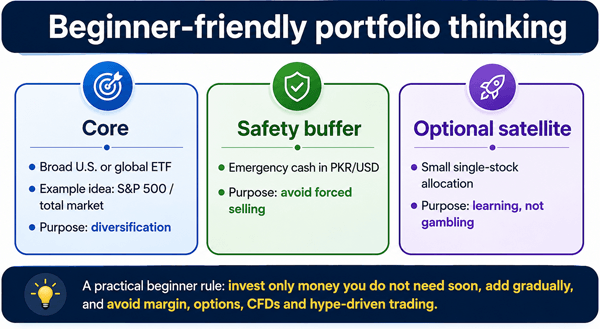
For a person with no experience, broad ETFs are usually easier to understand and manage than individual stocks. The U.S. Securities and Exchange Commission notes that ETFs and mutual funds can make diversification less expensive than buying many individual stocks and bonds. That does not mean ETFs are risk-free. It means they reduce the risk that one company ruins your whole portfolio.
| Choice | Good for | Beginner risk | Practical example |
|---|---|---|---|
| Broad-market ETF | Long-term, diversified exposure. | Market can fall; USD risk remains; ETF expense ratio applies. | An S&P 500 ETF or total U.S. market ETF as a core holding. |
| Individual stock | Learning about businesses and targeted exposure. | High company-specific risk; easy to overtrade. | Buying a small amount of Microsoft after reading its financials. |
| Leveraged ETF | Short-term traders only, not beginners. | Can decay and lose money quickly; not for long-term holding. | Avoid unless you deeply understand it. |
| CFD on U.S. stocks | Speculation, not ownership. | Leverage, overnight fees and liquidation risk. | Beginners should generally avoid. |
10. A simple beginner portfolio example
This is not a recommendation, only a teaching example. A cautious beginner might keep most savings in local emergency cash and invest only a small, affordable amount abroad. Inside the U.S. brokerage account, the person might use a broad ETF as the core and keep single stocks small until they have more experience.
| Portfolio part | Example allocation | Purpose | Beginner note |
|---|---|---|---|
| Broad U.S. or global ETF | 80% to 100% of invested amount | Diversification and long-term exposure. | Simpler than picking stocks. |
| Single stocks | 0% to 20% | Learning and personal conviction. | Keep small; write down why you are buying. |
| Cash inside broker | Small amount only | Fees, future purchases or withdrawal buffer. | Large idle cash may create tax/withholding or opportunity-cost questions. |
| Margin/options/CFDs | 0% | Not needed for beginners. | Avoid until advanced, and even then use extreme caution. |
11. Taxes Pakistani investors should know about
Tax is one of the most misunderstood parts of investing in U.S. stocks from Pakistan. There are two sides: U.S. withholding tax and Pakistan tax/reporting. U.S. dividends paid to non-U.S. investors are commonly subject to withholding. Brokers collect tax documentation through forms such as W-8BEN. In Pakistan, residents may have reporting and tax obligations for foreign income and assets depending on their facts. Because tax law changes and personal status matters, the honest advice is to keep records and speak with a qualified tax adviser rather than relying on social-media comments.
| Tax topic | Beginner explanation | Action |
|---|---|---|
| W-8BEN | A form used by foreign individuals to certify non-U.S. status to the broker/withholding agent. | Complete it accurately inside the broker portal when requested. |
| Dividend withholding | U.S. tax may be withheld before dividends are paid to you. | Track gross dividend, tax withheld and net dividend. |
| Capital gains | Selling at a profit may create reporting/tax questions in Pakistan. | Keep trade records, exchange rates and broker statements. |
| Foreign assets | Foreign brokerage assets may need disclosure depending on your tax profile. | Discuss with an FBR-aware tax professional. |
| Double taxation | Some taxes paid abroad may be relevant for local reporting, but rules are technical. | Do not assume automatic exemption; get advice. |
12. Common mistakes Pakistani beginners make
| Mistake | Why it hurts | Better practice |
|---|---|---|
| Using a random CFD app because deposits are easy | You may not own real shares, and leverage can wipe out cash quickly. | Use regulated brokers and understand product type. |
| Ignoring SBP/bank requirements | Funding may be blocked, reversed or questioned. | Use Authorized Dealer banking channels and written documentation. |
| Buying only famous stocks | Good companies can still be bad investments at the wrong price. | Use diversified ETFs as a core and keep single-stock bets small. |
| Confusing zero commission with zero cost | FX spreads, wire charges and taxes may be larger than commission. | Calculate total cost before funding. |
| Using market orders in fast-moving stocks | Execution price can surprise you. | Use limit orders for control. |
| Keeping no records | Tax filing and performance tracking become painful. | Download statements and maintain a simple spreadsheet. |
| Investing emergency funds | A market crash may force you to sell at a loss. | Keep emergency cash separate before investing abroad. |
| Following WhatsApp signals | Incentives are unclear, and pump-and-dump risk is high. | Use research, diversification and written rules. |
13. A practical due-diligence checklist before depositing money
- Type the broker URL yourself. Do not open account links from WhatsApp groups.
- Check the broker’s regulator and legal entity that will hold your account.
- Confirm Pakistan is accepted for new accounts today.
- Read the broker’s fee page, not just a review article.
- Confirm whether you are buying real stocks/ETFs or CFDs.
- Ask your bank for the legal remittance route and required documents.
- Send only to the official broker/custodian bank account shown in your secure broker portal.
- Enable two-factor authentication before funding.
- Start with a small amount and test withdrawal after your account is active.
- Keep screenshots, confirmations and statements in a secure folder.
14. How to write the first trade plan
Before buying anything, write a one-page trade plan. This simple habit prevents emotional investing.
| Question | Example answer |
|---|---|
| What am I buying? | A broad U.S. market ETF, not a leveraged product. |
| Why am I buying it? | Long-term diversified exposure to U.S. equities. |
| How long can I hold? | At least 5 to 10 years. |
| How much can I afford to lose on paper? | I can tolerate a 30% temporary fall without selling. |
| What order type will I use? | Limit order during U.S. market hours. |
| When will I add more? | Monthly or quarterly, only from surplus savings. |
| When will I sell? | Only if my goal changes, the product changes, or I need planned funds. |
15. FAQ: U.S. stock investing from Pakistan
15.1 Can I buy U.S. stocks from Pakistan?
Potentially yes, through an international broker that accepts Pakistan residents and through a compliant funding route. The key is to verify broker eligibility and use proper banking documentation.
15.2 What is the best broker for U.S. stocks in Pakistan?
Interactive Brokers is often the first broker to research because it lists Pakistan as an available country and provides access to U.S. stocks and ETFs. But the best broker depends on approval, funding, fees and your experience level.
15.3 Can I invest in the S&P 500 from Pakistan?
You may be able to buy an S&P 500 ETF through an eligible international brokerage account. Check the exact ETF ticker, expense ratio, domicile, tax treatment and broker availability.
15.4 Is U.S. stock investing halal?
This depends on the company, ETF holdings, debt levels, business activities and your chosen Shariah screening method. Consider a qualified Islamic finance adviser and look for Shariah-screened ETFs if this matters to you.
15.5 How much money do I need to start?
Technically, fractional shares can allow small investments, but international wire and FX costs can make very small amounts inefficient. Start only after emergency savings and after understanding total costs.
15.6 Do I need a U.S. bank account?
Usually not for brokers that accept international wire transfers, but funding from Pakistan must be handled through proper channels. Some fintech accounts may not be available to Pakistan residents or may violate terms if misused.
15.7 Should beginners trade options or margin?
No. Options, margin and leveraged products can create losses far beyond what beginners expect. Learn basic investing first.
15.8 What happens if the broker closes my account?
You may need to sell holdings or transfer them to another broker. This is why you should use reputable brokers, keep records and avoid violating residency, KYC or funding rules.
15.9 Are dividends taxed?
U.S. dividends to foreign investors are commonly subject to withholding, and Pakistani tax/reporting obligations may also apply. Keep statements and consult a tax adviser.
15.10 Is it better to invest in Pakistan stocks or U.S. stocks?
They serve different purposes. Pakistan stocks may match local opportunities and PKR needs; U.S. stocks provide global-dollar exposure. A thoughtful investor compares goals, currency, risk, taxes and costs.
16. Final beginner roadmap
- Learn the difference between real stocks, ETFs and CFDs.
- Confirm legal banking/remittance requirements before funding.
- Shortlist regulated brokers that accept Pakistan residents.
- Prepare documents honestly and complete W-8BEN accurately.
- Start with a small, affordable amount.
- Use diversified ETFs before individual stocks.
- Use limit orders and avoid leverage.
- Keep records for tax and personal tracking.
- Review quarterly, not hourly.
- Increase slowly only after you understand costs, risks and reporting.
Bottom line: Investing in U.S. stocks from Pakistan is possible for some investors, but it is not as simple as downloading an app and buying Apple shares. The winning approach is boring and careful: verify rules, choose a regulated broker, fund legally, buy diversified assets, keep records and avoid products you do not understand.
Sources Consulted and Checked
These sources were consulted and checked while preparing this article to support accuracy, reliability and further verification.
- State Bank of Pakistan, Foreign Exchange Manual, Chapter 20: Securities - https://www.sbp.org.pk/fe_manual/pdf/2021/Chapter-20.pdf
- Interactive Brokers, Available Countries and Territories - https://www.interactivebrokers.com/en/accounts/open-account-country-list.php
- Interactive Brokers, Commissions and Fees - https://www.interactivebrokers.com/en/pricing/commissions-home.php
- Interactive Brokers, Stock Commissions and Fractional Share Notes - https://www.interactivebrokers.com/en/pricing/commissions-stocks.php
- SIPC, Investor Protection Limits - https://www.sipc.org/
- IRS, Instructions for Form W-8BEN - https://www.irs.gov/pub/irs-pdf/iw8ben.pdf
- Investor.gov, Types of Orders - https://www.investor.gov/introduction-investing/investing-basics/how-stock-markets-work/types-orders
- Investor.gov, Introduction to Investing - https://www.investor.gov/introduction-investing
- U.S. SEC, Mutual Funds and ETFs investor guide - https://www.sec.gov/investor/pubs/sec-guide-to-mutual-funds.pdf
- BrokerChooser, Best Brokers for Buying U.S. Stocks for Global Investors in Pakistan - https://brokerchooser.com/best-brokers/best-brokers-us-stocks-global-investors-in-pakistan
Reader Advice
This article is provided solely for educational and informational purposes and does not constitute personal financial, investment, tax, legal or foreign-exchange advice. Investing involves risk, including possible loss of principal. Broker availability, fees, tax treatment, remittance procedures, foreign-exchange rules and regulatory requirements may change based on residency, account type, bank policy and other circumstances.
Before opening or funding an account, readers should verify all current facts, figures and requirements directly with the relevant broker, an Authorized Dealer bank, the State Bank of Pakistan, the Federal Board of Revenue and other official sources, and obtain advice from appropriately qualified professionals. Readers should make decisions only after considering their own objectives, financial position, risk tolerance and legal obligations.