How to Buy U.S. Stocks from India: Best Apps and Complete Guide
1. Quick answer
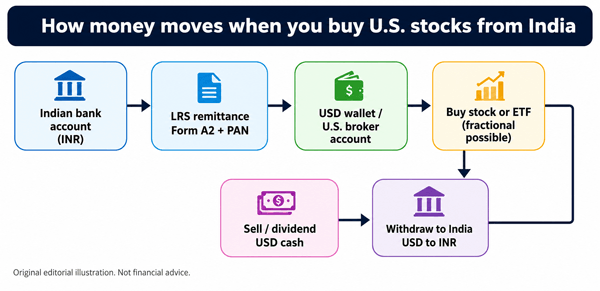
Yes, Indian residents can buy U.S. stocks such as Apple, Microsoft, Nvidia, Amazon, Tesla, Google/Alphabet, and U.S.-listed ETFs through global investing apps, Indian apps with U.S. stock access, or GIFT City routes. The normal route is: complete KYC, open a U.S. brokerage-linked account, remit money under RBI’s Liberalised Remittance Scheme (LRS), convert INR to USD, buy shares or fractional shares, and report foreign assets and income correctly in the Indian income-tax return.
For most beginners, the best route is not “pick ten famous U.S. stocks on day one.” A cleaner start is usually a diversified U.S. ETF or a small, rule-based portfolio with proper tax records. The biggest practical issues are not only brokerage fees; they are currency conversion cost, remittance charges, TCS cash-flow impact, tax reporting, dividend withholding, estate-tax exposure, and platform safety.
2. What does buying U.S. stocks from India mean?
When you buy a U.S. stock from India, you are investing in a company listed on a U.S. exchange such as Nasdaq or NYSE. You may own the stock directly through a U.S. brokerage account, or you may get exposure through an Indian mutual fund, ETF, fund-of-fund, or GIFT City product. Direct investing gives more control, but also more responsibility.
A simple example: suppose you want to invest Rs 50,000 in Apple. The money first moves from your Indian bank in rupees, gets converted to U.S. dollars, reaches your global investing account, and then you buy Apple shares or a fraction of one share. When you sell, the reverse process happens. Any profit, dividend, and foreign holding may need to be reported in India.
3. Why do Indian investors buy U.S. stocks?
- Global diversification: your income, home, emergency fund, and many investments may already be India-linked. U.S. exposure can reduce single-country concentration.
- Access to global leaders: many dominant companies in AI, cloud computing, semiconductors, software, payments, entertainment, and consumer brands are U.S.-listed.
- Dollar exposure: returns are affected by both stock performance and USD/INR movement. This can help if future goals are dollar-linked, such as overseas education.
- ETF choice: the U.S. market has deep ETF options, including S&P 500 ETFs, Nasdaq-100 ETFs, dividend ETFs, bond ETFs, and sector ETFs.
- Fractional shares: many apps allow investing small amounts, so beginners can buy a fraction of expensive shares instead of waiting to afford a full share.
But U.S. investing is not automatically better. The Nasdaq can fall sharply, currency can move both ways, and tax paperwork is more detailed than a normal Indian equity account. The right question is not “Can I buy U.S. stocks?” but “How much of my portfolio should reasonably be outside India, and can I maintain the paperwork?”
4. Who should consider it - and who should wait?
| Investor type | Good fit? | Practical guidance |
|---|---|---|
| Beginner with no emergency fund | Not yet | First build emergency savings, insurance, and basic Indian investments. U.S. stocks are not a substitute for financial foundation. |
| Long-term investor with 5+ year horizon | Potentially yes | Start with a diversified ETF or small allocation. Avoid day trading and hype-driven concentration. |
| Parent saving for overseas education | Often useful | Dollar exposure may match the future expense currency, but use a planned allocation and avoid last-minute risk. |
| Short-term trader | Risky | U.S. markets move at night in India; leverage, options, and frequent trading can be costly and unsuitable for most beginners. |
| Investor uncomfortable with tax reporting | Use simpler route | Consider Indian international mutual funds/ETFs or consult a CA before direct holdings. |
5. Main ways to invest in U.S. stocks from India
| Route | How it works | Best for | Main drawback |
|---|---|---|---|
| Direct U.S. stock apps | Open a brokerage-linked account, remit USD, buy stocks/ETFs directly. | Investors who want control, fractional shares, and specific U.S. stocks. | More tax reporting, currency conversion, and estate-tax considerations. |
| Indian mutual funds / FoFs | Invest in INR; fund invests abroad or in an overseas ETF. | Beginners wanting simple rupee investing and SIP. | Expense ratio, tracking limits, fund restrictions, less control. |
| GIFT City route | Access U.S. stocks/receipts through IFSC/GIFT City platforms. | Investors wanting a regulated India-linked international route. | Product availability, liquidity, and costs need careful comparison. |
| International broker directly | Open with a global broker that accepts Indian residents. | Advanced investors needing wide market access and lower direct brokerage. | Funding, support, tax documents, and compliance may be less beginner-friendly. |
6. Best apps to buy U.S. stocks from India
The “best” app depends on your use case. A beginner should compare regulation, partner broker, SIPC/asset protection disclosures, funding cost, FX spread, withdrawal cost, tax reports, support quality, and ease of Form W-8BEN/documentation. Do not choose only because the app says zero brokerage; the bigger cost can be currency conversion and remittance friction.
| App/platform | What it is useful for | Strengths to check | Watch-outs |
|---|---|---|---|
| INDmoney | All-in-one Indian and U.S. investing app. | Easy onboarding, Indian stocks plus U.S. stocks, app-based reports, widely used consumer interface. | Verify live pricing, FX spread, partner structure, tax statements, and withdrawal terms before funding. |
| Vested | Global investing specialist focused on U.S. stocks/ETFs and global products. | Long-running U.S. investing platform for Indian users, fractional investing, global investing focus. | Check plan pricing, funding method, bank charges, and exact broker/custodian details. |
| Winvesta | Global investing and U.S. stock access for Indian residents. | Fractional investing, broad U.S. securities access, advanced order features in some versions. | Withdrawal/remittance fees and support experience should be checked before large transfers. |
| Appreciate | Newer app focused on U.S. stocks, ETFs, SIP-style investing, and low-friction remittance. | Simple interface, fractional access, claims of low/no withdrawal fees. | Because it is newer than some competitors, check regulatory disclosures, partner broker, and user support record carefully. |
| Angel One via Vested / partner routes | Indian broker interface providing U.S. investing through a partner. | Useful for users already comfortable with the Indian broker. | Understand who actually holds assets, where statements come from, and what fees apply. |
| Zerodha/GIFT City style route | Access to U.S. stocks/receipts through IFSC/GIFT City products where available. | May suit investors who prefer India-linked market infrastructure. | Check liquidity, product universe, spreads, and whether you own direct U.S. shares or receipts. |
Practical ranking by use case: for a first-time investor who wants the easiest app experience, compare INDmoney, Vested, and Appreciate. For a globally focused investor who wants a platform built around international investing, compare Vested and Winvesta. For someone who already uses a major Indian broker, partner routes may feel familiar, but they still require understanding the U.S. custody and fee structure.
7. Step-by-step: how to buy your first U.S. stock from India
- Choose the route. Decide whether you want direct U.S. stocks, a U.S. ETF, an Indian international mutual fund, or a GIFT City product.
- Shortlist two or three apps. Compare fees, FX rate, withdrawal fee, tax reports, broker/custodian, regulatory disclosures, reviews, and support response.
- Complete KYC. Usually you need PAN, Aadhaar/identity proof, address proof, Indian bank account, and sometimes a selfie or video verification.
- Complete U.S. tax form W-8BEN if required. This helps the broker apply the correct non-resident tax treatment on U.S. dividends.
- Fund the account. You remit money under LRS from your Indian bank. The app may guide you through the purpose code, Form A2, and bank transfer process.
- Convert INR to USD and check the net amount. Before buying, note the exchange rate, remittance fee, GST, and any TCS impact.
- Place the order. Beginners should prefer limit orders for individual stocks and avoid chasing after-hours price movements.
- Download records. Save contract notes, account statements, dividend statements, tax documents, and remittance proofs for ITR filing.
- Review allocation quarterly, not every hour. U.S. markets run at night in India; constant checking often leads to emotional decisions.
7.1 Example: buying Apple stock from India with Rs 50,000
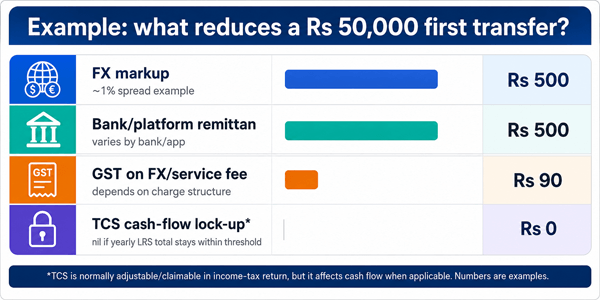
Assume an investor transfers Rs 50,000. The bank/app converts INR to USD. If the all-in currency and transfer cost is around Rs 1,000 in this simplified example, about Rs 49,000 worth of USD reaches the investing account. If Apple trades at a high dollar price, fractional investing allows buying 0.2, 0.5, or any supported fraction instead of one full share. Later, if the investment grows, the investor sells, receives USD, and can withdraw to the Indian bank account after conversion.
8. Fees and hidden costs beginners often miss
| Cost | What it means | Beginner tip |
|---|---|---|
| Brokerage/commission | Fee on buy/sell trades. Some apps advertise zero brokerage. | Zero brokerage does not mean zero cost. Check all other charges. |
| FX markup/spread | Difference between market USD/INR rate and the rate you receive. | This can be the biggest cost for small investors. Compare net USD received. |
| Bank remittance fee | Fixed fee charged by bank or transfer partner. | Small transfers suffer more because fixed fees are a bigger percentage. |
| GST | May apply on currency conversion/service charges. | Ask for a clear fee breakup before transfer. |
| Withdrawal fee | Cost to bring money back to India. | Check both platform fee and receiving bank charges. |
| TCS | Tax collected at source on certain LRS remittances above the applicable threshold. | Usually creditable/adjustable in ITR, but it can lock cash until tax filing/refund. |
| ETF expense ratio | Annual cost inside an ETF or fund. | Low-cost broad ETFs can be efficient, but compare U.S.-domiciled vs other structures. |
| Tax filing cost | CA or software cost for reporting foreign assets/income. | Budget this if you hold direct foreign stocks. |
9. LRS rules every Indian investor should know
The RBI Liberalised Remittance Scheme allows resident individuals to remit up to USD 250,000 per financial year for permitted current or capital account transactions, including overseas investments. The limit is per resident individual and includes other LRS uses such as travel, education, medical treatment, gifts, and maintaining relatives abroad. If you already used LRS for another purpose in the same financial year, your remaining investment room reduces.
- Use only your own bank account and correct PAN details. Do not route someone else’s money through your account.
- Maintain Form A2/remittance proof and app statements. These are useful for tax and compliance records.
- Do not use LRS for prohibited purposes, leveraged trading, margin products, lottery, banned entities, or transactions that the bank/app does not permit.
- For minors, LRS may be available with guardian formalities, but tax and documentation become more sensitive.
- NRIs are not treated the same as resident Indians for every rule; they should check NRE/NRO and country-of-residence rules separately.
10. Taxes on U.S. stocks for Indian residents
Tax is one of the most important parts of direct U.S. investing. The exact treatment can change, so readers should consult a qualified tax professional for their facts. The broad beginner framework is below.
| Item | Typical treatment for Indian resident individual | What to remember |
|---|---|---|
| U.S. dividends | U.S. generally withholds tax on dividends for non-resident investors; India taxes global income, with foreign tax credit subject to rules. | Dividend yield may look attractive before tax but lower after withholding. File Form 67/Schedule TR where applicable. |
| Capital gains in U.S. | Non-resident aliens are generally not taxed by the U.S. on normal stock capital gains, but India taxes the gains. | Keep buy/sell dates, USD amounts, INR conversion, and charges. |
| Indian capital gains | Foreign shares are usually treated differently from listed Indian equity for tax holding-period and rate purposes. | Do not assume Indian STT equity rules apply to U.S. shares. |
| Foreign asset reporting | Foreign stocks/accounts may need disclosure in the Foreign Assets schedule of ITR. | Non-reporting can create penalties. Save year-end statements. |
| TCS under LRS | Collected by authorised dealer/platform when applicable; generally available as credit/refund subject to tax filing. | It is not an extra investment tax, but it affects cash flow. |
| Estate tax risk | U.S.-situated assets may create U.S. estate-tax filing/exposure for non-U.S. persons above low thresholds. | Large direct U.S. stock portfolios need estate planning advice. |
11. Safety checklist before choosing a U.S. stock app
| Question to ask | Why it matters |
|---|---|
| Who is the U.S. broker/custodian? | The app may be an interface; assets may be held by a partner broker. Know the actual regulated entity. |
| Is there SIPC protection and what exactly is covered? | SIPC is not market-loss insurance. It may protect eligible securities/cash if a member broker fails, subject to limits. |
| How does the app earn money? | Revenue can come from FX spread, plans, remittance fees, brokerage, interest, or partner arrangements. |
| Can I download official statements? | You need records for taxes, audit trail, and estate/nominee planning. |
| What happens if the app shuts down? | Understand whether you can transfer securities to another broker and how support will work. |
| Are reviews complaining about withdrawals? | Withdrawal delays and unclear support are more serious than a pretty interface. |
| Is customer support reachable? | Test support with a small query before sending a large amount. |
12. Beginner portfolio examples
These are educational frameworks, not recommendations. The right allocation depends on income, risk tolerance, goals, taxes, existing portfolio, and time horizon.
| Profile | Possible U.S. allocation approach | Why it may work |
|---|---|---|
| Very new investor | 0-5% learning allocation or use Indian international fund first. | Keeps mistakes small while learning taxes and platform mechanics. |
| Long-term diversified investor | 10-20% of equity portfolio in broad U.S./global ETFs. | Balances Indian growth exposure with global diversification. |
| Overseas education goal | Gradually build dollar exposure using broad ETFs or lower-risk USD assets as goal nears. | Currency matching can reduce rupee-dollar mismatch. |
| Stock picker | Core ETF plus small satellite positions in 3-5 companies. | Avoids putting the full U.S. allocation into fashionable stocks. |
A practical first-month plan: open the account, transfer a small test amount, buy one diversified ETF or one fractional share, download statements, understand tax reports, and only then increase allocation. Many negative user experiences come from transferring too much before understanding costs and withdrawal process.
13. Common mistakes to avoid
- Buying only famous names because they appear daily in news.
- Ignoring currency conversion cost and looking only at brokerage.
- Trading at night out of excitement and losing discipline.
- Not reporting foreign assets/income correctly in ITR.
- Assuming U.S. stocks are safer than Indian stocks. They can also fall 30-50%.
- Putting emergency money or short-term goal money into volatile stocks.
- Not understanding estate-tax exposure for large direct holdings.
- Using leverage, margin, options, or complex ETFs without experience.
14. U.S. stocks vs Indian international mutual funds
| Feature | Direct U.S. stocks/apps | Indian international mutual funds/FoFs |
|---|---|---|
| Control | High: choose exact stocks/ETFs. | Low/medium: fund manager or index decides. |
| Minimum amount | Can be low with fractional shares. | Often SIP-friendly in INR. |
| Currency handling | Investor handles remittance and USD conversion. | Fund handles overseas investing; investor pays in INR. |
| Tax paperwork | More detailed foreign asset/income reporting. | Usually simpler for investor. |
| Costs | FX/remittance/app/trading costs. | Expense ratio and possible tracking/underlying fund cost. |
| Best for | Investors wanting direct exposure and control. | Beginners wanting simplicity and rupee SIP. |
15. Frequently asked questions
15.1 Can I buy U.S. stocks from India legally?
Yes, resident individuals can invest overseas within the permitted LRS framework and platform rules. The key is to use authorised banking channels, complete KYC, and follow tax reporting requirements.
15.2 What is the minimum amount needed?
Some apps allow fractional investing from very small dollar amounts, but the practical minimum should consider fixed remittance fees. A Rs 1,000 test transfer may be inefficient if fixed costs are high; many beginners start with a small but meaningful amount after checking fees.
15.3 Can I buy fractional shares of Apple, Tesla, Nvidia, or Amazon?
Many U.S. investing apps offer fractional shares, but availability depends on the broker and security. Always verify before funding.
15.4 Is SIP possible in U.S. stocks?
Some platforms offer SIP-style recurring investing. Even when automatic SIP is available, confirm how each remittance is handled, what FX rate applies, and whether TCS or bank charges affect recurring transfers.
15.5 Are U.S. stocks better than Indian stocks?
Not always. U.S. stocks offer global diversification and access to certain sectors, but valuations, currency movement, taxes, and reporting complexity matter. A balanced portfolio can include both Indian and global exposure.
15.6 Do I need a CA?
For very small learning investments, tax software may be enough for some users, but direct foreign assets make ITR more detailed. If dividends, multiple trades, or larger holdings are involved, a CA familiar with foreign assets is strongly advisable.
15.7 What happens when I receive dividends?
U.S. dividend withholding may apply before the dividend reaches your account. The dividend is still part of your Indian tax calculation, with foreign tax credit subject to filing rules.
15.8 Should beginners buy individual stocks or ETFs?
Most beginners are better served by starting with diversified ETFs or a small allocation. Individual stocks require business analysis, valuation discipline, and emotional control.
16. Final beginner checklist
- Decide your goal: diversification, dollar goal, or learning.
- Keep U.S. exposure within a sensible percentage of your total portfolio.
- Compare at least two apps using net USD received, not marketing claims.
- Start with a test amount and complete one full buy/sell/statement cycle.
- Prefer diversified ETFs before concentrated stock picking.
- Keep all remittance, trade, dividend, and year-end statements.
- Report foreign assets and income honestly in ITR.
- Consult a qualified tax professional before large allocations.
17. Bottom line
Buying U.S. stocks from India is now much easier than it was a decade ago, but easy access does not remove responsibility. The smartest beginner is not the one who opens the fastest account; it is the one who understands LRS, costs, taxes, platform safety, and portfolio allocation before sending money. Start small, learn the process, use diversified exposure, maintain clean records, and treat global investing as a long-term wealth-building tool rather than a shortcut to quick returns.
Sources Consulted and Checked
The following sources were consulted and checked while preparing this article to support accuracy and reliability. Readers should still verify current rules, rates, fees, tax provisions, and platform terms directly from official or primary sources before acting.
- RBI FAQ on Liberalised Remittance Scheme: https://www.rbi.org.in/Commonperson/english/Scripts/FAQs.aspx?Id=1834
- INDmoney U.S. stocks and pricing pages: https://www.indmoney.com/us-stocks ; https://www.indmoney.com/pricing
- Vested Finance disclosures: https://vestedfinance.com/
- Winvesta U.S. stocks page / app listing: https://www.winvesta.in/invest-in-us-stocks
- Appreciate U.S. stocks page: https://appreciatewealth.com/us-stocks-trading-account
- IRS estate tax for nonresidents: https://www.irs.gov/businesses/small-businesses-self-employed/estate-tax-for-nonresidents-not-citizens-of-the-united-states
- IRS Form 706-NA filing threshold page: https://www.irs.gov/individuals/international-taxpayers/some-nonresidents-with-us-assets-must-file-estate-tax-returns
- Income-tax/TCS references from major banks and tax explainers: Readers should verify the latest Finance Act and bank circulars before making any decision.
Reader Advice
This article is provided solely for educational and informational purposes and does not constitute investment, financial, legal, accounting, or tax advice. Rules, tax rates, remittance limits, platform features, fees, product availability, regulatory requirements, and market conditions may change based on law, policy, jurisdiction, investor status, and other factors.
Before opening an account, transferring money, buying or selling any security, or making any related decision, readers should independently verify all facts and figures from current official sources and obtain advice from appropriately qualified professionals. Investing in stocks, ETFs, foreign securities, and currencies involves risk, including possible loss of capital and adverse currency movements. Examples and portfolio frameworks in this article are simplified illustrations, not personal recommendations or guarantees of returns.