International Investing: A Beginner-Friendly, Practical Guide to Global Investing
1. What International Investing Is and How Beginners Can Use It
International investing means putting part of your money into assets outside your home country. In simple words, instead of only owning companies, bonds, or funds from the country where you live, you also own a small piece of businesses and markets in other parts of the world.
For a beginner, the easiest example is this: a person living in the United States buys an international ETF that owns shares of companies in Europe, Japan, Canada, India, Taiwan, South Korea, Brazil, and other markets. A person living in Pakistan, India, the UAE, the UK, Canada, or Australia may do something similar by using a regulated investment platform that gives access to global ETFs, mutual funds, or foreign shares, depending on local rules.
The main idea is not to chase a hot country or guess which market will rise next month. The practical goal is usually diversification: spreading your investment across more companies, currencies, economies, and industries so your future does not depend on only one market.
| Quick question | Simple answer |
|---|---|
| Is international investing only for rich investors? | No. Many beginners can get global exposure through low-cost ETFs or mutual funds, sometimes with small monthly amounts. |
| Do I need to buy individual foreign stocks? | No. Most beginners are better served by diversified funds than by picking foreign stocks one by one. |
| Is it risk-free? | No. It adds currency, political, tax, and market risks. The aim is to manage risk, not remove it. |
| Is it the same as forex trading? | No. International investing means owning assets. Forex trading usually means speculating on currency movements. |
| Can it fit a retirement portfolio? | Yes, if used sensibly as part of a diversified, long-term plan. |
Key takeaway: International investing is best understood as “owning the world in small pieces,” not betting on one foreign market. A beginner should focus first on broad diversification, low fees, tax awareness, and long-term discipline.
2. Why People Invest Internationally
People usually invest internationally for four practical reasons: diversification, access to global growth, exposure to industries missing at home, and protection against overdependence on one currency or economy. U.S. Investor.gov highlights diversification and growth as two of the chief reasons investors seek international exposure. Vanguard also describes international investing as a way to diversify beyond a single domestic market.
- Diversification: Different countries and sectors do not always move in the same direction at the same time. When one market is weak, another may be stronger.
- Access to global leaders: Many world-class companies are based outside an investor’s home country. Examples may include global luxury brands, semiconductor suppliers, banks, pharmaceutical companies, automakers, energy companies, and consumer brands.
- Growth from emerging economies: Some developing economies may grow faster than mature economies, although they can also be more volatile.
- Currency diversification: International assets may rise or fall partly because of exchange-rate changes. This can help or hurt, but it reduces dependence on only one currency.
- Avoiding home bias: Many investors naturally prefer familiar local companies. That comfort can lead to an overly concentrated portfolio.
3. How International Investing Works
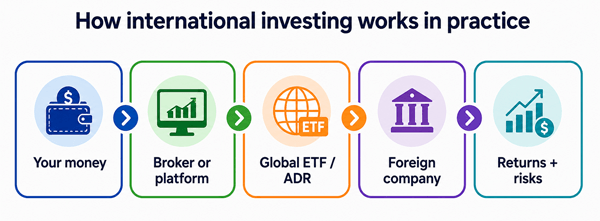
International investing can look complicated from the outside, but the basic process is simple. You use a regulated investment account, choose the type of international exposure you want, invest money, and then your return depends on the assets you own plus currency movements, fees, taxes, and market conditions.
- You open an investment account with a regulated broker, retirement platform, bank, robo-advisor, or wealth management service that allows global investing.
- You choose an investment vehicle, such as an international ETF, mutual fund, global index fund, ADR, or direct foreign share.
- Your money is converted or economically exposed to another currency when the fund or asset buys foreign securities.
- The investment owns shares or bonds from companies and governments outside your home country.
- Your return comes from price changes, dividends or interest, currency changes, minus fees and taxes.
| Method | How it works | Best for | Main caution |
|---|---|---|---|
| International ETF | A fund traded like a stock that holds many foreign stocks or bonds. | Most beginners who want simple, diversified global exposure. | Watch expense ratio, tracking index, liquidity, and currency exposure. |
| International mutual fund | A pooled fund managed passively or actively, often bought through a fund platform. | Investors using retirement plans or platforms where mutual funds are easier than ETFs. | May have higher fees, minimums, or less trading flexibility. |
| Global index fund | A fund tracking a world index that may include U.S. and non-U.S. stocks together. | Hands-off investors who want one broad fund. | Check whether it duplicates holdings you already own. |
| ADR | A receipt traded on a local exchange that represents shares of a foreign company. | Investors who want a specific foreign company through a familiar exchange. | Single-company risk; ADR fees; tax and reporting differences. |
| Direct foreign shares | Buying shares directly on another country’s stock exchange. | Advanced investors with strong research ability and broker access. | Higher complexity, currency conversion, settlement, market hours, and local rules. |
| International bonds | Bonds issued by foreign governments or companies. | Investors seeking income and broader bond diversification. | Currency risk, credit risk, interest-rate risk, and country risk. |
4. The Beginner’s First Decision: Fund or Individual Foreign Stock?
Most beginners should start by understanding diversified funds before considering individual foreign stocks. Buying one famous foreign company can feel exciting, but it does not provide the same diversification as owning hundreds or thousands of companies through a low-cost ETF or index fund.
| Beginner choice | Pros | Cons | Practical verdict |
|---|---|---|---|
| Broad international ETF | Easy, diversified, usually low cost, transparent holdings. | Still exposed to market and currency risk. | Usually the simplest first step. |
| Country-specific ETF | Targets one country such as Japan, India, Germany, China, Brazil, or South Korea. | Can be concentrated and volatile. | Useful only after you understand country-specific risk. |
| Emerging-market ETF | Access to developing economies and sectors. | Higher volatility, political risk, liquidity risk, and governance risk. | Use cautiously as a smaller part of the portfolio. |
| Individual ADR or foreign stock | Direct ownership of a chosen company. | Company-specific risk, research burden, taxes, fees, and currency issues. | Better for experienced investors, not a first step for most beginners. |
5. Developed Markets, Emerging Markets, and Frontier Markets
International investing is not one single category. Germany and Japan are very different from India, Brazil, Vietnam, Nigeria, or frontier markets. Beginners should know the basic labels because they affect risk and expected volatility.
| Market type | Examples | Typical strengths | Typical risks |
|---|---|---|---|
| Developed markets | Japan, UK, Canada, Germany, France, Switzerland, Australia. | Large companies, stronger regulation, deeper markets, better reporting. | Slower growth in some economies, currency risk, valuation risk. |
| Emerging markets | India, China, Taiwan, South Korea, Brazil, Mexico, South Africa. | Potentially faster growth, younger consumers, expanding middle classes, key technology supply chains. | Political risk, currency swings, governance issues, sharper market declines. |
| Frontier markets | Smaller, less mature capital markets. | Early-stage growth potential and low correlation with major markets. | Lower liquidity, weaker regulation, political instability, fewer large companies. |
FINRA notes that frontier markets can have greater volatility, lower liquidity, political instability, and lower legal or accounting standards. This is why a beginner should not treat all “international” funds as equal. A broad developed-market ETF is usually very different from a narrow frontier-market fund.
6. The Real Risks of International Investing
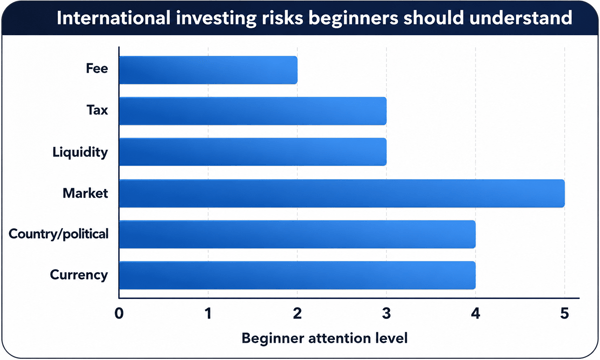
International investing can reduce dependence on one country, but it does not make investing safer in every situation. It changes the risk mix, so the following risks deserve careful attention.
6.1 Currency risk
If you invest in a foreign market, your return may be affected by exchange rates. Suppose your foreign stock fund rises 8% in its local market, but the foreign currency weakens 5% against your home currency. Your return after conversion may be closer to 3% before fees and taxes. The reverse can also happen: a currency move can increase your return.
6.2 Country and political risk
Government policy, capital controls, sanctions, war, elections, corruption, banking stress, or sudden regulation can affect foreign markets. A strong company can still suffer if its home market faces political or economic stress.
6.3 Market risk
Foreign stocks can fall just like local stocks. Global recessions, inflation shocks, interest-rate changes, and sector crashes can hit many markets together.
6.4 Liquidity risk
Some foreign markets have fewer buyers and sellers. This can make trading more expensive or difficult, especially in smaller countries or frontier markets.
6.5 Information and accounting risk
Foreign companies may report in another language or under different accounting rules. Even when reports are available, beginners may struggle to compare them with local companies.
6.6 Tax risk
Dividends may be taxed in the country where the company is based and again in your home country. Some investors may qualify for foreign tax credits or treaty benefits, but rules differ by country and account type.
6.7 Fee and spread risk
International funds can have higher expense ratios than domestic funds. Direct foreign trading can also involve custody fees, currency conversion spreads, ADR fees, and wider bid-ask spreads.
6.8 Concentration risk disguised as diversification
A fund may say “international,” but it might be heavily concentrated in one country, one sector, or a few mega-cap companies. Always check the holdings.
7. A Practical Example: Two Beginner Portfolios
The right mix depends on age, goals, income stability, home country, currency needs, tax rules, and risk tolerance.
| Investor profile | Possible approach | Why it may make sense | What to watch |
|---|---|---|---|
| A cautious beginner investing for 3-5 years | Mostly cash or high-quality bonds; little or no stock exposure. | International stocks can be too volatile for short goals. | Avoid investing money needed soon in risky assets. |
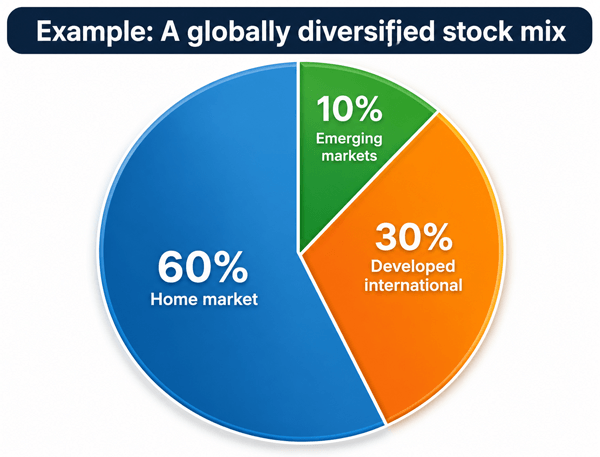
| A long-term beginner investing for 15+ years | Broad domestic stock fund + broad international stock fund + bonds/cash. | Long time horizon can absorb market cycles; global exposure reduces home-market dependence. | Rebalance yearly; do not chase recent winners. |
| A beginner with strong home-market exposure through job and property | Add diversified global ETF exposure gradually. | Salary, house, and savings may already depend on one country. | Avoid overconcentration in one currency or local economy. |
| An advanced beginner interested in emerging markets | Core broad global fund plus a small emerging-market allocation. | Adds growth exposure without making the whole portfolio high risk. | Keep position size modest; expect volatility. |
8. How Much International Exposure Should a Beginner Consider?
There is no perfect percentage for everyone. Some investors use global market-cap weights. Some use a smaller international allocation because of taxes, currency needs, or comfort level. Others use a larger allocation because their home market is small or concentrated. The better question is not “What is the magic number?” but “What role should international exposure play in my plan?”
| Approach | Example allocation idea | Good fit | Possible problem |
|---|---|---|---|
| Small starter allocation | 5-15% of stock portfolio internationally. | Nervous beginners who want to learn slowly. | May be too small to meaningfully diversify a concentrated portfolio. |
| Balanced global allocation | 20-40% of stock portfolio internationally. | Long-term investors who want meaningful global diversification. | May feel uncomfortable during periods when foreign markets lag. |
| Market-cap aware allocation | Closer to global stock-market weights. | Investors who want a neutral global approach. | Can feel too foreign-heavy for investors whose expenses are in one local currency. |
| One global fund approach | A total world stock ETF or global multi-asset fund. | Hands-off investors who want simplicity. | Less customization; may overlap with existing funds. |
A practical beginner method is to start with a target that you can hold through bad years. A perfect allocation that you abandon during a market drop is worse than a reasonable allocation you can stick with.
9. Step-by-Step: How a Beginner Can Start International Investing
- Clarify your goal. Are you investing for retirement, education, wealth building, income, or currency diversification?
- Check your emergency fund first. Do not use international stocks as a place for short-term savings.
- Understand local rules. Some countries restrict foreign brokerage accounts, foreign exchange transfers, tax reporting, or offshore investment limits.
- Choose a regulated platform. Look for investor protection, transparent fees, strong custody arrangements, and clear tax documents.
- Decide your vehicle. For most beginners, broad ETFs or index funds are easier than individual foreign stocks.
- Compare fees. Review expense ratio, trading commission, currency conversion spread, custody fee, withdrawal fee, and tax reporting costs.
- Check the index and holdings. Know whether the fund owns developed markets, emerging markets, one country, one region, or the whole world.
- Start with a small amount or monthly plan. Gradual investing helps beginners learn without emotional pressure.
- Rebalance once or twice a year. Bring the portfolio back to your target allocation instead of chasing performance.
- Keep records. Save trade confirmations, dividends, withholding tax details, and annual tax forms.
10. Beginner Checklist Before Buying an International ETF
| Question | Why it matters | What a beginner should look for |
|---|---|---|
| What index does it track? | The index decides what you actually own. | Broad, transparent, diversified index. |
| How many holdings? | More holdings usually means less single-company risk. | Hundreds or thousands for broad exposure. |
| Which countries are included? | Some funds exclude the U.S.; others include the whole world. | Match it to your existing portfolio. |
| Developed, emerging, or both? | Emerging markets usually carry higher risk. | Know the split before investing. |
| Expense ratio? | Fees reduce returns every year. | Prefer low-cost options when quality is similar. |
| Bid-ask spread and trading volume? | Hidden trading costs can matter. | Avoid thinly traded funds if alternatives exist. |
| Currency hedged or unhedged? | Hedging changes how currency movements affect returns. | Understand the trade-off; do not choose blindly. |
| Dividend policy? | Accumulating vs distributing funds affect income and taxes. | Choose based on tax rules and cash-flow needs. |
| Domicile and tax treatment? | Fund location can affect withholding tax and estate/tax issues. | Research local tax rules or ask a qualified tax professional. |
| Does it overlap with what I already own? | You may unknowingly double up on the same companies. | Compare top holdings and country weights. |
11. Currency Risk Explained in Plain English
Currency risk is one of the most confusing parts of international investing. Think of it as a second layer of return. First, the asset itself changes in price. Second, the currency translation changes what that asset is worth in your home currency.
| Scenario | Foreign market return | Currency move | Approximate result in home currency |
|---|---|---|---|
| Good market, stable currency | +10% | 0% | About +10% before fees/taxes |
| Good market, weaker foreign currency | +10% | -6% | About +4% before fees/taxes |
| Flat market, stronger foreign currency | 0% | +5% | About +5% before fees/taxes |
| Bad market, weaker foreign currency | -10% | -5% | About -15% before fees/taxes |
Should beginners use currency-hedged funds? Sometimes, but not automatically. Currency hedging can reduce exchange-rate swings, especially for foreign bonds, but it can also add cost and complexity. For long-term stock investors, many people accept currency movements as part of global diversification. For short-term goals or foreign bonds, currency risk deserves extra attention.
12. Taxes: What Beginners Should Know Before Investing Abroad
Taxes can make international investing feel harder than domestic investing. The details depend on your country, account type, fund domicile, treaties, and whether the investment pays dividends or interest.
- Foreign withholding tax: A foreign country may withhold tax from dividends before you receive them.
- Home-country tax: Your own country may also tax dividends, interest, or capital gains.
- Foreign tax credit: In some countries, investors may be able to claim credit for qualifying foreign taxes paid. The IRS, for example, says U.S. taxpayers may be able to claim a foreign tax credit for certain foreign taxes paid to a foreign country or U.S. possession.
- Tax forms and records: International funds may issue tax documents showing foreign taxes paid. Keep these records.
- Account type matters: A taxable brokerage account, retirement account, pension account, and offshore account may have different tax results.
- Estate and inheritance rules: Some cross-border investments can create estate-tax or inheritance-tax complications. This is especially important for larger portfolios.
| Tax issue | Beginner mistake | Better practice |
|---|---|---|
| Dividend withholding tax | Ignoring it and comparing only headline returns. | Compare after-tax returns where possible. |
| Fund domicile | Buying any global ETF without checking tax treatment. | Understand whether U.S., Ireland, Luxembourg, local, or other domicile matters for your country. |
| Foreign tax credit | Assuming every withheld tax is recoverable. | Check local tax rules and eligibility. |
| Recordkeeping | Deleting broker statements and dividend reports. | Save annual statements, tax vouchers, and trade confirmations. |
| Unregulated offshore schemes | Trusting promises of tax-free high returns. | Use regulated platforms and qualified tax guidance. |
13. International Investing vs. Forex Trading vs. Offshore Investing
| Term | What it means | Risk level for beginners | Important difference |
|---|---|---|---|
| International investing | Owning foreign stocks, bonds, ETFs, or funds. | Moderate to high depending on assets. | You own productive assets or securities. |
| Forex trading | Speculating on exchange-rate movements between currencies. | High, especially with leverage. | Usually short-term and often leveraged. |
| Offshore investing | Holding investments through accounts, funds, or structures outside your home country. | Varies widely. | Can be legitimate, but must follow tax and reporting laws. |
| Global investing | A broad term for investing across many countries, sometimes including your home country. | Varies by allocation. | Often used for diversified worldwide portfolios. |
Avoid claims such as “guaranteed foreign returns,” “tax-free offshore secret,” or “safe international profits.” Such language is misleading because international investing involves both opportunities and material risks.
14. Common Mistakes Beginners Make
| Mistake | Why it hurts | What to do instead |
|---|---|---|
| Chasing the best-performing country from last year | Recent winners often become expensive or crowded. | Use a long-term allocation plan. |
| Buying a single foreign stock and calling it diversification | One company can fail even if the country grows. | Use diversified funds for core exposure. |
| Ignoring currency conversion costs | Small spreads add up over years. | Compare all platform and FX fees. |
| Overloading emerging markets | Growth stories can be tempting but volatile. | Keep emerging-market exposure sized to your risk tolerance. |
| Not checking fund overlap | Two funds may own many of the same companies. | Review top holdings and country weights. |
| Using leverage or CFDs as a beginner | Losses can exceed expectations quickly. | Start with cash-funded, diversified investments. |
| Thinking international means automatically better returns | Diversification can reduce dependence, not guarantee outperformance. | Set realistic expectations. |
| Ignoring taxes until year-end | Tax surprises can reduce net returns. | Learn reporting needs before investing. |
15. How to Compare International Investment Options
A beginner can compare options using a simple “FIT” test: Fit, Index, Total cost.
| FIT factor | Question to ask | Example of a good sign |
|---|---|---|
| Fit | Does this investment match my goal, time horizon, and risk level? | A long-term investor uses a broad global equity ETF, not a leveraged country fund. |
| Index | What exactly does the fund own? | The fund clearly states developed markets, emerging markets, country weights, sector weights, and top holdings. |
| Total cost | What will I pay in fund fees, brokerage fees, FX spreads, custody fees, and taxes? | The platform and fund disclose costs clearly and the investor understands after-tax implications. |
16. Practical Scenario: A Beginner Wants to Invest $200 a Month Globally
Imagine Sara, a beginner investor, earns in her home currency and wants long-term exposure to global companies. She does not have time to research foreign companies individually. She decides not to trade forex or chase single-country funds. Instead, she takes a simple path:
- She builds an emergency fund first.
- She chooses a regulated investment platform with clear fees and access to global ETFs.
- She selects a broad international or total-world ETF after checking expense ratio, holdings, domicile, and tax treatment.
- She invests $200 every month rather than trying to time the market.
- She reviews the portfolio twice a year and rebalances only if the allocation drifts too far.
- She keeps tax records and avoids social-media tips promising quick foreign profits.
This example is boring, and that is the point. Many successful investors describe good investing as a repeatable system rather than an exciting prediction game. The experience of many beginners is that the hardest part is not finding an investment; it is staying patient when one market outperforms another for several years.
17. When International Investing May Not Be Suitable
- You need the money within the next few months or years and cannot tolerate losses.
- You do not understand the platform, fees, or tax reporting obligations.
- You are using borrowed money or leverage to invest abroad.
- Your country has restrictions you have not checked.
- You are buying because of social-media hype or a promise of guaranteed returns.
- You already have a complicated portfolio and do not know your existing exposure.
18. Frequently Asked Questions About International Investing
18.1 What is international investing in simple words?
International investing means buying investments from outside your home country, such as foreign stocks, global ETFs, international mutual funds, or overseas bonds. It helps investors access more markets but also adds risks such as currency changes and foreign taxes.
18.2 Is international investing good for beginners?
It can be suitable for beginners when done through diversified, low-cost funds and with a long-term plan. It is less suitable when beginners buy single foreign stocks, use leverage, or ignore tax and currency risk.
18.3 What is the easiest way to invest internationally?
For many beginners, the easiest route is a broad international ETF, global index fund, or total-world fund through a regulated brokerage or retirement platform. The exact product depends on your country and tax rules.
18.4 What are the best international investments?
There is no single best international investment for everyone. A good option is one that fits your goal, risk tolerance, time horizon, tax situation, and costs. Broad, low-cost, diversified funds are often more beginner-friendly than narrow country bets.
18.5 Can I lose money in international investing?
Yes. International investments can lose value because of stock-market declines, currency movements, political events, recessions, taxes, fees, or poor company performance.
18.6 How is international investing different from global investing?
International investing often means investing outside your home country. Global investing can mean investing across the world, including your home country.
18.7 Should I invest in emerging markets?
Emerging markets can offer growth potential, but they can also be more volatile and riskier. Beginners usually use them as part of a diversified fund or as a modest satellite allocation, not as the entire portfolio.
18.8 Do international ETFs pay dividends?
Many do. Some distribute dividends to investors, while others automatically reinvest dividends inside the fund. Tax treatment depends on the fund, account, and investor’s country.
18.9 What is an ADR?
An American Depositary Receipt is a security that represents shares of a foreign company and trades on a U.S. exchange or over-the-counter market. It can make foreign stock access easier but does not remove company, currency, tax, or country risk.
18.10 How often should I check my international portfolio?
For long-term investors, checking too often can cause emotional decisions. A practical rhythm is monthly for contributions and once or twice a year for rebalancing, unless your personal circumstances change.
19. Final Advice for Beginners
International investing is useful because the world is bigger than one stock market. But it is not magic. It will not protect you from every crash, and it will not always outperform your local market. Some years it will feel smart; other years it will feel disappointing. That is normal.
The best beginner approach is simple: avoid hype, use regulated platforms, prefer broad and low-cost funds, understand currency and tax effects, invest for long-term goals, and keep records. If the decision involves large amounts, complex tax questions, inheritance planning, or cross-border residency, speak with a qualified financial advisor or tax professional.
Sources Consulted and Checked
These sources were consulted and checked while preparing this article to support its accuracy and clarity. Readers should use the latest official versions when verifying time-sensitive information.
- Investor.gov: International investing can provide diversification and growth exposure; diversification is a core risk-management idea.
- SEC Investor Bulletin: International Investing: Explains U.S.-registered mutual funds and ETFs, ADRs, foreign ordinary shares, and risks of international exposure.
- Vanguard investor education and market outlook resources: Used for current framing around global diversification and international markets.
- MSCI ACWI and MSCI ACWI ex USA index factsheets: Used to verify that broad international indexes include developed and emerging markets.
- FINRA investor education: Used for risk framing on political risk, currency risk, emerging markets, frontier markets, liquidity, and regulation.
- IRS foreign tax credit guidance: Used for general U.S. foreign-tax-credit concept; tax rules vary and readers should seek local advice.
- BlackRock/iShares ETF education and fund materials: Used for ETF definitions and practical context around international ETF products.
Reader Advice
This article is provided solely for educational and informational purposes. It does not constitute personalized financial, investment, tax, legal, accounting, or regulatory advice, and it should not be treated as a recommendation to buy, sell, or hold any security, fund, currency, or financial product. Investment values can rise or fall, and readers may lose some or all of the money invested. Rules, taxes, product features, fees, market conditions, and regulatory requirements may change and may differ by country, residency, account type, and personal circumstances.
Before making any decision, verify current facts and figures through official regulatory, tax, fund-provider, and brokerage sources, review all relevant documents and costs, and consider obtaining advice from appropriately qualified professionals. Never rely on promises of guaranteed returns or invest money needed for near-term expenses.