Should You Invest Outside the U.S.? Diversification Benefits Explained
1. Quick Answer: Should Beginners Invest Outside the U.S.?
Yes, many long-term investors can benefit from owning at least some investments outside the United States. The reason is simple: the U.S. is a powerful market, but it is not the entire world. International stocks give a portfolio exposure to different economies, currencies, industries, interest-rate cycles, and company leaders that may not move in the same direction as the U.S. market every year.
That does not mean a beginner should sell U.S. stocks and make a big bet on foreign markets. A smarter approach is to use international diversification as a risk-management tool. In practice, this often means adding a low-cost international stock ETF or index fund beside a U.S. total stock market fund or S&P 500 fund, then holding and rebalancing over time.
Plain-English takeaway
International investing is not about predicting which country wins next year. It is about avoiding the mistake of placing your entire stock portfolio in one country, one currency, and one market cycle.
2. What Does “Investing Outside the U.S.” Mean?
Investing outside the U.S. means buying assets tied to companies, governments, or economies outside the United States. For most everyday investors, the phrase usually refers to international stocks: shares of companies based in places such as Japan, the United Kingdom, Canada, Switzerland, France, Germany, Taiwan, South Korea, India, China, Brazil, and many others.
A beginner does not need to open accounts in foreign countries or trade on foreign exchanges. The easiest path is usually through U.S.-listed ETFs or mutual funds that hold international companies. For example, a U.S. investor can buy a single international ETF in a normal brokerage account, IRA, or retirement account and instantly own hundreds or thousands of companies outside the U.S.
| Term | Simple meaning | Beginner example |
|---|---|---|
| International stocks | Stocks of companies based outside the U.S. | Toyota, Nestle, ASML, Samsung, Novo Nordisk, Taiwan Semiconductor |
| Developed markets | Higher-income markets with mature financial systems | Japan, U.K., Canada, Germany, Switzerland, Australia |
| Emerging markets | Faster-growing but often riskier economies | India, China, Brazil, Mexico, Indonesia, South Africa |
| Global fund | A fund that may include both U.S. and non-U.S. stocks | Total world stock ETF |
| International fund | A fund that usually excludes U.S. stocks | Total international stock ETF |
| ADR | A U.S.-traded receipt representing shares of a foreign company | A foreign company trading on a U.S. exchange |
3. Why International Diversification Works
Diversification works because different markets do not always rise and fall together. A portfolio holding only U.S. stocks depends heavily on the U.S. economy, U.S. corporate profits, U.S. investor sentiment, U.S. interest rates, and the U.S. dollar. When you add international stocks, you add return drivers from other parts of the world.
This matters because market leadership rotates. There are long periods when U.S. stocks lead. There are also periods when international stocks lead. A globally diversified investor does not need to guess the next winner. They accept that different regions will take turns, and they build a portfolio that can participate in more than one source of growth.
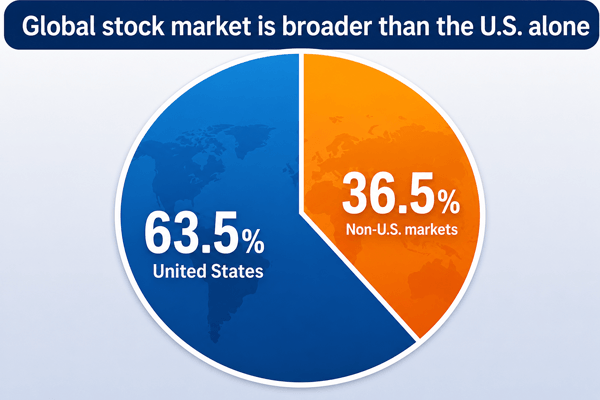
MSCI’s global equity data shows that the United States was about 63.5% of the MSCI ACWI Index as of late May 2026, meaning non-U.S. markets still represented a large share of the global stock opportunity set. That is too large to ignore if the goal is broad market exposure rather than a U.S.-only bet. [1]
| Diversification benefit | How it helps | Simple example |
|---|---|---|
| Country diversification | Reduces dependence on one nation’s stock market | If U.S. valuations fall, foreign holdings may not fall as much |
| Currency diversification | Adds exposure to currencies outside the dollar | A weaker U.S. dollar can increase foreign returns for U.S.-based investors |
| Sector diversification | Accesses industries that may be bigger overseas | Luxury goods in Europe, semiconductors in Taiwan, industrials in Japan |
| Valuation diversification | Avoids owning only the market that may be most expensive | Cheaper markets can sometimes offer better future return potential |
| Economic-cycle diversification | Different regions may expand or slow at different times | Europe, Asia, and emerging markets can follow different growth cycles |
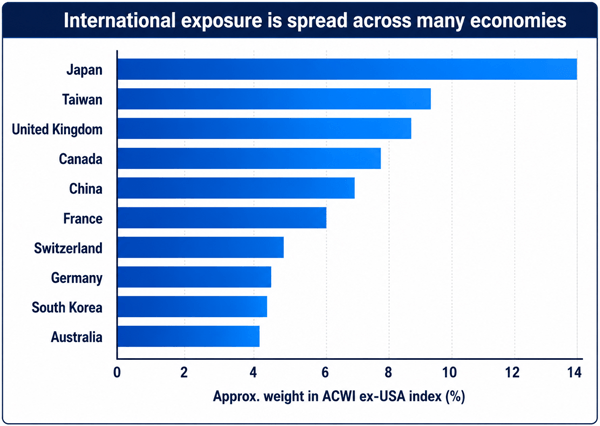
Figure: International stock exposure is not a single-country bet. Broad ex-U.S. indexes spread holdings across developed and emerging markets. Sources: MSCI ACWI ex USA factsheet and ETF provider factsheets. [2]
People’s real-world experience
Many beginners say they first bought only the S&P 500 because it felt familiar. That is understandable. But investors who lived through different market cycles often learn that “familiar” is not the same as “fully diversified.” A simple international ETF can make a portfolio feel less dependent on one country’s headlines.
4. U.S. Stocks vs International Stocks: A Practical Comparison
The U.S. market has world-class companies, deep liquidity, strong investor protections, and a long record of wealth creation. That is why many investors keep U.S. stocks as the core of their portfolio. But the case for international investing is not that the U.S. is bad. The case is that a strong portfolio does not require every dollar to depend on the same market.
| Factor | U.S. stocks | International stocks | What beginners should do |
|---|---|---|---|
| Familiarity | High for U.S. investors | Lower, because brands and rules may be less familiar | Use diversified funds instead of trying to research every country |
| Market depth | Very deep and liquid | Varies by country; broad ETFs reduce single-market problems | Prefer large, low-cost ETFs or index funds |
| Currency exposure | Mostly U.S. dollar | Foreign currencies affect returns | Accept currency movement as part of diversification |
| Valuation risk | Can become expensive when investor enthusiasm is high | May be cheaper or expensive depending on region | Avoid performance chasing; rebalance periodically |
| Political/regulatory risk | Known U.S. system | Varies widely by country | Diversify across many countries, not one headline market |
| Tax complexity | Usually simpler for U.S. investors | Foreign withholding taxes may apply | Use U.S.-domiciled funds and learn the foreign tax credit basics |
5. Developed Markets vs Emerging Markets
International investing is not one category. Developed markets and emerging markets behave differently. Developed markets are generally more stable, more liquid, and more similar to the U.S. in legal and financial infrastructure. Emerging markets can offer faster growth potential, but they often come with more volatility, political risk, currency swings, and governance concerns.
| Feature | Developed markets | Emerging markets |
|---|---|---|
| Typical countries | Japan, U.K., Canada, Germany, France, Switzerland, Australia | India, China, Brazil, Mexico, Indonesia, South Africa |
| Risk level | Usually moderate compared with emerging markets | Usually higher |
| Potential reward | Steady exposure to mature global companies | Higher growth potential, but less predictable |
| Currency risk | Present but often less extreme | Can be significant |
| Best use for beginners | Core international allocation | Small satellite position or included through a total international fund |
For beginners, the simplest solution is usually not to choose between developed and emerging markets manually. A total international stock fund already includes both, in proportions set by the index. That gives exposure without forcing the investor to make country-level predictions.
6. How Much International Exposure Is Enough?
There is no single perfect percentage for every investor. A globally market-weighted portfolio would hold a large non-U.S. allocation because non-U.S. stocks represent a meaningful part of global stock market capitalization. But many U.S. investors prefer some home bias because they spend in dollars, understand U.S. companies better, and may have tax or behavioral reasons to keep a larger U.S. core.
A practical range for beginners is often 10% to 40% of the stock portion of the portfolio in international stocks. Investors who are nervous can start around 10% to 20%. Investors who want broader global exposure may choose 30% to 40%. The key is to pick a target you can hold through both good and bad years.
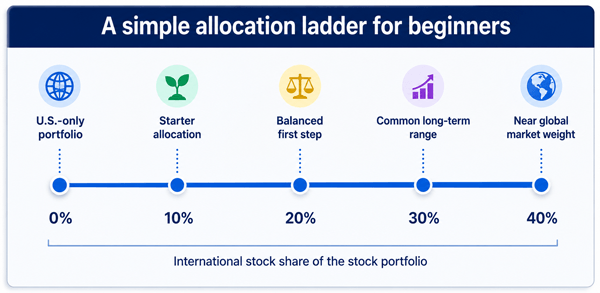
Figure: A beginner does not need to jump from 0% to a global market weight overnight. A gradual allocation can reduce regret and improve consistency.
| Investor type | Possible international stock allocation | Why it may fit |
|---|---|---|
| Very cautious beginner | 10% | Adds diversification without creating a large emotional change |
| Balanced beginner | 20% | Meaningful exposure while keeping U.S. stocks dominant |
| Long-term index investor | 30% | Closer to a globally diversified stock portfolio |
| Global market believer | 40% or more | Wants portfolio weights to reflect the global opportunity set |
| Retiree or near-retiree | Depends on total plan | Should coordinate with bonds, spending needs, taxes, and withdrawal strategy |
Actionable rule
Do not choose your international allocation based only on last year’s winner. Choose it based on what you can hold for 10, 20, or 30 years.
7. Best Beginner-Friendly Ways to Invest Internationally
Most beginners should keep international investing boring. That means broad funds, low costs, no country guessing, and no complex tax structures. The main options are international ETFs, international index mutual funds, total world funds, target-date funds, ADRs, and individual foreign stocks.
| Method | Best for | Pros | Cons |
|---|---|---|---|
| Total international stock ETF | Most beginners wanting non-U.S. exposure | Low cost, diversified, easy to buy, usually includes developed and emerging markets | Can lag U.S. stocks for long periods |
| International index mutual fund | Investors who prefer automatic investing | Easy dollar-cost averaging and fractional investing | May be limited by brokerage platform |
| Total world stock ETF | Investors wanting one stock fund | Holds U.S. and international stocks in one fund | Less control over U.S./international split |
| Target-date fund | Retirement savers who want an all-in-one portfolio | Includes stocks, bonds, U.S., international, and automatic glide path | Less customizable |
| ADRs | Investors who want individual foreign companies | Trade in the U.S.; easy access to specific companies | Company-specific risk; not diversified |
| Direct foreign shares | Advanced investors | Can access local markets directly | Currency, tax, custody, liquidity, and reporting complexity |
For a beginner, the cleanest choice is often a U.S.-domiciled total international ETF or index mutual fund. It avoids many complications of buying foreign-domiciled funds directly, and it can be held in common brokerage or retirement accounts. BlackRock’s iShares ACWI ex U.S. ETF, for example, tracks large- and mid-cap equities from developed and emerging markets outside the United States and is designed to complement U.S. equity exposure. [3]
8. Practical Portfolio Examples
Below are simple examples for educational purposes. They are not recommendations for any specific person. The right mix depends on age, income stability, risk tolerance, time horizon, taxes, and whether the money is for retirement, a home purchase, education, or another goal.
| Portfolio type | Example allocation | Who it may fit |
|---|---|---|
| U.S.-only starter | 100% U.S. total stock or S&P 500 fund | Someone just beginning, but not globally diversified |
| Simple global stock portfolio | 70% U.S. stock fund / 30% total international stock fund | Long-term investor who wants global equity diversification |
| Three-fund portfolio | 55% U.S. stock / 25% international stock / 20% U.S. bonds | Beginner who wants stocks plus stability from bonds |
| One-fund retirement option | Target-date fund with built-in international exposure | Hands-off retirement saver |
| Aggressive global portfolio | 60% U.S. stock / 30% developed international / 10% emerging markets | Investor comfortable with higher volatility and more control |
8.1 Example: How International Exposure Changes a Portfolio
Imagine two investors each put $10,000 into stocks. Investor A buys only a U.S. stock fund. Investor B buys 70% U.S. stocks and 30% international stocks. If U.S. stocks outperform, Investor A may feel smarter for a while. But if the U.S. dollar weakens, U.S. valuations compress, or international markets have a strong cycle, Investor B has a second engine of return. The goal is not to win every calendar year. The goal is to reduce the chance that one country’s bad decade controls the entire outcome.
9. Risks: What Can Go Wrong and How to Manage It
International investing adds diversification, but it also adds risks. A good article should be honest about both. Schwab notes that international investments can involve risks such as currency fluctuations, geopolitical risk, foreign taxes and regulations, accounting differences, and potentially less liquid markets. [4]
| Risk | What it means | How to manage it |
|---|---|---|
| Currency risk | Foreign returns change when currencies move against the U.S. dollar | Use broad funds; do not overreact to short-term currency swings |
| Political risk | Government instability, sanctions, capital controls, or conflict can hurt markets | Avoid concentrated single-country bets |
| Accounting/governance risk | Rules may differ from U.S. standards | Use diversified ETFs with professional index rules |
| Liquidity risk | Some markets are harder to trade | Prefer large funds with broad holdings and reasonable trading volume |
| Tracking and fee risk | Some funds cost more or do not track indexes well | Compare expense ratios, spreads, index coverage, and fund size |
| Behavior risk | Investor sells after years of underperformance | Set a target allocation and rebalance instead of chasing returns |
Honest investing practice
Never present international investing as a guaranteed way to improve returns. The truthful claim is narrower and stronger: it can broaden opportunity and may reduce dependence on one market, but it can also underperform for long periods.
10. Taxes, Account Location, and Fees
Taxes can make international investing feel confusing, but beginners only need the basics at first. Many international funds pay foreign taxes on dividends before the money reaches the investor. In a taxable account, U.S. investors may be eligible for a foreign tax credit in some situations, which is intended to reduce double taxation. Tax rules are complex and can change, so readers should verify their own situation with a tax professional or official IRS guidance.
One important caution: U.S. taxpayers should be careful with foreign-domiciled mutual funds or ETFs. Some may create Passive Foreign Investment Company, or PFIC, reporting issues. Many U.S. investors avoid this complexity by using U.S.-domiciled ETFs or mutual funds that hold foreign stocks.
| Topic | Beginner-friendly guidance |
|---|---|
| Expense ratio | Lower is usually better, especially for broad index exposure. Small fee differences compound over decades. |
| Bid-ask spread | For ETFs, trade during market hours and avoid thinly traded niche funds when possible. |
| Foreign tax credit | May matter in taxable accounts, but eligibility depends on details. Do not assume it applies automatically. |
| Retirement accounts | International funds can be held in IRAs/401(k)s, but tax-credit treatment may differ from taxable accounts. |
| PFIC risk | U.S. taxpayers should generally avoid buying foreign-domiciled funds without tax advice. |
| Turnover | High-turnover active funds may create more taxable distributions than index funds. |
11. Common Beginner Mistakes
- Mistake 1: Going all-in after a strong international year: International markets can have powerful rallies, but buying only after a big run often leads to disappointment. Build a target allocation instead of chasing performance.
- Mistake 2: Thinking S&P 500 companies already provide enough global exposure: Many U.S. companies sell globally, but they are still U.S.-listed stocks influenced by U.S. valuations, U.S. index concentration, and the U.S. dollar. Foreign revenue is not the same as owning foreign markets.
- Mistake 3: Buying too many overlapping funds: A total international fund may already hold developed and emerging markets. Adding several country funds can create accidental concentration.
- Mistake 4: Ignoring costs: International funds sometimes cost more than U.S. index funds. Costs are not the only factor, but they are one of the few things investors can control.
- Mistake 5: Selling because international stocks lag for a few years: Diversification always means owning something that disappoints. If every holding rises at the same time, the portfolio probably is not truly diversified.
- Mistake 6: Treating emerging markets like a quick-growth shortcut: Emerging markets can grow fast economically while stocks still disappoint because of valuation, currency, governance, or political issues.
12. Step-by-Step Action Plan for Beginners
- Step 1: Define the goal - Retirement money can usually tolerate more stock volatility than money needed in the next three years.
- Step 2: Decide your stock/bond split first - International allocation is part of the stock decision. It does not replace the need for bonds or cash if the goal requires stability.
- Step 3: Pick a target international percentage - Start with a range such as 10%, 20%, 30%, or 40% of stocks. Choose a number you can stick with.
- Step 4: Choose a broad, low-cost fund - Look for total international or global ex-U.S. index exposure, low expense ratio, diversified country weights, and enough fund size/liquidity.
- Step 5: Invest gradually if nervous - Dollar-cost averaging can help investors who worry about buying at the wrong time.
- Step 6: Rebalance once or twice a year - If international stocks rise above target, trim back. If they fall below target, add. This creates discipline.
- Step 7: Review taxes before using taxable accounts - Understand foreign tax credit basics, fund distributions, and whether a fund is U.S.-domiciled.
- Step 8: Write an investment policy note - A short written plan helps avoid emotional selling during underperformance.
Sample investment policy note
I will keep 30% of my stock portfolio in a broad international index fund because I want exposure to global companies outside the U.S. I will rebalance annually. I will not sell the fund just because it trails U.S. stocks for several years.
13. FAQ: Investing Outside the U.S.
13.1 Is international investing necessary?
Not strictly. A U.S.-only investor can still build wealth. But international exposure can make a stock portfolio broader and less dependent on one country.
13.2 Is the S&P 500 enough because big U.S. companies sell overseas?
It helps, but it is not the same as owning foreign companies. The S&P 500 is still a U.S. stock index with U.S. valuations and U.S. dollar exposure.
13.3 Should I buy individual foreign stocks?
Most beginners should avoid making individual foreign stock picks. A broad ETF or index fund is usually simpler, cheaper, and more diversified.
13.4 What is a good first international fund?
A broad total international stock ETF or index mutual fund is often the easiest starting point. Readers should compare cost, holdings, index coverage, and tax structure.
13.5 Should I hedge currency?
Most beginners do not need to hedge currency in a long-term stock portfolio. Currency exposure can help or hurt in different periods. Hedging adds complexity and cost.
13.6 Can international stocks underperform for a long time?
Yes. That is one reason the allocation should be realistic. Diversification is a long-term strategy, not a promise of short-term outperformance.
13.7 Are emerging markets worth it?
They can be part of a broad international allocation, but they are more volatile. Beginners often get emerging market exposure through a total international fund rather than a separate large bet.
13.8 How often should I rebalance?
Once or twice a year is enough for many long-term investors. Rebalancing too often can increase taxes and trading friction.
13.9 Should retirees invest internationally?
Many retirees can still benefit from diversification, but the right amount depends on withdrawal needs, income sources, taxes, and risk tolerance.
13.10 What is the biggest risk?
The biggest practical risk is often behavior: buying after strong performance and selling after weak performance. A written plan helps.
14. Bottom Line: A Smarter Way to Think About International Investing
The question is not “Will international stocks beat U.S. stocks next year?” Nobody knows that consistently. The better question is: “Do I want my long-term portfolio to depend entirely on one country?” For many investors, the answer is no.
Investing outside the U.S. can provide country, currency, sector, valuation, and economic-cycle diversification. It can also bring extra risks, including currency swings, foreign taxes, political uncertainty, and long stretches of underperformance. The practical solution is not to make a dramatic bet. It is to add a simple, low-cost, diversified international allocation that fits your plan and then hold it with discipline.
For beginners, the most sensible path is usually: keep a strong U.S. core, add a broad international index fund, avoid expensive or concentrated products, pay attention to taxes, and rebalance on a schedule. That is not exciting, but good investing rarely needs to be exciting.
Reader Advice
This article is provided solely for educational and informational purposes and does not constitute personalized financial, investment, tax, accounting, or legal advice. Investing involves risk, including the possible loss of principal. Before making any decision, readers should consider their objectives, financial circumstances, time horizon, risk tolerance, tax position, and other relevant factors, and should seek advice from an appropriately qualified professional when needed. Laws, tax rules, market data, fund details, fees, index weights, and regulatory requirements may change over time or vary by jurisdiction and individual circumstances. Readers should therefore verify all material facts, figures, eligibility requirements, and current rules directly with official regulators, tax authorities, fund providers, and other authoritative sources. Past performance does not guarantee future results, and no investment strategy can ensure a profit or prevent a loss.
Sources Consulted and Checked
These sources were consulted and checked while preparing this document to support accuracy, reliability, and currency of the information presented.
- [1] MSCI ACWI Index Factsheet, country weights, May 29, 2026. https://www.msci.com/www/index-factsheets/msci-acwi/05737588
- [2] MSCI ACWI ex USA Index Factsheet and State Street SPDR MSCI ACWI ex-US ETF factsheet, 2026 country weights. https://www.msci.com/www/index-factsheets/msci-acwi-ex-usa/07428682
- [3] iShares MSCI ACWI ex U.S. ETF description and fund facts, BlackRock/iShares, 2026. https://www.blackrock.com/us/individual/products/239594/ishares-msci-acwi-ex-us-etf
- [4] Charles Schwab, Global Investing and international investing risk disclosures. https://www.schwab.com/global-investing
- [5] Vanguard, Why invest internationally? https://investor.vanguard.com/investor-resources-education/understanding-investment-types/why-invest-internationally
- [6] Vanguard Capital Markets Model forecasts, April 22, 2026. https://corporate.vanguard.com/content/corporatesite/us/en/corp/vemo/vemo-return-forecasts.html
- [7] Bogleheads Wiki, Foreign tax credit and tax-efficient fund placement, reviewed 2026. https://www.bogleheads.org/wiki/Foreign_tax_credit
- [8] IRS official website for tax forms and guidance. https://www.irs.gov/