Trading Psychology: Complete Guide, Examples, Risks and Best Practices
Trading psychology is the mental side of trading. It is the way a trader thinks, feels, reacts, and makes decisions when money is at risk. Many beginners spend most of their time learning chart patterns, indicators, strategies, and market news. Those things matter, but they are not enough. A weak strategy can lose money, but even a good strategy can fail when the trader panics, chases trades, increases size after a loss, or refuses to accept being wrong.
This guide explains trading psychology from the ground up. It covers what it means, why it matters, the emotions that affect traders, common mistakes, practical examples, risk management habits, journaling, best practices, and realistic ways to improve discipline. It is written for beginners, but the principles apply to stocks, forex, crypto, commodities, futures, options, and other active markets.
1. Quick Answer: What Is Trading Psychology?
Trading psychology is the study and practice of managing your emotions, habits, biases, and decision-making while trading. It helps you follow a plan instead of reacting impulsively to fear, greed, hope, stress, or excitement. Good trading psychology does not mean having no emotions. It means noticing emotions early and preventing them from controlling your trades.
| Key idea | Simple meaning | Why it matters |
|---|---|---|
| Fear | Worry about losing money or missing an opportunity | Can make you exit too early, avoid valid trades, or close winners too soon |
| Greed | Wanting more profit than the plan allows | Can lead to overtrading, oversized positions, and ignoring risk |
| Discipline | Following your rules even when emotions are strong | Keeps decisions consistent and measurable |
| Patience | Waiting for proper setups instead of forcing trades | Reduces low-quality trades and emotional losses |
| Risk control | Deciding how much you can lose before entering | Protects your account from one bad decision |
2. Why Trading Psychology Matters More Than Beginners Expect
Trading is emotionally difficult because every decision has an uncertain outcome. You can follow your plan and still lose. You can break your rules and still make money once. This creates confusion. Beginners often judge a trade only by profit or loss, but professionals judge it by process: Was the setup valid? Was risk defined? Was the position size reasonable? Was the exit planned?
The market gives instant feedback, but not always accurate feedback. A profitable mistake can teach the wrong lesson. A well-planned losing trade can feel like failure even though it was part of the system. Trading psychology helps you separate short-term results from long-term decision quality.
Without emotional discipline, traders often repeat the same cycle: they wait too long, enter late, risk too much, panic during normal price movement, exit randomly, then try to recover the loss with another rushed trade. The goal is not to become perfect. The goal is to become consistent enough that your trading results can reflect your plan instead of your mood.
3. The Core Emotions in Trading
Every trader experiences emotions. The problem is not emotion itself; the problem is unmanaged emotion. Fear, greed, hope, regret, frustration, boredom, and overconfidence all push traders away from rational decisions.
Fear can be useful when it reminds you to respect risk. But fear becomes harmful when it makes you close good trades too early or avoid trades that match your plan. Greed can motivate research and improvement, but it becomes dangerous when it makes you increase position size, ignore stop losses, or hold a winning trade far beyond the plan. Hope is especially risky because it often appears after a trade moves against you. A trader may say, “I will wait for it to come back,” even though the original reason for the trade is gone.
Frustration appears after losses or missed opportunities. It often leads to revenge trading, which means entering another trade mainly to recover money or prove yourself right. Boredom is also dangerous because markets do not always provide good setups. A bored trader may create a trade where no trade exists.
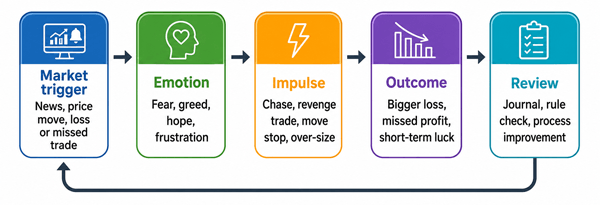
Diagram: The trading psychology loop. A trader improves by noticing emotional triggers before they turn into impulsive actions.
4. Common Psychological Biases That Affect Traders
A bias is a thinking shortcut that can distort judgment. Biases are normal, but traders need to recognize them because markets punish repeated poor decisions.
| Bias | What it looks like in trading | Practical fix |
|---|---|---|
| Confirmation bias | Only looking for information that supports your trade idea | Write down one reason the trade could fail before entering |
| Loss aversion | Holding losing trades too long because realizing a loss feels painful | Predefine your invalidation point and position size before entry |
| Overconfidence | Increasing size after a few wins because you feel “locked in” | Use fixed risk limits and review at least 20 trades, not 2 or 3 |
| Recency bias | Assuming the next trade will behave like the last few trades | Judge each setup against your checklist, not your recent mood |
| Anchoring | Fixating on a previous price, entry, or target even when conditions change | Ask whether you would enter the same trade now at the current price |
| Sunk cost fallacy | Staying in a bad trade because you already spent money or time on it | Treat every moment as a fresh decision based on current evidence |
5. Trading Psychology Examples for Beginners
5.1 Example 1: Closing a Winning Trade Too Early
A trader buys a stock at $50 with a planned target of $56 and a stop loss at $48. The price rises to $52. The trader becomes afraid that the profit will disappear and exits immediately. Later, the stock reaches $56. The issue was not that taking profit is bad. The issue was that the exit was based on fear, not the original plan.
Better approach: before entering, decide whether the trade will use a fixed target, a trailing stop, partial profit-taking, or another exit method. Once the trade is open, follow the chosen rule unless the market gives a clear reason to change the plan.
5.2 Example 2: Revenge Trading After a Loss
A crypto trader loses $100 on a planned trade. Instead of stopping, they immediately open a larger position to win it back. The second trade is not based on a setup; it is based on frustration. The market moves against them and the loss grows to $350.
Better approach: use a daily loss limit. For example, stop trading for the day after losing 2% of the account or after three consecutive losing trades. A pause protects the trader from emotional decision-making.
5.3 Example 3: Moving a Stop Loss
A forex trader enters a trade with a stop loss 30 pips away. When price approaches the stop, the trader moves it farther away because they do not want to be wrong. The loss becomes much larger than planned. This is one of the clearest signs that emotion has taken control.
Better approach: if the stop was placed at a logical invalidation point, respect it. If the stop was too tight, learn from the review and improve future placement. Do not fix a poor entry by increasing risk after the fact.
6. The Difference Between a Winning Mindset and a Gambling Mindset
| Trading mindset | Gambling mindset |
|---|---|
| Uses a written plan before entering | Decides based on excitement, fear, or a hot tip |
| Accepts losses as part of the process | Tries to avoid every loss or quickly win it back |
| Risks a small, predefined amount | Risks more when emotional or overconfident |
| Tracks trades and reviews mistakes | Blames the market, broker, news, or bad luck only |
| Focuses on long-term consistency | Focuses on one big win |
| Waits for high-quality setups | Trades because the market is moving |
7. Risk Management Is Part of Trading Psychology
Risk management and psychology are connected. Many emotional problems become worse when the position is too large. A trade that feels manageable at 0.5% account risk may feel terrifying at 10% account risk. When risk is too high, the trader becomes more likely to panic, move stops, exit early, or check the chart every few seconds.
A beginner should think of risk management as emotional protection. The smaller and clearer the risk, the easier it is to follow the plan.
7.1 Practical Risk Rules Beginners Can Use
- Risk only a small percentage of your account on each trade. Many beginners start with 0.5% to 1% risk per trade while learning.
- Use a stop loss or clear invalidation point before entering. Do not decide after the trade moves against you.
- Set a daily or weekly maximum loss. When the limit is hit, stop trading and review later.
- Avoid increasing size after a loss. This is usually revenge trading in disguise.
- Do not trade money needed for bills, rent, debt payments, or emergencies.
- Keep leverage low or avoid it until you understand how quickly it can increase losses.
8. How to Build a Trading Plan That Reduces Emotional Decisions
A trading plan is a written set of rules that tells you what to do before the market pressures you. It does not need to be complicated. The purpose is to reduce random decisions.
| Part of plan | Questions to answer |
|---|---|
| Market | What will I trade: stocks, crypto, forex, indices, options, futures? |
| Timeframe | Am I day trading, swing trading, or investing? |
| Setup | What exact conditions must appear before I enter? |
| Entry | What confirms the trade? What would make me skip it? |
| Risk | How much can I lose on this trade? Where is my stop? |
| Exit | Where will I take profit? Will I use partial exits or trailing stops? |
| Limits | When will I stop trading for the day or week? |
| Review | What will I record after each trade? |
9. Trading Journal: The Most Practical Tool for Improving Psychology
A trading journal helps you see patterns in your behavior. Without a journal, many traders remember only the most painful losses and exciting wins. A journal gives you evidence. It shows whether you break rules after losses, trade worse at certain times, close winners too early, or take too many low-quality trades.
9.1 What to Record in a Trading Journal
- Date, market, timeframe, entry price, exit price, position size, stop loss, and target.
- The reason for entering the trade.
- The reason for exiting the trade.
- Your emotional state before, during, and after the trade.
- Whether you followed your plan: yes, no, or partly.
- Screenshot before entry and after exit, where possible.
- One lesson from the trade.
A useful journal does not need to be fancy. A spreadsheet, notebook, or trading journal app can work. The key is honesty. The journal should not be used to shame yourself. It should be used to find repeatable improvements.
10. A Simple Pre-Trade Checklist
- Is this trade part of my strategy, or am I reacting to emotion?
- What is the exact entry reason?
- Where is the stop loss or invalidation point?
- How much money can I lose if the trade fails?
- Is the position size reasonable for my account?
- What is the planned exit if the trade wins?
- What news, earnings, economic event, or major volatility risk could affect this trade?
- Would I still take this trade if I were calm and not trying to recover a loss?
11. Best Practices for Better Trading Psychology
| Best practice | How to apply it | Why it helps |
|---|---|---|
| Trade smaller while learning | Reduce position size until losses feel emotionally manageable | Smaller risk makes discipline easier |
| Use written rules | Write entry, exit, and risk rules before trading | Prevents decisions based only on mood |
| Pause after losses | Take a break after a large loss or several losses in a row | Reduces revenge trading |
| Review weekly | Look for repeated mistakes, not just profit or loss | Improves the process over time |
| Avoid constant chart watching | Check trades at planned intervals when possible | Reduces impulsive exits |
| Separate trading from self-worth | A losing trade does not mean you are a failure | Keeps confidence stable |
| Use alerts and orders | Set alerts, stops, and targets instead of staring at every tick | Reduces stress and overreaction |
12. Common Trading Psychology Mistakes
- Believing confidence is the same as skill. Real skill is measured over many trades, not one good week.
- Thinking a strategy will remove emotions. Even a good strategy creates emotional pressure during drawdowns.
- Risking too much because the trade “looks obvious.” No trade is guaranteed.
- Changing strategies after every loss. A single loss does not prove a strategy is broken.
- Ignoring physical condition. Sleep, stress, health, and focus affect trading decisions.
- Trying to trade every market move. Sometimes the best trade is no trade.
- Blaming only the market instead of reviewing personal decisions.
13. Important Misconceptions About Trading Psychology
| Misconception | Reality |
|---|---|
| Good traders never feel fear | Good traders feel fear but manage it with rules and risk control |
| More screen time always improves results | Unstructured screen time can increase overtrading and stress |
| A winning trade means it was a good decision | A rule-breaking trade can make money by luck |
| A losing trade means it was a bad decision | A planned losing trade can be a correct decision in an uncertain market |
| Discipline means being rigid forever | Discipline means following rules, then improving them through review |
14. Trading Psychology by Trading Style
| Trading style | Main psychological challenge | Helpful habit |
|---|---|---|
| Scalping | Fast decisions, high stress, temptation to overtrade | Use strict limits and take scheduled breaks |
| Day trading | Emotional swings during the session | Define daily max loss and stop after poor focus |
| Swing trading | Holding through normal pullbacks | Use wider planned stops and avoid checking too often |
| Position trading | Patience during slow movement | Review thesis at planned intervals, not every small move |
| Options/futures trading | Leverage, time decay, and rapid losses | Use smaller size and understand product risk before trading |
15. Practical Exercises to Improve Trading Psychology
15.1 The One-Rule Challenge
Pick one rule you often break, such as moving stop losses or entering late. For the next 20 trades, focus mainly on obeying that rule. Do not try to fix everything at once. One consistent improvement can change your results more than ten vague goals.
15.2 The Screenshot Review
Take a screenshot before entry and after exit. Later, review the chart without the emotional pressure of the live trade. Ask: Was the trade clear? Did I enter early, late, or correctly? Did I exit because of evidence or emotion?
15.3 The 24-Hour Rule After Big Losses
After a painful loss, stop trading for the rest of the day or for 24 hours. This rule prevents one emotional decision from becoming a series of losses. The goal is account protection, not punishment.
15.4 The “Would I Enter Now?” Test
If you are holding a losing trade and feel tempted to hope, ask yourself: “If I had no position, would I enter this trade right now?” If the honest answer is no, you may be holding because of attachment rather than logic.
16. Benefits of Strong Trading Psychology
- More consistent execution of your trading plan.
- Fewer impulsive trades and emotional entries.
- Better ability to accept losses without panic.
- More realistic expectations about risk and uncertainty.
- Improved learning because you can review decisions honestly.
- Lower chance of large avoidable losses caused by revenge trading or over-sizing.
17. Risks and Limitations
Trading psychology can improve discipline, but it cannot guarantee profit. Markets are uncertain, and losses are part of trading. A calm trader can still lose money if the strategy has no edge, risk is too high, costs are ignored, or the market environment changes. Psychology works best together with education, testing, risk management, and realistic expectations.
Another limitation is that emotional control takes time. Reading one guide is useful, but behavior changes through repeated practice, journaling, review, and smaller risk. Traders who expect instant emotional mastery often become frustrated. Improvement usually happens gradually.
18. Beginner Roadmap: How to Start Improving Today
- Choose one market and one simple strategy to study instead of jumping between everything.
- Write a basic trading plan with entry, exit, risk, and stop rules.
- Risk small enough that one loss does not affect your mood for the whole day.
- Keep a journal for at least 30 trades before judging your performance.
- Review whether you followed the plan, not only whether you made money.
- Reduce trading frequency if you notice boredom trades or revenge trades.
- Increase size only after consistent rule-following, not after a few lucky wins.
19. Key Takeaways
- Trading psychology is the mental and emotional side of trading decisions.
- Fear, greed, hope, regret, boredom, and overconfidence can all damage performance.
- Good psychology does not remove losses; it helps you handle losses without losing discipline.
- Risk management is emotional management because smaller, planned risk is easier to follow.
- A trading journal is one of the most useful tools for finding repeated behavior patterns.
- The best traders focus on process, not just the result of one trade.
- Beginners should start small, use written rules, review trades, and avoid revenge trading.
20. FAQs About Trading Psychology
20.1 What is trading psychology in simple words?
Trading psychology is how your thoughts, emotions, habits, and biases affect your trading decisions. It helps you avoid impulsive actions and follow a plan.
20.2 Why do beginners struggle with trading psychology?
Beginners often risk too much, expect quick results, and judge themselves by each trade. This makes normal losses feel personal and can lead to emotional decisions.
20.3 How can I control fear while trading?
Reduce position size, define your stop before entry, accept that losses are part of trading, and avoid watching every small price movement if it makes you panic.
20.4 How can I stop revenge trading?
Use a daily loss limit, take a break after losses, write down the reason for every trade, and do not enter a new trade unless it matches your checklist.
20.5 Is discipline more important than strategy?
Both matter. A good strategy without discipline can fail, and strong discipline with a poor strategy can still lose money. You need both process and edge.
20.6 How long does it take to improve trading psychology?
It depends on the trader, but improvement usually comes through repeated practice, journaling, small risk, and reviewing many trades rather than expecting instant change.
20.7 Can trading psychology make me profitable?
It can improve execution and reduce avoidable mistakes, but it does not guarantee profit. Profitability also depends on strategy, risk management, market conditions, costs, and experience.
20.8 What is the best daily habit for trading psychology?
The most useful daily habit is reviewing whether you followed your plan. This builds self-awareness and helps you correct repeated mistakes.
Reader Advice
This article is provided for educational and informational purposes only. It is not personalized financial, investment, legal, tax, or trading advice, and it does not recommend any particular market, strategy, broker, product, or transaction. Trading and leveraged products involve substantial risk, including the possible loss of all money committed, and past performance does not guarantee future results. Rules, policies, laws, market practices, product terms, and statistics can change over time and may vary by country, region, regulator, broker, and trading platform. Before making a decision, verify current information through relevant official sources, assess whether the risks suit your circumstances, and consider guidance from an appropriately qualified professional. Use demo trading or small position sizes where suitable, never trade money needed for essential expenses, and make decisions independently and carefully.