Crypto Options Trading: Complete Guide, Examples, Risks and Best Practices
Crypto options trading is a way to trade contracts linked to the price of a cryptocurrency, such as Bitcoin or Ether, without always needing to buy or sell the coin directly. Options can be used to speculate on price movement, hedge an existing crypto position, or create more flexible risk-and-reward setups than simple spot trading.
However, options are not beginner toys. They involve time decay, volatility, liquidity, margin rules, exchange risk, and complex pricing. A trader can be right about market direction and still lose money if the option is too expensive, expires too soon, or is difficult to exit. This guide explains crypto options in plain English so a beginner can understand how they work before risking real money.
1. What Is Crypto Options Trading?
Crypto options trading means buying or selling option contracts whose value is based on a cryptocurrency or crypto index. An option gives the buyer a right, but not an obligation, to buy or sell the underlying asset at a set price before or on a set expiry date, depending on the contract type.
| Term | Simple meaning | Example |
|---|---|---|
| Underlying asset | The crypto asset the option is based on | BTC, ETH, SOL, or a crypto index |
| Call option | A contract that benefits when the underlying price rises above the strike enough to cover the premium | Buying a BTC call if you expect Bitcoin to rise |
| Put option | A contract that benefits when the underlying price falls below the strike enough to cover the premium | Buying an ETH put to protect against a drop |
| Strike price | The price level used to calculate the option payout | A BTC call with a $70,000 strike |
| Premium | The price paid by the option buyer and received by the seller | Paying $1,200 for a BTC call |
| Expiry date | The date/time when the option ends | Weekly, monthly, or quarterly expiry |
| Settlement | How the contract is paid at expiry | Cash-settled, crypto-settled, or stablecoin-settled |
2. How Crypto Options Work
An option has two sides: the buyer and the seller. The buyer pays a premium. In return, the buyer receives a right. The seller receives the premium but takes on an obligation. This is why buying options has limited loss for the premium paid, while selling uncovered options can create very large losses.
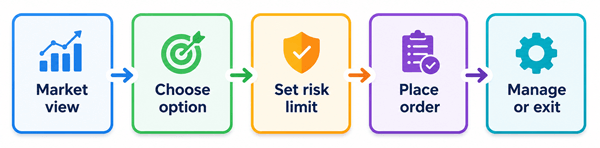
Diagram: A simple crypto options trading workflow from market view to trade management.
2.1 Call Options Explained
A call option generally increases in value when the underlying crypto price rises, all else equal. A beginner might buy a call when they expect a strong upward move but want to limit the maximum loss to the premium paid.
Example: Bitcoin trades at $65,000. You buy a one-month BTC call with a $70,000 strike and pay a $1,500 premium. At expiry, Bitcoin is $75,000. The option is worth $5,000 before fees because $75,000 minus $70,000 equals $5,000. Your approximate profit is $3,500 before fees because you paid $1,500. If Bitcoin expires below $70,000, the option expires worthless and your loss is the $1,500 premium.
2.2 Put Options Explained
A put option generally increases in value when the underlying crypto price falls, all else equal. Traders use puts to speculate on downside moves or protect existing crypto holdings.
Example: You own ETH and worry about a short-term drop. ETH trades at $3,500. You buy a put with a $3,200 strike for a $120 premium. If ETH falls sharply, the put can offset some of the loss on your ETH position. If ETH stays above the strike, the put may expire worthless, but your loss on the hedge is limited to the premium.
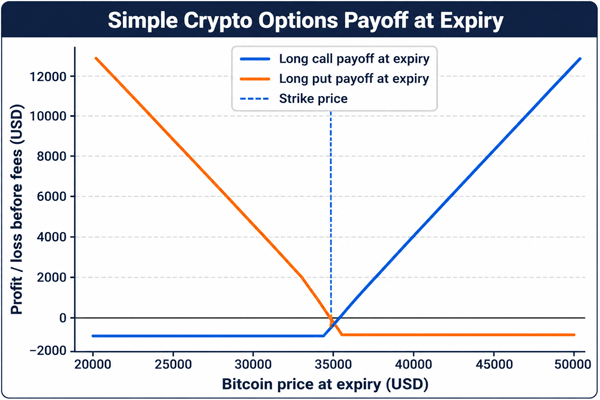
Chart: Long call and long put payoff examples at expiry. Actual outcomes may differ because fees, spreads, implied volatility, and early exits affect results.
3. Crypto Options vs Spot Trading vs Futures
| Feature | Spot crypto | Crypto futures/perpetuals | Crypto options |
|---|---|---|---|
| What you trade | The crypto asset itself | A contract tracking future or perpetual price exposure | A right or obligation linked to a strike and expiry |
| Main risk | Price falls after buying | Leverage, liquidation, funding, margin calls | Premium loss, time decay, volatility, liquidity, margin if selling |
| Can loss exceed initial cash? | Usually no, unless using borrowing or margin | Yes, depending on leverage and margin rules | Buying: usually limited to premium. Selling: can be very large |
| Best beginner use | Long-term holding or simple trading | Advanced short-term trading and hedging | Defined-risk speculation or hedging after learning basics |
| Complexity | Lower | Medium to high | High |
4. Why Traders Use Crypto Options
Crypto options are popular because they can shape risk in ways spot trading cannot. A trader can define maximum loss when buying options, hedge a portfolio, trade volatility, or build structured strategies for specific market views.
- Limited-risk directional trades when buying calls or puts.
- Portfolio protection using puts as a form of insurance.
- Income strategies where experienced traders sell options, while accepting higher risk.
- Volatility trading, where the trader is focused on expected movement rather than only direction.
- Event hedging around ETF decisions, upgrades, halving cycles, macro data, or major regulatory news.
5. Main Risks of Crypto Options Trading
The biggest mistake beginners make is thinking options are safer just because a bought option has limited loss. Buying options can still lose money quickly. Selling options can be far more dangerous because losses may be large if the market moves sharply.
| Risk | What it means | Practical protection |
|---|---|---|
| Time decay | Options lose value as expiry approaches if the expected move does not happen | Avoid buying very short-dated options without a clear plan |
| Volatility risk | An option can fall even if price moves in your direction if implied volatility drops | Compare premium to realistic expected movement |
| Liquidity risk | Wide bid-ask spreads make entry and exit expensive | Trade liquid expiries and strikes; use limit orders |
| Margin risk | Selling options may require collateral and can trigger margin calls | Avoid uncovered selling as a beginner |
| Platform/custody risk | Crypto venues may face outages, hacks, insolvency, or withdrawal restrictions | Use reputable venues and avoid keeping excess funds on exchanges |
| Regulatory risk | Availability and rules differ by country and can change | Check local law and platform eligibility |
| Model risk | Options pricing assumptions can be wrong in fast crypto markets | Stress-test trades instead of trusting one calculator |
6. Key Concepts Beginners Must Understand
6.1 Moneyness: In the Money, At the Money, Out of the Money
Moneyness describes where the strike price is compared with the current market price. A call is in the money when the market price is above the strike. A put is in the money when the market price is below the strike. At-the-money options are near the current price. Out-of-the-money options need a move before they have intrinsic value.
6.2 Intrinsic Value and Time Value
Intrinsic value is what the option would be worth if it expired immediately. Time value is the extra value traders pay for the possibility that the market will move before expiry. Many beginners overpay for time value during hype periods.
6.3 Implied Volatility
Implied volatility is the market’s expectation of future movement as reflected in option prices. Higher implied volatility usually means more expensive options. In crypto, implied volatility can rise before major events and collapse after the event, even if the price moves.
6.4 The Greeks in Simple Language
| Greek | Beginner meaning | Why it matters |
|---|---|---|
| Delta | How much the option price may move for a small move in the underlying | Helps estimate directional exposure |
| Theta | How much value the option may lose as time passes | Shows the cost of waiting |
| Vega | How much the option may react to changes in implied volatility | Important before and after big events |
| Gamma | How quickly delta changes as the market moves | Higher near expiry and near the strike |
| Rho | Sensitivity to interest rates | Usually less important for most short-term crypto traders |
7. Beginner-Friendly Crypto Options Examples
7.1 Example 1: Buying a BTC Call
Situation: BTC is at $65,000. You think it may rise within one month, but you do not want to buy spot BTC or use futures leverage.
| Trade detail | Value |
|---|---|
| Buy | 1 BTC call option |
| Strike | $70,000 |
| Premium | $1,500 |
| Expiry | 1 month |
| Maximum loss | $1,500 plus fees |
| Break-even at expiry | $71,500 |
If BTC expires at $80,000, the option has $10,000 intrinsic value. Approximate profit before fees is $8,500. If BTC expires at $69,000, the option expires worthless and the loss is the premium. The key lesson is that the market must move enough, soon enough, to overcome the premium.
7.2 Example 2: Buying an ETH Put as Protection
Situation: You hold ETH for the long term but worry about a sharp drop over the next few weeks. Instead of selling your ETH, you buy a put option as temporary protection.
| Trade detail | Value |
|---|---|
| Current ETH price | $3,500 |
| Put strike | $3,200 |
| Premium | $120 |
| Purpose | Reduce downside risk |
| Maximum hedge cost | $120 plus fees per ETH-equivalent contract |
If ETH falls to $2,700, the put has value and can offset part of your spot loss. If ETH rises, your ETH gains value and the put may expire worthless. This is similar to paying an insurance premium.
7.3 Example 3: Covered Call on Crypto Holdings
A covered call means you own the underlying asset and sell a call against it. The premium gives income, but your upside can be capped if price rises above the strike. This is not risk-free: if the crypto price falls, the premium may not cover the loss on the asset.
8. Common Crypto Options Strategies
| Strategy | Market view | Risk level | Beginner notes |
|---|---|---|---|
| Long call | Bullish | Defined risk when bought | Simple, but premium can decay quickly |
| Long put | Bearish or protective | Defined risk when bought | Useful for hedging, but cost can be high |
| Covered call | Neutral to moderately bullish | Medium | Requires owning the crypto; upside is capped |
| Protective put | Bullish long term but worried short term | Medium | Acts like insurance on a holding |
| Bull call spread | Moderately bullish | Defined risk and capped reward | Often cheaper than buying a naked call |
| Bear put spread | Moderately bearish | Defined risk and capped reward | Often cheaper than buying a naked put |
| Straddle | Expecting a large move either way | High cost | Needs movement big enough to beat both premiums |
| Iron condor | Expecting range-bound market | Advanced | Can lose quickly in volatile crypto markets |
9. How to Start Crypto Options Trading Safely
A beginner should not start by selling uncovered options or trading large size. The safer learning path is to understand payoff diagrams, use a demo environment if available, and begin with defined-risk strategies only after understanding the platform rules.
- Learn calls, puts, strike prices, expiry, premium, and settlement before opening an account.
- Check whether crypto options are legal and available in your country.
- Use paper trading or very small size first.
- Choose liquid assets and expiries, usually major assets such as BTC or ETH.
- Use limit orders instead of market orders when spreads are wide.
- Risk only a small percentage of capital on any single trade.
- Write down the reason for the trade, invalidation level, target, and exit plan before entry.
- Review each trade afterward to learn from decision quality, not just profit or loss.
10. How to Choose a Crypto Options Platform
A trading platform should be evaluated for regulation, product availability, liquidity, fees, custody practices, margin rules, customer support, and transparency. Some venues are designed for professional traders and may not be appropriate for beginners.
| Factor | What to check |
|---|---|
| Jurisdiction and eligibility | Whether the platform legally serves your country or region |
| Liquidity | Depth near the bid and ask, especially for BTC and ETH options |
| Fees | Trading fees, settlement fees, withdrawal fees, and hidden spread costs |
| Settlement currency | Whether contracts settle in crypto, fiat, or stablecoins |
| Risk controls | Position limits, margin calculators, liquidation rules, and alerts |
| Security | Cold storage policy, proof of reserves where applicable, audits, and incident history |
| Education tools | Option chain explanations, Greeks, testnet/demo mode, and documentation |
11. Fees and Costs to Consider
The premium is not the only cost. Crypto options traders also face bid-ask spreads, exchange fees, settlement fees, withdrawal fees, funding costs for collateral, and sometimes currency conversion costs. A strategy that looks profitable on paper can become unattractive after costs.
12. Best Practices for Crypto Options Trading
- Prefer defined-risk trades while learning.
- Do not sell naked calls or puts unless you fully understand margin and worst-case scenarios.
- Avoid using options to chase losses after a bad trade.
- Do not buy options only because they look cheap; cheap options may have a low probability of profit.
- Compare the required break-even move with realistic volatility.
- Avoid concentrating all positions in one expiry date.
- Keep extra collateral if using margin, because crypto can move sharply outside normal hours.
- Use a trading journal to track setup, thesis, price, implied volatility, exit, and lesson learned.
- Treat exchange risk as real; do not keep unnecessary funds on any platform.
13. Common Mistakes Beginners Make
| Mistake | Why it hurts | Better approach |
|---|---|---|
| Buying far out-of-the-money options because they are cheap | They often expire worthless unless the move is very large | Use realistic strikes and understand probability |
| Ignoring expiry | The trade may need to work quickly | Choose enough time for the thesis to play out |
| Using market orders in illiquid options | Wide spreads create instant losses | Use limit orders and check depth |
| Selling options for income without understanding risk | Losses can exceed collected premium | Start with defined-risk spreads or avoid selling |
| Confusing direction with profitability | Correct direction can still lose if premium is too high | Calculate break-even and expected move |
| Risking too much on one trade | Options can lose 100% of premium | Use small position sizing |
14. Pros and Cons of Crypto Options
| Pros | Cons |
|---|---|
| Can define maximum loss when buying options | Options pricing is complex for beginners |
| Useful for hedging crypto holdings | Premium can decay quickly |
| Allows bullish, bearish, neutral, and volatility strategies | Liquidity may be poor outside major strikes and expiries |
| Can reduce capital needed compared with spot exposure | Selling options can create large or unlimited losses |
| Can be used for event-risk management | Platform, custody, and regulatory risks remain |
15. Regulation and Investor Protection
Crypto derivatives rules vary widely by country. In the United States, official investor materials from agencies such as the CFTC, SEC, NFA, and FINRA repeatedly warn that virtual currency and crypto asset products can be volatile, speculative, and exposed to fraud, custody, platform, and market risks. The CFTC has specifically warned about risks in virtual currency spot, futures, and options markets. The SEC has warned that crypto asset securities can be highly speculative and may lack important investor protections. The NFA has also warned that virtual currency derivatives involve a high level of risk and may not be suitable for all investors.
Before trading, check whether the product is regulated in your location, whether the platform is allowed to serve you, and what protections apply if the platform fails. A regulated venue does not remove trading risk, but it may provide clearer rules, oversight, and dispute procedures than an offshore or unregulated venue.
16. Simple Risk Management Checklist
- Can I explain the payoff at expiry in one sentence?
- Do I know my maximum possible loss before entering?
- Have I included fees and spread in the break-even calculation?
- Is the option liquid enough to exit?
- Do I understand what happens at expiry and settlement?
- Am I risking a small amount relative to my total capital?
- Have I considered what happens if volatility drops?
- Am I trading from a plan rather than emotion or social media hype?
17. Frequently Asked Questions
17.1 Is crypto options trading good for beginners?
It can be educational, but it is not simple. Beginners should first learn spot crypto, basic risk management, and option payoff diagrams. If they trade at all, they should start with small, defined-risk trades such as buying calls or puts, not selling uncovered options.
17.2 Can you lose more than you invest in crypto options?
If you buy a call or put and do not use margin, the loss is usually limited to the premium paid plus fees. If you sell options, use margin, or trade complex structures, losses can be much larger and may exceed the premium collected.
17.3 What is the safest crypto options strategy?
No strategy is completely safe. For beginners, defined-risk strategies are generally safer than uncovered option selling. A protective put or a small long call/put has a known maximum loss, but it can still lose 100% of the premium.
17.4 Are crypto options better than futures?
They are different tools. Futures are more direct and often more liquid, but leverage can create liquidation risk. Options can define risk when bought, but they are more complex because price depends on time, volatility, strike, and expiry.
17.5 What are the most common crypto options markets?
Bitcoin and Ether options are usually the most actively followed crypto options markets. Liquidity for smaller coins can be much thinner, which may create wider spreads and harder exits.
17.6 What does it mean when a crypto option expires worthless?
It means the option has no value at expiry. For a call, this usually happens when the market price is at or below the strike. For a put, it usually happens when the market price is at or above the strike.
17.7 Do crypto options trade 24/7?
Many crypto markets operate continuously, but platform rules, maintenance windows, expiry times, and settlement procedures vary. Always check the specific exchange documentation.
17.8 Should I trade options before understanding the Greeks?
No. You do not need to become a mathematician, but you should understand delta, theta, vega, and gamma in practical terms before risking meaningful money.
18. Conclusion
Crypto options trading is powerful because it allows traders to design risk and reward more precisely than spot trading. A call can express a bullish view, a put can protect against downside, and spreads can reduce cost while limiting both risk and reward. But options are also unforgiving. Time decay, volatility changes, wide spreads, margin rules, and platform risk can turn a promising idea into a loss.
For beginners, the best approach is slow and structured: learn the vocabulary, study payoff diagrams, practice with small or simulated trades, avoid uncovered selling, and treat risk management as the main skill. The goal is not to predict every market move. The goal is to survive long enough to learn, protect capital, and make decisions based on a plan rather than emotion.
Sources Consulted and Checked
These sources were consulted and checked while preparing this document to support accuracy and reliability.
- U.S. Commodity Futures Trading Commission (CFTC), Customer Advisory: Understand the Risks of Virtual Currency Trading.
- U.S. Securities and Exchange Commission (SEC), Investor Alert: Exercise Caution with Crypto Asset Securities.
- Financial Industry Regulatory Authority (FINRA), Crypto Assets investor education materials.
- National Futures Association (NFA), Investor Advisory: Virtual Currency.
- CME Group crypto futures and options product information.
- Deribit crypto options knowledge base and contract documentation.
Reader Advice
This article is provided for educational and informational purposes only and is not personalized financial, investment, legal, tax, or trading advice or a recommendation to buy, sell, or hold any crypto asset or derivative. Crypto options involve substantial risk, including the possible loss of the entire premium, rapid losses from volatility and time decay, margin calls, losses exceeding the premium received when selling options, and platform, custody, liquidity, settlement, and regulatory risks. Rules, policies, laws, product availability, fees, and market statistics can change over time and vary by country or region, so readers should verify current information through official regulators, exchange documentation, and qualified professional advisers before making decisions. Consider personal circumstances, experience, and risk tolerance, and never trade with money you cannot afford to lose.