Crypto Trading for Beginners
1. What Is Crypto Trading?
Crypto trading is the buying and selling of digital assets such as Bitcoin, Ether, stablecoins, and other cryptocurrencies with the aim of making a profit from price changes. A trader may buy a coin because they expect its price to rise, or sell because they expect the price to fall. Unlike long-term investing, trading usually focuses on shorter time frames, market timing, risk control, and repeatable decision-making.
For beginners, the most important idea is simple: crypto trading is not guessing. A good trader uses a plan, understands basic market mechanics, limits losses, protects accounts, records decisions, and learns from mistakes. The goal is not to win every trade. The goal is to avoid large avoidable losses while gradually improving decision quality.
2. Crypto Trading vs Crypto Investing
| Topic | Crypto Trading | Crypto Investing |
|---|---|---|
| Main goal | Profit from price moves over shorter periods | Hold quality assets for long-term growth or use |
| Time frame | Minutes, hours, days, or weeks | Months or years |
| Skill focus | Charts, order types, liquidity, risk control, psychology | Research, valuation, security, long-term conviction |
| Risk level | Often higher because decisions are more frequent | Still risky, but usually less active |
| Best beginner approach | Small positions, spot trading, strict stop-loss rules | Dollar-cost averaging, custody education, diversification |
3. How Crypto Trading Works
Most beginners trade through a crypto exchange. The exchange matches buyers and sellers in a market such as BTC/USDT or ETH/USD. The first asset in the pair is the asset being bought or sold, and the second asset is the pricing currency. If BTC/USDT trades at 65,000, it means one Bitcoin is priced at 65,000 USDT on that exchange at that moment.
Prices move because buyers and sellers constantly adjust their orders. If more aggressive buyers are willing to pay higher prices, the market may rise. If sellers are more aggressive, the market may fall. News, liquidity, leverage, macroeconomic conditions, regulation, exchange outages, and social media attention can all influence crypto prices.
3.1 Basic Terms Beginners Should Know
| Term | Simple meaning | Beginner example |
|---|---|---|
| Exchange | A platform where people buy and sell crypto | Coinbase, Kraken, Binance, or another regulated platform available in your country |
| Trading pair | Two assets traded against each other | ETH/USDT means Ether priced in USDT |
| Spot trading | Buying or selling the actual crypto asset | Buying 0.05 BTC and holding it in your exchange account or wallet |
| Limit order | An order that executes only at your chosen price or better | Buy ETH only if it falls to $3,000 |
| Market order | An order that executes immediately at the best available price | Buy BTC now at the current market price |
| Stop-loss | An order or rule used to limit loss | Exit if price falls 5% below entry |
| Liquidity | How easily an asset can be bought or sold without moving price too much | BTC usually has deeper liquidity than small unknown coins |
| Slippage | The difference between expected and actual trade price | You expect $1.00 but your order fills at $1.02 |
| Leverage | Borrowed exposure that magnifies gains and losses | 5x leverage means a 10% adverse move can be devastating |
4. Beginner Crypto Trading Workflow
The chart below shows a safe learning sequence for new traders. Many beginners fail because they skip directly to buying coins without understanding security, risk, fees, and emotional discipline.
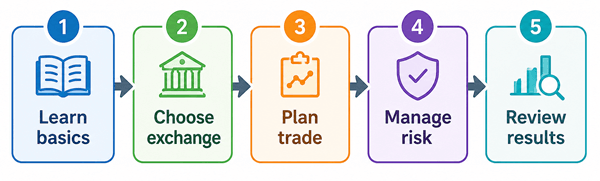
Figure 1: A simple beginner-friendly crypto trading workflow.
4.1 Choose a Reliable Crypto Exchange
A beginner should start with a reputable exchange that is legally available in their country, has clear fees, offers two-factor authentication, provides withdrawal options, and supports major liquid assets. Avoid platforms promoted through random social media messages, private groups, romance scams, or unrealistic profit claims.
4.2 Secure Your Account Before Depositing Money
Use a unique password, enable app-based two-factor authentication, beware of phishing links, and whitelist withdrawal addresses where possible. Do not share screenshots of balances, seed phrases, account codes, or support chats. If you move crypto to a self-custody wallet, write down the recovery phrase offline and never type it into websites.
4.3 Start With Spot Trading, Not Leverage
Spot trading is easier to understand because you buy or sell the actual asset. Leveraged futures, margin trading, and perpetual contracts are much more complex. They can liquidate a position quickly, especially during volatile crypto moves. Beginners should generally learn spot markets first.
4.4 Make a Trading Plan Before Entering
A trading plan defines what you will buy, why you will buy it, your entry price, your invalidation point, your target or exit rules, your position size, and the maximum amount you are willing to lose. Without a plan, a trade can quickly become emotional gambling.
| Trading plan item | Question to answer before trading | Example |
|---|---|---|
| Market | Which pair are you trading? | BTC/USDT |
| Reason | Why does this trade make sense? | Price is near support and overall market trend is rising |
| Entry | Where will you enter? | $65,000 |
| Stop-loss | Where is your idea wrong? | $63,700 |
| Risk per trade | How much can you lose? | 1% of account balance |
| Exit rule | How will you take profit or cut the trade? | Take partial profit near $68,000; exit if stop hits |
5. Common Crypto Trading Strategies for Beginners
No strategy works all the time. Beginners should understand the purpose, risk, and difficulty of each approach before using it with real money.
5.1 Dollar-Cost Averaging
Dollar-cost averaging means buying a fixed amount on a regular schedule, such as weekly or monthly. It is more of an investing method than active trading, but it is often safer for beginners than trying to time every market move. It reduces the pressure of choosing one perfect entry point.
5.2 Trend Following
Trend following means trading in the direction of the broader market trend. A simple beginner version is to avoid buying weak coins during a clear downtrend and focus only on strong liquid assets when the overall market is improving. The risk is buying late after a large move has already happened.
5.3 Range Trading
Range trading means buying near an area where price has repeatedly found support and selling near an area where price has repeatedly faced resistance. It can work in sideways markets, but it fails when price breaks out of the range with strong momentum.
5.4 Breakout Trading
Breakout trading means entering when price moves above resistance or below support. The challenge is false breakouts, where price briefly moves beyond a level and then reverses. Beginners should use small size and predefined stop-loss rules if practicing this method.
6. Practical Crypto Trading Example
Imagine a beginner has a $1,000 trading account and decides never to risk more than 1% on one trade. That means the maximum planned loss is $10. The trader wants to buy ETH at $3,000 and believes the trade idea is wrong if ETH falls below $2,940. The risk per ETH is $60. To risk only $10, the trader could buy about 0.166 ETH because $10 divided by $60 equals 0.166. This example shows why position sizing matters more than excitement about the coin.
If ETH rises to $3,120, the trade gains about $120 per ETH. On 0.166 ETH, that is about $19.92 before fees. If ETH falls to $2,940, the planned loss is about $10 before fees. This is not a prediction; it is a risk-control example.
7. Main Risks of Crypto Trading
Crypto assets can be exceptionally volatile and speculative. Regulatory protections may also differ from traditional securities markets. Beginners should understand the risks before depositing funds.
| Risk | What it means | How beginners can reduce it |
|---|---|---|
| Market volatility | Prices can move sharply in minutes or hours | Use small positions, avoid leverage, set exit rules |
| Exchange risk | A platform may freeze withdrawals, fail, be hacked, or face legal issues | Use reputable platforms, avoid keeping all funds on one exchange |
| Liquidity risk | Small coins may be hard to sell without a bad price | Prefer liquid major pairs while learning |
| Scam risk | Fake exchanges, pump groups, phishing, and romance scams target beginners | Never trust guaranteed-profit messages or private wallet requests |
| Leverage risk | Borrowed exposure can cause liquidation | Avoid leverage until you fully understand it |
| Tax risk | Trading may create reportable taxable events | Keep records and consult a tax professional when needed |
| Psychological risk | Fear, greed, revenge trading, and overconfidence can damage decisions | Use a written plan and trading journal |
8. Best Practices for Beginner Crypto Traders
8.1 Use a Risk Limit Per Trade
Many experienced traders risk only a small percentage of their account on a single trade. A beginner can start with 0.5% to 1% risk per trade while learning. This does not mean investing only 1% of the account; it means the planned loss if the trade fails should be limited to that percentage.
8.2 Avoid Trading Too Many Coins
Beginners often jump between dozens of tokens because social media makes every coin look urgent. A better approach is to study a few liquid markets first, such as BTC and ETH pairs, and learn how they move. Smaller coins can have wider spreads, lower liquidity, more manipulation risk, and less reliable information.
8.3 Track Fees and Slippage
Trading fees, withdrawal fees, funding rates, spreads, and slippage can turn a small winning strategy into a losing one. Before placing an order, check the total cost. Market orders are convenient but may create more slippage in fast or illiquid markets.
8.4 Keep a Trading Journal
A trading journal should record the date, asset, entry, exit, position size, reason for the trade, emotional state, screenshot if useful, result, and lesson learned. This helps beginners identify repeated mistakes such as entering late, moving stops, overtrading, or ignoring market conditions.
8.5 Separate Trading Money From Life Money
Crypto trading should never use rent money, emergency savings, borrowed funds, school fees, or money needed for family responsibilities. The safest beginner mindset is to treat early trading capital as tuition for learning, not guaranteed income.
9. Common Beginner Mistakes
- Buying only because a coin is trending on social media.
- Using leverage before understanding liquidation and funding rates.
- Trading without a stop-loss or invalidation point.
- Putting the whole account into one coin.
- Moving a stop-loss farther away because the trader does not want to accept a loss.
- Chasing green candles after a large move has already happened.
- Trusting influencers, private signal groups, or guaranteed-profit claims.
- Ignoring taxes, fees, and account security.
| Beginner question | Practical answer |
|---|---|
| How much money should I start with? | Only an amount you can afford to lose. Many beginners should practice with very small amounts or paper trading first. |
| Should I trade daily? | Not necessarily. More trades do not mean better results. Waiting for clear setups is usually safer. |
| Is Bitcoin safer than small coins? | Bitcoin is generally more liquid and established, but it is still volatile and risky. |
| Can I make a living from crypto trading? | Most beginners should not expect this. Trading income is uncertain and requires skill, capital, discipline, and risk control. |
10. Crypto Trading Checklist Before Your First Trade
Before placing a real trade, a beginner should be able to answer yes to these questions:
- Do I understand the asset and trading pair?
- Have I checked the exchange fees and withdrawal options?
- Is two-factor authentication enabled?
- Do I know my entry, stop-loss, and exit plan?
- Have I calculated the maximum amount I can lose?
- Am I avoiding leverage while learning?
- Am I trading because of a plan, not emotion or hype?
- Will I record the trade in a journal?
11. FAQs About Crypto Trading for Beginners
11.1 Is crypto trading good for beginners?
Crypto trading can be learned by beginners, but it is risky and should be approached slowly. Beginners should focus first on education, security, risk management, and spot markets rather than leverage or short-term speculation.
11.2 What is the safest way to start crypto trading?
The safer beginner path is to use a reputable exchange, enable strong security, trade only small amounts, avoid leverage, focus on liquid assets, and use a written plan for every trade.
11.3 What is the difference between a market order and a limit order?
A market order buys or sells immediately at the best available price, while a limit order only executes at the price you choose or better. Market orders are faster, but limit orders give more price control.
11.4 Can I lose more than I deposit in crypto trading?
In normal spot trading, losses are generally limited to the value of the asset. With leverage, margin, or certain derivatives, losses can be much larger and liquidations can happen quickly.
11.5 Do I have to pay taxes on crypto trades?
Tax rules depend on your country. In the United States, the IRS says income from digital assets is taxable and digital asset transactions may need to be reported. Traders should keep detailed records and seek local tax advice.
11.6 Are crypto signals reliable?
Many signal groups are unreliable, biased, or scams. Even when a signal is correct, followers may enter late, use poor risk control, or misunderstand the trade. Beginners should learn to make independent decisions.
11.7 What is a good risk per trade for beginners?
A conservative beginner range is often 0.5% to 1% of account equity as the maximum planned loss per trade. The exact number depends on personal risk tolerance and experience.
12. Final Thoughts
Crypto trading can be interesting and educational, but it is not easy money. The beginner who survives long enough to learn is usually the one who avoids large losses, ignores hype, protects accounts, keeps records, and improves slowly. Start with the basics, trade small, focus on risk first, and treat every trade as a test of your process rather than a promise of profit.
Sources Consulted and Checked
These sources were consulted and checked while preparing this article to support its accuracy and reliability.
- FINRA: Crypto Assets
- FINRA: Crypto Assets - Risks
- Investor.gov / SEC: Exercise Caution with Crypto Asset Securities
- SEC: Cyber, Crypto Assets and Emerging Technology
- IRS: Digital Assets
- IRS: FAQs on Virtual Currency Transactions
Reader Advice
Important note: This article is educational only and is not financial, investment, tax, or legal advice. Crypto trading is risky. Beginners should never trade with money they cannot afford to lose and should check local regulations and tax rules before trading. Rules, policies, laws, tax treatment, market conditions, platform features, and statistics can change over time and may vary by country or region, so verify current information through official sources before making a decision. Crypto trading involves substantial risk, including volatility, scams, exchange failure, liquidity problems, and the possible loss of your entire trading amount; consider your circumstances and seek advice from a qualified financial, tax, or legal professional when appropriate.