HD Wallets and Derivation Paths Explained: BIP39, BIP32 and Wallet Recovery
A modern crypto wallet usually does not store one private key for one address. Instead, it uses a system that can create many keys and addresses from one master backup. That system is called a hierarchical deterministic wallet, or HD wallet.
This article explains HD wallets from the ground up. You will learn what BIP39 and BIP32 do, how derivation paths such as m/84'/0'/0'/0/0 work, why the same recovery phrase can show different balances in different wallets, and how to recover a wallet more safely.
1. Quick answer: what is an HD wallet?
An HD wallet is a crypto wallet that creates a whole tree of private keys, public keys, and addresses from one master seed. In most wallets, that master seed is backed up as a BIP39 recovery phrase, often called a seed phrase or mnemonic phrase. The wallet then uses BIP32-style key derivation and one or more derivation paths to find the right accounts and addresses.
- BIP39 usually explains the human-readable backup phrase.
- BIP32 explains the hierarchical key tree and extended keys.
- Derivation paths tell the wallet which branch of that tree to use.
- Wallet recovery works only when the phrase, optional passphrase, coin/network, derivation path, and address type match.
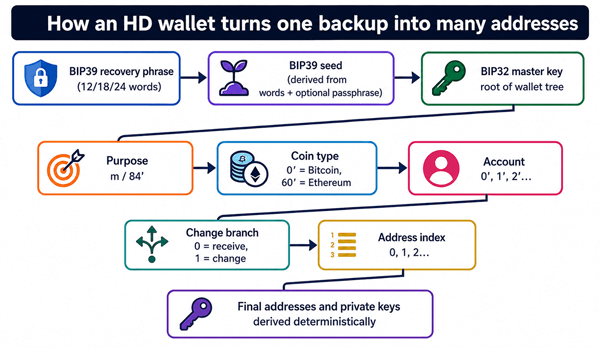
Diagram: A simplified HD wallet flow from BIP39 phrase to derived addresses.
2. Why HD wallets exist
Early wallets could require users to back up many separate private keys. That was risky. If you created a new address after making a backup, that new key might not be included in the old backup. HD wallets solved this by making the wallet deterministic: the same seed always recreates the same wallet tree.
This design is especially useful because good wallets create new receiving addresses for privacy. A Bitcoin wallet, for example, may show a fresh address every time you receive funds, but all those addresses can still come from the same original backup.
| Problem with old-style wallets | How HD wallets help |
|---|---|
| Many separate private keys to manage | One seed can recreate a large tree of keys |
| New addresses could be missed by old backups | The backup stays valid as long as the seed is preserved |
| Harder to separate accounts and address types | Paths organize coins, accounts, receiving addresses, and change addresses |
| Poor backup habits increased loss risk | A single recovery phrase is easier to write down and verify |
3. The three ideas beginners must understand
| Term | Plain-English meaning | Why it matters |
|---|---|---|
| Recovery phrase / seed phrase | A list of words used to recreate the wallet seed. | Anyone with the correct phrase can usually control the funds. |
| Seed | The binary root secret generated from the recovery phrase and optional passphrase. | The wallet uses it to create the master key. |
| Derivation path | A map that tells the wallet where to look in the key tree. | The wrong path can make a valid wallet look empty. |
| Private key | The secret that can spend funds from an address. | It must never be shared. |
| Public key / address | Information used to receive funds or identify wallet outputs. | Usually safe to share, though it may reduce privacy. |
| Extended public key (xpub/ypub/zpub etc.) | A public branch of an HD wallet tree. | Can generate addresses and reveal transaction history, but cannot spend. |
4. BIP39 explained: recovery phrases and mnemonic words
BIP39 is the common standard many wallets use for mnemonic recovery phrases. The official BIP39 specification describes a mnemonic code for generating deterministic wallets and converting that mnemonic into a binary seed that can be used by BIP32 or similar wallet systems.
4.1 How a BIP39 phrase is created
- The wallet generates strong random entropy. Good randomness is essential.
- A checksum is added so the phrase can catch many typing or word-order mistakes.
- The result is split into groups that map to words from the BIP39 word list.
- The words are shown to the user as a 12-, 18-, or 24-word recovery phrase.
- During wallet use, the phrase plus an optional BIP39 passphrase is processed to create the seed.
4.2 12 words vs 24 words
| Phrase length | Typical entropy | Beginner-friendly interpretation |
|---|---|---|
| 12 words | 128 bits before checksum | Widely used and considered strong when generated by a reputable wallet. |
| 18 words | 192 bits before checksum | Less common, but valid in BIP39-compatible wallets. |
| 24 words | 256 bits before checksum | Common in hardware wallets; gives a larger security margin. |
For most users, the biggest real-world risk is not that a properly generated 12-word phrase will be brute-forced. The bigger risks are phishing, screenshots, cloud backups, typing the phrase into a fake website, losing the phrase, or forgetting an optional passphrase.
4.3 The optional BIP39 passphrase: powerful but dangerous if forgotten
A BIP39 passphrase is an extra secret sometimes called the “25th word,” although it can be a word, sentence, or random string. It is not the same thing as a wallet app password or device PIN.
- Same recovery phrase + no passphrase = one wallet.
- Same recovery phrase + passphrase “blue river 77” = a completely different wallet.
- Same recovery phrase + passphrase “Blue river 77” = another different wallet, because capitalization and spaces matter.
This is useful for advanced security, but it creates a serious recovery risk. If you lose the passphrase, the recovery phrase alone will not recover the hidden wallet.
5. BIP32 explained: the wallet tree
BIP32 defines hierarchical deterministic wallets. In simple terms, it describes how one master key can derive child keys, grandchild keys, and so on. This creates a tree structure where each branch can represent a coin, account, receiving chain, change chain, or individual address.
5.1 A simple analogy
Think of the BIP39 phrase as the master blueprint, BIP32 as the branching filing cabinet, and the derivation path as the drawer label. If you open the wrong drawer, the files are not missing; you are just looking in the wrong place.
5.2 Private and public branches
HD wallets can create extended private keys and extended public keys. An extended private key can derive private keys and spend funds. An extended public key can usually derive public addresses and track balances, but cannot spend funds by itself.
| Item | Can create addresses? | Can spend funds? | Main risk |
|---|---|---|---|
| Recovery phrase / seed | Yes | Yes | Total wallet compromise if exposed |
| Extended private key (xprv and similar) | Yes | Yes | Can compromise the branch it controls |
| Extended public key (xpub, ypub, zpub and similar) | Yes | No | Can expose wallet history and future addresses |
| Single public address | No, only that address is known | No | Can reveal activity linked to that address |
5.3 Hardened vs non-hardened derivation
You will often see an apostrophe in derivation paths, such as m/44'/0'/0'. The apostrophe means hardened derivation. Hardened derivation is used for sensitive levels of the wallet tree because it limits what can be derived from public information.
| Type | Path marker | Beginner meaning | Typical use |
|---|---|---|---|
| Hardened | Apostrophe: 44' | A stronger boundary between parent and child branches. | Purpose, coin type, and account levels. |
| Non-hardened | No apostrophe: 0/5 | Allows public child addresses to be derived from an extended public key. | Receiving/change branches and address indexes. |
6. Derivation paths explained
A derivation path is a route through the HD wallet tree. It normally starts with m, which means the master key, followed by numbered levels separated by slashes.
Example: m/84'/0'/0'/0/0
| Path part | Meaning | Example value |
|---|---|---|
| m | Master root | Start of the wallet tree |
| 84' | Purpose | BIP84-style native SegWit Bitcoin wallet |
| 0' | Coin type | Bitcoin mainnet |
| 0' | Account | First account |
| 0 | Change branch | External receiving addresses |
| 0 | Address index | First receiving address |
6.1 Common derivation paths beginners see
| Use case | Common path pattern | Address style or note |
|---|---|---|
| Bitcoin legacy | m/44'/0'/0'/0/0 | Addresses often start with 1. |
| Bitcoin nested SegWit | m/49'/0'/0'/0/0 | Addresses often start with 3. |
| Bitcoin native SegWit | m/84'/0'/0'/0/0 | Addresses often start with bc1q. |
| Bitcoin Taproot | m/86'/0'/0'/0/0 | Addresses often start with bc1p. |
| Ethereum account | m/44'/60'/0'/0/0 | Common Ethereum path; address format starts with 0x. |
| Bitcoin testnet | m/84'/1'/0'/0/0 | Test coins only; not mainnet funds. |
Important: path conventions vary by coin, wallet, address type, and era. A wallet may support several paths at once, or it may scan only the default path unless you choose advanced recovery options.
7. BIP39 vs BIP32 vs BIP44: what is the difference?
| Standard | What it mainly covers | Beginner takeaway |
|---|---|---|
| BIP39 | Mnemonic phrase and seed generation. | Your word backup usually comes from here. |
| BIP32 | Hierarchical deterministic key derivation. | This is the tree that creates many keys from one seed. |
| BIP44 | A common multi-account path structure using purpose, coin type, account, change, and address index. | This gave wallets a shared way to organize coins and accounts. |
| BIP49 / BIP84 / BIP86 | Common Bitcoin path purposes for nested SegWit, native SegWit, and Taproot. | Different address types can use different paths. |
8. How wallet recovery works in real life
Wallet recovery is not magic. The new wallet app repeats the same deterministic process: phrase to seed, seed to master key, path to addresses, then blockchain scan for balances and transactions.
- Install a trusted wallet that supports the coin and address type you used before.
- Choose restore or recover wallet, not create new wallet.
- Enter the recovery phrase in the exact word order.
- Enter the BIP39 passphrase if you used one. Leave it blank only if you never used one.
- Choose the correct network, account type, and derivation path if the wallet asks.
- Let the wallet scan the blockchain. Some wallets need time to find older or unused addresses.
8.1 Why a recovered wallet may show zero balance
| Likely cause | What to check |
|---|---|
| Wrong recovery phrase | Confirm every word is from the correct word list and in the right order. |
| Forgotten BIP39 passphrase | Try to remember exact capitalization, spacing, and punctuation. |
| Wrong derivation path | Try the path used by the original wallet or common alternatives. |
| Wrong address type | For Bitcoin, check legacy, nested SegWit, native SegWit, and Taproot options. |
| Wrong coin or network | Bitcoin mainnet, Bitcoin testnet, Ethereum, and other chains are separate. |
| Wallet has not finished scanning | Wait for synchronization or increase the account/address gap limit if supported. |
| Funds were moved | Check known addresses in a block explorer using public addresses only. Never paste the recovery phrase into a website. |
9. Real-world recovery scenarios
9.1 Scenario 1: Same seed phrase, different Bitcoin address
A user restores a wallet and sees a Bitcoin address starting with 1, but their old wallet used bc1q addresses. The phrase may be correct, but the wallet is using the legacy path instead of the native SegWit path. The user should look for a recovery option such as native SegWit, BIP84, or m/84'/0'/0'.
9.2 Scenario 2: The phrase works, but the wallet is empty
A hardware wallet user enabled a BIP39 passphrase years ago. When restoring, they enter only the 24 words and see an empty account. This is expected: the passphrase creates a different wallet. The exact passphrase is required.
9.3 Scenario 3: Ethereum address is different after recovery
Some wallets use different Ethereum account indexes or path layouts. The user may need to add more accounts or choose a custom path such as m/44'/60'/0'/0/0. Because Ethereum addresses are account-based, restoring the correct index matters.
10. Benefits of HD wallets
- Simpler backup: one recovery phrase can restore many addresses.
- Better privacy: wallets can generate a new receiving address for each transaction.
- Organized accounts: paths can separate coins, accounts, address types, and change addresses.
- Watch-only setups: an extended public key can monitor addresses without exposing spending keys.
- Compatibility: many wallets understand common BIP standards, making recovery easier than with proprietary systems.
11. Risks and limitations
- The recovery phrase is a single point of failure. If someone gets it, they may steal the funds.
- A passphrase improves security only if it is backed up and remembered exactly.
- Not every wallet scans every path automatically.
- Extended public keys can leak financial privacy even though they cannot spend.
- Some coins and wallets use non-standard or legacy paths, which can complicate recovery.
- A seed phrase does not prove that funds still exist; it only recreates keys. The blockchain determines current balances.
12. Best practices for safe wallet backup and recovery
- Write the recovery phrase offline on paper or a metal backup. Do not store it in screenshots, email, cloud notes, or chat apps.
- Verify the backup by using the wallet’s built-in recovery check when available.
- Record important recovery details: wallet name, coin, address type, account number, and derivation path. Store this separately from the seed if needed.
- Use a hardware wallet for meaningful amounts, especially if you transact from a general-purpose computer or phone.
- Never type the seed phrase into a website, search result, browser extension popup, or support chat.
- Test recovery with a small amount before relying on a new wallet setup.
- Keep heirs or trusted executors in mind. A perfect backup is not useful if nobody can access it when needed.
12.1 A practical recovery details template
| Field | Example | Why it helps |
|---|---|---|
| Original wallet | Ledger Live, Sparrow, Electrum, MetaMask | Different wallets may use different defaults. |
| Coin/network | Bitcoin mainnet, Ethereum mainnet | Prevents scanning the wrong chain. |
| Address type | Native SegWit, Taproot, Ethereum account | Helps choose the right path. |
| Derivation path | m/84'/0'/0' or m/44'/60'/0'/0 | The main clue for finding the right branch. |
| Account number | Account 0 or Account 1 | Some wallets hide funds in additional accounts. |
| Passphrase used? | Yes/No reminder only, not necessarily the passphrase itself | Prevents confusing a passphrase wallet with an empty wallet. |
13. Common mistakes and misconceptions
| Mistake or misconception | Reality |
|---|---|
| “My seed phrase is my wallet password.” | No. A wallet password usually unlocks the app or device. The seed phrase restores the wallet. |
| “If the phrase imports, my funds must appear.” | Only if the correct passphrase, coin, path, and address type are used. |
| “An xpub is harmless.” | It cannot spend, but it can reveal addresses and transaction history. |
| “A 24-word phrase is always safe, even online.” | No. A leaked 24-word phrase is compromised. |
| “I can choose any 12 words myself.” | User-chosen words are usually insecure and may fail checksum rules. Let a trusted wallet generate the phrase. |
| “A recovery phrase stores my coins.” | Coins are recorded on the blockchain. The phrase recreates keys that can control them. |
14. Should you use a custom derivation path?
Most beginners should not use custom derivation paths unless they have a clear reason and understand the recovery consequences. Standard paths make future recovery easier. Custom paths can be useful for advanced setups, but they must be documented carefully. If the path is forgotten, the seed may be valid while the wallet appears empty.
15. Security checklist before restoring a wallet
- Confirm you downloaded the wallet from the official source.
- Disconnect from suspicious browser extensions or websites.
- Use a clean device when possible.
- Restore on a hardware wallet for significant funds.
- Do not enter the phrase into any site that claims to “check” or “sync” a wallet.
- After recovery, send a small test transaction before moving large amounts.
- If you suspect the phrase was exposed, move funds to a new wallet with a new seed generated on a trusted device.
16. Frequently asked questions
16.1 What does HD wallet mean?
HD means hierarchical deterministic. The wallet creates a hierarchy, or tree, of keys. Deterministic means the same seed recreates the same keys every time.
16.2 Is BIP39 the same as BIP32?
No. BIP39 is mainly about mnemonic phrases and seed generation. BIP32 is about deriving a tree of keys from a master key.
16.3 Can two wallets use the same recovery phrase but show different addresses?
Yes. They may use different derivation paths, address types, accounts, or passphrases.
16.4 What is a derivation path in simple words?
It is the route a wallet follows through the HD key tree to reach a specific account or address.
16.5 What does the apostrophe mean in m/44'/0'/0'?
It marks hardened derivation. Hardened levels are commonly used for important boundaries such as purpose, coin type, and account.
16.6 Can I recover Bitcoin with only the seed phrase?
Usually yes, but you may also need the correct passphrase, address type, and derivation path used by the original wallet.
16.7 Can I change my seed phrase?
You cannot safely “edit” an existing seed phrase. To change it, create a new wallet with a new seed and move the funds to addresses from the new wallet.
16.8 Is a 12-word seed phrase safe?
A properly generated 12-word BIP39 phrase is generally very strong. The more common danger is exposure or loss, not mathematical brute force.
16.9 Should I store my recovery phrase in a password manager?
For large holdings, offline storage is safer. Some people use password managers for small amounts, but cloud-synced storage increases exposure if the account or device is compromised.
16.10 What should I do if I entered my seed phrase into a suspicious website?
Assume it is compromised. Create a new wallet on a trusted device and move funds immediately if they are still there.
17. Final takeaway
HD wallets make crypto backup practical: one recovery phrase can restore many keys and addresses. But recovery depends on more than the words alone. For a smooth recovery, you need the correct seed phrase, any optional BIP39 passphrase, the right coin or network, and the right derivation path or address type. Treat your recovery phrase as the master key, document recovery details carefully, and never enter the phrase anywhere you do not fully trust.
Sources Consulted and Checked
The following sources were consulted and checked while preparing this document and reviewing its accuracy:
- BIP39: Mnemonic code for generating deterministic keys: https://github.com/bitcoin/bips/blob/master/bip-0039.mediawiki
- BIP32: Hierarchical deterministic wallets: https://github.com/bitcoin/bips/blob/master/bip-0032.mediawiki
- BIP44: Multi-account hierarchy for deterministic wallets: https://github.com/bitcoin/bips/blob/master/bip-0044.mediawiki
- BIP48: Multi-script hierarchy for multisig wallets: https://bips.dev/48/
Reader Advice
This article is provided for educational and informational purposes only and is not personalized legal, financial, investment, cybersecurity, or wallet-recovery advice. Cryptocurrency recovery can involve permanent loss, theft, privacy exposure, and irreversible transactions, especially when seed phrases, passphrases, private keys, derivation paths, or untrusted software are involved. Standards, wallet features, security practices, laws, regulations, policies, and available statistics may change over time and vary by country, network, and service provider. Verify important details through official wallet documentation, recognized BIP specifications, and applicable local authorities or qualified professionals before acting. Never disclose a recovery phrase or private key, and test recovery steps cautiously with small amounts where appropriate.