Seed Phrase Explained: How Recovery Phrases Protect Your Crypto Wallet
A seed phrase, also called a recovery phrase, is one of the most important things you will ever handle as a crypto wallet user. It is usually a list of 12, 18, or 24 simple words that lets you recover access to your crypto wallet if your phone, computer, or hardware wallet is lost, broken, stolen, or reset.
The phrase is powerful because it can recreate the private keys linked to your wallet. That is what makes it useful, but also dangerous. Anyone who gets your correct recovery phrase can usually restore your wallet on another device and move your crypto. There is no bank, help desk, or password reset button that can reverse that kind of loss in most self-custody wallets.
This guide explains what a seed phrase is, how it works, why it protects your crypto, what it cannot protect you from, and how beginners can store it safely.
1. Quick Answer: What Is a Seed Phrase?
A seed phrase is a human-readable backup for a crypto wallet. It is a sequence of words generated by the wallet during setup. If you lose the wallet device or app, the same words can rebuild the wallet and restore access to the crypto addresses controlled by that wallet.
| Term | Beginner meaning |
|---|---|
| Seed phrase | The backup words used to recover a crypto wallet. |
| Recovery phrase | Another common name for a seed phrase. |
| Mnemonic phrase | A technical name for the same idea: words that represent wallet data. |
| Private key | The secret cryptographic key that proves you can spend crypto from an address. |
| Public address | The address people can send crypto to. This can be shared. |
| Self-custody wallet | A wallet where you control the private keys and backup yourself. |
Seed Phrase Flow Diagram
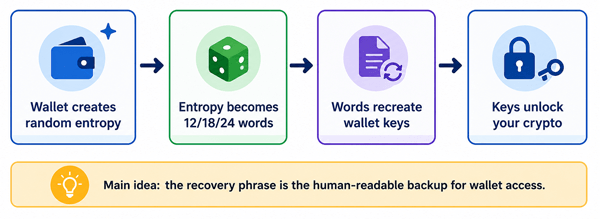
Seed Phrase Flow Diagram
2. Why Seed Phrases Exist
Crypto wallets do not hold coins in the same way a leather wallet holds cash. Your crypto exists as records on a blockchain. Your wallet holds the keys that let you control those records. If those keys are lost, the blockchain does not know that you are the rightful owner.
Before recovery phrases became common, users often had to back up individual private keys or wallet files. That was difficult, error-prone, and risky. A recovery phrase made backup more practical by turning complex wallet data into a short list of common words that a person can write down accurately.
In simple terms, the seed phrase is a safer and more user-friendly way to back up access to your wallet. It does not make crypto risk-free, but it gives you a way to recover from device failure or app loss.
3. How a Seed Phrase Works Behind the Scenes
When you create a modern self-custody wallet, the wallet generates strong random data. In many wallets, that random data is converted into a list of words using a standard such as BIP39. BIP39 describes a mnemonic code for deterministic wallets and includes common phrase lengths such as 12, 15, 18, 21, and 24 words.
The important beginner idea is this: the words are not random motivational words and they are not chosen by the wallet company. They are a readable form of cryptographic randomness. The wallet uses those words to derive a seed, and that seed can generate many private keys and public addresses.
That is why one recovery phrase can restore many accounts inside the same wallet. For example, a hardware wallet might show Bitcoin, Ethereum, and several token accounts. The backup phrase can often restore access to all compatible accounts derived from that same wallet seed.
4. A Simple Real-World Example
Imagine Sara buys a hardware wallet. During setup, the device shows her 24 words. She writes the words on paper, checks the spelling and order, and stores the paper in a safe place. Two years later, the hardware wallet is damaged in a flood.
Sara buys a new compatible wallet. During setup, she chooses the recovery option and enters the 24 words in the correct order. The new device rebuilds the same wallet structure and gives her access to her crypto again.
Now imagine a different situation. Sara takes a photo of the 24 words and stores it in cloud storage. A scammer gets access to that cloud account. The scammer imports the recovery phrase into another wallet and drains the funds. The original hardware wallet did not need to be stolen, because the recovery phrase alone was enough.
5. Seed Phrase vs Private Key vs Wallet Password
Beginners often confuse seed phrases, private keys, passwords, and PINs. They are related, but they are not the same.
| Item | What it does | Can it recover your wallet? | Can it be safely shared? |
|---|---|---|---|
| Seed phrase | Backs up the wallet root that can recreate private keys. | Yes, usually. | No. Never share it. |
| Private key | Controls one specific crypto address or account. | Sometimes, but usually only for that key/address. | No. Never share it. |
| Wallet password | Unlocks a wallet app on a device. | Usually no, unless tied to a backup system. | No. Keep it private. |
| Hardware wallet PIN | Unlocks the physical device. | No. It protects the device, not the backup. | No. Keep it private. |
| Public address | Lets others send crypto to you. | No. | Yes. This is meant to be shared. |
6. Why Recovery Phrases Protect Crypto Wallets
A recovery phrase protects you mainly against losing access. It is a backup, not a shield against every threat.
- Device loss: If your phone or hardware wallet is lost, the phrase can restore the wallet on a new compatible wallet.
- Device failure: If a phone dies or a hardware wallet stops working, the phrase can bring access back.
- App deletion: If you delete a wallet app, the phrase can restore the wallet after reinstalling a compatible app.
- Multi-asset recovery: Many wallets derive multiple accounts from the same phrase, so one backup may cover several assets.
- Independence from one company: In many cases, a standard recovery phrase can be used with another compatible wallet if the original wallet provider disappears.
7. What a Seed Phrase Does Not Protect You From
A seed phrase is not magic security. It solves one problem: recovery. It does not automatically prevent theft, scams, or user mistakes.
| Risk | Does the seed phrase protect you? | What helps instead |
|---|---|---|
| Phishing website asks for your phrase | No | Never type the phrase into websites or chats. |
| Malware records your screen or keyboard | No | Use clean devices, hardware wallets, and official apps. |
| You send crypto to the wrong address | No | Verify addresses and test small transactions. |
| You lose the written backup | No | Use durable, private, redundant storage. |
| Someone finds your backup | No | Store it securely and consider advanced protections like a passphrase if appropriate. |
| Exchange account is hacked | Usually not relevant | Use strong account security; exchange wallets are not self-custody wallets. |
8. Words vs 24 Words: Which Is Better?
Many wallets use either 12 or 24 words. A 24-word phrase usually represents more entropy than a 12-word phrase, but both can be secure when generated correctly by a reputable wallet. For beginners, the bigger practical risk is usually not that someone guesses the phrase. The bigger risk is losing it, exposing it, typing it into a scam, or storing it online.
| Phrase length | Common use | Beginner takeaway |
|---|---|---|
| 12 words | Common in many software wallets. | Secure when generated properly, easier to write and check. |
| 18 words | Less common but supported by the BIP39 structure. | Valid in some wallets, but not the default in many apps. |
| 24 words | Common in hardware wallets. | More entropy, but longer to copy and verify. |
9. Best Practices for Storing a Seed Phrase Safely
The best storage method depends on your risk level, assets, home situation, and ability to keep track of important documents. These beginner rules cover most people.
9.1 Write it down offline
Write the words by hand during wallet setup. Keep them in the exact order. Do not store the phrase in email, cloud notes, screenshots, password managers, messaging apps, or photo galleries unless you fully understand and accept the added risk. For most beginners, offline storage is safer.
9.2 Check spelling and order immediately
A seed phrase is order-sensitive. The same words in the wrong order may not restore the wallet. After writing it down, compare every word with the wallet screen. Many wallets include a confirmation step for this reason.
9.3 Use durable backup materials
Paper is easy, but it can burn, tear, fade, or get wet. For meaningful crypto holdings, consider a metal backup plate designed for seed phrases. Metal backups can resist fire and water better than paper, but they still need private storage.
9.4 Store it somewhere private and physically secure
Good locations include a home safe, a bank safe deposit box where available, or another secure place only trusted people can access. Avoid obvious places such as desk drawers, photos on your phone, or a sticky note near your computer.
9.5 Consider redundancy, but avoid careless copies
One copy can be lost. Too many copies can be discovered. A practical approach is to keep two carefully controlled physical copies in separate secure locations. Do not make extra copies casually.
9.6 Plan for emergencies and inheritance
If something happens to you, your family may not know how to access the wallet. Consider leaving clear, secure instructions with an estate plan. Do not place the full seed phrase in a will that may become public. Professional legal advice may be useful for larger holdings.
10. Common Seed Phrase Mistakes Beginners Should Avoid
- Taking a screenshot of the phrase. Screenshots may sync to cloud storage or be exposed by malware.
- Typing the phrase into a website. Real wallet recovery happens inside a trusted wallet app or hardware wallet process, not a random web form.
- Sending the phrase to support. Legitimate support teams should not need your recovery phrase.
- Storing the phrase in plain text on a computer. A hacked device can reveal it.
- Using a phrase you invented yourself. Human-made phrases are usually much weaker than wallet-generated randomness.
- Changing word order or adding extra words without understanding the system. Recovery requires precision.
- Failing to test the backup. A backup that cannot restore the wallet is not a backup.
- Confusing a wallet password with the seed phrase. A password may unlock the app, but the phrase restores wallet access.
11. Seed Phrase Scams: Red Flags to Recognize
Seed phrase theft is one of the most common ways people lose self-custody crypto. The scam usually works because the attacker convinces the victim to reveal the phrase voluntarily.
- A fake wallet app says there is an error and asks for your 12 or 24 words.
- A social media account pretending to be support asks you to verify your wallet.
- A phishing website says you must connect or synchronize your wallet by entering your phrase.
- A fake airdrop, NFT mint, staking offer, or investment platform asks for recovery words.
- Someone says they need your phrase to help recover funds. In most cases, this gives them the power to steal the funds.
Simple rule: Your recovery phrase should only be entered during a deliberate wallet recovery process, using a trusted wallet or hardware wallet that you intentionally chose. If an interface unexpectedly asks for your seed phrase, stop.
12. What About a Passphrase or “25th Word”?
Some wallets support an optional passphrase, sometimes casually called a “25th word.” This is not the same as the normal seed phrase. It is an additional secret that changes the wallet derived from the seed phrase.
| Benefit | Risk |
|---|---|
| If someone finds only the seed phrase, they may still not access the passphrase-protected wallet. | If you forget or mistype the passphrase, you may lock yourself out permanently. |
| Can create separate wallets from the same seed phrase. | Family or heirs may not know the passphrase exists. |
| Useful for advanced users with higher security needs. | Beginners can make recovery more complicated than necessary. |
For beginners, a passphrase can be powerful but unforgiving. Do not use one unless you understand exactly how your wallet handles it and you have a reliable backup plan for both the seed phrase and the passphrase.
13. Do Exchange Wallets Have Seed Phrases?
Usually, no. If your crypto is on a centralized exchange, you normally log in with an email, password, and two-factor authentication. The exchange controls the wallet infrastructure. That is called custodial storage.
A self-custody wallet is different. You control the recovery phrase and private keys. This gives you more control, but it also gives you more responsibility. If you lose the recovery phrase and cannot access the wallet, there may be no recovery department that can help.
| Wallet type | Who controls the keys? | Recovery method | Main trade-off |
|---|---|---|---|
| Centralized exchange account | The exchange | Account recovery through the exchange | Convenient, but you depend on the company. |
| Self-custody software wallet | You | Seed phrase | More control, but your backup security matters. |
| Hardware wallet | You, with keys kept offline on the device | Seed phrase, sometimes with passphrase option | Strong security, but you must protect the backup. |
14. How to Create and Back Up a Wallet Safely: Beginner Checklist
- Download wallet software only from the official website or trusted app store listing. Check spelling and avoid sponsored phishing links.
- Create the wallet on a secure device. Avoid public computers, borrowed phones, or devices you suspect are infected.
- Let the wallet generate the seed phrase. Do not invent your own words.
- Write the words down in order. Use clear handwriting and number each word.
- Confirm the phrase in the wallet setup process if asked.
- Store the backup offline in a private, durable, secure place.
- Send a small test amount first before moving large funds.
- For larger holdings, consider a hardware wallet and a metal backup.
- Review your emergency plan so trusted heirs can recover funds if needed without exposing the phrase today.
15. How Wallet Recovery Usually Works
The exact steps vary by wallet, but the general recovery process looks like this:
- Install or open a trusted compatible wallet.
- Choose “restore,” “recover,” or “import existing wallet.”
- Enter the recovery phrase in the correct word order.
- Set a new local password or PIN for the app or device.
- Allow the wallet to scan supported blockchains and show your accounts.
- Verify that the addresses and balances are correct before making transactions.
Important: Importing the phrase into a less secure wallet can expose it. For example, if you normally use a hardware wallet, entering its seed phrase into a regular internet-connected software wallet may reduce your security. Prefer recovery on a new hardware wallet when possible.
16. Common Misconceptions About Seed Phrases
| Misconception | Reality |
|---|---|
| “My crypto is inside my wallet device.” | The crypto is recorded on the blockchain. The wallet controls keys. |
| “If my hardware wallet breaks, my crypto is gone.” | Not if you have the correct recovery phrase and any required passphrase. |
| “Customer support can recover my phrase.” | In self-custody wallets, support should not know your phrase and usually cannot restore it for you. |
| “A seed phrase is just another password.” | It is more powerful than a normal password because it can recreate wallet keys. |
| “I can store it in cloud notes because my account has a password.” | Cloud accounts can be hacked, synced, subpoenaed, or exposed by malware. Offline storage is usually safer. |
| “If someone only sees the phrase once, it is fine.” | A photo or quick copy may be enough to steal funds later. |
17. Pros and Cons of Seed Phrases
| Pros | Cons |
|---|---|
| Easy for humans to write compared with raw private keys. | Anyone with the phrase may control the wallet. |
| Can restore access after device loss or failure. | Loss of the phrase can mean permanent loss of access. |
| Often portable across compatible wallets. | Compatibility can vary by wallet path, coin, or passphrase settings. |
| Supports self-custody and independence. | Requires personal security discipline. |
| Can back up many addresses from one wallet. | A single exposed phrase can compromise many accounts. |
18. Practical Scenarios: What Should You Do?
18.1 Scenario 1: You lost your phone with a software wallet
Install the same wallet or a compatible wallet on a trusted new device and restore using your recovery phrase. If you believe the phone was unlocked or compromised, move funds to a newly created wallet after recovery.
18.2 Scenario 2: Someone saw a photo of your seed phrase
Assume the wallet is compromised. Create a brand-new wallet with a new recovery phrase and move funds to the new wallet as soon as safely possible. Do not reuse the exposed phrase.
18.3 Scenario 3: You found an old seed phrase but no wallet app
Try to identify the original wallet and supported coins. Use a reputable compatible wallet to restore. Be cautious: typing an old seed phrase into random tools can expose funds.
18.4 Scenario 4: Your phrase does not restore the expected wallet
Check word order, spelling, the wallet type, derivation path, coin network, and whether you used an additional passphrase. Do not share the phrase with anyone while troubleshooting.
19. The Safest Beginner Mindset
Treat your seed phrase like the master key to your crypto. A public address is like your email address: people can know it. A wallet password is like the lock on one app. A seed phrase is closer to the master blueprint that can rebuild the keys to the whole wallet.
The safest beginner strategy is simple: generate the phrase with a reputable wallet, write it down offline, verify it carefully, store it privately, never share it, and practice with small amounts before trusting the wallet with serious money.
20. FAQs About Seed Phrases
20.1 Is a seed phrase the same as a recovery phrase?
Yes. In everyday crypto use, seed phrase and recovery phrase usually mean the same thing. Mnemonic phrase is another technical term for it.
20.2 Can someone steal my crypto with only my seed phrase?
In many self-custody wallets, yes. If they have the correct seed phrase and any required passphrase, they can restore the wallet and move funds.
20.3 Can I change my seed phrase?
Not directly like changing a password. To use a new phrase, create a new wallet with a new seed phrase and transfer funds to the new wallet addresses.
20.4 What happens if I lose my seed phrase?
If you still have access to the wallet, move funds to a new wallet with a safely backed-up phrase. If you lose both wallet access and the phrase, recovery may be impossible.
20.5 Should I store my seed phrase in a password manager?
Some advanced users do, but for beginners it adds online and device risks. Offline physical storage is usually easier to understand and safer from remote hacking.
20.6 Should I split my seed phrase into parts?
Splitting can reduce one risk but create others. If one part is lost, recovery may fail. If parts are stored badly, attackers may still reconstruct it. Beginners should be cautious with complex schemes.
20.7 Can I memorize my seed phrase?
You can, but memory is not a reliable backup by itself. Stress, illness, time, or simple mistakes can cause permanent loss. Use a physical backup.
20.8 Is a 24-word seed phrase always safer than 12 words?
A 24-word phrase usually has more entropy, but a properly generated 12-word phrase can still be very secure. Most real losses come from exposure, phishing, bad storage, or lost backups.
20.9 Can customer support ask for my seed phrase?
No legitimate support process should require your full seed phrase. If someone asks for it, treat the request as a scam.
20.10 Does my seed phrase expire?
No. It remains valid as long as the wallet standard and derivation details are supported. The security issue is whether it has been exposed or lost.
21. Final Takeaway
A seed phrase protects your crypto wallet by giving you a way to recover access when a device or app is gone. But it also concentrates enormous power into a short list of words. Keep it offline, private, accurate, and recoverable. Never share it. Never type it into surprise prompts. If you understand that one principle, you already understand the most important part of seed phrase security.
Sources Consulted and Checked
These sources were consulted and checked while preparing this article to support accuracy and provide useful reference points.
- Bitcoin Improvement Proposal 39 (BIP39): describes mnemonic codes for deterministic wallets and common phrase lengths.
- Bitcoin Improvement Proposal 32 (BIP32): describes hierarchical deterministic wallets that can derive many keys from one seed.
- Federal Trade Commission consumer guidance: useful for recognizing scams and reporting fraud.
- Official wallet-provider security education, such as Ledger and Trezor support materials: useful for product-specific recovery and phishing guidance.
Reader Advice
This article is provided for educational and informational purposes only and is not personalized legal, financial, investment, tax, cybersecurity, or professional advice. Crypto wallets and self-custody involve risks, including scams, theft, device failure, irreversible transactions, and permanent loss of access if a recovery phrase or passphrase is lost or exposed. Laws, regulations, platform policies, technical standards, product features, and statistics can change over time and may vary by country or region. Before making decisions or handling significant funds, verify current information through official sources, use trusted wallet documentation, assess your own circumstances and risk tolerance, and seek qualified professional advice where appropriate.