Hot Wallet vs Cold Wallet: Which Crypto Wallet Is Safer for Beginners?
Choosing a crypto wallet can feel confusing because the safest option is not always the easiest option. A hot wallet is simple to install and useful for small, frequent transactions. A cold wallet is usually safer for long-term storage because it keeps your private keys offline. For most beginners, the best answer is not hot wallet or cold wallet. It is a sensible mix of both.
This guide explains how each wallet works, where the real risks are, what beginners often misunderstand, and how to build a safer wallet setup without making crypto harder than it needs to be.
Quick Answer: Which Wallet Is Safer for Beginners?
A cold wallet is generally safer for storing crypto because it keeps the private keys offline and away from most online attacks. A hot wallet is easier to use but more exposed because it runs on an internet-connected phone, browser, or computer.
For a beginner, the safest practical setup is:
- Use a hot wallet only for small amounts you plan to use, trade, or experiment with.
- Use a cold wallet for larger balances or crypto you plan to hold for months or years.
- Never store your seed phrase in screenshots, email, cloud notes, chat apps, or password managers unless you fully understand the risk model.
- Start with a reputable, simple wallet and practice with a small test transaction before moving meaningful funds.
| Best for | Recommended wallet type | Why |
|---|---|---|
| Learning crypto with a small amount | Hot wallet | Easy to install, free, and convenient for practice. |
| Daily transactions or DeFi use | Hot wallet, with strict limits | Fast access, but more risk from phishing, malicious approvals, and device malware. |
| Long-term holding | Cold wallet | Private keys stay offline, reducing exposure to online attacks. |
| Larger balances | Cold wallet plus secure backup | Better protection, but you must protect the device and recovery phrase. |
| Maximum beginner safety | Use both | Hot wallet for spending, cold wallet for savings. |
1. What Is a Crypto Wallet?
A crypto wallet is a tool that lets you receive, store, and send cryptocurrency. It does not usually store coins in the way a leather wallet stores cash. Your crypto exists on a blockchain. The wallet stores or controls the keys that let you prove ownership and authorize transactions.
1.1 The three terms beginners must understand
| Term | Simple meaning | Why it matters |
|---|---|---|
| Public address | Like an account number you can share. | People use it to send crypto to you. |
| Private key | The secret key that can spend crypto from an address. | Anyone who has it can move the funds. |
| Seed phrase / recovery phrase | A group of words that can recreate your wallet keys. | If someone gets it, they can restore your wallet and steal the funds. If you lose it, you may lose access forever. |
The most important rule is simple: whoever controls the private keys or seed phrase controls the crypto. This is why wallet safety is mostly about key safety.
2. What Is a Hot Wallet?
A hot wallet is a crypto wallet connected to the internet. It might be a mobile app, desktop app, browser extension, exchange account, or web wallet. Hot wallets are popular because they are fast, convenient, and usually free to start.
2.1 How a hot wallet works
When you create a hot wallet, the app generates private keys and usually shows you a seed phrase. The wallet uses those keys to sign transactions. Because the wallet lives on a device that connects to the internet, it can interact quickly with exchanges, decentralized apps, NFT marketplaces, and other blockchain services.
2.2 Common examples of hot wallets
- A mobile wallet used to send crypto to a friend.
- A browser extension used to connect to decentralized apps.
- A desktop wallet used to manage a small Bitcoin or Ethereum balance.
- A hosted exchange wallet where a platform holds custody for you.
Note: An exchange account is often called a hosted or custodial wallet. It may be convenient, but it is different from a self-custody hot wallet because the exchange may control the private keys, not you.
2.3 Hot wallet pros
- Easy for beginners to set up.
- Usually free or low cost.
- Good for small transactions and learning.
- Convenient for DeFi, staking interfaces, swaps, NFTs, and frequent transfers.
- Can be restored with a recovery phrase if your device is lost, assuming you backed it up correctly.
2.4 Hot wallet risks
- More exposed to phishing websites, fake apps, malware, and malicious browser extensions.
- Easy to make fast mistakes, such as approving a bad transaction or connecting to a scam site.
- If your phone or computer is compromised, your wallet may be at risk.
- If you save your seed phrase digitally, cloud sync or malware can expose it.
- A beginner may confuse the wallet password with the seed phrase. The password protects the app on that device; the seed phrase can restore the wallet elsewhere.
3. What Is a Cold Wallet?
A cold wallet keeps private keys offline. The most common beginner-friendly cold wallet is a hardware wallet: a physical device that signs transactions without exposing the private key to your internet-connected computer or phone. Paper wallets and fully air-gapped devices are also forms of cold storage, but they can be harder for beginners to use safely.
3.1 How a cold wallet works
A hardware wallet creates or stores your private keys inside the device. When you want to send crypto, you prepare the transaction on a phone or computer, then confirm and sign it on the hardware wallet. The signed transaction is broadcast online, but the private key is intended to remain inside the device.
3.2 Cold wallet pros
- Stronger protection from many online attacks because keys are kept offline.
- Good for long-term holding and larger balances.
- Transaction confirmation on the device screen can help prevent some tampering.
- Useful as your crypto savings wallet while your hot wallet acts like spending money.
3.3 Cold wallet risks and limitations
- Costs money, usually more than a software wallet.
- Can be lost, damaged, stolen, or bought from an unsafe source.
- Still depends on your seed phrase backup. If the backup is exposed, the cold wallet can be drained.
- Not as convenient for frequent transactions.
- Does not protect you from every mistake. You can still sign a malicious transaction or send funds to the wrong address.
4. Hot Wallet vs Cold Wallet: Side-by-Side Comparison
| Feature | Hot wallet | Cold wallet |
|---|---|---|
| Internet connection | Usually connected to the internet. | Private keys are kept offline. |
| Beginner convenience | Very easy and fast to start. | Takes more setup and care. |
| Cost | Often free. | Usually requires buying hardware. |
| Best use | Small balances, everyday use, DeFi, testing. | Long-term storage and larger balances. |
| Main risk | Phishing, malware, fake apps, malicious approvals. | Lost device, exposed seed phrase, user error. |
| Recovery | Seed phrase or account recovery, depending on wallet type. | Seed phrase or recovery method tied to the device. |
| Safety level | Good only with small limits and careful habits. | Generally safer for storage, but not foolproof. |
| Ideal beginner setup | Use as a spending wallet. | Use as a savings wallet. |
5. Diagram: A Simple Beginner Wallet Setup
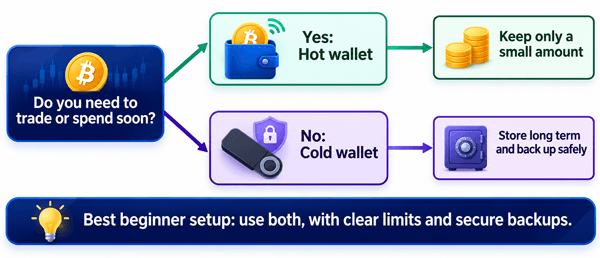
Figure: A simple decision flow for choosing between hot and cold wallet storage.
6. Real-World Scenarios: Which Wallet Should You Use?
6.1 Scenario 1: You bought $50 of crypto to learn
Use a hot wallet or a reputable exchange wallet while you learn the basics. The amount is small, and convenience matters. Still, write down your recovery phrase if it is a self-custody wallet and never share it.
6.2 Scenario 2: You hold $2,000 for the long term
A cold wallet is more appropriate. Keep only the amount you need for near-term activity in a hot wallet. Move the rest to a hardware wallet after making a small test transfer first.
6.3 Scenario 3: You want to use DeFi or NFTs
Use a hot wallet with a limited balance. For better safety, some users connect a hardware wallet to a wallet interface, but beginners should still avoid signing anything they do not understand. Malicious approvals and fake websites can be dangerous even if the private key is stored offline.
6.4 Scenario 4: You trade every week
A hot wallet or exchange account may be more convenient for active trading. But avoid keeping your entire portfolio there. Treat it like cash in your pocket, not your life savings.
6.5 Scenario 5: You are worried you will lose the seed phrase
This is a real concern. Cold wallets are safer from online theft, but self-custody requires responsibility. If you cannot safely store a recovery phrase, a regulated custodial platform may feel easier, but it introduces counterparty risk. The safer choice depends on which risk you are more able to manage: personal key management or reliance on a third party.
7. The Biggest Beginner Mistakes to Avoid
- Saving the seed phrase in a screenshot, email, cloud drive, notes app, or messaging app.
- Typing the seed phrase into a website because a support agent, pop-up, email, or direct message asked for it.
- Buying a hardware wallet from an unknown marketplace seller instead of the official source or trusted authorized seller.
- Sending a large amount without doing a small test transaction first.
- Not checking the full receiving address, network, and token before sending.
- Assuming a cold wallet prevents all scams. It reduces key exposure; it does not make every transaction safe.
- Keeping all crypto in one wallet. A single mistake can affect everything.
- Confusing wallet password, private key, and seed phrase.
8. Best Practices for Hot Wallet Safety
- Keep only a small working balance in a hot wallet.
- Download wallet apps only from official websites or official app stores.
- Use a dedicated browser profile for crypto activity if you use browser wallets.
- Avoid clicking wallet links from ads, direct messages, comments, and search results you do not trust.
- Turn on strong device security: screen lock, operating system updates, antivirus where appropriate, and two-factor authentication for exchange accounts.
- Review wallet permissions and token approvals regularly if you use DeFi.
- Use a separate wallet for risky experiments, new dApps, airdrops, or NFTs.
- Never rush a transaction because a website says your account will be closed or your wallet must be verified.
9. Best Practices for Cold Wallet Safety
- Buy the device from the manufacturer or an authorized seller.
- Set it up yourself. Do not use a wallet that arrives with a prewritten seed phrase.
- Write the recovery phrase offline on paper or metal and store it securely.
- Do not photograph, scan, upload, or type your seed phrase into an internet-connected device.
- Use a PIN on the hardware wallet.
- Make at least one backup and store backups in separate secure locations if the value justifies it.
- Practice recovery with a small balance before trusting the setup with meaningful funds.
- Verify receiving addresses on the hardware wallet screen when sending funds.
10. Custodial vs Non-Custodial Wallets: A Beginner-Friendly Explanation
The hot wallet vs cold wallet discussion is closely related to custody. Custody means who controls the private keys.
| Wallet model | Who controls the keys? | Main benefit | Main risk |
|---|---|---|---|
| Custodial wallet, such as many exchange accounts | The platform controls or manages the keys. | Easy account recovery and simple user experience. | You rely on the platform security, rules, solvency, and availability. |
| Non-custodial hot wallet | You control the keys on an online device. | More control and access to on-chain apps. | You are responsible for seed phrase and phishing protection. |
| Non-custodial cold wallet | You control keys kept offline. | Stronger long-term storage security. | You must protect the device and recovery phrase. |
11. Is a Cold Wallet Always Safer?
A cold wallet is generally safer for storage, but it is not automatically safer in every situation. A cold wallet can fail as a security tool if the seed phrase is stored online, if the user signs a malicious transaction, if the device is bought from a tampered source, or if the backup is lost.
Think of a cold wallet as a safe. It is better than leaving cash on a table, but it still needs a strong lock, a secure location, and careful use.
12. Is a Hot Wallet Ever Safe Enough?
Yes, a hot wallet can be safe enough for small amounts and normal learning, especially if you use good habits. The mistake is treating a hot wallet like a bank vault. Because it is connected to the internet and used frequently, it should hold only what you can afford to expose to higher risk.
13. A Practical Beginner Setup: The Two-Wallet Method
For most beginners, the simplest safe system is the two-wallet method:
- Create a hot wallet for learning, spending, and small transactions.
- Buy and set up a cold wallet when your balance becomes meaningful to you.
- Send a tiny test amount to the cold wallet first.
- After confirming the test, move the long-term balance to cold storage.
- Keep a small amount in the hot wallet for everyday activity.
- Review your setup every few months, especially after changing phones, computers, or storage locations.
A beginner rule of thumb: If losing the amount would seriously hurt, do not keep all of it in a hot wallet.
14. How to Choose a Beginner-Friendly Crypto Wallet
14.1 What to look for in a hot wallet
- Clear security warnings and a simple recovery process.
- Support for the blockchain and tokens you actually use.
- A strong reputation and active updates.
- Easy transaction review before signing.
- Compatibility with a hardware wallet if you plan to upgrade later.
14.2 What to look for in a cold wallet
- A device from a reputable manufacturer with clear setup instructions.
- On-device transaction confirmation.
- Support for your coins and networks.
- Secure backup and recovery process.
- Good documentation, transparent security practices, and reliable support channels.
15. Myths and Misconceptions
| Myth | Reality |
|---|---|
| My crypto is inside the wallet app. | The crypto is recorded on the blockchain. The wallet controls keys that authorize transactions. |
| A wallet password is enough to recover my funds. | The password usually unlocks the app on one device. The seed phrase is what restores the wallet. |
| Cold wallets cannot be hacked or drained. | They reduce online key exposure, but scams, bad approvals, and exposed seed phrases can still cause loss. |
| I should share my seed phrase with support to fix an issue. | Legitimate support should not need your seed phrase. Anyone asking for it is a major red flag. |
| One wallet is enough for everything. | Separating spending, experiments, and savings reduces damage from mistakes. |
16. Beginner Checklist Before Moving Crypto
- Confirm the receiving address carefully.
- Confirm the blockchain network, such as Bitcoin, Ethereum, Solana, or another network.
- Send a small test transaction first.
- Wait for confirmation before sending more.
- Make sure your recovery phrase is backed up before moving meaningful funds.
- Do not act under pressure from messages, pop-ups, support chats, or social media posts.
- Keep records for tax and personal tracking purposes where required.
17. Final Verdict: Hot Wallet vs Cold Wallet for Beginners
For pure safety, a cold wallet is usually the better choice because it keeps private keys offline. For ease of use, a hot wallet wins because it is fast, free, and beginner-friendly. The most practical answer is to use both: a hot wallet for small, active use and a cold wallet for long-term storage.
The safest wallet is not just a product. It is a system. Good wallet safety comes from choosing the right wallet for the job, limiting how much you expose, protecting your seed phrase, testing transactions, and slowing down before you sign anything.
18. FAQs
18.1 What is the main difference between a hot wallet and a cold wallet?
A hot wallet is connected to the internet and is best for convenience. A cold wallet keeps private keys offline and is usually better for long-term storage.
18.2 Which crypto wallet is safer for beginners?
A cold wallet is generally safer for storing larger amounts, but a beginner may still use a hot wallet safely for small amounts and learning. The best setup is often both.
18.3 Can a cold wallet be hacked?
A cold wallet greatly reduces online attack risk, but it is not magic. Funds can still be lost if the seed phrase is exposed, the user signs a malicious transaction, or the device and backup are handled carelessly.
18.4 Should I keep all my crypto on an exchange?
Exchanges are convenient, but they introduce platform risk because you rely on the company for custody, access, and security. Many users keep trading funds on an exchange and long-term holdings in self-custody cold storage.
18.5 How much crypto should I keep in a hot wallet?
Only keep an amount you need for near-term use and can afford to expose to higher risk. There is no universal number because it depends on your financial situation.
18.6 What happens if I lose my cold wallet?
If you still have your recovery phrase, you can usually restore the wallet on a compatible device. If you lose both the device and the recovery phrase, the funds may be unrecoverable.
18.7 Is a mobile wallet safer than a browser extension?
A mobile wallet may reduce some browser-related risks, but both are hot wallets. Safety depends on your device security, download source, wallet design, and behavior.
18.8 Should I take a picture of my seed phrase?
No. A photo can sync to cloud storage, be accessed by malware, or be exposed if your account is compromised. Write it offline and store it securely.
18.9 Do I need a cold wallet for a small amount of crypto?
Not necessarily. For a small learning amount, a hot wallet may be enough. Consider a cold wallet when the amount becomes meaningful to you.
18.10 Can I connect a cold wallet to a hot wallet app?
Yes, many hardware wallets can work with software interfaces. The private key remains on the hardware device, but you still need to review transactions carefully before signing.
Sources Consulted and Checked
The following sources were consulted and checked while preparing this article and reviewing its accuracy:
- Coinbase Learn: Hot vs cold crypto wallet: What is the difference?.
- Coinbase Learn: How to set up a crypto wallet.
- Reserve Bank of Australia: Digital Currencies Explainer.
- SEC statement for crypto asset ETP disclosures, including hot, warm, and cold storage policies.
- Nikolay Ivanov and Qiben Yan, EthClipper: A Clipboard Meddling Attack on Hardware Wallets with Address Verification Evasion.
- ACM Computing Surveys: Security Aspects of Cryptocurrency Wallets - A Systematic Literature Review.
Reader Advice
This article is provided for general educational and informational purposes only. It is not personalized legal, financial, investment, tax, cybersecurity, or professional advice, and it does not recommend any particular wallet, platform, asset, or transaction. Crypto assets and self-custody involve significant risks, including scams, theft, irreversible transfers, loss of private keys or recovery phrases, device failure, platform failure, market volatility, and possible loss of all funds. Laws, rules, policies, product features, security practices, fees, and statistics can change over time and may vary by country or region. Before acting, verify current information through official and reliable sources, assess the risks carefully, and seek qualified professional advice where appropriate.